Asides

Matt Heckert

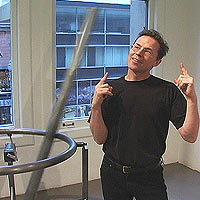
For nearly 20 years, Matt Heckert has been building visually striking machines to create arresting industrial soundtracks. Spark visits the sound artist and kinetic sculptor in his studio as he prepares for a one-person show at San Francisco’s Catharine Clark Gallery.

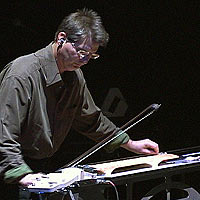
Heckert began playing with sound machines while working with the San Francisco mechanical art collective Survival Research Laboratories (SRL), commonly credited as the initiator of contemporary machine art. In addition to fabricating parts, Heckert assisted SRL by producing soundtracks intended to communicate the personalities and emotional states of various machines used in performances. In 1990, Heckert left SRL to take his own sound machines on the road, performing across North America and Europe with his Mechanical Sound Orchestra.

Since 1999, Heckert has been focusing his energies on gallery installations. Unlike many kinetic sculptors, Heckert is concerned primarily with the sounds his pieces make. He designs pieces according to an aesthetic that he feels adequately represents the sound. For example, “Birds” — a work he originally exhibited at Catharine Clark, then expanded for a show at Yerba Buena Center for the Arts — began with the sound of sheet metal as it bends. Only after the piece was completed did Heckert give the work a name, realizing that the resulting machines resembled a flock of birds.

Like “Birds,” Heckert’s “Rotification” uses multiple identical components to create complex and varying soundscapes. It is composed of six steel poles that create centripetal sound as they rotate within circular steel armatures. As gallery visitors move between the sculpture’s parts, various aspects of the work’s densely layered bed of sound becomes audible.

Matt Heckert earned a B.F.A. from the San Francisco Art Institute in 1979. He has exhibited his work with SRL and as a solo artist in galleries throughout North America and Europe and has won numerous awards, including two fellowships from the National Endowment for the Arts and the prestigious Prix Ars Electronica. He currently teaches kinetic sculpture at the San Francisco Art Institute.

  • Array
  • Array
  • Array

Paul Dresher

For more than 30 years, world-renowned experimental musician and composer Paul Dresher has been fashioning remarkable instruments that help him push the limits of contemporary composition. Dresher employs his inventions in works that range from musical theater to contemporary opera to electronic chamber music to film and theatrical scores. Spark visits the maestro at work as he prepares for a performance of new music at San Francisco’s Yerba Buena Center for the Arts.

To create his instruments, Dresher often begins by experimenting with found or scrap materials. The quadrachord, one of his recent creations, began with a seven-foot-long plank of wood, onto which Dresher fastened guitar pickups and extended strings. A second version, which is twice as long, functions as a kind of giant electric/acoustic slide guitar that can be prepared, plucked, bowed or hammered.

Another such instrument is a giant metronome that Dresher created for his musical theater piece “Sound Stage.” Rather than merely replicate a metronome on a colossal scale, Dresher built the massive instrument to produce a complex array of sounds. The finished metronome, which became the centerpiece of “Sound Stage,” features two 15-foot swinging pendulums that pluck the strings of a giant harp and strike a series of percussive objects.

With the Electro-Acoustic Band — a high-tech experimental ensemble he founded in 1993 — Dresher performs his own music as well as the work of some of the most innovative composers of the last several decades. For their show at Yerba Buena, the ensemble tackles three new works by three different composers as well as Dresher’s own compositions from his CD “Cage Machine.” It is a difficult task, demanding long rehearsal hours to iron out the bugs in the technology-dependent compositions. In the end the concert is a success. Dresher and his band render the works both sonically complex and emotionally haunting.

Paul Dresher earned his B.A. in music from UC Berkeley and his M.A. in composition from UC San Diego, where he studied with Robert Erickson, Roger Reynolds, Pauline Oliveros and Bernard Rands. He has received commissions from numerous institutions, including the U.S. Library of Congress, Saint Paul Chamber Orchestra, Kronos Quartet, San Francisco Symphony, Zeitgeist, Walker Arts Center, University of Iowa, Meet the Composer and American Music Theater Festival. Dresher has performed throughout North America, Asia and Europe, including concerts with the Munich State Opera and New York Philharmonic. Dresher has also developed original music for dance performances for many choreographers, including Margaret Jenkins, Brenda Way, Nancy Karp, Wendy Rogers and Allyson Green.

Array

  • Array
  • Array

Workshop on Space Artists

Frank Pietronigro is using his art to go where no artist has gone before — outer space. The San Francisco artist is a pioneer in space art, a movement dedicated to building bridges between artists and space exploration organizations. Spark takes a look at this futuristic work at the Workshop on Space Artists’ Residencies and Collaborations, which brings together artists and scientists from around the world at the NASA Ames Research Center in Mountain View.

Space art is still a loosely defined field that encompasses a range of interdisciplinary practices, including painting, sculpture and performances that use space flight and/or the technologies of space exploration. Works may be produced within an antigravity environment, use materials specially designed for space travel, or be generated by information collected from celestial bodies and phenomena.

In an effort to bring attention to space art, Pietronigro co-founded the Zero Gravity Arts Consortium, an international organization dedicated to fostering greater access for artists to space technologies through the creation of partnerships between arts organizations, space agencies and research centers. The groundbreaking organization is a small step in a field that is sure to be a giant leap for space artists around the world.

  • Array
  • Array
  • Array

New Conservatory Theatre Center

Spark drops in on San Francisco’s New Conservatory Theatre Center (NCTC) on a typical Saturday night. There are three theater spaces, and each one is full: cabaret in Theater Three; a comedy about drug addiction called “Rescue and Recovery,” by Steve Murray, in the Walker Theatre; and “Mambo Italiano,” by Steve Galluccio, in the Decker Theatre.

NCTC founder Ed Decker, who is also the theater center’s executive and artistic director, explains how, for him, risk-taking is what it is all about. “I strive to push past my comfort level. Whenever I start to see us producing things that are easily done, I quickly move in the other direction.” He celebrates the uniqueness of the NCTC as a populist community theater that speaks to and for diverse audiences, especially for the gay community in San Francisco.

The productions under consideration for the NCTC’s 2005 Gay Pride Season illustrate a commitment to trying new and challenging material. Contenders include a piece about photographer Richard Mapplethorpe and “Slap and Tickle,” by new writer Davis Parr, about a gay bathhouse. Both pieces are controversial, as is the work of Tony Award-winning playwright Terrence McNally, who is currently in residence at the NCTC as part of its new works program. McNally will have his third première at the NCTC in the 2006 Gay Pride Season.

Now that dramatizing the gay experience has become more acceptable, Decker sees the NCTC responding and moving in a new direction. It is no longer a question of gay theater or black theater or women’s theater. Now that theater articulates these voices, Decker believes that theater needs to reach out to other communities. Things may change, but the mission of the NCTC remains constant: to effect personal and societal growth, enlightenment and change.

The NCTC is a recipient of multiple Drama-Logue, Bay Area Theatre Critics and Dean Goodman awards and has also received substantial support from the National Endowment for the Arts. The NCTC was the first theater in the United States to use theater to educate youth in grades K-12 on HIV awareness and prevention as part of its nationally acclaimed YouthAware Education Theatre. The NCTC also offers adult classes throughout the year.

Array

  • Array
  • Array
  • Array

San Francisco Performances

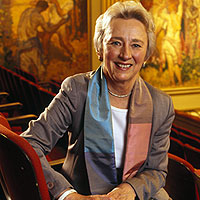
For years, Ruth Felt has worked hard to bring internationally acclaimed classical music and modern dance talent to the Bay Area. As presenter for San Francisco Performances, Felt has helped to turn San Francisco into a destination for some of the world’s most gifted performers. Spark checks in on Felt as she puts together one of her most ambitious shows yet — a gala all-star event for her organization’s 25th anniversary.

Since Felt founded SF Performances in 1980, she has brought more than a thousand artists from around the world to San Francisco stages. Over the years she has introduced Bay Area audiences to world-renowned performers, including cellist Yo-Yo Ma, violinist Anne-Sophie Mutter, pianist András Schiff and violinist Gidon Kremer, as well as the Paul Taylor Dance Company, Ballet Preljocaj from France and Sweden’s Cullberg Ballet. Presenting talent such as this is grueling work, involving every imaginable aspect of production, from coordinating dates to booking venues to managing finances to handling all last-minute, unexpected ordeals.

The overwhelming success that SF Performances has enjoyed over the last quarter-century was far from a sure thing. When Felt started out, friends and critics alike suggested that a rough road lay ahead. SF Performances was faced with multiple challenges, including a dwindling audience for classical music and the lack of a permanent venue. Nonetheless, Felt believed that she had something new to offer by combining the world’s best chamber music ensembles and modern dance with the most promising emerging talents.

Over the years, Felt has hedged her bets by initiating a number of audience development programs designed to bring in new audiences and keep them coming back. The most impressive of these has been her work in placing artists in San Francisco public schools. Each year, SF Performances books as many as 50 performers in schools and sponsors extended residences to musicians so that they can work with students for an entire school year. It is a way of giving back to the community that is also an investment in SF Performances’ future. In a time of waning arts education in the public schools, Felt’s efforts ensure a new generation of audiences and performers.

  • Array
  • Array
  • Array

Shotgun Players

Persistence has finally paid off for the East Bay’s Shotgun Players. After more than a decade of being nomads, the theater ensemble finally has a more permanent home with a 35-year lease on their space on Berkeley’s busy Ashby Avenue. Spark checks in on this grassroots troupe as they rehearse for a production of French existentialist Albert Camus’s “Les Justes” (1949).

The Shotgun Players came together in 1992 when a group of 11 theater artists decided to put on a play in the only reasonable space they had available to them — the basement of a local pizza parlor. This became their home base for five years and the site of a half-dozen performances a year. Since then, the Shotgun Players have worked in more than 30 different venues, including church basements, print shop back rooms, university stages, outdoor arenas and even in front of inmates at San Quentin Prison. Over the years, their hard work has earned them a wide subscriber base, critical acclaim and devoted audiences.

The mission of the Shotgun Players is to make bold, relevant and affordable theater with a commitment to doing rarely produced plays. “Les Justes” considers a group of terrorists from the early 20th century. The play stirred heated discussion in France at the time of its first production, and the Shotgun Players believe it is as relevant today as it was more than half a century ago.

Since their formation, the Shotgun Players have won prestigious DramaLogue awards for direction, set design and production. Other awards include the 1998 SF Weekly Black Box Awards for Best Company, Production and Acting, the 1999 SF Bay Guardian Award for Outstanding Theater Company, and four 1999 Bay Area Critics Circle Awards for Entire Production, Original Script and Ensemble.

Shotgun Players at Ashby Stage
Where: 1901 Ashby Ave., Berkeley
Phone: (510) 841-6500

  • Array
  • Array
  • Array

Chris Cobb

Installation artist Chris Cobb‘s “There Is Nothing Wrong in This Whole Wide World” involved reclassifying the books at the Mission District’s Adobe Books — by color. Cobb, along with nearly 20 assistants, spent an entire night arranging all of the neighborhood bookstore-and-sometime-gallery’s estimated 20,000 books to create a continuous spectrum, covering the whole shop. The installation remained in place from November 12, 2004 until January 20, 2005. Spark checked in on Cobb and his team as they transformed an everyday space into a stunning work of art.

Adobe was a carefully chosen site for Cobb, who saw his project as a tribute to the shop’s endurance as a kind of resource and community center for book lovers and artists. In the 15 years since Adobe first opened its doors, it has become a launching pad for many young, up-and-coming San Francisco artists and musicians. By turning the shop itself into a work of art, Cobb wished to pay tribute to the store’s history and to celebrate its future.

Installation art differs from more traditional forms in that it is concerned with the alteration of an entire space rather than the production of an isolated object. Part of the lyricism of Cobb’s project at Adobe came from the fact that the artist has neither added nor taken away anything in the bookstore, but merely rearranged what was already there to create a completely dreamlike space.

Adobe Books employee Shi Ananda, who assisted in reshelving the books when the installation ended, noted that blue-colored books sold the most, brown books were most often stolen and red books tended to remain on the shelves. There were more white books in the store than any other color, whereas very few books were colored yellow.

Cobb earned a B.F.A. from the San Francisco Art Institute and is currently studying in the graduate art practice program at the University of California, Berkeley.

Adobe Books
adobebooks.org
Where: 3166 16th St., San Francisco
Phone: (415) 864-3936

  • Array
  • Array
  • Array

Jonathon Keats

San Francisco writer, critic and conceptual artist Jonathon Keats is looking for God, and he thinks he may have found Him — in a petri dish. Spark trails Keats as he works on his latest project, “Divine Taxonomy,” which attempts to find God’s place on the phylogenetic tree.

Keats works with what he calls “found processes,” procedures that he discovers in the activities of everyday life that he then appropriates for his art. In “Brain Trust,” Keats adopted the process involved with buying shares of a company’s stock. Keats offered futures contracts for shares of his brain to be exercised upon his death, at the bargain price of 10 dollars per 1 million neurons. The complicated process draws attention to the procedure itself rather than to what the process apparently seeks to accomplish.

Keats’s latest work attempts to determine what God’s DNA might look like by discovering whether it is closer to that of a fruit fly or blue-green algae (cyanobacteria). With the assistance of Smithsonian zoologist Mark Moffett and Berkeley geneticist Tom Cline, Keats assembled three groups of each species and exposed them to continuous tape loops of prayers from the three major monotheistic religions — Judaism, Christianity and Islam. Keats also established a control group that was exposed to recordings of talk radio.

“Divine Taxonomy” could be seen as a test for the creationist/evolutionist debate. Cyanobacteria are simple, single-cell organisms and are believed to be the oldest life form on Earth, whereas fruit flies exist on the same phylogenetic branch as human beings. If evolutionary theory is accurate, then God’s DNA should most resemble cyanobacteria. On the other hand, if the creationists are correct, then God’s genetic makeup will prove to be more like those animals closest to those He created in His own image.

Jonathon Keats has published in several venues, including “The New York Times,” the “San Francisco Chronicle” and “Wired,” and has written columns for Artweek and “San Francisco Magazine.” “Lighter Than Vanity: A Novel,” his second long work of fiction will be published by Eksmo Press.

Array

  • Array
  • Array
  • Array

Laura Splan

Mixed media artist Laura Splan borrows from anatomy and medicine to make works of art that are both unsettling and oddly beautiful. Spurred by advances in medical science and technology, Splan’s paintings, sculptures, photographs and videos explore connections between the inside of our bodies and the world outside. In the “Artist in Search of a Medium” episode, Spark gets a guided tour of Splan’s remarkable objects.

Splan comes from a family involved in the medical field. Both her father and her sister work for a company that makes artificial bones and other medical implants, and her grandmother was a nurse. Following in their footsteps, Splan moved to California to study biological sciences at the University of California, Irvine, but soon abandoned her major to study art instead. When she went on for her M.F.A. at Mills College, she continued to pursue her interest in the medical sciences by complementing her art education with an independent study in microbiology.

Splan’s work regularly combines medical imagery and materials with objects associated with home and domesticity. In the “Wallpaper/Samples” series, begun in 2003, the artist uses samples of Victorian wallpaper designs, painting over their intricate lines in her own blood. The patterns, intended to evoke a sense of familiarity and comfort, are put in tension with the visceral and potentially disturbing medium in which Splan has chosen to render them. Similarly, in her 2004 “Doilies” series, Splan created a series of beautifully intricate doilies — icons of quaint domestic interiors — but built their patterns on the structures of viruses — SARS, herpes, influenza and HIV.

Other of Splan’s works deal with the culture and practice of medicine. Her “Stethoscope” extends the tubing of a normal stethoscope to an absurd 25 feet, and her “Tongue Depressors” and “Cotton Swabs” are stretched to four feet. Before the invention of the stethoscope in 1816, doctors would put their head directly on the chest of the patient. The instrument introduced a mediating distance between professional and client. These works speak to the sense of alienation engendered by these objects in what would otherwise be very intimate acts.

Laura Splan’s work has been exhibited at many Bay Area venues, including SFMOMA Artist’s Gallery, the San Jose Institute of Contemporary Art, the Catharine Clark Gallery, the San Francisco Arts Commission Gallery, the Headlands Center for the Arts and Southern Exposure, and in galleries around the country. In 2003, Splan was the recipient of a Trillium Fund Grant, and in 2004, she won a Kala Art Institute Fellowship.

  • Array
  • Array
  • Array

Garry Knox Bennett

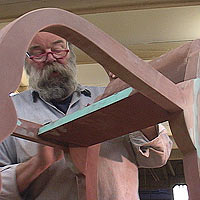
For more than three decades, Garry Knox Bennett has been at the vanguard of furniture making with his unusual tables, desks, chairs, clocks and lamps. Working in the face of woodworking purists, Bennett became one of the first furniture craftsmen to use Formica, plastic, aluminum and other unconventional materials in his pieces. In “Elevating the Everyday,” Spark visits the artist at work as he produces chairs for an exhibition called “Garry Knox Bennett: Preoccupations of a Serial Chairmaker.”

Bennett has gained a reputation in the world of woodworking as something of a revolutionary for his daring innovations and often whimsical creations, perhaps best demonstrated in his piece “Nail Cabinet” (1979). In part as a response to the woodworking mainstream, Bennett produced a lavishly crafted cabinet that rivaled even the most canonical examples of the form. When the piece was finished, Bennett drove a large nail into the cabinet’s door, scandaling the more traditional woodworkers.

Bennett’s “Preoccupations of a Serial Chairmaker” is composed of 50 chairs for an Oakland Museum of California offsite exhibition (January 20 through March 25, 2005) at Gallery 555 and the Sculpture Court. Several of the chairs rework Gerrit Rietveld’s 1934 design, the classic Zig Zag, whereas others offer modifications to standard mass-produced garden and lawn chairs. The diversity of pieces is a reflection of Bennett’s working method: Rather than beginning with sketches and drawings, Bennett goes straight to the materials, working them part by part into a finished idea. It is a technique that allows Bennett the freedom to change the direction of a piece several times before it is complete.

In addition to being a renowned master craftsman and innovator, Bennett is also a collector of rare and unusual furnishings and decorative objects. He and his wife, Sylvia, share a collection that spans 40 years, selections from which formed the inaugural show at San Francisco’s Museum of Craft and Design, “Dovetailing Art and Life: The Bennett Collection,” in 2004.

Array

  • Array
  • Array
  • Array

Richard Shaw

Since the late 1960s, Bay Area ceramicist Richard Shaw has been steadily re-creating the world around him in clay, piece by piece. Shaw’s remarkable sculptures mimic everyday objects with an accuracy that belies their medium. Spark visits the artist in his Fairfax studio as he scrambles to finish work for a one-person gallery show.

Shaw is associated with Bay Area Funk, a movement characterized by its irreverent, sometimes surreal assemblage of everyday objects into artworks that can be alternately whimsical and disturbing. But rather than use readymade found objects, Shaw fashions his pieces out of porcelain, perfectly cast to replicate exactly the ordinary things that surround us.

The kind of work that Shaw produces is known as trompe l’oeil, a French term that literally means “fool the eye.” In order to produce these amazing effects, Shaw has developed an array of techniques that extend to printmaking and overglaze transfer decals, which help to increase the realism of his objects. Shaw keeps a library of hundreds of molds in his workshop, a vocabulary of objects that he inverts, varies and combines in his assemblages.

Richard Shaw earned a B.A. from the San Francisco Art Institute in 1965 and an M.F.A. from the University of California, Davis, in 1968. He has won grants from the National Endowment for the Arts. His ceramics can be found in major collections across the country, including the Smithsonian’s National Museum of American Art in Washington, D.C., and the Whitney Museum of American Art in New York, as well as in collections in Europe and Japan. Shaw is currently an art professor at the University of California, Berkeley.

Array

  • Array
  • Array
  • Array

Laurel True

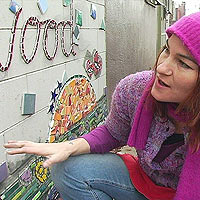
For nearly 15 years, artist Laurel True has been making mosaics, a practice that has taken her around the world. But True’s latest mural decorates a building much closer to home — the rough industrial space that sits right across the street from her Oakland studio. In “Elevating the Everyday,” Spark visits True onsite while she creates public art.

After years of looking out her studio at the tree-trimming business across the road, True decided to replace its makeshift “Free Wood” sign with an elaborate mural covering a large section of the building’s façade. Using handmade tile and glass, along with commercial tile, broken dishes and pieces of mirror, True and her team created an arbor-themed diptych featuring fantastical trees that surround the words “Free Wood.” The mural is typical of True’s work, which regularly employs fluid, sinuous lines and organic forms executed in a colorful array of tiles and glass. True especially enjoys incorporating mirrored surfaces that reflect light, movement and the mural’s viewer.

Laurel True studied art and design in schools in New York, Chicago, San Francisco, Dakar, Senegal and Ravenna, Italy. She produces murals and other works in her studio, True Mosaics, which she founded in 1991. Her architectural, sculptural mosaics adorn parks, hospitals, schools, restaurants, shops and private residences across the United States. One of True’s projects took her to West Africa, where she designed and facilitated a community mosaic mural project in a fishing village in Ghana.

Array

  • Array
  • Array
  • Array

Hung Liu

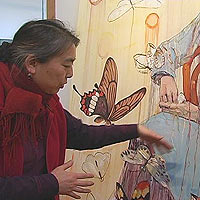
Oakland painter Hung Liu combines Western and Chinese traditions to create larger-than-life images of everyday people who have been lost in the sweep of history. In “Paint x 3,” Spark visits Liu in her studio as she works on a series of canvases for an exhibition in New York in May 2005.

Born in China in the 1940s, Liu came of age during Chairman Mao’s Cultural Revolution. As a young woman, Liu was sent to labor in a remote village and learn a distorted account of Chinese history as part of her “reeducation.” Four years later, she trained as an artist in Beijing, where she was taught to paint in the Social Realist style so that she would be able to serve the state by making colossal mural paintings of Mao and other prominent members of the Communist Party.

In 1984, after years of working as an artist and teacher in China, Liu immigrated to the United States and began making paintings informed by a wider perspective on her nation’s history. Her work was enhanced when, during a 1990 visit to China, Liu discovered several hundred photographs from the time of the Cultural Revolution. These photographs have formed a basis for much of her work since. Personal photos from this era are rare because families often destroyed images that might be used as evidence that they were not proletarians.

Many of these images are extremely rare portraits of prostitutes, made in limited numbers for distribution to patrons. Liu’s latest series monumentalizes these anonymous young women by depicting them in a style usually reserved for historical figures. Her canvases are rendered in a photorealist mode that looks back to her work for the Communist Party, yet they are populated by individuals that are the object, rather than the subject, of history.

The photorealism of the works is tempered by Liu’s technique of diluting her paint with linseed oil, which then is dripped onto the surface, blurring and distorting the portrait. The painting becomes akin to a memory image, which cannot claim to be objective, but fades and changes over time.

Liu earned a B.A. in education at Beijing Teacher’s College before studying mural painting at Beijing’s Central Academy of Fine Art. In 1986 she earned an M.F.A. from the University of California, San Diego. Liu has received numerous awards, including two painting fellowships from the National Endowment for the Arts. Her work has been exhibited nationally and internationally in such venues as the Smithsonian Institution, the Tokyo Metropolitan Museum of Photography, the National Museum of American Art and the Walker Center. She currently resides in Oakland and is a professor of visual arts at Mills College.

Array

  • Array
  • Array
  • Array
  • Array

Nathan Oliveira

Editor’s note: Nathan Oliveira passed away on November 13, 2010.

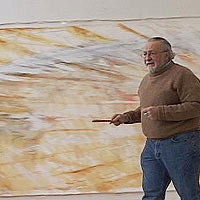
For more than 30 years, internationally recognized painter Nathan Oliveira occupied a serene studio nestled in the foothills above Stanford University, where he taught for decades. Spark visited Oliveira where he created some of his most famous works.

Oliveira is well-known as a major painter associated with a group of artists called the Bay Area Figurative School. Taking a cue from the abstract expressionist style that characterized East Coast painting in the postwar period, Oliveira and others used a thick, painterly style, but used it to represent rough, abstracted figures and landscapes.

Over the last 20 years, Oliveira had intermittently worked on “The Windover,” a series of paintings named for a poem by Gerard Manley Hopkins. The canvases, which depict abstract forms recalling wings, were inspired by the red-tailed hawks living in the foothills that surround Oliveira’s studio. In an effort to keep the series of nearly 20 paintings together as a group, Oliveira had been meeting with Stanford officials to create a quiet space somewhere in the foothills to house “The Windover” and be designed as a peaceful refuge where visitors can go to meditate and collect their thoughts.

Nathan Oliveira earned a B.A. in 1951 and an M.F.A. in 1952 from the California College of Arts and Crafts (now known as the California College of the Arts). He has won several awards, including an Artist’s Grant from the National Endowment for the Arts and the distinction of Ann O’Day Maples Professor in the Arts at Stanford University. In 1999, he was named Commander of the Order of Henry the Navigator, the highest civilian honor awarded by the Republic of Portugal, for contributions to Portuguese culture. His work can be seen in international collections, including the Metropolitan Museum, the Museum of Modern Art, the Whitney Museum of American Art and the Guggenheim Museum in New York, the Tate Gallery in London, and Smithsonian American Art Museum and the Hirshorn Museum in Washington, D.C.

  • Array
  • Array
  • Array