Asides

Kate Pocrass

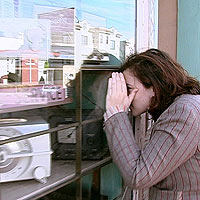
Most artists strive to create unique and unusual representations of the world around them. This is decidedly not the case for Kate Pocrass, a conceptual artist and photographer living in San Francisco. Through her Mundane Journeys project, Pocrass has managed to use the often-overlooked as the basis for her public art.

Every week since starting Mundane Journeys in 2001, Pocrass updates a message on her project’s telephone hotline at (415) 364-1465. She records directions to shops that are off the beaten track, odd-looking tree trunks in city parks, miscellaneous markings on sidewalks, specific foods in specialty markets and anything else that strikes her fancy. “If there’s one reason I do like other people to do these things, it’s [so they] stop and look with intention, not going from point A to B quickly,” Pocrass tells Spark in the episode “Out and About.”

Pocrass’s hotline recordings often come with instructions prompting journeyers to do things like chat with employees at certain shops, visit the far back corner of a big box store for something special or admire a particular scene from a particular vantage point. Callers often leave on the hotline their own messages, suggestions and reactions.

To feed the cult following that demanded Mundane Journeys more frequently than once a week, Pocrass published a guidebook of the same name in 2003 that features 50 sample adventures. The latest version of Mundane Journeys is due out in the summer of 2006. Pocrass also organizes occasional bus tours that shuttle curious fans of her project to her favorite destinations. Armed with a handout describing journeys in the area, bus tour attendees dutifully march out into the streets to experience the people, places and things that have caught Pocrass’s attention over the years.

“The bus tour is a very special atmosphere because there’s art people on the bus, my roommates’ family is on the bus – the dynamics between [them] are so great. People are trying to figure people out. [They’re] not sure how to act. Is this an art tour? Is this some random city tour? Is this some touristy thing? No one really knows what this is,” Pocrass says.

And therein lies part of the project’s intrinsic artistic appeal. Mundane Journeys, which now encompasses the original hotline, a Web site, a guidebook and the bus tour, is as much about the interaction among journeyers and their varied experiences tracking down Pocrass’s mundane destinations as it is about the destinations themselves.

In many senses, Pocrass’s ongoing, constantly growing display of chosen spots challenges the boundaries and meaning of public art. Just as the bus tour escapes neat and tidy definitions, the entire project raises more questions about art than it answers. In fact, even the artist herself isn’t quite sure how her project fits into the art world. “I have no idea how it’s art other than I’m making people look at things they overlook,” Pocrass says.

Kate Pocrass earned a B.F.A from the University of Michigan and an M.F.A. from the California College of Arts. She has exhibited work locally at Southern Exposure, the Rena Bransten Gallery, Spanganga, Pond and New Langton Arts and internationally at the Foundation de Appel, in the Netherlands, and Rooseum, in Sweden. She also was selected to participate in Bay Area Now IV, at the Yerba Buena Center for the Arts. With Mundane Journeys, Pocrass is striving to emphasize the importance of having meaningful art encounters through socially attuned and ephemeral projects.

  • Array
  • Array
  • Array

Todd Hido

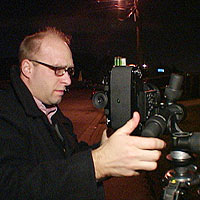
Internationally acclaimed photographer Todd Hido has made a name for himself capturing unsettling images of the suburban landscape. Spark joins the artist at work as he cruises one of his favorite Bay Area neighborhoods in search of the perfect shot. Hido looks for the anonymous, even mysterious aspects of American life, recording buildings and landscapes eerily absent of human presence.

At the center of Hido’s work is a certain degree of realism. He uses only available light and does not move objects when composing his images. Hido shoots his signature residential landscapes at night using long exposure times and employing the ambient atmosphere that surrounds his subjects. His minimalist, moody images, set in architecturally homogeneous settings, suggest sinister narratives.

Hido’s technique of using long exposure times presents particular challenges. When photographing a house or landscape, any temporary change in light affects the picture. The headlights of a car driving by can create the desirable effect of brightening the image, whereas the lights of a plane flying overhead can create an unwanted streak across the sky.

For his latest book, Hido is taking a different approach to pursuing the themes of isolation and loneliness evident in his earlier work. Spark travels with the photographer to a hotel in San Francisco’s Tenderloin neighborhood, where he is working with a model to create a series of portraits. For Hido, old hotels provide an exciting range of possibilities. Details like old fixtures and furniture can be rife with suggested stories and associations when captured in the just the right way. He still uses only natural light, although he may use curtains to alter or block light.

Lately, Hido has been using a vintage 126 camera that his wife found in a thrift shop. He first used the camera to help his models relax before he would begin shooting with his professional equipment, but soon he noticed that the vintage camera’s flash created an amateurish snapshot look. Hido found this aesthetic appealing, so he decided to use the camera in his work.

For Hido, editing and sequencing his images for publication adds meaning to them. The photographer considers his books to be like paper movies – arrangements of images that suggest loose narratives. Scenes are sometimes tied together through formal criteria, such as light, composition or a particular tonal palette, and sometimes through stories and characters that seem to inhabit the images themselves.

Todd Hido earned a B.F.A. from Tufts University in 1991 and an M.F.A. in photography from the California College of Arts and Crafts in 1996. His work has been shown in galleries and museums across the United States and in the United Kingdom. Hido’s photographs can be found in many prominent collections, including the Guggenheim Museum and the Whitney Museum of American Art, both in New York City, and the San Francisco Museum of Modern Art. He has published four books, “Roaming” (2005), “House Hunting” (2001), “Outskirts” (2002) and “Taft Street” (2001). Hido is represented by the Stephen Wirtz Gallery of San Francisco.

Array

  • Array
  • Array
  • Array

Felipe Dulzaides

If Felipe Dulzaides has his way, his art will make people question their everyday environments. Spark talks to him about his public art piece, “Double Take: A Billboard Project,” a collaboration with New Langton Arts consisting of eight billboards that were installed throughout San Francisco over the course of a year from December 1, 2004 to December 31, 2005.

Before the project began, Dulzaides and city developer David Prowler scouted locations from playgrounds to parking lots and photographing particular views or aspects of the site. Dulzaides then played with the scale of the images, turning them into giant billboards. The result is a head-turning mix of the ordinary and the unexpected.

Cuban-born visual and performing artist Felipe Dulzaides earned a B.F.A. in theater from Instituto Superior de Arte de la Havana and an MFA in new genres from the San Francisco Art Institute. His work has been exhibited locally at numerous venues including SFMOMA and the Yerba Buena Center for the Arts, and internationally at Centro Cultural de Españ:a in Cuba, and Buro Spors in Germany. He was a 2003 artist in residence at the Headlands Center for the Arts, a recipient of a 2002 Artadia Award and a 2001 Cintas Fellowship.

  • Array

Andrew Kleindolph

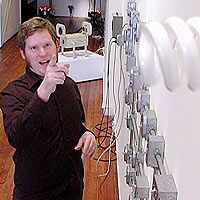
In the proverbial battle between man and machine, you might say that Andrew Kleindolph is on the machines’ side. Many of the artist’s interactive electronic sculptures play games with their human counterparts, instead of the other way around. Spark follows Kleindolph from his workshop at the Headlands Center for the Arts to his show at San Francisco’s RX Gallery as he demonstrates his interactive artwork.

One recent Kleindolph creation resembles a video game like any other. The catch? The game never starts. Instead, Kleindolph’s machine sends its users through an endless series of pointless prompts and error screens. At a Kleindolph show, players’ increasing frustration with an obstinate video game, onlookers’ confusion over which switches illuminate which light bulbs and baffled stares at a contraption emitting manipulated audio tracks of wild animal calls are as much a part of the art as the machines themselves.

The tension between humans and machines is an overarching theme in both Kleindolph’s three-dimensional electronic pieces and his two-dimensional digital images. The latter looks like a cross between blueprints for the innards of fantastic machines and a busy intergalactic highway frequented by space-age cellular creatures. The images juxtapose electronic circuitry and organic forms in a way that’s both playfully cartoon-like and technically precise.

Machines have been a part of Kleindolph’s life since childhood. His family owned a vacuum cleaner and sewing machine sales and repair shop in his small hometown of Muscatine, Iowa. His grandfather started the business, and his parents, uncle and cousins worked there. Kleindolph also worked there for a time.

When he begins working on a new piece, Kleindolph doesn’t just do what he already knows how to do. Instead, each sculpture is a learning process in and of itself. An idea, like the one for an “anger meter” that lights up in the presence of body heat, will often send Kleindolph to his studio in the basement of the Headlands Center for the Arts, where he has had space for several years.

As he tinkers with new devices and works on projects sure to baffle and surprise visitors at his next show, Kleindolph is turning the senseless vagaries of life into art. “A lot of the stuff that I’ve been doing looks at everyday situations and how absurd they are. The sort of things that we do everyday can be [absurd]. Yet we just tolerate this and that and just go onward with our business.”

Andrew Kleindolph earned a B.F.A. in painting from the University of Iowa and an M.F.A. in electronic arts from Mills College. While attending Mills, he began teaching at City College of San Francisco. He still works at City College part time, but focuses on his electronics classes at Lick-Wilmerding High School in San Francisco.

  • Array
  • Array
  • Array

Toychestra

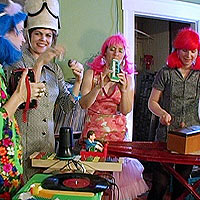
If fond memories of your childhood include a brightly colored xylophone, plastic saxophone or Fraggle Rock drum kit, then you’d probably enjoy Toychestra. The group began as a one-off performance in 1996 for a women’s music festival at Hotel Utah, when they decided to abandon their regular instruments and play only toys. Their songs were a hit, and Toychestra was born.

Since then, Toychestra has played for a diverse audience in various venues, including rock clubs, experimental music venues and classrooms. In addition to their original compositions, the group plays covers of such diverse artists ranging from Dvorak to Black Flag. They have made several recordings, including a collaborative effort with Dan Plonsey and Fred Frith called “Concerto for Guitar and Toy Orchestra.”

  • Array

Lisa Kristine

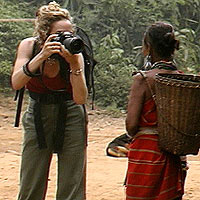
When San Francisco based photographer Lisa Kristine was a child, she pored over “National Geographic” depictions of tribal peoples in faraway lands. Now she has photographed every one of the indigenous groups that once captivated her young imagination. From Papua New Guinea to Ethiopia, Laos to Tibet, Kristine has journeyed the globe to photograph people and places seemingly untouched by our modern world.

“I’m drawn to people who have been living closer to the earth and have very, very old traditions, [people] that have not in any way been altered by modernism,” she explains in the Spark episode “Think Globally.”

A California native, Kristine learned to take black and white photographs when she was 11 years old. Her world travels began in the early 1980s, when a visit to Greece as a teenager morphed into an extended journey that eventually led her around the world, starting with Italy, Israel, Egypt and Thailand.

Since then, Kristine has visited more than 50 countries across six continents. She spends months getting to know her subjects before documenting their private worlds on film. She always travels with a translator and never photographs subjects without their permission.

Traveling the world, visiting places and people that so many of us will experience only through photographs and stories, Kristine is drawn to the human capacity for creating meaning and the different ways global communities produce and perpetuate meaning through religion, tradition, philosophy and culture. She has recently been drawn to capturing America – her own country – in this same way.

Lisa Kristine’s vibrantly colorful photographs depict scenes as simple as a single arched doorway in Morocco and as enigmatic as a geisha’s red smile. Using 4×5 analogue cameras of different sizes, Kristine emphasizes natural light. She is known to spend hours waiting for the light to shift so that it colors her chosen scene in just the right hue. And although she does use a tripod for scenes that move and with large-format cameras, she prefers taking handheld shots of her subjects as they work, pray and perform daily tasks.

  • Array

Michael Arcega

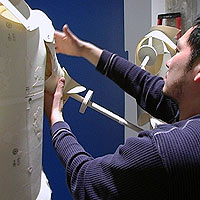
Conceptual artist Michael Arcega likens the titles of his works to punch lines. There’s “El Conquistadork,” the 10-foot high Spanish galleon he made from manila folders and sailed on Tomales Bay, and “Conquistadorks I & II,” elaborate suits of armor also crafted with manila folders.

Although their titles speak to the artist’s quirky sense of humor and his obsession with word play, the pieces themselves delve into weightier issues. Born in Manila, the 30-something artist is as concerned with Filipino history, imperialism and global socio-political issues as he is with puns.

“I use manila folders to talk about trade and business and colonialism. Having paper armor, I think, shows the frailty of military strength,” he tells Spark in the “Think Globally” episode.

Tucking himself into the paper-hulled vessel, Arcega managed to sail his “El Conquistadork,” a tiny, masted ship, in open waters without springing any leaks. The boat’s solid construction is characteristic of Arcega’s meticulous approach to his work.

With “Conquistadorks I & II,” which first appeared in the 2006 solo show “Getting Mid – Evil” at the Heather Marx Gallery in San Francisco, Arcega emphasizes the frameworks of power that fueled the 16th- and 20th-century European and Spanish conquests in the Philippines. As for the paper armor so prominently displayed in the same show, Arcega says that it points to both the common material’s economic implications and its fragility.

His other works comment on and satirize contemporary themes, like the United States’ complicated relationship with oil production. “In Gaud We Trust,” a 12-foot-high gothic cathedral constructed with black petroleum-based plastic, features oil derricks as its spires and a cross that looks as if it is spitting out black gold.

Although many of his most recognized pieces are mixed-media sculptures, Michael Arcega is a true interdisciplinary artist whose works range from paintings to installations, videos to drawings. He earned a B.F.A. in interdisciplinary studies at the San Francisco Art Institute in 1998 and was awarded residencies at the de Young Museum in 2002 and at the Headlands Center for the Arts in 2005. Arcega is represented by the Marx & Zavattero gallery in San Francisco.

Array

  • Array
  • Array

San Francisco Ethnic Dance Festival

The San Francisco Ethnic Dance Festival is one of the largest cultural dance festivals in the United States. Presented by San Francisco’s World Arts West, this festival attracts more than 9,000 visitors annually and provides ethnic dance companies the opportunity to share their cultural forms of expression as well as their artistic skills.

Every January, nearly 100 dance groups audition for the festival. Each group has 10 minutes to perform, and hopefully, impress the panelists enough to be one of the 30 groups selected to perform in the festival in June. Spark closely follows two groups — Ensambles Ballet Folklorico de San Francisco and the Northern California Korean Dance Association — as they prepare and audition for the 28th annual festival.

Ensambles Ballet Folklorico has been performing traditional Mexican folk dance since 1992. The 22-member ensemble performs on a volunteer basis. For the 2006 festival, they are preparing a traditional Catholic dance from the Veracruz region of Mexico. The choreography involves precise footwork and complex patterns on stage.

The Northern California Korean Dance Association is led by dancer and choreographer Hearan Chung, the group’s founder. Chung, who is well known in her native country, has performed in the festival before, but as a soloist, never as part of an ensemble. For the 2006 festival auditions, she choreographed an ensemble piece that was inspired by a shamanistic ritual.

The auditions are open to artists residing in Northern California or individual guest artists performing with a local group. The festival’s panel of dance teachers, performers and ethnologists select their top 20 choices from the four days of auditions. The panel considers the dynamics of the pieces, the balance of cultures represented and how well each performance represents the integrity of the dance form. The chosen groups have three months to fine-tune their performances before they get their chance to take the stage in the festival finals.

Array

  • Array
  • Array
  • Array

MoAD (Museum of the African Diaspora)

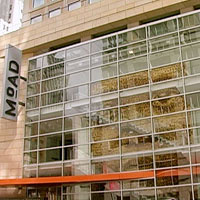
The Museum of the African Diaspora (MoAD) uses art, culture, history and technology to foster cross-cultural communication while it also provides an exhibit space and resource for African-American artists. MoAD is the newest addition to the collection of museums in the Yerba Buena arts district, surrounded by SFMOMA, the Cartoon Art Museum, the Museum of Craft and Folk Art, and the future sites of the Jewish and Mexican museums. MoAD receives international support from institutions such as the British Museum and the Museum of African Art, which have made it a truly global collaborative effort.

  • Array

Tracey Snelling

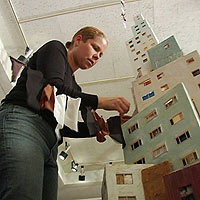
Tracey Snelling‘s miniatures are little tributes to ordinary American settings. Her small-scale renderings of run-down, neglected and overlooked buildings cast a nostalgic look back at a landscape of handmade signs, ad hoc architecture and highway development that is rapidly disappearing. In “New American Landscape,” Snelling takes Spark on a tour of her artistic process.

Snelling’s multimedia constructions boast a painstaking attention to detail, often combining electric light, still photography, moving images and sound. Drawing on imagery of small towns and desolate road stops, her landscapes eerily evoke the subtle moods of the places they represent. They resemble movie sets abandoned long after the film has been shot, inviting observers to project their own narratives onto them.

Spark follows Snelling as she installs her solo exhibition at the de Saisset Museum at the University of Santa Clara. The highlight of the show, which is entitled “Dark Detour,” is a meticulously crafted miniature tenement complex, complete with peeling paint, clotheslines, and a looping soundtrack of television sounds, plumbing and barking dogs, along with moving images in some of the windows. The piece re-creates for gallery visitors the voyeuristic experience of dense city living as they share in the sounds and sights that are central to apartment life.

Before experimenting with sculpture, Snelling worked primarily in photography, a medium that retains a central role in her process. Snelling’s miniatures often begin with a photograph that she has taken or found. Once she has re-created the photograph’s subject, Snelling photographs her miniatures in real-world settings, often creating surreal images depicting complex relationships between varying levels of representation.

Tracey Snelling earned a B.F.A. from the University of New Mexico, Albuquerque. In addition to her show at the de Saisset Museum, her work has been featured in solo exhibitions at the Mission 17 gallery in San Francisco, the Stephen Cohen Gallery in Los Angeles, and the Museum of Art and History in Santa Cruz as well as in group exhibitions at the Kala Art Institute in Berkeley, Intersection for the Arts in San Francisco and the Center on Contemporary Art in Seattle.

Array

  • Array
  • Array

Paul Madonna

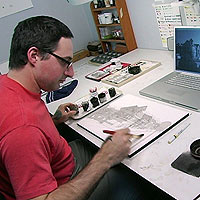
Paul Madonna‘s work captures the subtle and intricate tones, spaces and moods of San Francisco neighborhoods. Madonna draws “All Over Coffee,” a lyrical and often enigmatic comic strip published in the San Francisco Chronicle. Spark catches up with the artist as he begins work on a Mission District scene for his strip.

Madonna works directly in ink on paper, painstakingly rendering minute architectural details. He forgoes pencil sketches of his subjects, so oftentimes his renderings aren’t perfect, lending them a detached quality that offsets their otherwise photographic detail. Once he has captured his subjects in contour drawings onsite, Madonna goes back to his studio and uses photographs of the site to aid him in shading his drawings with ink washes.

The snatches of text that complete the strips often pre-exist the drawings and usually bear a tangential or obscure relationship to the scene that Madonna has represented. Sometimes words in Madonna’s strips appear to be excerpts of an overheard conversation, whereas other times they seem like meditative thoughts. Madonna carefully plays with the relationship between image and text in his work, creating an open and fluid association between the two.

Madonna adds to the mystery of his strips by removing any sense of movement from his scenes; otherwise busy streets are portrayed eerily empty, absent of human figures and cars. The overall tone is one of stillness and reflection. His images appear almost as memories, and the captions seem like disembodied voices emanating from unseen sources.

Paul Madonna grew up in Pittsburgh, Pennsylvania. While still in high school he began attending art classes at Carnegie-Mellon University, where he eventually completed a B.F.A. in 1994. During his senior year of college, Madonna became the first art intern ever taken in by MAD Magazine. Upon graduation, he moved to San Francisco and began making minicomics, which he left in public places for free. In 2004, Madonna began doing “All Over Coffee,” which appears weekly in the San Francisco Chronicle.

  • Array
  • Array
  • Array

Trevor Paglen

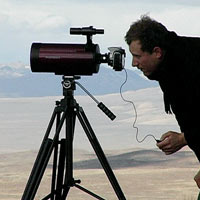
The work of artist Trevor Paglen explores the intersection of conceptual art, geography and activism. Paglen’s ongoing project of photographing and otherwise documenting restricted military bases and testing facilities operates at the limits of vision, rendering visible landscapes normally invisible to the naked eye. In “The New American Landscape,” Spark joins Paglen on an expedition to the edges of the restricted area that surrounds the Tonopah test range to catch a glimpse of the artist and geographer at work.

According to Paglen, it is not illegal to photograph secret government bases, provided one does not enter a restricted area to do so. Tonopah is a vast area containing multiple test sites and secret military bases, including the famed Area 51. It encompasses 3.1 million acres and 12,000 square miles of airspace — an area roughly the size of Switzerland.

Bases like the ones at Tonopah are located in remote areas and surrounded by hundreds of miles of restricted empty land, making these facilities literally invisible without the aid of a telescope. To photograph these areas, Paglen uses technologies borrowed from astrophotography. He notes that these areas are so well buffered that it is actually easier to photograph the planet Jupiter because there are only about six miles of breathable atmosphere between someone standing on Earth and the outer planets, whereas dozens of miles of restricted area may separate Paglen from his subject matter.

Even with the assistance of the latest telescopic technology, photographing remote targets such as these presents a unique set of challenges. Paglen is limited in terms of composition, because usually there are only a few vantage points from which he can observe a site. His palette is restricted to the colors of the Nevada desert, and Paglen often shoots during a particular season to exploit its subtle changes in color. In addition, the thickness of the atmosphere creates a painterly effect, impinging on the crispness of the image.

By Paglen’s estimates, the United States is currently spending more money on classified programs than ever before. To demonstrate the extent of these programs, Paglen created the “Code Names” installation, a list of code names for classified military programs whose names have been declassified or have otherwise entered the public domain. Paglen constantly updates the list, adding new names as they become available and removing those of programs believed to have been ended. Though the list includes more than 2,000 entries, it represents only a small portion of active secret programs because the code names of the vast majority of them remain classified.

Trevor Paglen earned an M.F.A. from the School of the Art Institute of Chicago and is currently pursuing a Ph.D. in geography at the University of California, Berkeley. His work has been exhibited at the Chicago Museum of Contemporary Art, the University of California San Diego and the California College of Art, among other places. He is a contributing editor to the “Journal of Aesthetics and Protest” and develops tactical media projects with the prison-abolitionist group Critical Resistance. Paglen’s writing has been published in “Blu Magazine,” “Art Journal” and the collection “Spaces of Terror.”

Array

  • Array

Liz Hickok

Artists have long been concerned with capturing the spirit of the cities they live in. Liz Hickok is no exception. In her “San Francisco in Jell-O” sculpture series, she has crafted jiggling and jewel-colored landscapes out of one of America’s favorite desserts. Spark caught up with her working on her creations.

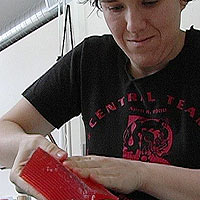
Hickok started off as a photographer, shooting scale models of cities used by architects and urban planners. While studying sculpture in graduate school, she decided to create her own San Francisco landscape. The offbeat beauty and unstable consistencies of Jell-O made it the perfect medium. Hickok starts her process with scale models, which then become cast rubber silicone molds. After the Jell-O filled molds set, she arranges them on Plexiglass lit from below.

Liz Hickok is a multi-media artist who works in video, painting, and installation. She was the recipient of a fellowship from the Kala Art Institute and has earned an M.F.A. from Mills College. She has earned a B.F.A. and B.A. from the School of the Museum of Fine Arts and Tufts University in Boston, Massachusetts. In spring of 2006, Hickok’s Jell-O sculptures were included in an exhibit that commemorated the 1906 earthquake at the Exploratorium.

  • Array

Anna Halprin


View Spark segment on Anna Halprin. Original air date: May 2006. (Running Time: 11:04)


View Spark Web extra with an excerpt from Anna Halprin’s “Intensive Care” (Running Time: 3:55)

Dance legend Anna Halprin, now in her eighties, has spent more than 50 years challenging the conventions of modern dance. A visionary in the field, she continues to teach, choreograph and perform. In January 2006, she brought a group of dancers to the Jewish Community Center of San Francisco to perform some of her work, including the two well-known pieces “Parades and Changes” and “Intensive Care.” Spark follows Halprin as she prepares for the performances and talks about her lifetime as artist, teacher, health advocate and innovator.

Halprin teaches dance to people of all ages, helping them to build awareness of their bodies. She explores how the mind informs the body and how the body can inform the mind. Through one’s own creative process, Halprin believes, each of us will find a path of personal discovery through movement.

When it first premiered in New York City in 1965, “Parades and Changes” provoked significant scandal because the dancers fully disrobe and redress, three different times. Halprin says the piece is about “the process of undressing, finding your place in space.” Halprin created this piece like she creates most of her dances, using a special set of instructions called a score, much like a musical score that provides instruction for the dancers on what to do, but that allows them to decide how they do it.

Forty years after its premier, “Parades and Changes” is still an audience favorite, and Halprin continues to refine it, keeping it elastic and keeping audiences connected. This ongoing dynamism is just one expression of Halprin’s commitment to continually challenge ideas about what dance should be.

In 2000, Halprin debuted “Intensive Care,” a piece that explores the themes of pain, love, healing and death. “It is not an easy performance to watch,” she notes. Halprin originated the dance while her husband was in intensive care for a month. Over time, the piece has become connected to different ideas. For Halprin, this dance is now connected to the war in Iraq, the suffering in the world and other news items she has read. Halprin says that today, the dance is “dedicated to the suffering and fear and the disasters in the world.”

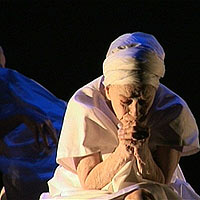
Halprin also continues to challenge traditional notions about who can dance. In 2005, she began working with seniors in Marin County to create a dance together. She found an island in a lagoon at the Civic Center in San Rafael that would be the site of the dance, and she asked the community for donations, receiving 69 rocking chairs for the dancers to use. She and the seniors then developed a score and created their dance. “I never saw such soulful dancing in my life,” Halprin says.

Born in Winnetka, Illinois, Halprin discovered dance as a child, and as a teenager she studied with Josephine Schwarz, who had been a dancer with Doris Humphrey and Charles Weidman. At the University of Wisconsin, Madison, Halprin became a protégée of Margaret H’Doubler. Following World War II, Halprin moved to San Francisco with her husband, landscape architect Lawrence Halprin. There she extended H’Doubler’s approach to movement discovery into improvisation.

Halprin co-founded the Tamalpa Institute in Marin County, an institute that offers training in the Halprin Process, a movement-based healing arts practice. Halprin has received many awards and honors over the years, including fellowships for choreography from the National Endowment for the Arts, a Guggenheim Fellowship, the American Dance Guild Award, the Balasaraswati Award from the American Dance Festival, the prestigious Dance Magazine Award and the Samuel H. Scripps/American Dance Festival Award. Halprin has also been documented in the Bay Area’s Legacy Oral History Project at the San Francisco’s Performing Arts Library & Museum (PALM).

Array

  • Array
  • Array