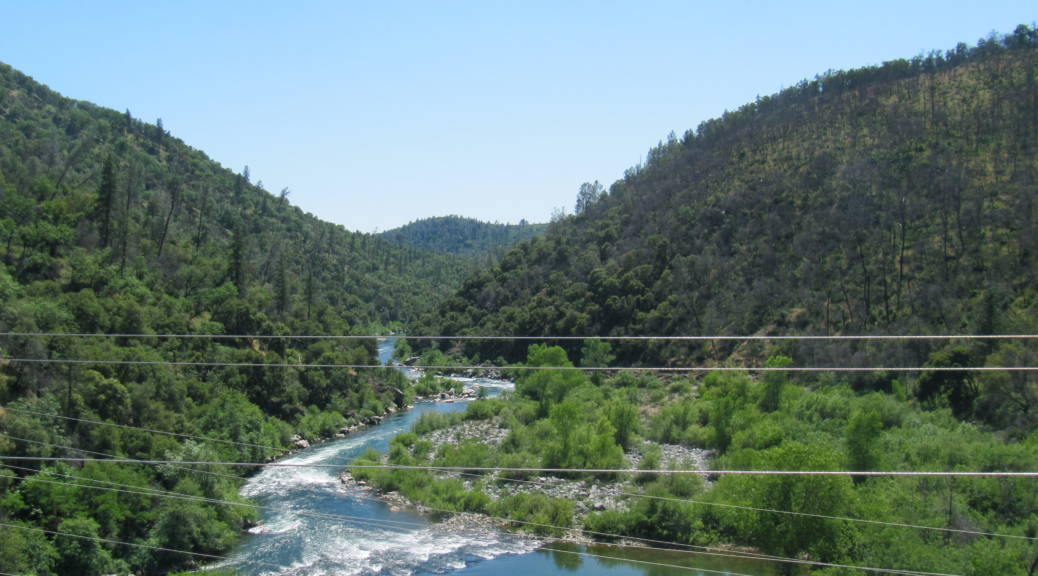
Just so we all start on the same page: there are a lot of dams in California. People have been building dams here since the Gold Rush, and though the dam building boom of the first half of the 20th century is long-over, the dams are still here.
This animation shows all the dams in California. To see a breakdown of which ones are connected to hydropower projects (and which rivers in California remain undammed), explore the Water and Power map. Graphics produced by Don Clyde. Research by Lisa Pickoff-White.
When people began building dams in California, they probably were probably mostly thinking about gold. Later, they had more lofty ideals: controlling floods, supplying water to cities and farms, generating electricity.
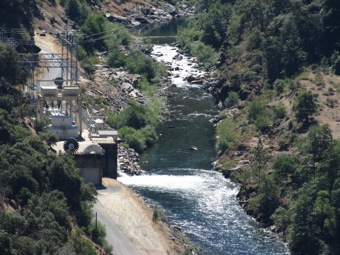
PCWA's Ralston Powerhouse on the Rubicon River in Placer County. California typically gets about 15% of its electricity from hydro facilities inside the state..
While much is uncertain about California’s warming climate, there is little doubt that it’s already changing the fundamentals of how most of us get our water. In fact, the Bureau of Reclamation has estimated that the Sierra snowpack could be reduced by half as soon as a decade from now.
And that has some far-reaching implications that could even show up on your electric bill.
“When you hear people talk about a depleted snowpack, it’s because of warmer temperatures and the snow just cannot stay in the hills,” says Robert Shibatani, a hydrologist and consultant to numerous government agencies. He says the “hydrograph” for California — the “usual” pattern of precipitation and runoff — is already changing. “There’s no question about it,” he told me in a recent interview. “That’s not an if. It’s not even a when, because I can tell you the when. It’s happening now.” Continue reading Hydropower With a Shrinking Snowpack→
Fire management in the West: A dangerous game of Whac-a-Mole
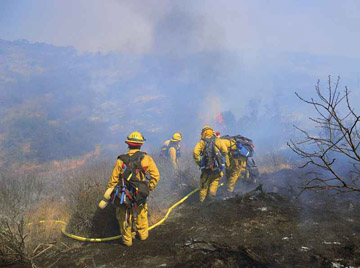
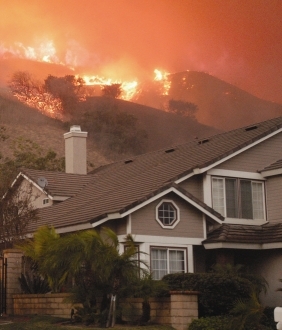
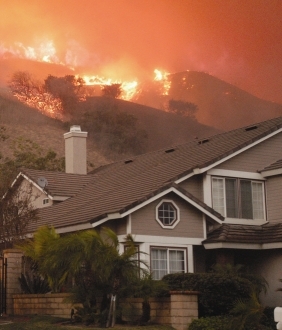
U.S. Fish and Wildlife and Cal Fire crews fighting a wildfire near San Diego. Federal and state budget cuts have greatly reduced California’s wildland fire resources.” credit=”USFWS
As more than 400 firefighters attack a 2200-acre wildfire in Riverside County, and huge fires continue to burn in Colorado and the Southwest, recent studies have projected that the western U.S, wracked by an increasingly hot and dry climate, will experience more frequent and intense fires in the near future.
The job of seasonal wildfire forecasting, it turns out, falls to an agency called the National Interagency Fire Center. Each month, the Boise-based NIFC, a collaborative of eight federal agencies, including the National Forest Service, Bureau of Land Management and National Weather Service, issues its Wildland Fire Outlook [PDF], which offers a year-to-date tally and projections of acres burned along with a comprehensive look at where fire conditions are ripe.
Ed Delgado, manager of the NIFC’s Predictive Services program, says his team looks at a number of factors including snowpack, drought, fuel conditions (that is, the amount of dry vegetation available to burn) and periodic climate variations such as El Niño and La Niña.
This year, the Great Basin, Rocky Mountains and northern Sierra are in the “above normal” category for fire, said Delgado, because of prolonged drought, low snowpack and high fuel-loading of of dead timber and grasses. “We had a very limited snow in the deserts of the Great Basin and that allowed grasses from previous years to remain standing tall,” said Delgado. “This added to the fuels available to burn.”
As for California, the NIFC has predicted that the central Sierra and the Coastal Ranges will come into above average fire danger from July to September, with fires above 8,000 feet more likely than in recent seasons. (Richard Minnich, a fire ecologist at the University of California, Riverside, has predicted low fire risk at low elevations in the southern half of the state because of scant winter rainfall that killed grasses before they deposited seeds.)
Delgado says he has personally seen fire season come earlier by a matter of a few weeks in parts of Utah and Nevada. But the NIFC’s forecasts do not examine whether such changes in seasonal fire activity – such as that in the central Rocky Mountains where the forecast number of fires (1,888) are more than double, and the number of acres projected to burn (186,083) nearly double, the June average – are the result of long-term shifts in climate, or fire suppression, grazing and other management practices that have increased fuel stores – or some combination of these ingredients.
Figuring out just how these factors contribute to fire activity, year-to-year, may be critical, especially with resources stretched thin because of deep cuts to wildland firefighting budgets at federal, state and local levels. Earlier this month, for example, the Guardian reported $512 million in federal cuts for wildfire suppression and preparedness – an overall decrease of 12 percent since 2010. In California, governor Jerry Brown announced an $80 million reduction in the Cal Fire budget. In response, the agency downsized the number of seasonal firefighters on its rolls from 3100 in 2010, to 1700 this year, and for the second straight year has reduced staffing on engine crews from four to three. (Cal Fire faces another $60 million in trigger cuts next year if the governor’s new tax plan fails to be adopted in the November election.)
Experts wondered if “fighting” these colossal fires wasn’t about as effective as dropping DC-10 tanker loads of $100 bills into the flames. More than three million acres have burned each year since 1999—and a 10-million-acre year is almost certainly on the horizon. As the cost of firefighting crossed the billion-dollar mark every year since 2002, another measure of “mega” began to catch policy makers’ eyes: mega expensive. The money being thrown around to douse these fires has pretty much gone up in smoke—and more than 400 wildfire fighters have died since 1987.
The fire-prone reaches of the West are faced with a daunting future. Climate change coupled increased fuel loads from periodic drought, fire suppression and pine beetle outbreaks will make fires more frequent and more intense. Declining budgets coupled with rising costs of fighting these growing conflagrations will limit the resources available to suppress them. While fire is indeed necessary to germinate seeds and reduce fuels, suburban and exurban growth has pushed to the edges — and deep into the interiors — of the nation’s forests and rangelands. (For example, more than 800,000 structures now sit in fire prone areas amid the 31 million acres of California open space overseen by Cal Fire.) This creeping development has permanently altered the natural dynamics of forests and has made some of the best tools for preventing large wildfires – prescribed burns, for example – into highly risky propositions.
The heat is on for solutions. What are your thoughts?
Tagged by some as a “convert” to global warming, the Berkeley physicist talks about his work, some of its controversial funding, and his views on renewable energy
While Richard Muller has come around on global warming, he remains skeptical toward many aspects of climate science.
The outcome of Richard Muller’s sweeping independent audit of temperature data surprised a lot of people — including him. Known as the Berkeley Earth Surface Temperature study, or BEST, the project was rooted in Muller’s own skepticism toward some of the key data underlying conclusions that the UN’s influential climate panel has drawn about global warming.
The author of two books worth of science advice “for future presidents” now concedes that “global warming is real,” but he remains skeptical about a lot of things, like:
The objectivity of some of his colleagues
The link between climate change and severe weather
The future of some renewable energy sources, like solar thermal and geothermal
In the video clip (below), Muller talks about the perils of accepting scientific findings at face value.
The EPA’s new air quality standards reduce the amount of soot allowed in the air
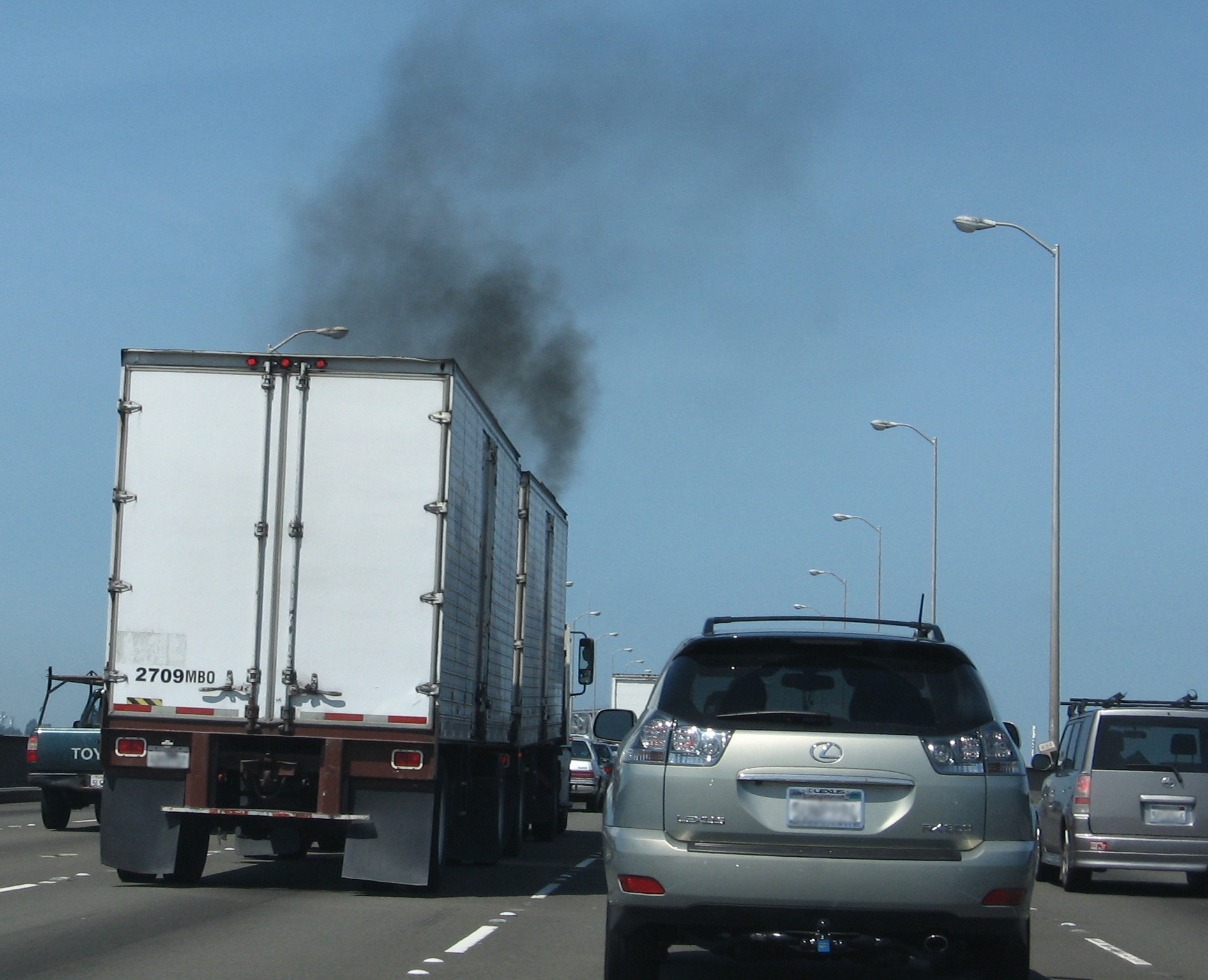
Soot comes from diesel trucks, industrial emissions and fires.
Two California counties are already behind the eight-ball with the Environmental Protection Agency’s proposed new limits on soot. San Bernardino and Riverside are the only counties in the country that the EPA projects will not be able to adhere to the upper limits of its new range.
The Environmental Protection Agency is proposing an update to its national air quality standards, which seeks to lower the amount of soot in the atmosphere. The new rule would limit the annual exposure to fine particle pollution to between 12-and-13 micrograms per cubic meter. The current standard is 15 micrograms per cubic meter.
Forget California, says the outspoken Berkeley physicist. It’s what China does that matters
Richard Muller
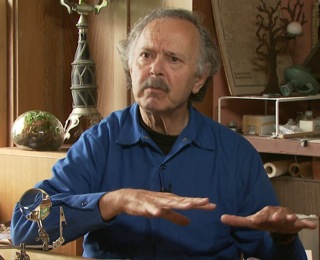
Despite some well-publicized recent conversions on climate matters, Richard Muller’s reputation as a climate skeptic is well earned. In two books, one published and one forthcoming, the UC Berkeley physicist offers counsel on physics and Energy for Future Presidents.
One thing Muller is highly skeptical of is California’s legislated climate strategy, a perspective that he laid out for me in a recent interview at his home in the Berkeley Hils. What matters, he says, is what China does. And little else:
CM: The point here is, and you’ve written about this, is that California can’t save the world in terms of cutting emissions, that no matter what we do, what matters is what China’s doing.
RM: Certainly, California is far too small a part of the global warming problem that anything we do here cannot really help. Even setting an example is something that, I think, is not something we are going to do. But if we can develop an industry that lowers the price of solar cells that lowers the price of wind, that makes nuclear safe, if we can do those things, then that could have a real impact on the future. Continue reading Muller on Climate: It’s All About China→
The Southwest and Northeast have warmed the most. California is, well, average
They call it “global warming” but where you fall on the warming scale depends a lot on where you live. Not everywhere has warmed the same amount (or at all), and it certainly hasn’t happened at the same rate.
A new analysis from Climate Central, a climate education organization (and content partner with Climate Watch), breaks down the warming trends in the continental U.S., state by state.
Some states show an increase in average temperatures (Minnesota, Maine, Arizona and New Mexico, for instance), and some show nearly none (Florida, Alabama, Georgia). California ends up pretty much in the middle of the pack. Continue reading Mapping the Patchwork of U.S. Warming Trends→
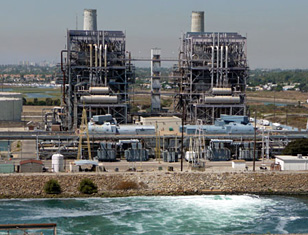
A natural gas power plant in Long Beach that uses "once-through" cooling.
We hear a lot about how green our energy is in California. Instead of using coal, the state runs on natural gas and increasingly, renewable power.
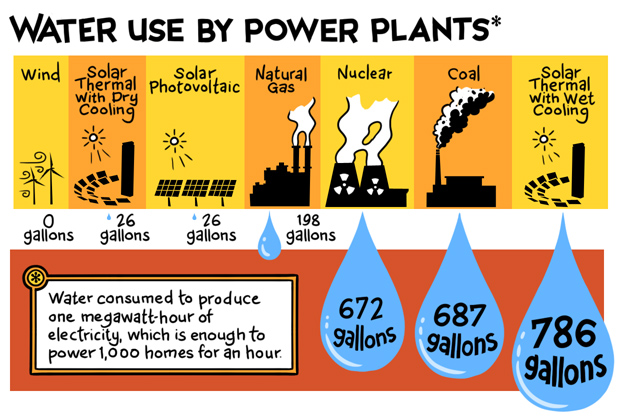
But there’s a hidden cost to our energy supply: water use. In fact, every time you turn on a light, it’s like turning on your faucet. It’s been calculated that it takes 1.5 gallons of water to run a 100-watt light bulb for 10 hours.
The way water and power work together is a lot like a tea kettle. Steam drives the power industry.
How Power Needs Water
You can see it at the Gateway Generating Station, a natural gas power plant in the northeast Bay Area. The plant looks complicated but making power is pretty simple. Step number one: burn natural gas. That produces a lot of heat.
“You’ve got 1,700-degree exhaust energy, or waste heat,” says Steve Royall of PG&E, who is giving me a tour through the maze of pipes and compartments. The heat hits pipes that are filled with water and the water is boiled off to create steam. That’s step number two: make steam to turn a steam turbine, which is attached to a generator. It’s the water that’s making the power.
Source: National Renewable Energy Laboratory. Illustration by Andy Warner.
A new study projects fires in the western U.S. will become more frequent within the next 30 years.
Large fires in the western U.S. — such as those currently raging in Colorado and New Mexico — may be part of a shifting pattern of wildfire risk brought on by climate change, according to a study led by researchers at UC Berkeley.
The study, published Tuesday in the journal Ecosphere, analyzed the results of 16 different global climate change models. The models included variables such as annual precipitation and mean temperature of the warmest month and projected an increase in the frequency of fires across the majority of North America and much of Europe within the next 30 years.
When you open that faucet, it’s more than water that’s flowing.
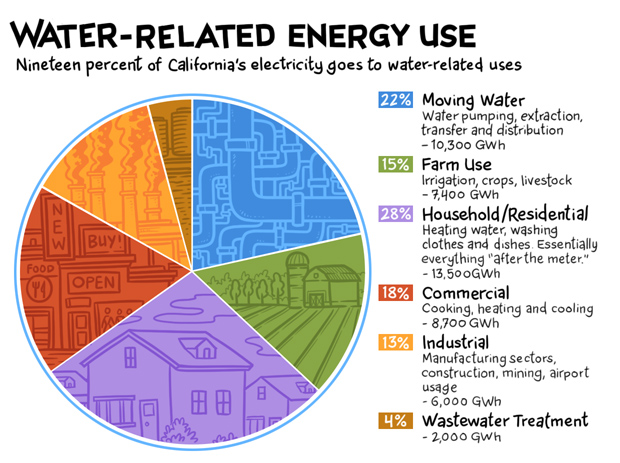
A few years back, number crunchers at the California Energy Commission tried to add up how much electrical power (and other forms of energy) goes into using water in California. The bottom line number they came up with: 19%. That is, nearly a fifth of all the power generated in California — as well as huge quantities of natural gas and diesel fuel consumed in the state — goes into water-related uses. You might call that report, entitled California’s Water-Energy Relationship, as The Great Wake-Up Call. The idea that so much power could go into this one vital activity—moving and treating and using water—is both stunning and captivating. And it has spurred both state agencies and water and power utilities into action.
The California Public Utilities Commission, responsible for overseeing the activities of the state’s big investor-owned electric utilities on one hand and numerous small water providers on the other, responded to the 19% number by authorizing a series of pilot projects to assess how to cut the amount of power used in connection with water. Since the CPUC is supposed to make sure that utility investments are cost-effective and don’t burden ratepayers with excessive charges, the focus of most of the pilots was on areas where utilities could get the most bang for the buck. Mostly, that turns out to be water conservation. Continue reading 19%: The Great Water-Power Wake-Up Call→