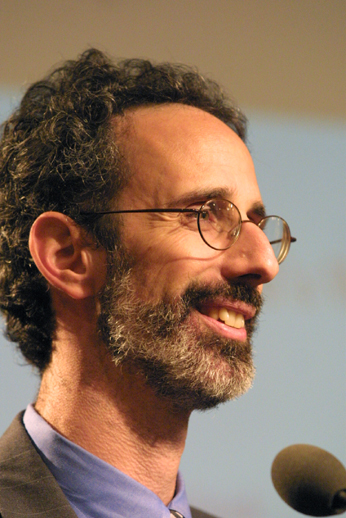
Jeremy Miller is a contributing editor for High Country News, and his stories have appeared in numerous publications including Harper's, Orion, Men's Journal, Earth Island Journal, The Boston Globe and The San Francisco Chronicle Sunday Magazine. He currently lives in the East Bay with his wife, Emma, and children, Deirdre and Owen.
With changes in climate and weather . . . past weather data are no longer adequate predictors of future extremes. Advanced modeling capabilities could potentially provide useful predictions and projections of extreme environments.
Those “useful predictions and projections,” according to the report, could come in various forms — supplying farmers with better information about what to plant, year-to-year, say, or giving local officials greater insights into future flood risk, or providing climatologists with better information about specific parts of the country most susceptible to extreme heat. Continue reading NAS Study Calls for ‘Next Generation’ of Climate Models→
Energy from trash and fewer catastrophic fires? What’s the catch?
A wood-burning power plant in Northern California. In 2007, "biomass" energy accounted for roughly 2.1 percent of California energy production. A new state bioenergy plan seeks to substantially increase that percentage.
Wood scraps, animal manure, household garbage and other wastes may soon fuel a sweeping “clean energy” initiative in California, if the collective vision of several state agencies comes to pass.
“Swift action on bioenergy will create jobs, increase local clean energy supplies, and help businesses grow in California,” said resources agency secretary John Laird in a Department of Natural Resources release. Currently, the bioenergy sector employs roughly 5,000 people and contributes $575 million to the state economy; the agency estimates the new plan could create an additional 4,000 jobs statewide. Continue reading California Powers Up Plan for Waste-to-Watts→
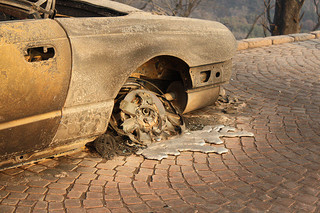
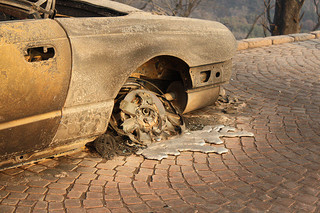
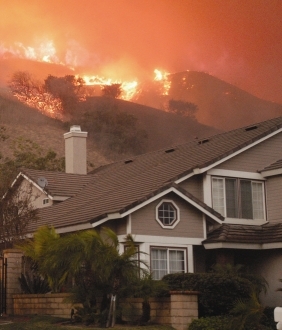
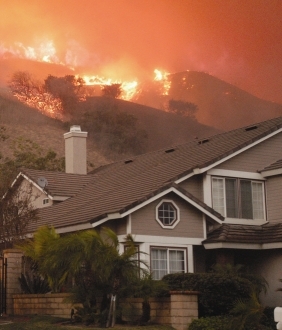
Wildfires can leave little to salvage for homeowners caught in harm's way.
Climate change will disproportionately affect California’s most disadvantaged and isolated communities, according to a recent report from the Pacific Institute.
By looking at a broad array of factors – from social indicators such as income and birth rates, to environmental ones such as tree cover and impervious surfaces – the Oakland-based think tank has found that 12.4 million Californians live in census tracts with high “social vulnerability” to climate change.
This vulnerability can play out in various ways, says Heather Cooley, co-director of the institute’s water program and a lead author of the report. “In low-income communities, many people may not have insurance,” Cooley told me. “So when a flood or fire hits their homes, they may not be able to rebuild. If they’re suffering from a heat-related illness, they may not be able to seek treatment and their health may deteriorate as a result.” Continue reading 12 Million Californians ‘Highly Vulnerable’ to Climate Change — Now What?→
Help map the spread of invasive plants with a smartphone app
Artichoke thistle flower in Wildcat Canyon Regional Park. Citizens with smartphones can help in a statewide weed-mapping initiative.
If you have a sharp eye for invasive plants – and a smartphone – you can help a Bay Area non-profit in its effort to document the distribution and spread of invasive plants across California.
The Berkeley-based California Invasive Plant Council, or Cal-IPC, has found that weeds cost the state at least $82 million annually in terms of increased erosion and flooding, degraded agricultural land and reduced water supplies.
Climate change is making the issue even more complex, says Doug Johnson, Cal-IPC’s executive director, who is trying to better understand how non-native plants may respond and how they may gain advantage over native plants during prolonged bouts of warming or cooling. Continue reading Tapping Crowds to Track California’s Weeds→
Forecast: warmer, drier and more of us in harm’s way
The towering flames of the Robbers fire, which burned 2,600 acres and destroyed five buildings in Placer County in July. A new UC Merced report says such fires may double in the next 40 years because of urban growth and warming temperatures.
As notices begin to arrive in the mail to nearly 850,000 California residences in fire-prone areas for Cal Fire’s controversial new fire prevention fee, a study out of the University of California Merced offers a powerful rationale for beefing up the state’s wildland firefighting resources.
Warmer average temperatures coupled with urban growth will greatly increase wildfire risk to California homes in the decades to come, according to the new UC study [PDF] prepared for the California Energy Commission.
Stanford professor is using new tools to hang out and chat
Stanford professor Noah Diffenbaugh is using real time, online video chat to engage the public in discussions of climate science.
Noah Diffenbaugh, an assistant professor in the Department of Environmental Earth System Science at Stanford, has focused largely on climate variability and the influence of humans on the global climate system. Lately, he’s also being spending time in the cloud.
In April, he launched an online discussion forum called Hangouts on Air, in which participants from anywhere around the world (with a broadband connection, that is) can participate in real-time online discussions about climate.
Participation has been limited in these first months, but Diffenbaugh says the model holds promise for engaging the public on the complex, contentious and rapidly evolving issues in climate science. He agreed to answer some questions for Climate Watch. Continue reading Talking Climate, Online in Real Time→
Fire management in the West: A dangerous game of Whac-a-Mole
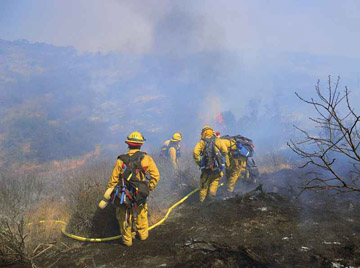
U.S. Fish and Wildlife and Cal Fire crews fighting a wildfire near San Diego. Federal and state budget cuts have greatly reduced California’s wildland fire resources.” credit=”USFWS
As more than 400 firefighters attack a 2200-acre wildfire in Riverside County, and huge fires continue to burn in Colorado and the Southwest, recent studies have projected that the western U.S, wracked by an increasingly hot and dry climate, will experience more frequent and intense fires in the near future.
The job of seasonal wildfire forecasting, it turns out, falls to an agency called the National Interagency Fire Center. Each month, the Boise-based NIFC, a collaborative of eight federal agencies, including the National Forest Service, Bureau of Land Management and National Weather Service, issues its Wildland Fire Outlook [PDF], which offers a year-to-date tally and projections of acres burned along with a comprehensive look at where fire conditions are ripe.
Ed Delgado, manager of the NIFC’s Predictive Services program, says his team looks at a number of factors including snowpack, drought, fuel conditions (that is, the amount of dry vegetation available to burn) and periodic climate variations such as El Niño and La Niña.
This year, the Great Basin, Rocky Mountains and northern Sierra are in the “above normal” category for fire, said Delgado, because of prolonged drought, low snowpack and high fuel-loading of of dead timber and grasses. “We had a very limited snow in the deserts of the Great Basin and that allowed grasses from previous years to remain standing tall,” said Delgado. “This added to the fuels available to burn.”
As for California, the NIFC has predicted that the central Sierra and the Coastal Ranges will come into above average fire danger from July to September, with fires above 8,000 feet more likely than in recent seasons. (Richard Minnich, a fire ecologist at the University of California, Riverside, has predicted low fire risk at low elevations in the southern half of the state because of scant winter rainfall that killed grasses before they deposited seeds.)
Delgado says he has personally seen fire season come earlier by a matter of a few weeks in parts of Utah and Nevada. But the NIFC’s forecasts do not examine whether such changes in seasonal fire activity – such as that in the central Rocky Mountains where the forecast number of fires (1,888) are more than double, and the number of acres projected to burn (186,083) nearly double, the June average – are the result of long-term shifts in climate, or fire suppression, grazing and other management practices that have increased fuel stores – or some combination of these ingredients.
Figuring out just how these factors contribute to fire activity, year-to-year, may be critical, especially with resources stretched thin because of deep cuts to wildland firefighting budgets at federal, state and local levels. Earlier this month, for example, the Guardian reported $512 million in federal cuts for wildfire suppression and preparedness – an overall decrease of 12 percent since 2010. In California, governor Jerry Brown announced an $80 million reduction in the Cal Fire budget. In response, the agency downsized the number of seasonal firefighters on its rolls from 3100 in 2010, to 1700 this year, and for the second straight year has reduced staffing on engine crews from four to three. (Cal Fire faces another $60 million in trigger cuts next year if the governor’s new tax plan fails to be adopted in the November election.)
Experts wondered if “fighting” these colossal fires wasn’t about as effective as dropping DC-10 tanker loads of $100 bills into the flames. More than three million acres have burned each year since 1999—and a 10-million-acre year is almost certainly on the horizon. As the cost of firefighting crossed the billion-dollar mark every year since 2002, another measure of “mega” began to catch policy makers’ eyes: mega expensive. The money being thrown around to douse these fires has pretty much gone up in smoke—and more than 400 wildfire fighters have died since 1987.
The fire-prone reaches of the West are faced with a daunting future. Climate change coupled increased fuel loads from periodic drought, fire suppression and pine beetle outbreaks will make fires more frequent and more intense. Declining budgets coupled with rising costs of fighting these growing conflagrations will limit the resources available to suppress them. While fire is indeed necessary to germinate seeds and reduce fuels, suburban and exurban growth has pushed to the edges — and deep into the interiors — of the nation’s forests and rangelands. (For example, more than 800,000 structures now sit in fire prone areas amid the 31 million acres of California open space overseen by Cal Fire.) This creeping development has permanently altered the natural dynamics of forests and has made some of the best tools for preventing large wildfires – prescribed burns, for example – into highly risky propositions.
The heat is on for solutions. What are your thoughts?
A new study projects fires in the western U.S. will become more frequent within the next 30 years.
Large fires in the western U.S. — such as those currently raging in Colorado and New Mexico — may be part of a shifting pattern of wildfire risk brought on by climate change, according to a study led by researchers at UC Berkeley.
The study, published Tuesday in the journal Ecosphere, analyzed the results of 16 different global climate change models. The models included variables such as annual precipitation and mean temperature of the warmest month and projected an increase in the frequency of fires across the majority of North America and much of Europe within the next 30 years.
The Heartland Institute cries foul as Gleick is invited back to work
After a three-month internal investigation, Pacific Institute president Peter Gleick has been cleared of further wrongdoing in the Heartland Institute scandal.
The announcement that Peter Gleick has been reinstated as president of the Pacific Institute was met with an outcry from the Heartland Institute, which has vowed to press ahead in its effort to prosecute the noted scientist for fraud.
“The Pacific Institute’s board of directors has failed to perform its duty and should be deeply ashamed,” said Heartland president Joseph Bast in a statement released today. “We have asked the federal government to prosecute Gleick for what we believe were serious crimes he committed, and we await its decision.”
Gleick took a leave of absence from the Oakland-based Pacific Institute in February, as an independent internal investigation began looking into allegations that he had given a false name to Heartland, and also manufactured a document containing detailed strategy information on Heartland’s national effort to downplay climate science.