Category Archives: The Science

Latest research from the field and the lab

Western Lakes Warming Up Rapidly

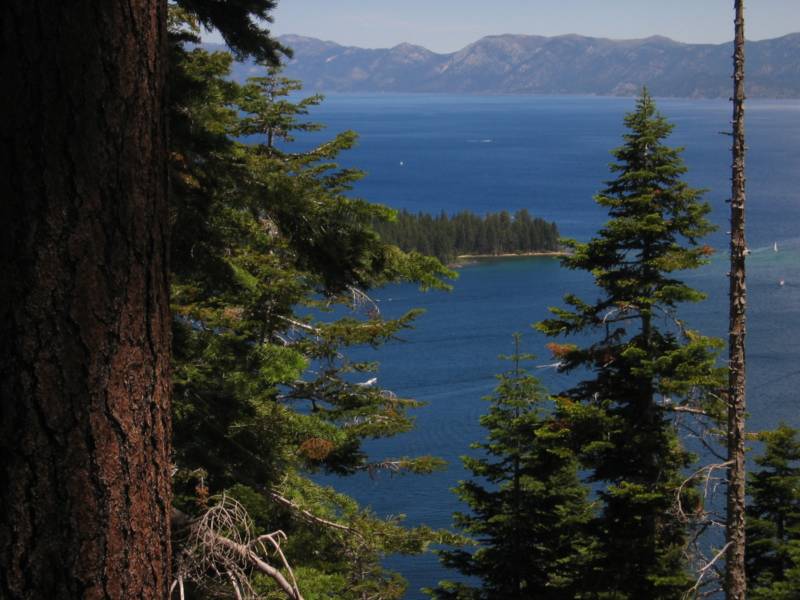
Photo: Craig Miller

Some lakes in Northern California and Nevada are warming twice as fast as the surrounding air temperature, raising concerns that climate change may be affecting aquatic ecosystems more rapidly than terrestrial ones, according to a recently published study.

Researchers from the Tahoe Environmental Research Center, UC Davis and NASA’s Jet Propulsion Laboratory in Pasadena, studied Lake Tahoe, Lake Almanor, Clear Lake, and Mono Lake in California, and Nevada’s Pyramid and Walker Lakes, by analyzing 18 years of temperature data from satellite sensors.

Long-established instrument buoys provided a flow of temperature data for Tahoe, dating back to 1968, which allowed the team to calibrate satellite readings, raising confidence in data gathered from the other lakes. Previous studies have documented the warming of Lake Tahoe but John Reuter, associate director of the Tahoe Environmental Research Center (TERC), says the new study takes that information one step further.

“This study really shows that this phenomenon is happening on a much larger scale than just Lake Tahoe,” said Reuter.

All of the lakes studied showed a strong warming trend among summer nighttime temperatures between 1992 and 2008.  The two lakes that warmed the most during that time, Almanor and Mono, warmed 4.3 degrees (F).  During that time Lake Tahoe’s surface waters warmed 3.7 degrees, averaging .23 degrees annually.  In contrast, Tahoe City’s air temperature increased just .1 degree each year.

TERC director Geoffrey Schladow, who co-authored the study, said there is no doubt in his mind that rising lake temperatures are related to climate change, and he expects that it’s happening across the world, not just in Northern California and Nevada.

“The significance of this study is that across the western United States these very different lakes are displaying signs of warming.  It’s not just a Tahoe issue, it’s a regional issue.  And in all likelihood, it’s a global issue,”said Schladow.

Over the next six months, researchers will be using the remote sensors to extend the study to 50 lakes across the world to evaluate whether or not large lakes everywhere are warming at similar rates.

Warmer temperatures can affect water circulation, which influences the amount of oxygen and nutrients available throughout the lake.  A 2008 study from TERC predicts that warming due to climate change could dramatically affect the amount of mixing in Lake Tahoe, which would deplete the bottom water of oxygen and drastically disrupt the food web.

“Temperature is one of the conditions that dictates who lives in the lakes,” said Schladow. “Warmer temperatures may make the lakes more hospitable to invasive species and put native species under stress.  I’m not saying this is happening yet, but it could.”

In his article about the study, Matt Weiser of the Sacramento Bee has some examples of how warmer temperatures can affect lake ecosystems. And KQED news editor Dan Brekke has assembled an interactive map (below), showing the locations and some temperature data for lakes in the study.


View California’s Warming Lakes in a larger map
The Heated Debate Over Temperatures

87583224As the war over warming perception spills into a new decade, the last month of 2009 provided fresh ammo for the prevailing view. According to a preliminary report from the World Meteorological Organization (WMO), the “noughties” may have been the warmest decade on record.
And despite the rare sprinkling of snow we woke up to one December morning in the Bay Area, the report also says that 2009 will likely go down as one of the hottest years in modern history. Based on climate data from January to October, the WMO says that 2009 will likely be the fifth warmest since scientists began keeping records in 1850.

If that last claim seems improbable, you’re likely in Canada or the United States: The data shows that every continent but North America saw above-average temperatures in 2009, and that parts of Asia and Africa experienced their warmest year yet.

Dean Moosavi, a professor at the University of Massachusetts, Dartmouth, chalked the apparent discrepancy up to the Pacific ocean phase known as La Nina, and said it’s important to note the difference between weather and climate. “Snow in Houston this week, for example, is not proof of the absence of global warming any more than a large drought in the summer is proof that global warming is occurring,” Moosavi wrote in an email to Climate Watch. “You have to look over much longer periods of time…decades at the least before you can see a climatic trend of significance.”

This is perhaps a good place to acknowledge the oft-heard claim that the planet has actually been cooling down for more than a decade. In an article published in NOAA’s online magazine ClimateWatch (not affiliated with KQED Climate Watch), David Easterling of NOAA’s Climatic Data Center explains the statistical quirk that produces that mirage.

But Moosavi says he’s not quite ready to make a pronouncement. “I am not yet convinced that the 2000’s were warmer than the 90’s at this point,” Mossavi wrote. “Given the political and economic stakes of a statement of this type…I would be very cautious before declaring the 2000’s the warmest decade.”

Stanford’s Mark Jacobson, on the other hand, was less equivocal: “As 8 of the 10 warmest years in the history of surface measurements are in the 2000’s, it is clear that the 2000s was the warmest decade on record,” he wrote in an email.

The WMO findings come on the heels of a pair of reports that indicate that despite the global recession, average temperatures are on track to rise between 4 and 6 degrees Celsius by the end of the century.

For some perspective, the California Climate Change Center’s 2006 report on the risks of global warming predicts that a 6 C increase would have a devastating effect on the state. The report projects that a 10.5 F increase (just a little under 6 C) would result in up to 100 extra days of “extreme heat” in Los Angles and Sacramento, a 90% reduction in the Sierra snowpack and a 2-to-3-foot increase in sea levels.

The half-dozen climate scientists contacted for this post agreed that the 6 C prediction was within the realm of possibility, and most had the same answer when asked how the world should combat this risk. Stanford professor Ken Caldeira chose to respond in capital letters: “WE HAVE TO ACT NOW.”

“The question isn’t so much whether we need to take action this year or next, but rather how much more expensive and difficult are the solution and the impacts, if we delay,” Chris Field, director of the Carnegie Institution’s Department of Global Ecology, said. “Delaying action on climate is sort of like delaying action on paying your credit card bill. You may get by for a few months, but the problems get worse through time and more expensive to address.”

NASA’s Carbon Trackers Yield New Maps

Almost lost amid the Copenhagen media clutter was last week’s meeting of the American Geophysical Union in San Francisco. So this week we’re playing a little catch-up. Climate Watch contributor Molly Samuel has the last of three posts on some things that caught our attention at AGU.

The UN’s Collaborative Programme on Reducing Emissions from Deforestation and Forest Degradation in Developing Countries, or REDD, was a big topic the past two weeks at the climate conference in Copenhagen. Wealthy countries, including the United States, have put billions of dollars on the table to help developing countries use sustainable forestry practices.

Back here on the California climate beat, there’s forestry-related news, too. Scientists at the NASA Ames Research Center in Mountain View (see map, below) have been working with the California Energy Commission and the Air Resources Board to measure California’s greenhouse gas emissions for the state’s mandated greenhouse gas inventory under AB-32 (the Global Warming Solutions Act of 2006).

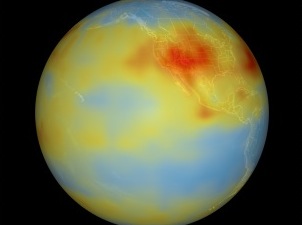
Carbon mapping by satellite. Image: NASA
Carbon-mapping California by satellite. Image: NASA

At the American Geophysical Union conference in San Francisco, NASA’s Christopher Potter shared information he’s gathered using MODIS, an imaging instrument that’s hitching a ride on NASA’s Terra satellite. Potter’s data shows that California’s ecosystems–forests, grasslands, croplands, wetlands, etc.–emit about the same amount of carbon that they absorb each year. And in wet years, they absorb considerably more. In an email Potter says, “the natural ecosystem sources can decrease or increase the net emissions of CO2 in the state by about 15%, depending on whether it is a normal precipitation year or a below-normal precipitation year, respectively.”

MODIS isn’t NASA’s only tool aimed at California as it circles the earth. AIRS, or Atmospheric Infrared Sounder, collects data from the troposphere (the layer of the atmosphere closest to the earth). NASA designed it to improve weather forecasting—the troposphere is where our weather happens–but it’s turned out to be an effective instrument for measuring carbons as they bubble up from the earth and circulate in the atmosphere.

Having collected seven years of data on carbon dioxide, carbon monoxide, and methane, scientists (and now you) can actually see where the carbons are coming from and where they go. NASA has posted animations showing the methane emitted by wildfires in California, and maps of carbon dioxide concentrations around the world.

Polar Bears and Sea Ice: Sorting it Out

87514496A recent post I wrote to highlight a radio discussion of the current plight of polar bears, drew a challenge from Russell Steele, one of our regular readers. Steele questioned some of the scientific conclusions underlying dire predictions for the bears.

To help sort some of this out, I asked for responses from two highly regarded scientists in the field. Here’s a response to the specific reader challenge from Mark Serreze, Director of the National Snow & Ice Data Center, in Boulder, CO:

It is unclear what Mr. Steele is trying to get at with reference to the seasonal cycles in sea ice extent from the AMSR-E data. The AMSR-E data, while valuable, only go back to 2002. Through combining SSM/I and SMMR satellite data with other information sources for earlier years, we have a decent record of Arctic sea ice extent going back to the early 1950s. The relevant issue is the long-term decline in end-of-summer (September) ice extent evident in this record, with the extreme September minima of recent years (represented in the short AMSR-E record) serving as exclamation points. The observed rate of September ice loss exceeds expectations from nearly all climate models.

I also turned to Waleed Abdalati. Now director of the Earth Sciences Observation Center at the University of Colorado, Abdalati is a veteran of the Cryospheric Sciences and Terrestrial Hydrology programs at NASA, and one of the most articulate people I’ve heard speak on the subject of polar ice. He offers the following:

I am not an expert on polar bears, but I do think it is safe to say that
 their primary habitat, the Arctic sea ice, is severely threatened.  I, and 
most of my colleagues believe we are well on our way to an ice-free Arctic
 in summer any time between this decade and the next 40 years.

This
 is because of two things:  1) it will be decades before the ocean has 
finished its response to present-day greenhouse forcing, so the impacts of 
what we’ve done already have not been fully realized; and 2) the loss of
 sea ice is self-compounding: when it starts to shrink, exposing a 
darker more (heat) absorbing ocean underneath, the likelihood of its continued
 shrinking is greater (ice melts, exposes darker ocean, absorbs more heat, 
melts more ice, exposes darker ocean, and so-on).

Of course the flipside
 of this is that as ice starts to grow, it is more inclined to grow, but
 against the backdrop of the increased warming, the former is far more likely 
than the latter. Finally, as thick multi-year ice disappears, it is
 replaced with thinner and younger ice that is more vulnerable to surface 
melt from the atmosphere, bottom melting from sea water, and being carried
 away to lower, warmer latitudes by ocean current and wind.

So back to the polar bears: If their habitat disappears and they are unable 
to hunt seals, their main source of food, they seem to stand little or no
 chance of survival. I am not a wildlife biologist but its hard for me to 
believe they as a population can sustain themselves on land and with only a
 seasonally-present ice cover. In some cases, the fact that they face more
 challenges on sea ice than in the past, has driven them to forage inland,
 creating the illusion in some people’s minds that their populations are 
increasing, because there are more sightings on land. Who knows? Maybe 
they’ll evolve to hibernate in late summer, when there is no ice, and hunt
 the rest of the year.

There is an added effect that doesn’t get much attention.  There was a 
fascinating study by a Canadian Biologist (Ian Stirling) and a sea ice
 expert (Claire Parkinson) [Stirling, I., and C.L. Parkinson. 2006. Possible 
Effects of Climate Warming on Selected Populations of Polar Bears (Ursus
maritimus) in the Canadian Arctic. Arctic 59(3): 261-275.], which suggested 
that the bears are also losing weight, and approaching the weights at which 
they have historically not been able to bear cubs.  So not only is the
population threatened by starvation, the ability to replenish the population
 seems diminished.

I don’t believe we can say anything with absolute certainty,
 so I, myself would not make the statement that the polar bears are doomed–but I will say that the outlook for them, in my view, looks very, very bad.

Creating Carbon Sponges

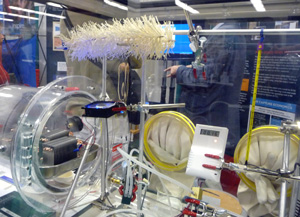
Carbon capture demo at the annual American Geophysical Union meeting. Credit: Molly Samual.
Carbon capture demo at the annual American Geophysical Union meeting. Photo: Molly Samuel

Almost lost amid the Copenhagen media clutter was last week’s meeting of the American Geophysical Union in San Francisco. So this week we’re playing a little catch-up. Lauren Sommer has the second of three posts on things that caught our attention at AGU.

Carbon capture technology has largely focused on the most convenient emissions sources–namely the stacks at large power plants. But as Columbia University’s Allen Wright showed at the American Geophysical Union conference in San Francisco last week, there are other ways to do it.

Wright and colleagues demonstrated their “air capture” technology, where carbon dioxide is absorbed straight from the air by something that looks a lot like a gadget for cleaning Venetian blinds. It’s a special plastic material with a sponge-like consistency. Once the carbon is absorbed, the material is exposed to water or water vapor which causes the carbon to be released. It can then be captured. Wright says it captures CO2 three to five times better than a leaf in full sunlight.

On a large scale, this technology might be built into “artificial trees” that could be stationed anywhere around the globe. The prototype, designed by Wright’s Global Research Technologies, doesn’t look much like a tree. It’s a shipping container with a circular, rotating basket on top where the air capture units are exposed to the air. After one rotation, the baskets would be brought “downstairs” where the carbon is captured. From there, the carbon could be geologically sequestered or even used to make beverages bubbly.

Of course, the main criticism of this approach is efficiency. Carbon dioxide is only about 0.04% of the atmosphere, which is why more concentrated sources like power plant stacks get more attention. Wright says capturing carbon from power generation will be important, “but capture at the stack isn’t enough. It won’t do what has to be done. Air capture has the advantage of being able to deal with emissions from anywhere on the planet from any source.”

Cars are one of the sources he’s talking about. Their prototype unit is designed to capture a ton of carbon a day, which would neutralize the emissions from about 20 cars. They hope to get the cost of each carbon-capturing unit down to the price of car, so the cost of reducing a ton of carbon could one day be similar to other technologies.

Still, to make an impact on global emissions, millions of these units would need to dot the landscape. And just as with renewable energy, NIMBY issues are a potential roadblock. But as is a common refrain these days, Wright says if we’re serious about cutting emissions, we’ll need every technology that shows promise.

1.5 Degrees (Celsius) of Separation

Haven’t I seen you somewhere before?

A few last over-the-shoulder observations from Rob Schmitz, who has at last escaped Copenhagen, after two weeks of reporting for Climate Watch and The California Report.

There goes Nancy Pelosi in a blazing red dress. Over there? Hugo Chavez surrounded by bodyguards and tracked by television cameras. Watch out! Al Gore’s security detail is coming through!

It was getting toward the end of Week Two, and the Bella Center, all but closed now to those pesky, protesting NGOs, was overrun by more than 120 world leaders and heads of state, and you couldn’t get to the restroom without bumping into one of them (or the elbows of their security guards).

With all this power crammed into once place, the folks who seem like bigwigs at home suddenly found themselves standing in line for hours with the rest of us. CEOs, heads of big-name state agencies and the like had to walk more than a mile to the conference Wednesday after protests forced police to shut down the Bella Center metro stop and erect twenty-foot barriers around it. Then, the UN barred access to most accredited NGO participants, enraging many who dropped thousands of dollars to come here and now couldn’t attend the finale of these negotiations.

At one point, I was looking for a table where I might sit down and eat my lunch. This is one of the joys of covering a conference like this: it’s crowded and everyone’s eating at the same time, so the nations of the world share tables (at least they can cooperate at lunchtime). I plopped my tray down at a table of three people dressed in elaborate white, blue, and red costumes, adorned with silver jewelry. As it turned out, they were three presidents of the parliamentary system of the Sami people, the indigenous nomadic reindeer herders of northern Norway, Sweden, and Finland, an area known as Lapland. The three were there to support language in the draft resolution text that would include indigenous peoples when deciding where to build renewable energy projects. They’ve had problems in the past when wind farms and dams were built on their lands. “The reindeer don’t like that,” said one of the leaders, “they’ll avoid anything that’s new, and it disturbs our herding,” she told me. The conversation soon turned to their costumes. “We usually don’t wear these outfits,” said one leader at the table, “but we wear them here, because it helps raise awareness of our people. Television journalists are very interested in us.” But, he said, the costumes were a double-edged sword of sorts. When they wear them at official functions, they have a hard time being taken seriously by officials from other governments, one lamented.

I had a similar notable encounter the day before, when I was reporting a story on what California got out of the climate summit. After wrapping up my interviews, I sat down and had breakfast at the Scandic Webers Hotel. Sitting next to me was a man dressed in a red Wisconsin Badgers t-shirt and grubby Adidas sweatpants. Me being from Minnesota, it was my Midwestern duty to inform him of this.

Me: “Wisconsin, eh?

Him: “Yup.”

Me: “I’m from Minnesota.”

Him: “Oh yeah? Well I hope we see you in the playoffs.”

He was referring to the NFL and the arch-rivalry between the Green Bay Packers and my team, the Minnesota Vikings. We proceeded to rib each other about football and had a fun, trash-talking conversation about quarterback Brett Favre. At the end of the conversation, I asked him what he did for a living in Wisconsin.

“Oh, I’m the governor.”

It’s been that kind of week. Wisconsin Governor Jim Doyle, dressed in sweatpants on this morning, was wearing suits when he was involved in meetings throughout the week, to urge the US to make a binding commitment to greenhouse gas emissions reductions and for congress to pass a cap-and-trade scheme. But he, of course, was playing second (or third) fiddle to the heaps of world leaders that piled into this conference.

Maybe he should have dressed like a reindeer herder.

Author: Polar Bears Doomed No Matter What We Do

US Fish & Wildlife Service
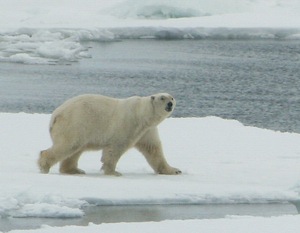
Photo: US Fish & Wildlife Service

Because our charter at Climate Watch is to examine climate change from the California perspective, you don’t see a lot here about melting ice caps and imperiled polar bears. But Michael Krasny’s interview with Richard Ellis on KQED’s Forum program is well worth an hour of your time.

Ellis is the author of On Thin Ice: The Changing World of the Polar Bear (Random House, 2009) and it’s fair to say that he managed to stun Krasny with a declaration that the species is “doomed,” no matter what we might try to do to save it at this point. Ellis says there is already too much warming in the pipeline (what scientists call “committed” warming) to reverse the disintegration of the bears’ arctic habitat.

Polar bear populations have been a topic of persistent confusion, recently amplified in an op-ed piece written by former Alaska governor Sarah Palin for The Washington Post.

According to the advocacy group Polar Bears International, there is little room for doubt about the animal’s decline. The organization’s website breaks down the numbers, which point to a “scientifically documented decline in the best-studied population, Western Hudson Bay, and predictions of decline in the second best-studied population, the Southern Beaufort Sea.”

The PBI analysis goes on to explain that:

The Western Hudson Bay population has dropped by 22% since 1987. The Southern Beaufort Sea bears are showing the same signs of stress the Western Hudson Bay bears did before they crashed, including smaller adults and fewer yearling bears.

At the most recent meeting of the IUCN Polar Bear Specialist Group (Copenhagen, 2009), scientists reported that of the 19 sub-populations of polar bears, eight are declining, three are stable, one is increasing, and seven have insufficient data on which to base a decision. (The number of declining populations has increased from five at the group’s 2005 meeting.)

Regardless of whether you share the conclusions of Ellis and PBI about the future of the “poster child for global warming,” the Forum interview is a fascinating hour.

Some Glaciers Buck the Trend

We’re entering the best time of year for fans of glaciers.  The high-country rivers of ice are getting their annual nourishment from winter’s snows–probably not enough, as Yosemite National Park geologist Greg Stock tells us: “Glaciers are getting about the same amount of snowfall each winter but they’re seeing a lot more melt in summertime because of those warmer temperatures.”

A database called Glaciers of the American West posits that, “Perhaps glaciers are the clearest expression of climate change.”  But within that National Science Foundation-funded database can be found a few growing glaciers–curious exceptions that buck the general melting trend.  Cherry-picking those exceptions allows some global warming skeptics to suggest we should be preparing for the next ice age (see here and here for examples of this). However, a closer examination of the anomalous glaciers suggests that unique circumstances are more likely at work.

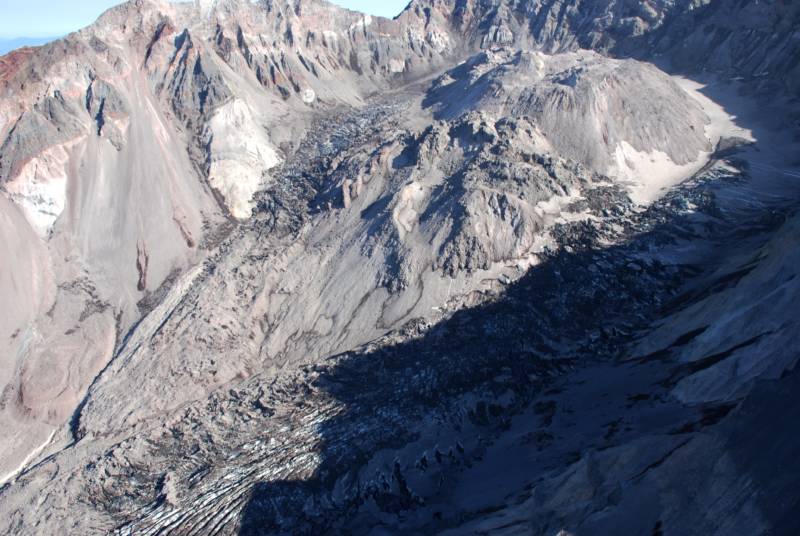
Crater Glacier on Mount St. Helens in southwest Washington State is a dramatic example of a growing glacier.  The glacier formed in the shaded recesses of the high elevation crater left by the catastrophic 1980 eruption of the volcano.  USGS research hydrologist Joe Walder told us the mass of ice and rock is advancing some 300 feet per year.  This time lapse video (file will download) provided by the U.S. Geological Survey shows why glaciers are also known as “rivers of ice.”

Another view from above shows how Crater Glacier got squeezed and pushed around when Mount St. Helens reawakened in 2006 and extruded a new lava dome.  That the young glacier survived the renewed eruption is remarkable by itself.  The fact that the horseshoe-shaped glacier is gaining mass indicates just what a perfect setting Mother Nature created at the volcano.  The north-facing crater acts like a catcher’s mitt reaching toward the moist jet stream.

Mount Rainier, also in Washington State, is the most heavily glaciated peak in the Lower 48 states.  On Rainier’s east flank, Emmons Glacier is advancing. The National Park Service offers this myth-busting explanation:

“The Emmons Glacier experienced a rock avalanche in 1963, which covered part of the glacier with a layer of rock debris. This debris now insulates the ablation (melting) zone of the glacier from sunlight and warm air temperatures and the melting of the glacier is smaller than from an otherwise clean glacier. Because melting is reduced, but the ice flow is the same, the glacier is advancing. This response has nothing to do with climate change.”

Mount Shasta

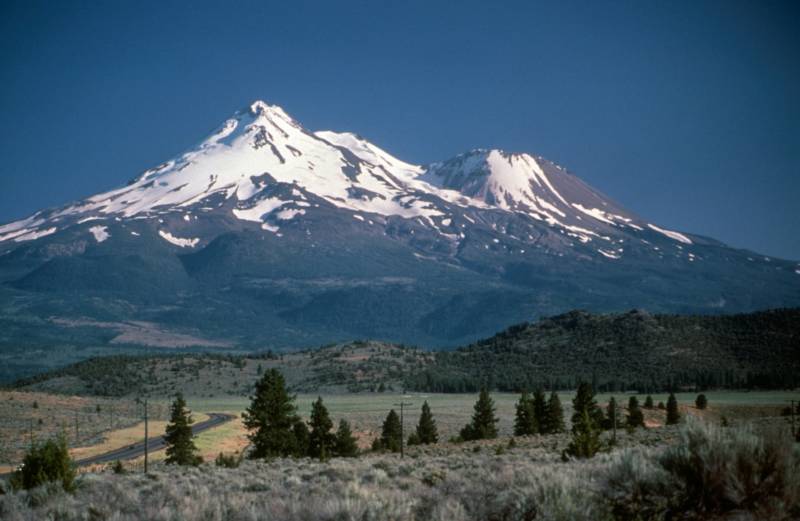
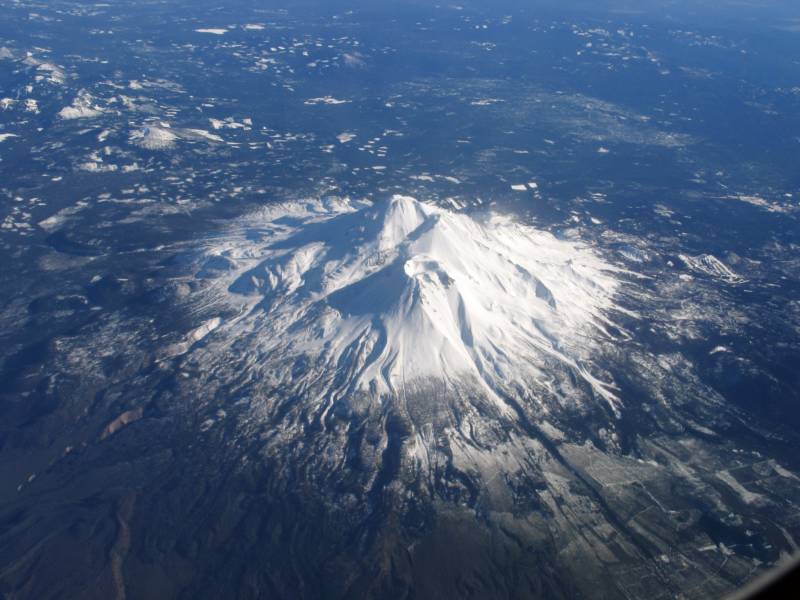
Something yet again different appears to be happening at northern California’s Mount Shasta. A research team from UC Santa Cruz documented 50 years of nearly continuous expansion of the two largest glaciers on Mount Shasta.  The researchers theorize in the journal Climate Dynamics that Shasta’s glaciers are benefiting from a warming Pacific Ocean. A warmer ocean means more evaporation, and hence more moisture blows over the high peaks near the coast.  Because of Shasta’s height, the enhanced precipitation mostly falls as snow, adding to the mass of the glaciers.

Portland State University glaciologist Andrew Fountain says no one has yet explained to his satisfaction why glaciers on peaks immediately to the north and south of Mount Shasta are not likewise growing.  It is as if a “snow gun” is aimed directly at Shasta’s 14,162-foot summit.  But he doesn’t lose sleep over that issue because Fountain and the other glaciologists who have studied Shasta do not expect the glacial advance to last.  Their climate models call for the snow level (elevation) to rise.

“We do expect it to be a temporary phenomenon,” Fountain said.  “The modeling done down on Mount Shasta expects the glaciers to retreat within the next decade or so, if they’re not already.”

Tom Banse’s radio feature on the West’s growing glaciers airs Monday morning on The California Report.

Sierra Snow: Scientists in Heated Agreement

Loot from the recent invasion of email servers at the Climatic Research Unit (CRU) in Britain has raised questions about whether scientists who dissent from the prevailing views of climate research are being muzzled by their colleagues.

Snow on Mt. Whitney. Photo: USFS

An interesting example of this arose this week in a report by Richard Harris for NPR’s All Things Considered. It’s worth a listen, if only for the back-and-forth between two climate scientists over snowfall in the southern Sierra Nevada mountains. John Christy of the University of Alabama, Huntsville, tells Harris about trouble he’s had publishing research that appears to counter the mainstream view that the Sierra snowpack is endangered. For a response, Harris goes to Philip Mote at Oregon State University, one of the scientists who reviewed Christy’s research.

Also interviewed are Gavin Schmidt of NASA and Judy Curry from Georgia Tech.

The head of the UN’s climate panel finally issued his own statement on the email flap, which was part condemnation of the hackers, part defense of the science and peer review process.

Scientists Respond Cautiously to Hijacked Email

I’ve spent several days dithering over whether to weigh in on the recent email heist from a server at the University of East Anglia in the UK. For those who choose to read it that way, the hacked email originally passed among climate scientists worldwide has, rightly or wrongly, provided those who reject the prevailing climate science with enough radioactive ammo to fill Yucca Mountain.

Some high-profile California researchers figure prominently in the material. In a searchable database of the messages, for example, the name of Ben Santer, a climate modeler at Lawrence Livermore National Lab came up 173 times. Stanford’s Steve Schneider came up 71 times. Both are outspoken defenders of science supporting the human contribution to global warming.

Another scientist quoted or referred to (99 times), Kevin Trenberth, is a name familiar to readers of this blog and listeners to Climate Watch radio coverage. Trenberth is a climatologist at the National Center for Atmospheric Research (NCAR) in Boulder, CO.  I’ve interviewed him mostly about the role of the Pacific oscillation known as El Nino in climate patterns. After the decade’s worth of email came to light, I wrote Trenberth for a response. His reply may not be entirely original. Some lines have also been attributed to a spokesman for the university whose servers were invaded. In any case, here’s Trenberth’s response to Climate Watch:

It is a matter of concern that data, including personal information about individuals, appears to have been illegally taken and a criminal investigation is underway. The selective publication of some stolen emails and other papers taken out of context is mischievous and cannot be considered a genuine attempt to engage with this issue in a responsible way. The volume of material published and its piecemeal nature makes it impossible to confirm what proportion is genuine.  Many elements have been published selectively on a number of websites. Generally the items are out of context, incomplete and very misleading. Some others are wildly misinterpreted and have a simple explanation.

The material published relates to the work of the Climatic Research Unit (CRU) and other scientists around the world.  Many of the scientists featured in the emails with [Phil] Jones [of East Anglia] have web sites and freely and openly make available their papers, presentations, blogs and other information. Several of the emails document the detailed procedures used in the IPCC AR4 Fourth Assessment report for Chapter 3 (for which Phil Jones and Kevin Trenberth were coordinating lead authors) and other chapters. They actually reveal the integrity of the process and the hard work that goes into such an assessment.

Trenberth then went on to cite some specific “examples of misinterpretations:”

From Kevin Trenberth, interpreted as a failure of computer models:

“The fact is that we can’t account for the lack of warming at the moment and it is a travesty that we can’t. The CERES data published in the August BAMS 09 supplement on 2008 shows there should be even more warming: but the data are surely wrong. Our observing system is inadequate.”

This refers to the inability of our current observations from satellites and in situ to account for where all the energy has gone. A paper on this is available here:

Trenberth, K. E., 2009: An imperative for climate change planning: tracking Earth’s global energy. Current Opinion in Environmental Sustainability, 1, 19-27, doi:10.1016/j.cosust.2009.06.001. [PDF]

This paper tracks the effects of the changing Sun, how much heat went into the land, ocean, melting Arctic sea ice, melting Greenland and Antarctica, and changes in clouds, along with changes in greenhouse gases. We can track this well for 1993 to 2003, but not for 2004 to 2008. It does NOT mean that global warming is not happening, on the contrary, it suggests that we simply can’t fully explain why 2008 was as cool as it was, but with an implication that warming will come back, as it has. In 2008 there was a La Nina event.  We now have an El Nino underway.

Kevin Trenberth

Meanwhile, the university’s Climate Research Unit has posted a series of rebuttals. Still, this digital hijacking is disturbing on a lot of levels. Whether you accept the prevailing climate science or consider the email damning evidence to the contrary, it is a distraction from the business at hand in Copenhagen and a public relations train wreck for the IPCC and many of its most eminent contributing scientists. You can bet that it won’t be forgotten when a major climate bill hits the floor of the U.S. Senate for debate, early next year. Oklahoma Republican James Inhofe, vocal critic of global warming science, is already calling for an investigation.