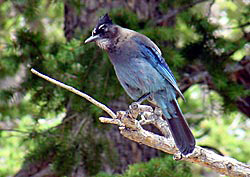
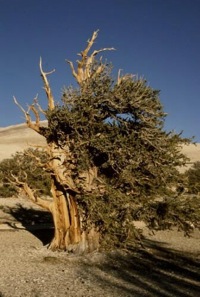
Bristlecone pine in the Inyo National Forest. Photo: US Forest Service
There’s a lot of history packed into a tree with more than 4,000 annual growth rings. Scientists who count them (dendrochronologists) have been able to learn a lot about the drought history of California and the West.
The Great Basin bristlecone pines that grow along the spine of the Sierra are the oldest living things on Earth–older, even, than the giant sequoias. Studying the uppermost trees, around 12,000 ft., researchers stumbled on a strange trend. The trees, legendary for their slow rate of growth, have been growing faster over the last 50 years or so, than at any time in the last three millennia.
If you missed it this week, Malcolm Hughes, one of the study’s lead researchers and a professor of dendrochronology at the University of Arizona’s Laboratory for Tree-Ring Research, spoke to NPR’s All Things Considered about the possible cause.
You can see these astonishing trees for yourself in the Ancient Bristlecone Pine Forest of Inyo National Forest–but you might want to wait until spring. The visitor center is not staffed between November and May and winter access is iffy at 10,000 feet. Worse yet, the original vistor center burned down in the fall of last year. The Forest Service is using a temporary (trailer) facility until a permanent one is rebuilt. According to the Forest Service website:
“…the visitor center is being designed to be a model of energy efficiency, utilizing the latest in “green” building practices. According to Bristlecone Pine Forest Manager John Louth, some of the improvements that visitors will see will be a state-of-the art solar power system, updated exhibits addressing the impacts of global warming on the ancient trees, a small research library, a slightly larger theatre room and a fire/intrusion detection & suppression system.”
A Matter of Degree is a survey of attitudes developed by Climate Watch, in partnership with Yale and George Mason Universities.
Keep emotions out of it and meet the uncertainties head-on. Those tips are among the advice offered in a new guide for climate change communicators. Published by the Center for Research on Environmental Decisions at Columbia University, “The Psychology of Climate Change Communication” is a 54-page guide available on the CRED website that attempts to help educators, journalists, and scientists communicate more clearly about the complicated, politically-charged subject of climate change. The gist? It’s not just what you say, it’s how you say it. Not that this is an earth-shattering revelation but it’s a good reminder to those tasked with conveying detailed scientific information to a general audience that might not have the time, context, or desire to fully process the message.
From the introduction:
… in order for climate science information to be fully absorbed by audiences, it must be actively communicated with appropriate language, metaphor, and analogy; combined with narrative storytelling; made vivid through visual imagery and experiential scenarios; balanced with scientific information; and delivered by trusted messengers in group settings.
This guide speaks to the messengers. Key recommendations include common-sense strategies such as knowing your audience, getting their attention, and being sure to translate scientific data into concrete experience. The guide also stresses avoiding the overuse of emotional appeals reasoning that while they may work in the short term, they could backfire down the road because people have a “finite pool of worry” and repeated emotional appeals could lead to “emotional numbing” and apathy. Most of these recommendations sound useful for all kinds of communication — not just about climate change.
One point, however, seems especially relevant to climate change; the recommendation to directly and precisely address scientific and climatic uncertainties. In other words, meet the unknowns head-on but keep them in perspective:
Climate science uncertainty often conveys the mistaken impression that scientists are hopelessly confused about this complicated subject, when in fact scientific uncertainties about exactly how much warmer the planet will be in 100 years does not change the very high confidence scientists have that human-made greenhouse gas emissions are warming the planet and are likely to continue doing so.
The guide stresses the importance of being very clear about where the uncertainties lie, because they are easy to overstate or understate, which leads to more confusion. A particularly interesting resource is Table 4: Words with Different Meanings to Scientists and the General Public. The table itself is a little confusing, but it gives recognition to the “language barrier” between scientists and “laymen,” a key to getting a clear message across.
A study published last month by the Pew Center for People and the Press found that the percentage of American adults who think that there is solid evidence that the average temperature on earth has been getting warmer over the past few decades has declined over the past year, from 71% to 57%. The proportion of Americans who say global temperatures are rising as a result of human activity, such as burning fossil fuels, shrank from 47% to 36% in the same period. It’s an indication that those who have taken on the mantle of communicating the current science can use a little help.
California’s Yosemite National Park has been scarred by several big fires in recent years—the latest contained less than two months ago. But new research affirms that this crown jewel among national parks is likely to have even more fire in its future.
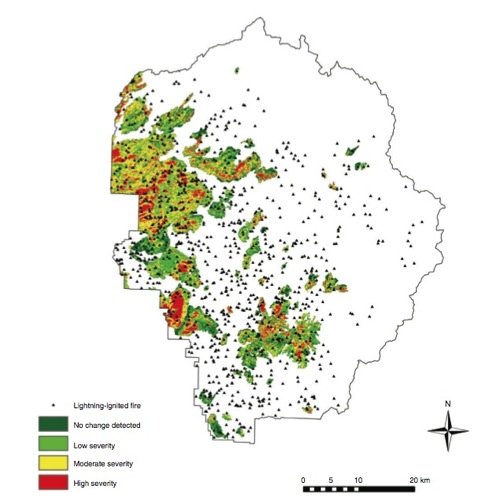
In late August, when fire crews attacked the Big Meadow Fire in Yosemite, it was hard to blame nature for the 74-hundred acres lost. That was a “prescribed burn” that got out of hand (or “escaped,” as the official report puts it). But nine out of ten wildland fires in the Sierra start with a lightning strike. Newly published work suggests that as California’s climate changes, the combination of warmer temperatures, less snow and more lightning strikes could mean 20% more fires by mid-century.
USGS research forester emeritus Jan van Wagtendonk co-authored the study with James Lutz at the University of Washington. He says they studied 20 years of Yosemite fire data to identify a trend. The mechanism starts with the oft-cited warming scenario, causing more rain and less snow at upper elevations.
“What happens in the mountains is that, as snow recedes in the spring the moisture in the fuels follows,” says van Wagtendonk. “The fuel starts drying out earlier and we extend the fire season by having more days available for fires to burn.”
But there’s another wildcard in the deck: lightning. Separate studies suggest that higher concentrations of atmospheric carbon dioxide will set the stage for more lightning strikes.
The study assumes a 17% reduction in snowpack by 2050—under the relatively modest B1 warming scenario, drawn from IPCC models. The results are in line with other climate studies that imply not just more fires, but more intense fires as the climate warms. It’s a trend, says van Wagtendonk, that has already started:
“We were able to trace, through satellite imagery, the change that we’ve seen in the severity of those fires just over the past 20 years, so it’s been obvious to us from those data that whatever temperature trends are occurring today are already having an effect on increased severity.”
“We see more of the same,” said the forester, “and a continued increase in both size, number and severity of fires.”
Yosemite fires from 1984-2005. The black triangles indicate fires sparked by lightning. Image: International Journal of Wildland Fire.
Scott Stephens, an associate professor of fire science at UC Berkeley, says lightning is changing the landscape in more ways than one.
Stephens recently told KQED’s Central Valley Bureau Chief, Sasha Khokha: “In Yosemite and Sequoia-Kings Canyon, they manage quite a few lighting fires in the wilderness area, away from people, and they allow these things to burn for months and months and months to try to allow that lighting fire to begin to shape the landscape again like it did 100 or 200 yrs ago. Those types of events probably increased the resiliency of the forest to deal with climate change and other impacts.”
Everybody’s got a summit nowadays. Last week, while the governors were doing their climate summitry in L.A., scientists and policy wonks convened at U.C. Davis for an ag-and-climate “summit.” The discussions seemed interesting and productive, despite (or perhaps because of) the fact that no world leaders appeared. This week the gods of green goop are gathered in San Diego for an Algae Biomass Summit. Climate Watch contributor and climate scientist Abbie Tingstad explains why algae deserves a summit.
The Power of Pond Scum
By Abbie Tingstad
The slimy yellowish brown muck known as “pond scum” may soon help fuel your car, make your airplane trips more environmentally friendly, and power your home. Scientists and start-ups around the world are now looking to tap into this unsightly source to produce ethanol, biodiesel and jet fuel, and even more efficient solar cells. This sustainable energy source consumes carbon dioxide and can be developed without competing with food crops for land.
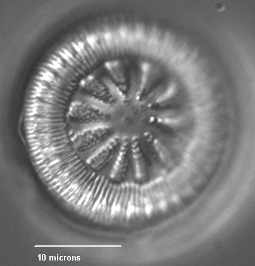
Yellow-brown pond scum is composed of diatoms; single-celled algae with elaborate silica-based cell walls (green films on water are made up of other types of algae and small water plants). These primary producers are ubiquitous: they inhabit a wide range of environments, requiring only sufficient light for photosynthesis and enough moisture to prevent desiccation. Worldwide, there may be 100,000 species living in oceans, lakes, estuaries, rivers, swamps, moist soils, and other damp environments.
Climate and environmental researchers have taken advantage of diatoms’ cosmopolitan living habits to reconstruct past climates and infer recent environmental changes related to pollution and climate warming. Since different locations tend to have unique diatom community compositions, these tiny algae have also helped forensic investigators solve crimes.
Now, diatoms and other types of algae and small aquatic plants like duckweed and watermeal might be used to generate ethanol, biodiesel, and jet fuel. A number of start-ups, such as Aurora Biofuels and SunEco Energy in California, have begun developing technologies to “farm” algae on non-agricultural land, using salt-or lower-quality fresh-water and also just happens to consume carbon dioxide. This research has seen renewed interest at large laboratories such as the National Renewable Energy Laboratory (NREL). Big private-sector players, such as ExxonMobil, Chevron, Dow Chemical, and Honeywell International, have begun investing in research as well.
Diatoms may also be able to make solar cells more powerful, according to recent research out of Oregon State University and Portland State University. Unlike more conventional silicon-based cells, dye-sensitized solar cells, which absorb photons on a dye molecule thin-film joined to a layer of titanium oxide on glass or plastic, are made from environmentally neutral materials and work well in lower light conditions. Using diatoms to coat the dye-sensitized solar cells could triple their efficiency, making them more competitive with silicon cells.
These diatom-based technologies are still in their infancy so it’s difficult to determine whether they’ll make a meaningful contribution to a new wave of renewables. However, California may well benefit if they do become more widespread because these can potentially be operated on dry land and, in the case of fuels, using salt water.
With these technologies still in their infancy, it’s not clear how soon, if ever, they’ll become widespread. However, with its surfeit of sunshine and lots of available desert land and access to saltwater, California stands to benefit from an algae boom, should investors wade in.
Abbie Tingstad is finishing her Ph.D. in the Department of Geography at UCLA, where she specializes in the analysis of tree-rings and diatoms (environmentally-sensitive unicellular algae) to infer information about climate and environmental change.
Behold the power of pond scum in the recent television segment produced by KQED’s Quest.
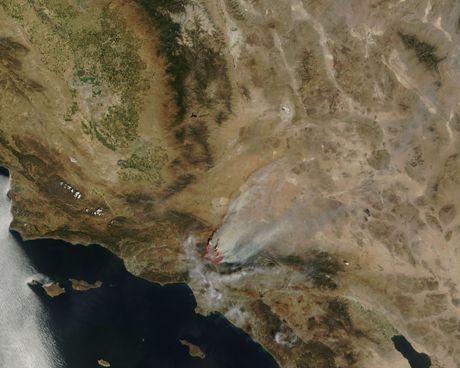
Earlier this week I got an email from a colleague in Boulder, Colorado, remarking on the crimson sunsets and brown haze that had settled across the Front Range, apparently caused by drifting smoke from California’s wildfires. At that point the Station Fire complex in Los Angeles County had already charred nearly 150,000 acres.
Smoke fans out from L.A. fires this week. Clickable image: NASA
My colleague Dan Brekke, an ardent watcher of elemental stuff like water and fire, featured a map of the spreading haze in his personal blog.
By Wednesday evening Brekke relayed that flames had consumed an area about the size of Chicago (and no, he couldn’t resist the low-hanging Mrs. O’Leary reference). With less than 30% containment, smoke had spread over about three-quarters of the state. Beyond California, NOAA had tracked the plumes “northward and eastward…across southern Nevada, Utah, Colorado, and Kansas.”
“Joe Ramey, a meteorologist with the National Weather Service in Grand Junction, said that a high-pressure system is continuing to pump smoke from several California fires and 17 fires currently burning in Utah into the state. He said a fire near Nucla in south-central Colorado also may be contributing to the haze…Most of the smoke, however, is being generated by the 190-square-mile fire burning near Los Angeles, he said.”
Atmospheric scientists classify smoke as an “aerosol” (any airborne particulate matter), which has a complicated set of feedbacks on the climate. For instance, aerosols encourage cloud formation and clouds have both positive and negative feedback effects on global warming. But it’s clear that smoke plumes generate greenhouse gases and also carry toxic air pollutants such as carbon monoxide.
Briefing journalists last month at the National Center for Atmospheric Research (NCAR)–in Boulder, no less–atmospheric chemist Gabriele Pfister said that wildfires have multiple effects on the atmosphere. They “disturb the carbon cycle,” interfering with energy exchanges and generating greenhouse gases. Itinerant smoke can generate ozone pollution far from the initial fires. This presents a challenge for local regulation of “ground-level” ozone, since it’s often likely an import from distant fires.
Climate change has California’s birds on the move, but not in the usual direction or at the same pace, a new study has found. Research suggests that warming temperatures and changing precipitation patterns will cause bird species distributions to shift independently, resulting in new bird “communities” appearing in up to half the state.
In some cases, these new communities will create combinations of birds that have never existed before, a situation that could disrupt the delicate balance of species interactions with potentially unanticipated consequences for whole ecosystems, the report authors concluded.
One of the co-authors, Stanford biologist Terry Root, told Climate Watch: “This will not be just a few species in a few locations–this tearing apart of communities could be quite extensive across California.”
The study authors, including Terry Root of Stanford and Diana Stralberg and John Wiens of PRBO, write that the emergence of new bird communities in the coming decades present enormous conservation and management challenges. They assert that rapidly changing habitats and ecological communities are going to require new approaches to conservation and management. “As new combinations of species interact, some species will face new competition and/or predation pressures, while others may be released from previous biotic interactions,” they wrote. “Managers and conservationists will be faced with difficult choices about how, where, and on which species to prioritize their efforts and investments.”
Root pointed to experience with wolves, coyotes and foxes, in which wildlife managers tried to control one, only to see unexpected spikes in the population of another: “Here is a community of only 3 canines to which we purposely forced changes, and we had two big surprises. Now we are talking about 70 species of birds shifting without any control of the force or the species being changed. I guarantee there will be a lot of surprises.”
Increasingly warmer temperatures in the Central Valley could pose a serious threat to California’s fruit and nut crops in the not-too-distant future, according to a new study out of UC Davis. The study finds that winter chill, which is an important factor in the productivity of tree crops, is likely to decrease by more than 50% by 2100, making the region less hospitable for crops like walnuts, peaches, plums, and cherries, unless changes in growing techniques are adopted.
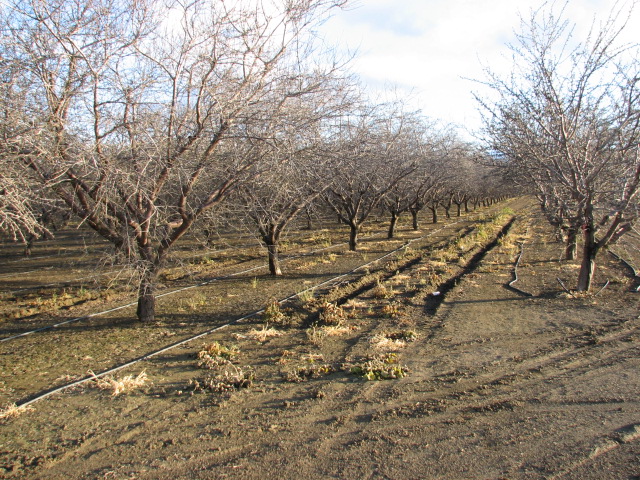
Almond trees in winter, Photo by Sahsa KhokhaTree crops go dormant in the winter when temperatures drop to a certain level for a certain period of time. Each crop then needs a certain number of ‘chilling hours’ – between 32 and 45 degrees Fahrenheit – in order to break dormancy and resume growth.
If crops don’t recieve their specific chilling requirement during the winter, problems arise. Flowering time is disturbed, which could be devastating for crops such as walnuts and pistachios that depend on simultaneous male and female flowering for pollination. And if crops don’t recieve enough winter chill to go dormant in the first place, they will continue producing buds and sprouting branches, but they may not yield fruit, having dire consquences for California’s $7.8 billion fruit and nut industry, explained study author Minghua Zhang.
“We hope that people will take this study as a wake up call,” said Zhang. “Crops are going to be seriously impacted.”
Zhang and her fellow reaserchers found that in certain parts of the Central Valley, winter chill declined by nearly 30% between 1950 and 2000. They expect that the decline will be 60% by 2050 and 80% by the end of the century.
“There is a problem coming up that we need to prepare for,” said Eike Luedeling, another of the study’s authors. “So far low chilling requirement haven’t even been a breeding goal, but we are going to need a long-term strategy to cope with this.”
The researchers found that by 2000, winter chill had declined to the point that only 4% of the Central Valley was suitable for growing apples, cherries, and pears, down from 50% earlier in the 20th century. They predict that by the end of the century, the region might no longer be suitable for growing these crops as well as walnuts, pistachios, peaches, plums, and apricots. Crops like almonds and pomegranates will most likely be affected the least, as they have low winter chill requirements.
Warm water patterns in the Pacific during normal (upper) and El Nino (lower) years. The lower image is from 1995-96. Image from NASA
Scientists with the National Oceanic and Atmospheric Administration today confirmed what many had pretty much surmised: El Nino is back.
Officially the El Nino Southern Oscillation (ENSO), the cyclical pattern of ocean conditions has broad implications for weather and the Pacific food chain.
“NOAA expects this El Niño to continue developing during the next several months, with further strengthening possible. The event is expected to last through winter 2009-10.”
NOAA’s Climate Prediction Center suggested about a month ago that conditions were right for the return of El Nino.
More recently, the high incidence of underweight sea lion pups turning up along the California coast was taken by some as a harbinger of ENSO. During El Nino cycles, normal upwelling of deep, cold water slows down, essentially shutting down the “food elevator” for many species.
Of course, there can be an upside. According to NOAA:
“El Niño’s impacts depend on a variety of factors, such as intensity and extent of ocean warming, and the time of year. Contrary to popular belief, not all effects are negative. On the positive side, El Niño can help to suppress Atlantic hurricane activity. In the United States, it typically brings beneficial winter precipitation to the arid Southwest, less wintry weather across the North, and a reduced risk of Florida wildfires.”
Links to climate change are less clear. Some scientists have suggested that warming air and sea temperatures might bring about more and longer El Nino events.
I thought the highlight of my trip to Point Reyes last week would be the cows grazing on spectacular cliffs covered with yellow lupine. I was visiting a historic dairy there for an upcoming story on crashing milk prices.
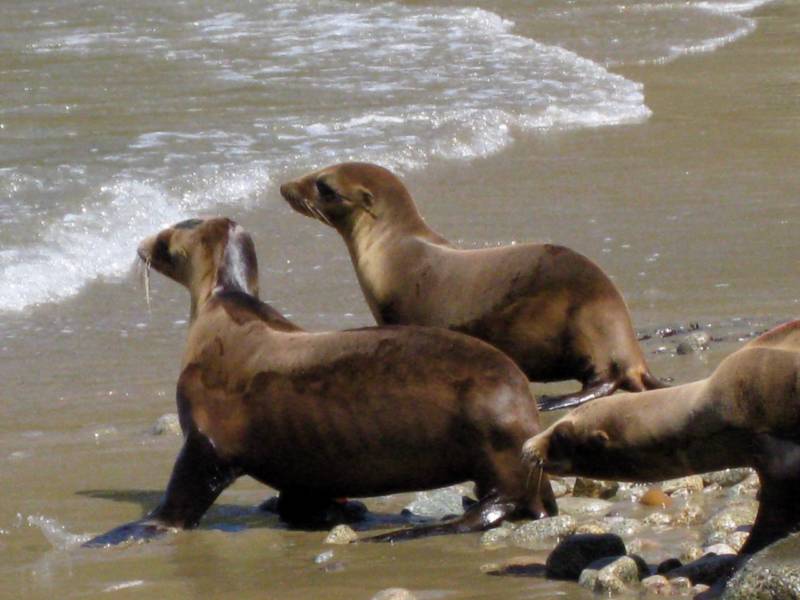
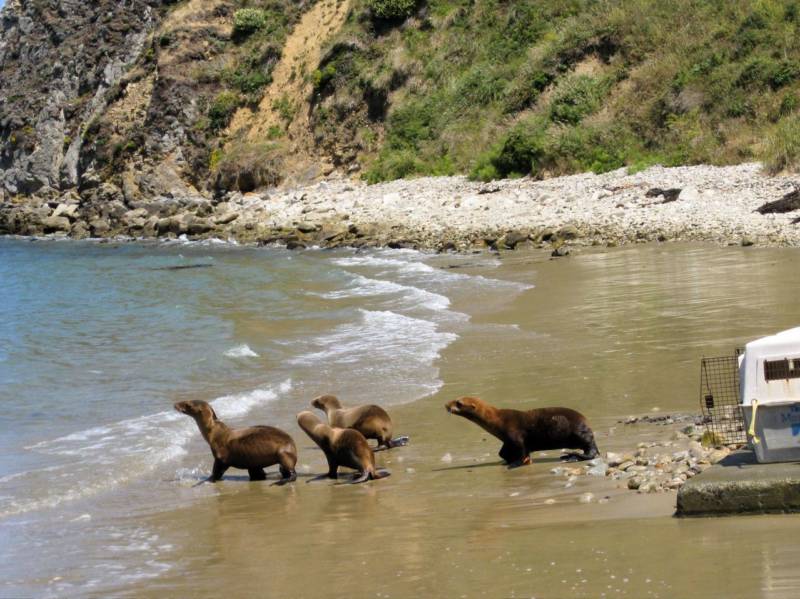
But then I noticed a white van marked “rescue” driving down to a dock near the Pt. Reyes lighthouse, and decided to follow it. Turns out, I stumbled upon an incredible scene: rescue workers releasing baby sea lions and elephant seal pups back into the waves.
Volunteers lugged what looked like over-sized pet carriers out of the van and slid them onto a cement boat dock. Then a trio of sea lion pups poked their heads out, sniffed the salt air, and flippered their way across the cement and into the water, playfully nuzzling each other.
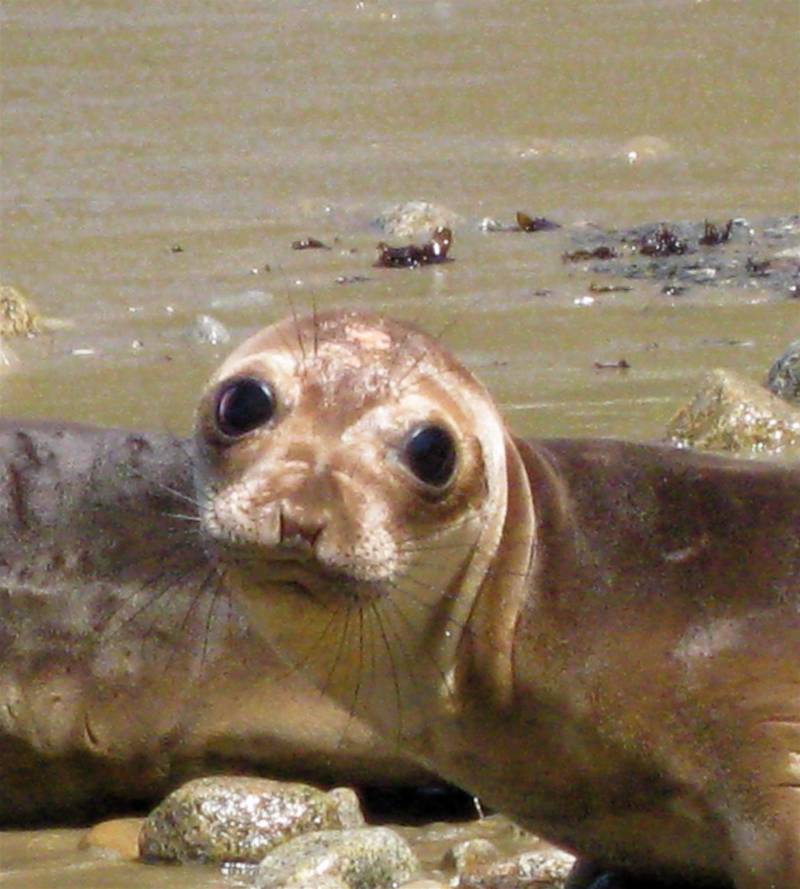
They seemed exhilarated–but thin. These pups had been rescued near Monterey, revived in the Marine Mammal Center’s Sausalito hospital, and were now healthy enough to return to the ocean, though you could still see their rib cages poking through their fur.
The sea lions swam out quickly but the elephant seals were a little more sluggish. One pup kept swimming back toward the humans, begging for fish. Then a giant female came out of the waves, perhaps offering herself as an adoptive mom, nudging the baby into the water.
Jim Oswald of the Marine Mammal Center (MMC) says the staff is seeing an unprecedented spike in rescue calls. In just the first two weeks of June, nearly 1,300 people phoned in, worried about stranded sea lions and other mammals. Most of them are malnourished sea lions who can’t seem to find enough anchovies, herring, or sardines to snack on.
Researchers aren’t quite sure why–but haven’t ruled out some kind of climate connection. The MMC is reporting its findings to the National Oceanic and Atmospheric Administration (NOAA) to try and figure out the cause. Possible El Nino Conditions? Warming oceans sending schools of smaller fish northwards? No one quite knows at this point.
“If it’s a climate change variable, that’s going to affect the fish the animals feed on,” says NOAA Wildlife Biologist Joe Cordaro. “That could be a very long temporary shift in the bait fish distribution, or it could be long-term depending on how severely climate change affects the surface temperature of the ocean.”
But Cordaro says at this point, the sea lion strandings are “one big puzzle,” with climate change as just one possible factor. We could simply be witnessing a high-birth year for sea lions, with a lot more pups than usual, or early signs of a returning El Nino weather pattern. Meteorologists won’t know until the fall whether California actually meets the criteria for a strong El Nino year. If so, Cordaro predicts “things are going to get a lot worse for the sea lions this fall and next spring.”
Regardless of the cause, the MMC’s Oswald says it’s cause for concern.
“These young sea lion pups get to the point where they’re so weak, they end up on the land and they’re too weak to go back,” Oswald explains. “It’s easier for them to waddle along, hoping they’ll find another waterway where they can find some food. They’re using up all their reserves if they stay out in the ocean.”
Stranded sea lion pups have even turned up on Bay Area freeways. Last week, rescuers found one on the 880 freeway in Oakland.
“His name is Fruitvale,” reports Oswald, “for the district in Oakland he was rescued from. He seems to be doing okay. He’s still being tube fed. I’m told from veterinarians that he’s feisty, moving around, and nippy, which is a good sign.”
The Marine Mammal Center’s Sausalito headquarters lets visitors watch volunteers in action. There’s an interactive exhibit with a sea lion on a gurney, where you can see its x-rays and test results. You can watch volunteers prepare fish meal, or even witness a post-mortem in the necropsy room.
Sounds grim, but until sea lion pups start finding more fish to eat–and humans start to figure out what’s causing the food chain to collapse, the Marine Mammal Rescue Squad plans on a very busy summer. Sasha Khokha is chief of KQED’s Central Valley Bureau and a frequent contributor to Climate Watch.
Just in case you can’t get enough climate science these days, public radio outlets doled out double-dose today.
Two recent climate studies were highlighted on KQED’s Forumprogram today. Host Dave Iverson invited me to join him, along with UC Berkeley researcher Inez Fung, author of a new study on seasons shifting from rising temperatures, and Phil Van Mantgem, who led a new USGS study on the alarming rise in tree mortality across the western U.S.
Podcasts of both programs are available at their respective websites (linked above).
This coming week, we’ll begin our two-part series on methane’s contribution to global warming. Part One airs on The California Report on Monday morning, followed by Part Two a week later. Part One examines where methane comes from and why regulators are looking at it with new concern. In Part Two, we’ll visit a dairy farm near Modesto, where methane from cow manure is being captured and turned into electric power and steam–but not without considerable expense and frustration with regional air & water quality regulators.

 The Power of Pond Scum