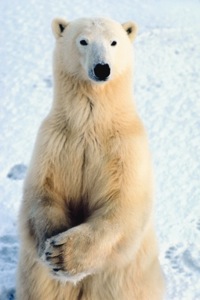
 A recent post I wrote to highlight a radio discussion of the current plight of polar bears, drew a challenge from Russell Steele, one of our regular readers. Steele questioned some of the scientific conclusions underlying dire predictions for the bears.
To help sort some of this out, I asked for responses from two highly regarded scientists in the field. Here’s a response to the specific reader challenge from Mark Serreze, Director of the National Snow & Ice Data Center, in Boulder, CO:
It is unclear what Mr. Steele is trying to get at with reference to the seasonal cycles in sea ice extent from the AMSR-E data. The AMSR-E data, while valuable, only go back to 2002. Through combining SSM/I and SMMR satellite data with other information sources for earlier years, we have a decent record of Arctic sea ice extent going back to the early 1950s. The relevant issue is the long-term decline in end-of-summer (September) ice extent evident in this record, with the extreme September minima of recent years (represented in the short AMSR-E record) serving as exclamation points. The observed rate of September ice loss exceeds expectations from nearly all climate models.
I also turned to Waleed Abdalati. Now director of the Earth Sciences Observation Center at the University of Colorado, Abdalati is a veteran of the Cryospheric Sciences and Terrestrial Hydrology programs at NASA, and one of the most articulate people I’ve heard speak on the subject of polar ice. He offers the following:
I am not an expert on polar bears, but I do think it is safe to say that their primary habitat, the Arctic sea ice, is severely threatened. I, and most of my colleagues believe we are well on our way to an ice-free Arctic in summer any time between this decade and the next 40 years.
This is because of two things: 1) it will be decades before the ocean has finished its response to present-day greenhouse forcing, so the impacts of what we’ve done already have not been fully realized; and 2) the loss of sea ice is self-compounding: when it starts to shrink, exposing a darker more (heat) absorbing ocean underneath, the likelihood of its continued shrinking is greater (ice melts, exposes darker ocean, absorbs more heat, melts more ice, exposes darker ocean, and so-on).
Of course the flipside of this is that as ice starts to grow, it is more inclined to grow, but against the backdrop of the increased warming, the former is far more likely than the latter. Finally, as thick multi-year ice disappears, it is replaced with thinner and younger ice that is more vulnerable to surface melt from the atmosphere, bottom melting from sea water, and being carried away to lower, warmer latitudes by ocean current and wind.
So back to the polar bears: If their habitat disappears and they are unable to hunt seals, their main source of food, they seem to stand little or no chance of survival. I am not a wildlife biologist but its hard for me to believe they as a population can sustain themselves on land and with only a seasonally-present ice cover. In some cases, the fact that they face more challenges on sea ice than in the past, has driven them to forage inland, creating the illusion in some people’s minds that their populations are increasing, because there are more sightings on land. Who knows? Maybe they’ll evolve to hibernate in late summer, when there is no ice, and hunt the rest of the year.
There is an added effect that doesn’t get much attention. There was a fascinating study by a Canadian Biologist (Ian Stirling) and a sea ice expert (Claire Parkinson) [Stirling, I., and C.L. Parkinson. 2006. Possible Effects of Climate Warming on Selected Populations of Polar Bears (Ursus maritimus) in the Canadian Arctic. Arctic 59(3): 261-275.], which suggested that the bears are also losing weight, and approaching the weights at which they have historically not been able to bear cubs. So not only is the population threatened by starvation, the ability to replenish the population seems diminished.
I don’t believe we can say anything with absolute certainty, so I, myself would not make the statement that the polar bears are doomed–but I will say that the outlook for them, in my view, looks very, very bad.