Category Archives: The Science

Latest research from the field and the lab

Geoengineering Report: Could Work, Go Slowly

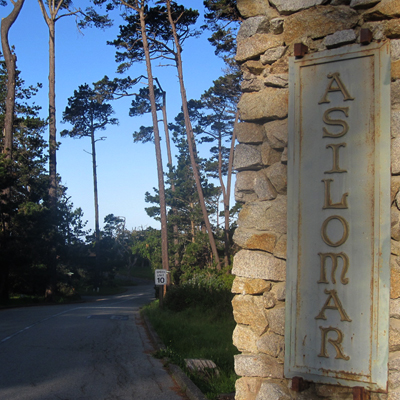
Photo: Gretchen Weber

More research is essential to determine whether or not geoengineering is a viable approach for addressing climate change, according to the final report from a spring geoengineering conference at Asilomar.

Today’s report, stemming from a week-long conference of scientists in March, states that:

“Without an aggressive pursuit of a multi-faceted global response strategy to limit and and then reverse climate change, the environmental consequences will be severe, with concomitant social costs that are likely to lead to widespread suffering in the most affected regions.”

The types of technologies discussed at the conference included intervention strategies that attempt to remove carbon from the atmosphere such as ocean fertilization, as well as those that attempt to mitigate the effects of climate change by blocking sunlight to reduce warming, such as spraying sulfur aerosols into the atmosphere or increasing the reflectivity of clouds with sea water. The Asilomar report suggests that:

“If research demonstrates that such approaches could be effectively and responsibly deployed, they could contribute a bridging strategy that would have the potential to moderate climate change and at least some of its impacts until sharp cuts in emissions return atmospheric composition and climate change to much lower levels.”

Of course, that’s a big “if.” Continue reading Geoengineering Report: Could Work, Go Slowly
Center to Study Climate Impacts on Ocean

Federal officials this week launched a new climate change research center, designed to be a hub for studies on the impacts of climate change on the San Francisco Bay and coastline.

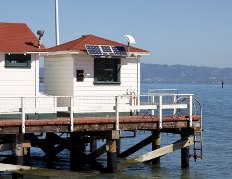
The tidal gauge off of San Francisco's Fort Point is the oldest in North America.

The Ocean Climate Center is housed in a collection of century-old military buildings on the edge of the Bay at Crissy Field. It couldn’t be a more picturesque — and critical — location. Adjacent to the oldest tidal gauge in North America, the center will allow cash-strapped federal agencies to pool resources into climate change research and work with natural resource managers to combat negative impacts on the marine ecosystem and communities along the coastline. Continue reading Center to Study Climate Impacts on Ocean

Arctic Tipping Points Affect World Climate

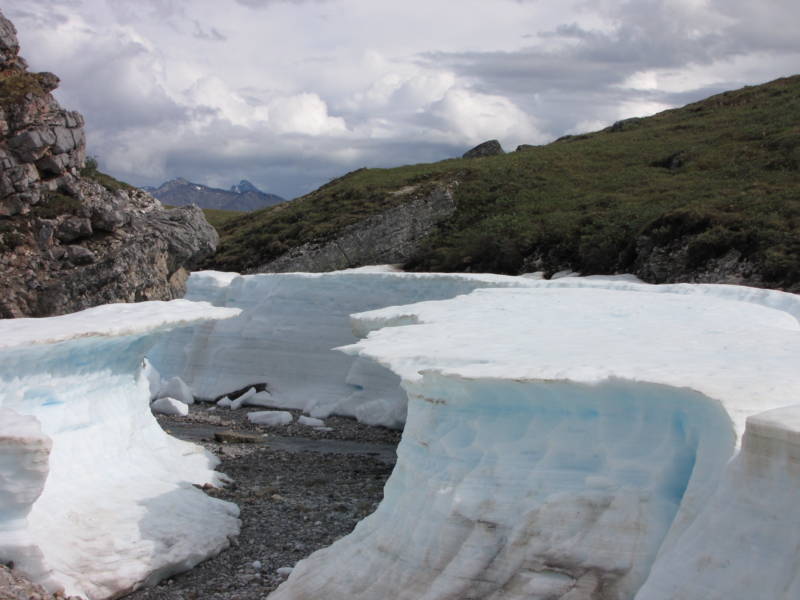
The Arctic is warming, and what happens there has consequences for California.

Take in the companion radio feature and slide show at The California Report weekly magazine. Gretchen’s slide show also appears below.

Photo: Gretchen Weber

During the two weeks I spent in the Arctic at Toolik Field Station this summer, there was a lot of talk about positive feedbacks and how what happens in the Arctic can affect the entire planet. Thawing permafrost, which I explore in my radio piece for The California Report, is cause for some of the greatest concern.

Another is the loss of sea ice. Mean summer temperatures in the Arctic have risen about three degrees Fahrenheit since 1960, and summer sea ice is shrinking more than 11% per decade.  This year ranks third for the minimum Arctic summer sea ice extent since satellite record-keeping began in 1979.   2007 and 2008 hold the records, and 2009 is in fourth place. Continue reading Arctic Tipping Points Affect World Climate

Candidates Question Climate Science

Third-party candidates for governor call the science of global warming “junk science” and “a scam at worst.”


Photo: Craig Miller

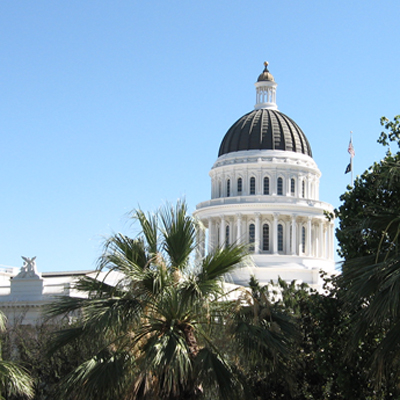
While Meg Whitman and Jerry Brown debate the pros and cons of the state’s global warming law (AB 32) and the ballot initiative that would suspend it (Proposition 23), two of the four “alternative” candidates interviewed this morning on KQED’s Forum program, attacked the science behind California’s climate change policy.

“I’ve become convinced that the whole thing is an exaggeration at best, and a scam at worst,” said Dale Odgen, the Libertarian Party candidate.  “The science has been fudged in order to get grants for people.  People like Al Gore have used it to become even more wealthy at the expense of the rest of us.” Continue reading Candidates Question Climate Science

California Heats Up

A chilly summer suddenly switches to record-breaking heat in much of California.  Is this climate change?

Photo: Craig Miller

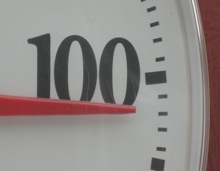
It reached 113 degrees in Los Angeles on Monday, a record. And while a string of hot days in California doesn’t signify climate change any more than do record snowstorms in Washington D.C., the summer of 2010 did set quite a few records for high temperatures and heat waves. Although for us here in California, this week notwithstanding, we’ve had a pretty cool summer.

But this week’s heat — especially in Southern California — is a reminder of the ripple effects that could become commonplace if predictions of more frequent and severe heat waves come to pass, with a changing climate. Utilities pleaded with customers to conserve power as temperatures triggered record spikes in the electricity load and subsequent strain on the electrical grid. Continue reading California Heats Up

The Science of Reconstructing Past Climate

To find out what tree rings are telling us about droughts in the Colorado Basin, and to get some current perspective on the current eleven-year drought in the region, listen to my radio story for The California Report and view the slide show of my journey to the region. — Gretchen Weber

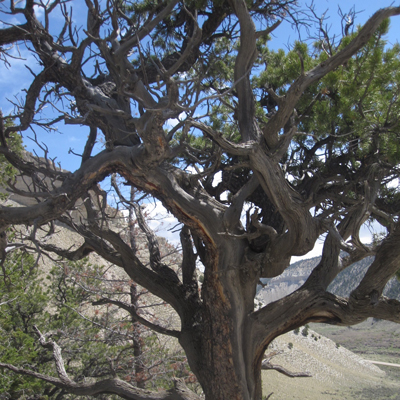
With cores from trees like this one, TIngstad was able to reconstruct more than 1,000 years of climate history in this region.

Abbie Tingstad is a paleoclimatologist whose doctoral work at UCLA involved reconstructing climate in the Upper Colorado River Basin, using tree rings and lake sediments.

By Abbie Tingstad

Unlike biology, chemistry, or most mainstream sciences, it’s hard to envision what someone who studies paleoclimatology actually does. I run into a lot of blank stares at dinner parties. So I’ve started describing the field as “climate forensics.”

Paleoclimatology and forensics of the Law & Order or Bones variety share the basic goal of reconstructing something that has happened in the past. In the latter, of course, the sequence of events that led to a crime is put together. In the former, researchers identify past variations in climate.  These sciences also have quite a lot in common when it comes to the basic methodology: Continue reading The Science of Reconstructing Past Climate

A Tale of Two Coasts: The East Roasts While the West Shivers

By Andrew Freedman

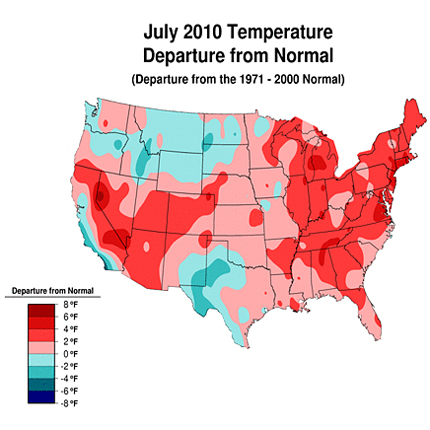
People along the West Coast from Seattle to San Diego, who have shivered through an unusually cool summer, can be forgiven for being just a little bit jealous of residents of the East Coast, where warm temperature records have repeatedly been smashed this summer. During June, July and part of August as well, it seemed that many coastal areas of the West were missing out on summer entirely.

Continue reading A Tale of Two Coasts: The East Roasts While the West Shivers

Climate News Roundup

A few items in the climate news that caught our eyes this week…

1. CEC approves 250-megawatt solar thermal project in Kern County
The California Energy Commission approved the Beacon Solar Energy project on Wednesday. It’s the first time in 20 years that state energy regulators have approved construction on a solar thermal farm, the Los Angeles Times reports.

2. Geoengineering won’t curb sea-level rise, study finds
A new report from the Proceedings of the National Academy of Sciences finds that geoengineering strategies to combat global warming by blocking the sun’s radiation would not have much of an impact on rising sea levels, unless the efforts are extremely aggressive. (Read more at Nature.com)

3. Earth’s plant growth fell due to climate change, says NASA
After 20 years of increasing growth under warming temperatures, the Earth’s vegetation   saw a slight decrease over the last decade, according to a new NASA analysis.  Scientists reported they were surprised to find that the negative effects of regional droughts outweighed the positive influence of a longer growing season.

4. Another hurdle cleared for the world’s largest solar farm
Federal regulators are one step closer to approving plans for the 1,000 megawatt plant proposed by Oakland-based company Solar Millennium LLC.  The project would be located across more than 7,000 acres in Riverside County. (Read more at The New York Times.)

Rebuilding a Buffer Against Climate Impacts

Hear our radio feature on wetlands restoration in San Francisco Bay, to be aired Friday afternoon on The California Report.

As my colleague Paul Rogers reported this week, earth has begun to move in the biggest wetlands restoration ever undertaken on the West Coast. This week I took a brief tour of the Eden Landing Ecological Reserve, near Hayward.

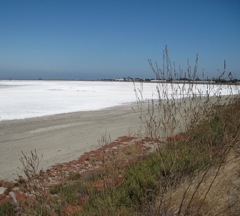
What is and what will be: Hundreds of acres of salt evaporation ponds, in the background, are being restored to tidal wetlands, as seen in the foreground of this scene from Eden Landing in Hayward. (All photos: Craig Miller)

Scanning much of the scene, “Eden” wasn’t exactly what came to mind. Vast, white expanses of salt and gypsum deposits are more reminiscent of Utah than a bay estuary. These are the remnants of a once booming salt harvesting industry.

But fueled partially by federal stimulus funding, bulldozers and backhoes are now reshaping levees there as part of the larger South Bay Salt Pond Restoration Project, which will eventually return 630 acres of abandoned salt flats into tidal wetlands at Eden Landing, and thousands more in an arc around the south end of San Francisco Bay. Continue reading Rebuilding a Buffer Against Climate Impacts

Clean Energy from Below

UPDATED with interactive map

Hear my radio feature on geothermal energy and the rest of a five-part collaboration on renewable energy between NPR and KQED, on NPR’s Morning Edition.

It may be a distant second to California now, but Nevada is making a run to become the nation’s largest producer of geothermal energy.

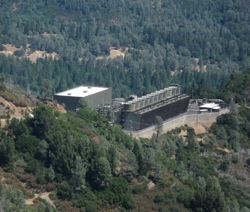
A conventional geothermal power plant at The Geysers complex in Lake County. (Photo: Craig Miller)

California still produces an estimated 80% of the nation’s geothermal power (used to produce electricity*), with more than 40 plants online. But according to a summary from the Geothermal Energy Association (GEA) this summer:

“Nevada could become the leading geothermal energy producer in the coming years if growth and production trends continue on their current trajectories. Nevada’s 86 planned or developing geothermal power plants have the potential add up to 3,686.4 Megawatts of geothermal power to Nevada’s energy portfolio, power for 2.6 million homes – enough to meet the electricity needs of 100% of the homes in the Las Vegas metropolitan area.”

GEA describes 14 Nevada projects as being “in latter stages of development.” Meanwhile, says the group’s executive director, Karl Gawell, development in California is slowing down. “Everything’s relative,” Gawell told me in a phone interview. “Projects are moving forward in California, they just take longer.” Continue reading Clean Energy from Below