Category Archives: The Science

Latest research from the field and the lab

Heat Records Set in 17 Countries — So Far

This post also appears at Climate Central, a content partner of Climate Watch.

By Andrew Freedman

California’s freakishly cool summer has been bucking a global trend this season. You’ve seen the headlines from Moscow and Pakistan–but that’s just part of the story. 2010 has featured several extreme heat events, as well as record flooding, in many countries worldwide. The number of countries that have set new national records for the warmest temperature recorded — 17 — would beat the old record of 14, provided that all of the new records are verified by meteorological agencies. According to meteorologist Jeff Masters of the private weather forecasting firm Weather Underground in Ann Arbor, Michigan, the countries that have set new records thus far this year comprise about 19 percent of the earth’s surface area. Continue reading Heat Records Set in 17 Countries — So Far

From Russia: More Heat, Less Wheat

This post also appears at Climate Central, a content partner of Climate Watch.

By David Lobell

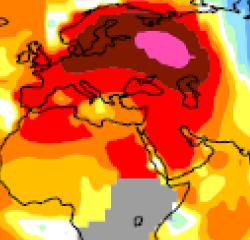
The heat wave in Russia has captured international media attention, breaking temperature records left and right (see figure below). It has also captured the attention of commodity traders. In a typical year Russia produces about as much wheat as the United States, and is among the top exporters of wheat flour in the world. But this year, wheat has been decimated in the areas around Moscow, with yield expected to be 30 percent or so below normal. This week Russia announced they are banning all exports of wheat from August 15 through the end of the year. Since late June, wheat prices on the Chicago Board of Trade have risen by 50 percent, to more than $7 a bushel. Continue reading From Russia: More Heat, Less Wheat

Annual Climate Report Shows a Warming World

This post also appears at Climate Central, a content partner of Climate Watch.

By Alyson Kenward

Global temperatures continued to increase in 2009, and atmospheric greenhouse gas levels also rose, according to a new “State of the Climate Report” from the US National Oceanic and Atmospheric Administration (NOAA). The report, released today as a supplement to the Bulletin of the American Meteorological Society, offers a detailed look at last year’s major weather and climate events, and reviews long-term global climate trends. Overall, it paints a picture of a world that continues its long-term warming trend, albeit with considerable variability from year-to-year.

The report finds that the earth warmed more last year than in the preceding two years, and reiterates the conclusion that the first decade of the 21st century, 2000-2009, was the warmest decade on record, both at the earth’s surface and in the lower atmosphere.

The State of the Climate report attributes many of the significant weather and climate events of 2009 to natural variability. For example, the return of El Niño, a periodic cycle of ocean warming in the tropical Pacific which influences global weather patterns, helped increase global temperatures. It states that El Niño may account for much of last year’s global increase in temperature compared to 2008 — about 0.1 degrees Celsius warmer in 2009.

“Global surface temperatures in 2009 saw a return to near-record levels as the cooling in the tropical Pacific associated with the 2007/08 La Niña event gave way to strengthening El Niño conditions in 2009,” the report states. The average global land and sea surface temperatures for 2009 was about 0.5 degrees Celsius warmer than the average between 1961-1990.
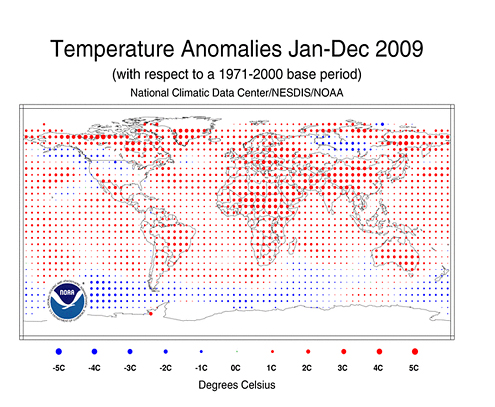

Surface temperature anomalies, Jan.-Dec. 2009. Click on the image to
see a larger version. (Source: NOAA/NCDC)

The abundance of warmer-than-normal water in the Pacific also contributed to the most active storm season there since 1997, while the Atlantic saw a relatively quiet season in 2009.

While NOAA publishes its State of the Climate reports annually, the 2009 version differs from previous years with its focus on a specific series of climate change indicators, such as global average air and ocean temperatures and ocean heat content. Tracking this group of metrics illustrates the long-term trends that are the hallmarks of climate change.

“For the first time, and in a single compelling comparison, the analysis brings together multiple observational records for the range of carefully selected indicators we would expect to change with surface temperatures,” said Dr. Peter Thorne, a co-author of the report and climate scientist at North Carolina State University, in a press release.

Examples of climate indicators investigated by NOAA:

  • Air temperature over land
  • Air temperature over sea
  • Troposphere temperature
  • Sea surface temperature
  • Ocean heat content
  • Sea level
  • Snow coverage
  • Sea ice extent

These indicators are bound to fluctuate from year to year, however. For example, the last decade may have been the warmest on record, but 2009 was not the hottest year ever recorded (though it managed to tie 2006 for the fifth spot since instrumental measurements began in the 1850s). Furthermore, 2009 saw a slight recovery in the extent of Arctic sea ice.

But when each year is lined up next to all the preceding years, NOAA said, these short-term variations are small compared to the clear and significant long-term warming trend.

“Despite the variability caused by short-term changes, the analysis conducted for this report illustrates why we are so confident the world is warming, ” said Dr. Peter Stott, a co-author of the new report in a press release. Stott is the team leader of the Climate Monitoring and Attribution group of the United Kingdom’s Met Office Hadley Centre, which contributed to the NOAA report.

The report itself was authored by more than 300 scientists from every continent and from 160 research groups around the world.

So far, the data for 2010 shows no let-up in sight for warmer than average global temperatures. As this summer drags on, the planet has already recorded its warmest year-to-date, with several record-breaking heat waves in the US, Asia and the Middle East. Along with April and May, June was the hottest such month on record worldwide.

With this year already off to a hot start and on a pace to surpass 2009 in terms of global temperature averages, Stott says the long-term trend sends a clear message: “When we follow decade-to-decade trends using multiple data sets and independent analyses from around the world, we see clear and unmistakable signs of a warming world.”

In addition, the report responds to questions during the past year from critics of climate science who have questioned the veracity of the surface temperature record. “Globally averaged surface temperature anomalies are shown to be robust given the close agreement between independently-derived datasets and strong corroborative evidence across a wide range of other climate variables,” it states, adding that the conclusion that the world is warming does not rest solely upon surface air temperature records. Evidence that the oceans are storing greater amounts of heat, sea levels are rising, atmospheric humidity is increasing, and land and sea ice is melting all point to a warming climate as well.

“If the land surface records were systematically flawed and the globe had not really warmed, then it would be almost impossible to explain the concurrent changes in this wide range of indicators produced by many independent groups,” the report states.
Another Climate Change Impact: Smog

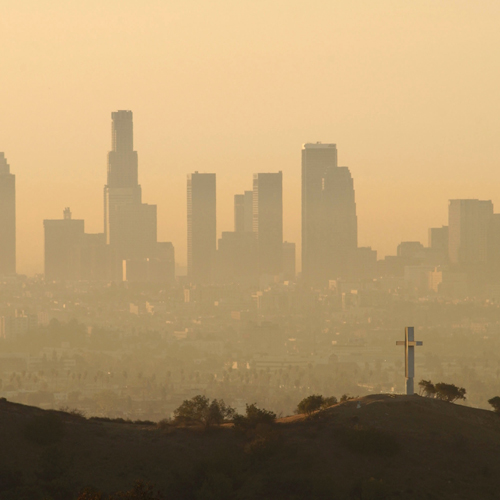
Los Angeles cloaked in smog shortly after sunrise. (Photo: David McNew/Getty Images)

Air pollution, already a problem for much of central and southern California, will get worse as temperatures warm, according to a new report from scientists at UC Davis and UC Berkeley.

By mid-century, trouble spots like the Central Valley and Los Angeles could experience between six and 30 more days per year when ozone concentrations exceed federal clean-air standards, depending on how much temperatures rise, and assuming that pollutant emissions in the state remain at current levels, the scientists project. Continue reading Another Climate Change Impact: Smog

The Next Frontier: Artificial Photosynthesis

The ultimate model for clean fuels? (Photo: KQED QUEST)

Amidst all the fretting over the development of solar and wind technology, it hasn’t been lost on some scientists that there are organisms on the planet that have already cracked the renewable energy code: plants.

Photosynthesis is a highly efficient way of converting sunlight to fuel. So why not try to copy them?

Continue reading The Next Frontier: Artificial Photosynthesis

For Roofs, White Is the New Cool

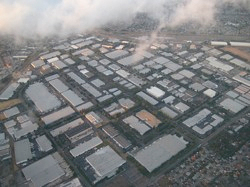
Officials at the US Department of Energy are checking their roofs for some of that “low hanging fruit” available to increase energy efficiency in buildings. A study released this week by Lawrence Berkeley National Laboratory suggests that “cool roofs” have the potential to offset up to two years worth of worldwide CO2 emissions and reduce the effects of urban “heat islands.” If that’s the case, increasing the albedo, or reflectivity, of roofs and pavements might be the solution to hotter days in the city.

Flying over most California cities reveals relatively few white roofs (Photo: Craig Miller)

Continue reading For Roofs, White Is the New Cool

Schneider’s Legacy: Speaking Truth to Power

There’s been much hand-wringing of late over the disconnect between science and “Main Street.” When it comes to communicating complex concepts to the general public, even many scientists admit that they haven’t been making the light bulb come on.

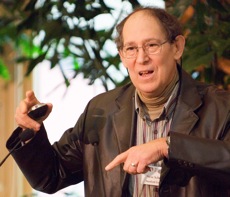
(Photo: Stanford University)

That was never an issue for Steve Schneider. He never had any problems communicating. Most colleagues of the Stanford climate scientist, who died this week, remember him not just for his science resume, but also for his laser-like approach to getting the point across. Continue reading Schneider’s Legacy: Speaking Truth to Power

Climate Science Loses a Bright Light

Shock spread through the climate science community today with the news that Stanford’s Stephen Schneider has died.

Steve Schneider was a fearless advocate of climate action (Photo: Stanford University)

Schneider reportedly suffered a heart attack on a flight from Stockholm to London. Schneider founded a scientific journal on the subject of climate change and was a vocal advocate of the need for policy action, to respond to the threat posed by global warming.

A release issued by  Stanford today reads, in part:

“Steve, more than anything, whether you agreed with him or not, forced us to confront this real possibility of climate change,” said his colleague at Stanford’s Woods Institute for the Environment, Jeff Koseff.

Schneider was influential in the public debate over climate change and wrote a book, Science as a Contact Sport: Inside the Battle to Save Earth’s Climate, about his experiences. He also wrote a book about his battle with leukemia, Patient from Hell.

He had been a White House consultant in the Nixon, Carter, Reagan, George H.W. Bush, Clinton, George W. Bush and Obama administrations.”

Schneider last appeared on KQED’s air just after the UN climate talks ended in last December, with what many considered a whimper. His disappointment was palpable as he spoke with Forum host Dave Iverson over a tenuous cell phone connection from Copenhagen (Schneider joins the program about 30 minutes in). He also made Forum appearances in programs in 2007 and 2004.

On his widely read Dot Earth blog for the New York Times, Andrew Revkin offers a personal perspective on Schneider, his work, and his bigger-than-life personality.

More Heat Waves and Health Problems Ahead

A backyard thermometer in upstate New York (Photo: Craig Miller)

I wore a wool coat to work today.  And I’m ashamed to say that last night I turned the heat on in my apartment.  San Francisco is obviously a special place, particularly in July.  And by “special,” I mean foggy, windy, and cold.  Weather.com says that it was in the 50’s last night and this morning, but I have trouble believing that.

So I found it a little bit hard to relate this morning on a conference call with journalists and scientists talking about climate change, heat waves, and public health.   It seems that much of the world beyond San Francisco has been experiencing some unprecedented heat lately.  According to NOAA, global combined surface and ocean temperatures for January through May 2010 are the warmest on record.   But in California, according to Tom Evans of the National Weather Service (NWS), so far this summer we’ve experienced pretty normal average temperatures, and that’s what the NWS Climate Prediction Center is forecasting for the rest of the summer for most of the state, he said, although the southeastern portion of the state may be in for some hotter-than-normal weather in the coming months.

On the call this morning, which was put together by the Union of Concerned Scientists, the speakers were careful to point out that one or two heat waves cannot be considered evidence for global warming, just at the snowstorms on the East Coast this winter couldn’t be used to refute it.  (This recent article in the Christian Science Monitor has more about the heat waves and changing attitudes about climate change.)

However, said NOAA climatologist David Easterling, “Warming temperatures increase the probability of heatwaves.  By the end of the century, what we currently consider a heat wave, or an extremely hot day, might become the norm.”

Warming temperatures can impact public health in a number of ways, said Michael McGeehin, director of the National Center for Environmental Health at the Center for Disease Control.

“Climate scientists predict that the U.S. will see an increase in the duration, intensity, and frequency of heat waves, and we know that heat waves are a public health disaster,” he said.  “They kill.”

And they could kill in large numbers in the centuries to come, according to a recent paper by Matt Huber of the Climate Change Research Center at Purdue.  Huber was on the call this morning to discuss his analysis, which found that if CO2 levels continue to rise over the next 200 years, hotter temperatures could make areas that are home to 50% of the world’s population uninhabitable during heat waves in the the centuries after 2100.  Problems start happening when the heat index is about 130, he said.  (A temperature of 105 degrees F with a humidity level of 50% has a heat index of 134.)

“I personally think that we’ve already committed to at least 2 degrees (Celsius) of warming, but the kind of warming we’re talking about here, which is on the order of at least 10 degrees Fahrenheit, maybe more like 15 degrees Fahrenheit, that’s something that we can still decide to avoid,” he said.  “And from our calculations it looks like we should really try and avoid that.”

And it looks like that potential warming could be becoming reality faster than some expected.  A new study out of Stanford announced today finds that “exceptionally long heat waves” could become commonplace in the United States in the next 30 years, particularly in the western US.  The study, headed up by Noah Diffenbaugh of the Woods Institute, used climate models to analyze what might happen if global temperatures rise two degrees C above pre-industrial levels by 2039. (An increase of two degrees Celsius is the limit agreed upon in the non-binding  2009 Copenhagen Climate Accord (PDF).)

The Stanford researchers found that “an intense heat wave – equal to the longest on record from 1951 to 1999 – is likely to occur as many as five times between 2020 and 2029 over areas of the western and central U.S.”

The analysis predicts during the 2030s the worst heat waves maybe be even more frequent.

It’s 57 degrees in San Francisco this afternoon, and I am wearing a winter scarf at my desk.  Despite all these grim predictions, right now it’s hard not to think that a little extra heat might be nice.

Humans and Climate, Past and Future

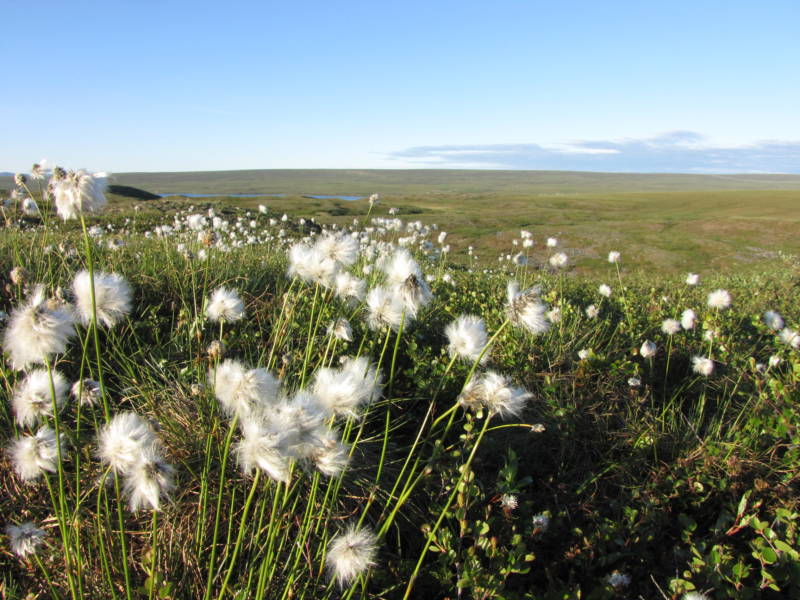
Arctic Cotton Grass, a tundra plant that may be replaced by birch as temperatures warm, studies show. (Photo: Gretchen Weber)

Two new studies out of Stanford’s Carnegie Institution for Science raise interesting questions about human influence on the future of the world’s climate and about our role in global warming thousands of years ago.

The first study, authored by Ken Caldeira and Long Cao, used models to examine the climatic effects of actively removing CO2 from the atmosphere.  What they found is that even if all CO2 emissions were magically halted, and CO2 levels in the atmosphere were instantly reduced to pre-industrial levels, the resulting drop in temperatures would offset less that half of the CO2-induced warming.

This discrepancy, the scientists say, is due to complexities in the carbon cycle.  First, as CO2 in the atmosphere drops, the ocean, which acts as a carbon sink by absorbing CO2 from the air, will release more of its stored carbon.  Second, the carbon balance on land will change, too.  As temperature and CO2 concentrations change, soils will begin to release more carbon than plants take in.

Therefore, in order for CO2 scrubbing to be effective, said Caldeira in an email, we may have to commit to it for a long time.  “To maintain atmospheric CO2 at low levels would require removing CO2 from the atmosphere as it degassed from the oceans and land surface. This process takes many decades, even centuries,” he wrote.

That revelation, “has obvious implications for the public and for policy makers as we weigh the costs and benefits of different ways of mitigating climate change,” according to Caldeira.

The second study, which has been the target of some skepticism in the blogosphere, suggests that humans may have been influencing the climate thousands of years ago, long before was previously believed.  In the paper, authors Chris Doughty, Chris Field, and Adam Wolf, all of the Carnegie Institute, propose that the extinction of mammoths 15,000 years ago, caused in part by human hunters, may have contributed to global warming by causing a change in the albedo of the land surface in the far north.  Mammoths ate birch, which kept the dark green plant in check across the grasslands of North America and present-day Russia. As the population of the large mammals declined, the authors assert, the birch spread and dominated the lighter-colored grasslands, which effectively changed the color of the landscape.  A darker land surface absorbs more heat than a light one. This in turn heats up the air, creating a positive feedback loop that encourages the spread of more birch.

The authors estimate that the mammoth extinction could account for approximately one-quarter of the spread of birch at that time, and that the increased birch cover could have warmed the planet .18 degrees F over several centuries.