All posts by Craig Miller

Craig is a former KQED Science editor, specializing in weather, climate, water & energy issues, with a little seismology thrown in just to shake things up. Prior to that, he launched and led the station's award-winning multimedia project, Climate Watch. Craig is also an accomplished writer/producer of television documentaries, with a focus on natural resource issues.

Air Board Chief One-on-One

My experiment in audience participation falls short

I had the chance to sit down for a few minutes with California’s top air regulator today. Mary Nichols, who chairs the state’s Air Resources Board joined us by satellite from Sacramento. The seven-minute interview will air on KQED’s This Week in Northern California, Friday evening.
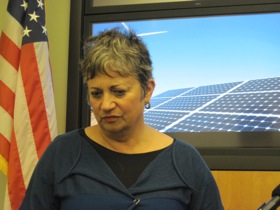
Nichols after a day-long public hearing in December of last year. (Photo: Craig Miller)

On Wednesday, blogger Jon Brooks posted a call for questions on “News Fix,” the KQED News blog. It was a worthwhile experiment but the results speak to the extent to which Nichols has become a lightning rod for opponents of environmental regulation in general and cap & trade in particular — and to some degree the state of public policy discourse in America today. The comments, some emailed and some posted on the comments thread at News Fix were largely a stream of invective directed at Nichols and the Air Board. Some questions were a bit technical for a seven-minute TV interview. Others were valid but off-topic. As the latest installment in our series of “Climate Watch Conversations,” I tried to keep to the climate-related business of the Board (with one exception: I felt I needed to have her address events unfolding in Japan and concerns here about radioactive drift).

Nonetheless I was able to cull a few for this brief interview. Continue reading Air Board Chief One-on-One
Crescent City: “It’s a mess, all right.”

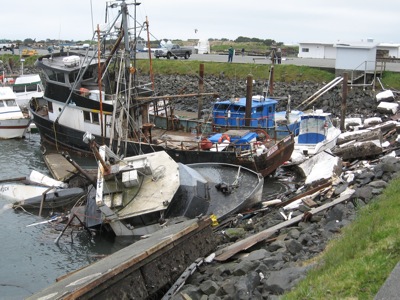
Astoundingly, the mess left by Friday’s tsunami was confined to the harbor…for now. No, it wasn’t 1964, when a tsunami triggered by a quake off Alaska took out the harbor and half the town, killing 11 people. But hanging out there on the northwestern tip of California, Crescent City is “Tsunami Central” for this part of the continent.

Through a quirk of geography, the opening to the city’s horseshoe-shaped inner harbor seems to be lined up perfectly for seismically induced waves sweeping across the Pacific. The most impressive video clips I’ve seen were shot by Bryant Anderson. Both are posted on the website of the Crescent City Daily Triplicate. Anderson captured one clip while the tsunami sirens were still sounding:

Crescent City Tsunami from Bryant Anderson III on Vimeo.

Crescent City Tsunami from Bryant Anderson III on Vimeo.

Friday’s surge, which peaked with an 8-foot wave, had its way with what local officials say had been the most productive seafood landing harbor on the California coast. The next challenge is environmental, as salvage crews wait out the weekend’s extreme weather to tackle the potential threat of nearly 60 damaged and sunken boats, many full of diesel fuel, industrial lubricants and other contaminants. “Every one of the vessels has fuel on board,” said Alexia Retallack, who is helping coordinate recovery efforts for the state Department of Fish & Game’s Office of Spill Prevention & Response. “So every vessel that’s either sunken or currently in the harbor and compromised is a source of petroleum product,” she said. Continue reading Crescent City: “It’s a mess, all right.”

Report: “Stalled” Energy Projects Costing Us

Business group says delays are costing thousands of jobs, billions in lost economic benefits

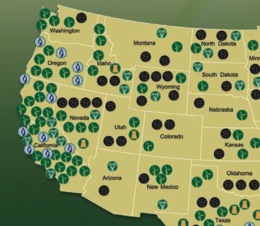
The US Chamber of Commerce says it’s taking too long to green-light energy projects — not just in California but across the US — and that it’s putting a drag on economic recovery.

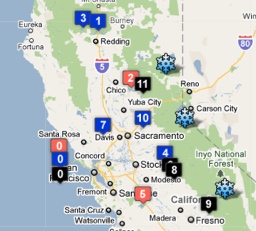
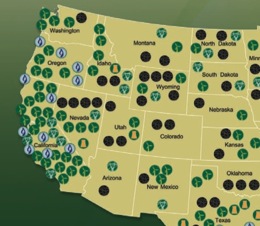
Map shows energy projects that are facing permitting or court challenges, 31 in California. (Image: US Chamber of Commerce)

The pro-business group issued a report that attempts to quantify the opportunity cost of projects that were in permitting or litigation limbo during March of 2010. That “snapshot” includes 31 projects in California. Continue reading Report: “Stalled” Energy Projects Costing Us

Arnold’s Advice to Jerry

Give incentives, don’t inflict guilt, repackage the climate message

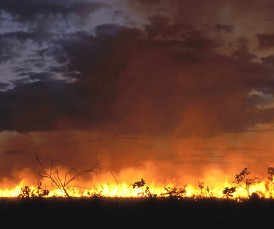
A forest ablaze in Brazil. (Photo: Haroldo Castro/Conservation Int'l)

Arnold Schwarzenegger has some advice for his successor as governor of California, Jerry Brown: “The important thing is for California to stay in there and continue the things that we started.” The former governor was talking to actor Harrison Ford at a recent fundraiser for the non-profit Conservation International (CI), about advancing the environmental and climate agenda.

“Concentrate on giving incentives to companies because in the end it’s technology that will save us all,” Schwarzenegger told the group of several hundred CI donors at San Francisco’s Four Seasons Hotel last week.

Ford, who was moderating the on-stage dialog, expressed frustration that apathy toward climate change is “a daunting obstacle to overcome.” Continue reading Arnold’s Advice to Jerry

Federal Budget Pressure on Rivers, Wetlands

Witnesses tell an Assembly committee that looming federal cuts would leave state programs adrift

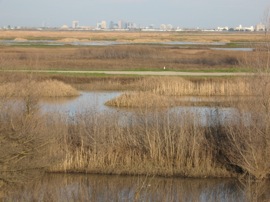
The Yolo Bypass, with Sacramento in the background. (Photo: Craig Miller)

An array of state programs to protect and restore rivers and wetlands is endangered by current plans to cut funding on Capitol Hill. That’s what a string of witnesses told the Assembly Water, Parks & Wildlife Committee in Sacramento this week.

At risk are programs that have leveraged federal money to restore hundreds of thousands of acres of wetlands and wildlife habitat in California, according to speakers for environmental and outdoor groups.

For a nearby example of how federal funds have been used, waterfowl advocate Bill Gaines pointed to the Yolo Bypass, almost within sight of the state Capitol. Gaines, president of the California Outdoor Heritage Alliance, said that over ten years, $5 million in federal money has fueled restoration of 4,300 acres of wildlife habitat. Continue reading Federal Budget Pressure on Rivers, Wetlands

Burgeoning Snowpack Sweetens Water Outlook

A wet and wild February provided a huge boost to California’s water outlook

An unusually dry January started some folks thinking that maybe the tap had been shut off for this season. But last month winter came roaring back as Pacific storms brought epic snowfalls to the Sierra. The result: Today’s monthly survey shows the water content of the mountain snowpack at 124% of normal for this date–and even above its normal level for April first.

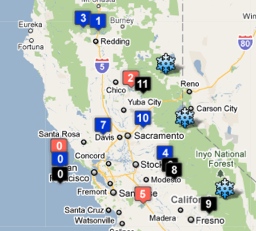
Check current reservoir levels with our interactive map, below.

Major reservoirs are also above their normal levels for early March. But it still doesn’t mean that contractors on the State Water Project will get all the water they ask for. Officials say they still expect deliveries to come in at about 60% of the volume requested. That’s a number that typically gets adjusted throughout the winter. Continue reading Burgeoning Snowpack Sweetens Water Outlook

Green Fire Spreading

A new documentary broadens awareness of a timeless thinker

“Civilization has so cluttered this elemental man-earth relationship with gadgets and middlemen that awareness of it is growing dim. We fancy that industry supports us, forgetting what supports industry.”
— Aldo Leopold,
A Sand County Almanac

Everybody in California seems to have at least a vague notion of who John Muir was. Now, with the help of a new documentary film, Aldo Leopold may get more of the props he earned during his fascinating life as a forester and conservationist.

Leopold’s following has been growing since his work in the first half of the 20th century. When Steve Dunsky set about with his co-producers creating Green Fire, they heard plenty of superlatives from the biographers, historians and naturalists they interviewed. One called Leopold the third pillar of conservation’s “Holy Trinity,” with Muir and Henry David Thoreau. Continue reading Green Fire Spreading

Renewables Standard One Step Closer to Law

Bill to require one-third renewable energy sails through state senate

(Photo: Craig Miller)

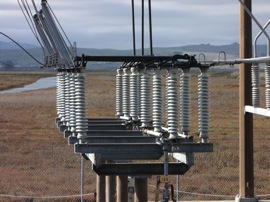
That next gust of wind you hear may be a collective sigh of relief from the renewable energy industry. By a margin of more than two-to-one, state senators have approved a bill to cement California’s requirement that utilities draw at least a third of their power from renewable sources by 2020.

Dan Kalb of the Union of Concerned Scientists says that while the bill still has to clear at least three committees in the assembly, it could come up for a floor vote in that house within two weeks. Continue reading Renewables Standard One Step Closer to Law

What Will Your Water Cost?

Report: Big changes needed to avert “widespread environmental and economic losses” in California

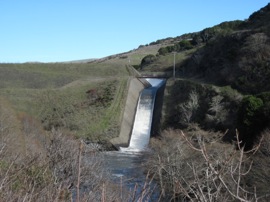
Grand illusion? Water rushes over the spillway at Nicasio Reservoir in Marin County. (Photo: Craig Miller)

A high-profile team of experts is calling for a major overhaul of the way California manages its water. In a 500-page report from the non-partisan Public Policy Institute of California, the authors say decades of well-intended water policies simply haven’t worked, leaving the state vulnerable to major crises, including water shortages, catastrophic floods, decline & extinction of native species, deteriorating water quality, and further decline of the Sacramento-San Joaquin Delta.

“Our system has been dying a death by a thousand cuts,” says co-author Ellen Hanak, an economist and policy analyst at the PPIC. Hanak says that the state’s water management efforts have been “incremental” and “piecemeal,” with little success to show for it. Continue reading What Will Your Water Cost?

Beetlemania Creeping Into California

As if drought and wildfires weren’t enough, California’s coniferous forests face another climate-related threat

(Photo: Reed Galin/Lone Tree Productions)

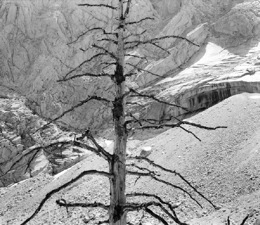
In the last decade, tiny forest-dwelling beetles have wiped out pine trees on millions of acres in the Canadian and American West, including Southern California. The rest of the state has been largely spared, but forest ecologists say that’s likely to change.

Reporter Ilsa Setziol recently spent some time tracking these bugs with an entomologist from the US Forest Service. They found beetles at work in Jeffrey pines and coulter pines in the San Bernardino National Forest, east of Los Angeles. Continue reading Beetlemania Creeping Into California