Craig is a former KQED Science editor, specializing in weather, climate, water & energy issues, with a little seismology thrown in just to shake things up. Prior to that, he launched and led the station's award-winning multimedia project, Climate Watch. Craig is also an accomplished writer/producer of television documentaries, with a focus on natural resource issues.
This post was originated by our content partners atCalifornia Watch.
Report says driving needs to be more costly to get us out of our cars
By Marie C. Baca
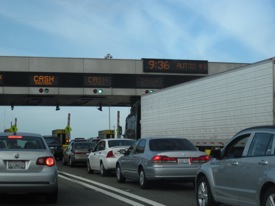
Drivers now pay $6 to cross the San Francisco Bay Bridge during peak traffic hours. "Peak pricing" is one strategy to push commuters to alternative transit. (Photo: Craig Miller)
California faces significant obstacles in complying with a 2008 state law aimed at reducing passenger vehicle usage, according to a report by the nonpartisan Public Policy Institute of California.
The report points to unrealized rail transit investments and resistance to pricing tools like fuel taxes as factors that have slowed reduction in car usage.
The two-year-old SB 375 mandates that California’s major metropolitan areas reduce per capita emissions from driving by 7 percent by 2020 and by 15 percent in 2035. While the primary focus of the bill is a reduction in the greenhouse gases that contribute to global warming, the legislation places a special emphasis on addressing traffic and public health concerns by reducing the number of miles residents drive. Continue reading State Struggling to Reduce Vehicle Emissions→
Studies reveal huge water withdrawals from aquifers under California’s Central Valley
The New York Times this weekend published a story and useful graphic describing new findings on the intensity of groundwater pumping in California’s San Joaquin Valley.
One eye-opening note from Felicity Barringer’s article:
“…the total loss of groundwater from the Sacramento and San Joaquin River basins in California’s Central Valley from 2003 to 2010 was just under 16.5 million acre-feet — approximately the volume of the Lower Colorado River reservoir, Lake Mead, when it is full.”
Lake Mead is the nation’s largest man-made reservoir (and has not been full for some time).
The wind energy industry faces multiple challenges in California.
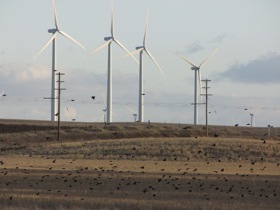
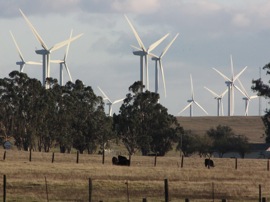
Flocks of birds near wind turbines in Solano County. (Photo: Craig Miller)
It’s hard to find people who are just flat out against wind energy. As with real estate, attitudes seem to come down to location, location, location. That’s why three of the thorniest issues with wind are project siting, transmission (lines for the power produced), and the industry’s turbulent history with birds and bats.
Last fall, even the National Audubon Society, one of the nation’s most stalwart protectors of winged creatures, published a position statement generally favorable toward wind power, calling it a “good news, bad news” proposition. The statement calls California’s Altamont Pass “notorious for killing many raptors, including golden eagles.” A 2003 study by the National Renewable Energy Lab calculated that on average, each turbine in the pass was claiming a bird about once every five years (0.19 birds/turbine/year) — but there are thousands of turbines in the pass, many older models that are more of a danger to birds.
Developers are in the process of “repowering” the pass with newer, larger turbines, less lethal to birds. That may seem counterintuitive but the older, smaller models caused more problems. Since they had lower output, more of them were required. The blades were positioned lower, spun faster, and supported by lattice towers that provided inviting nesting spots, unlike the smooth tubular towers of new turbines.
Altamont is the oldest of California’s four biggest wind energy zones, highlighted on this interactive map.
The Audubon statement concedes that newer turbine designs are becoming more bird-friendly, and finds climate change a bigger threat to avian critters in the long run. The Society went on to call for an extension of the federal Production Tax Credit for wind development, fearing its expiration next year encourages wind developers to rush projects along and “cut corners” on siting.
How much wind energy do we need to make California’s goal of 33% clean electricity by 2020? Whenever I put this question to one of the experts, the answer is always: “It depends.” But under almost any scenario, thousands more windmills will dot the California landscape in years to come.
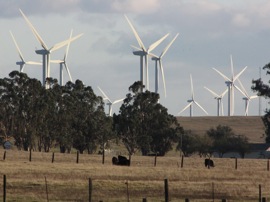
Cattle and wind turbines dot the Solano County landscape. (Photo: Craig Miller)
Those who don’t see them on a daily basis might be surprised to learn that there is already something on the order of 13,000 commercial wind turbines operating in California. Ryan Wiser, who tracks wind energy trends at Lawrence Berkeley National Lab, does a rough calculation that meeting that state-imposed threshold of 33% renewable energy could take 5,000 more, in order for wind to do its share. That’s based on an estimated 10,000 megawatts of new wind power, using the current standard two-megawatt turbine. While most of these will be concentrated in a few major “wind resource areas” (there are currently four big ones in the state), numbers like that almost ensure that wind turbines will become a more familiar feature of the California landscape. Continue reading Wind Farm Forecast: More & Bigger→
A high-ranking California official appeared on Capitol Hill today to defend the right of the federal Environmental Protection Agency to regulate greenhouse gas emissions.
James Goldstene, executive director of the state’s Air Resources Board, told members of a House subcommittee that the EPA’s recently released regulations will not create a “regulatory train wreck.”
Goldstene held up a planned power plant in Northern California to advance his case, saying that the Russell City Energy Plant will stand as an example of how power companies can use the “best available technology” for reducing emissions, as required under a recently issued EPA rule. The plant, to be built on the Hayward shore of San Francisco Bay, is a 600-megawatt plant to be fired by natural gas.
Goldstene’s appearance before the Subcommittee on Energy and Power (part of the Energy & Commerce Committee) was to counter Republican efforts to pull EPA’s authority to regulate greenhouse gas emissions, contained in a bill known as the Energy Tax Prevention Act. Goldstene said passage of the bill into law would “send a stark message…that the U-S isn’t serious about being a leader in the future economy.” It would also upstage a ruling by the US Supreme Court affirming the EPA’s authority to regulate carbon emissions under the Clean Air Act.
Plaintiffs who won a tentative ruling in a suit over the state’s climate law say they’re not out to torpedo AB 32
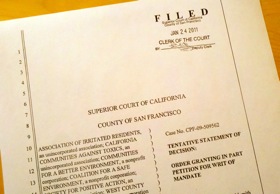
Six environmental justice groups sued state regulators over implementation of AB 32. (Photo: Craig Miller)
The half-dozen environmental justice advocacy groups sued over state regulators’ implementation plan and won a tentative ruling in their favor, from a state court in San Francisco. A lawyer for the Oakland-based Communities for a Better Environment called the ruling “very important and exciting,” but the groups insist that they’re looking to tweak the regulations under California’s Global Warming Solutions Act, not blow it up. Continue reading EJ Groups Say Suit is Not To Undo AB 32→
After all this, California’s global warming law may have hit a legal wall
Lawyers at the gates. (Photo: Craig Miller)
Oil companies couldn’t bring it down with a well-funded statewide ballot initiative. But the state’s landmark 2006 law to combat climate change by regulating carbon emissions might be undone by another of California’s major environmental laws.
Hear the companion radio feature about opposition to the Sunrise Powerlink at The California Report, starting Friday morning.
By Ruxandra Guidi
The road that takes you from the sleepy town of Boulevard into the path of the Sunrise Powerlink is a dusty, unmarked path that’s a couple of miles long. It ends at a gate without a sign, where a guard stands in the hot midday sun. He knows to keep any unauthorized visitors away; there’s a party going on inside, while the protesters make noise for hours outside.
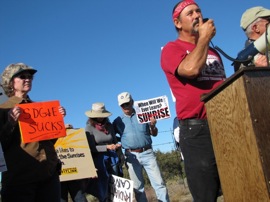
David Elliott speaks to protesters outside the Sunrise Powerlink headquarters in the town of Boulevard. (Photo: Ruxandra Guidi)
No one yet knows what the Sunrise Powerlink will end up looking like, and at what cost — and that’s just two of the main issues people have with it. Opponents of the giant network of powerlines, towers, and substations, say it will run for 120 miles, through delicate ecosystems and fire-prone areas. Its impact on local residents and wildlife will be irreparable.
On the other hand, SDG&E says its “superhighway” for transporting electrons from remote solar and wind farms to coastal population centers, will respect state and federal lands and go around delicate areas of the desert; that it will generate much-needed jobs while meeting state goals for green energy development. In the process, the California Imperial Valley is being touted as a so-called “mega-region;” a showcase for clean energy production. Continue reading Environment and Electrons Create Sparks in SoCal→
The US already has more than a million hybrid-electric vehicles on the road. (Photo: Craig Miller)
Continuing an exercise I started in yesterday’s post, I’ve asked a few experts to weigh in on two national goals laid out by President Obama in this week’s State of the Union address. The experts seemed split on the viability of getting 80% of the nation’s electricity from “clean energy” by 2035. Today they address Obama’s call for one million electric vehicles “on the road” by 2015 (less than five years from now): Continue reading Ask the Experts: 1 Million EVs by 2015?→
During his State of the Union speech last evening, President Obama articulated two national goals that jumped out at me: 80% of electricity from “clean” energy by 2035 and one million electric vehicles “on the road” by 2015 (just five years from now).
Keeping in mind that California’s goal of 33% renewable energy by 2020 is considered extremely ambitious, I put the question to a few experts in the renewable energy/alternative fuels field: Are these goals realistic? I’ll post their responses here as they come in. I’ve had to condense some of the replies for space considerations. Let’s take the 80% clean energy challenge first: Continue reading Ask the Experts: Obama Energy Goals Realistic?→