All posts by Craig Miller

Craig is a former KQED Science editor, specializing in weather, climate, water & energy issues, with a little seismology thrown in just to shake things up. Prior to that, he launched and led the station's award-winning multimedia project, Climate Watch. Craig is also an accomplished writer/producer of television documentaries, with a focus on natural resource issues.

CA Doubled Pace of Renewables Last Year

California Regulators say the state’s utilities about doubled the growth of new renewable energy sources last year. The California Public Utilities Commission says developers added 653 megawatts of capacity in 2010, nearly twice the pace of 2009.
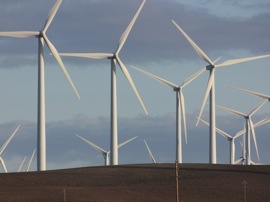
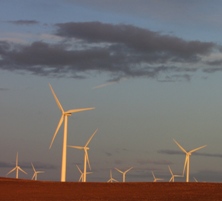
Recently erected wind turbines at the Solano County Wind Resource Area. (Photo: Craig Miller)

For all that, utilities did not quite make the state-imposed requirement that they get 20% of their electrical generation from renewables by last year. That requirement was affirmed by the legislature. In September of last year, former Governor Arnold Schwarzenegger moved the goalposts to 33% by 2020. But that mandate is backed by an executive order, not by state law. Continue reading CA Doubled Pace of Renewables Last Year
Scripps Launching Carbon-Tracking Net

Major partnership is said to be the most ambitious of its kind

Up to now, tracking greenhouse gas emissions around the world has been a patchwork affair for scientists. But if it lives up to its hype, a new partnership with roots in California will mean a much more accurate picture of the heat-trapping gases that cause global warming.

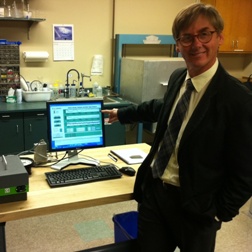
Climate scientist Ralph Keeling tracking real-time carbon dioxide readings from his lab at UC San Diego. (Photo: Ed Joyce)

Currently, scientists rely on a few dozen sampling stations to continuously monitor greenhouse gases around the globe.
But now, the Scripps Institution of Oceanography is teaming with a private-sector initiative to build the world’s most comprehensive network yet, for tracking carbon around the globe. Continue reading Scripps Launching Carbon-Tracking Net

Mapping California’s Worldbeating Cleantech Boom

The Golden State shines in a new global listing from the UK’s Guardian newspaper

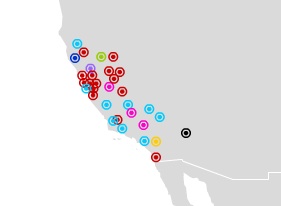
Detail of an interactive map of the world's innovative "cleantech" companies (Image: Guardian UK)

Of all the companies around the world that the UK’s Guardian called out for its second annual Global Cleantech 100, roughly a third are based in California. The list spans technologies including energy generation, storage and efficiency; water and waste water; transportation and others.

The special report includes an interactive map of where the firms are located. It makes an interesting study by itself, showing a dense cluster of 31 firms over California, with a smattering of others around the US. About a dozen are concentrated in a few northeastern states. Four are located in China, two in India. Continue reading Mapping California’s Worldbeating Cleantech Boom

So Much for La Niña

Pacific ocean conditions that often portend a dry winter sure haven’t so far.

Scientists like to joke that “climate is what you expect, weather is what you get.” The relatively soggy winter so far is a classic example of that.

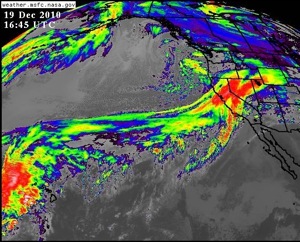
Satellite image from last weekend, showing storm systems marching across the Pacific toward California. (Image: NASA)

A closely-watched oscillation in the Pacific is in the La Niña phase this winter, creating colder-than-normal surface temperatures and distorting weather patterns. Usually a La Niña means drier-than-normal conditions for Southern California in particular and often for northern parts of the state as well. Not this year–at least not so far. The rain set multiple records over the weekend. Los Angeles has had a third of its average annual rainfall in a week. So what’s going on? Continue reading So Much for La Niña

It’s (Sort of) Official: Cap & Trade Is (Almost) Here

After a ten-hour hearing in which board members endured more than 170 speakers, the California Air Resources Board (CARB) voted to “endorse” a 200-page set of rules for what will be the world’s second largest cap & trade program (after Europe).

CARB is charged with implementing the 2006 Global Warming Solutions Act, or AB 32, which mandates that California reduce its greenhouse gas emissions to 1990 levels by 2020.  The cap & trade program is a key piece of the Air Board’s plans.

“It’s an exciting program,” said Board chair Mary Nichols. “It’s a very big step forward.”

Not that the job is done. Several facets of the regulation will now undergo a fine-tuning process, with another report back to the board in July of next year. Eventually it will find its way to the state’s Office of Administrative Law for review, and finally to the governor’s office, to be signed as an executive order. Continue reading It’s (Sort of) Official: Cap & Trade Is (Almost) Here

Lonely Road for Cap and Trade

California is the lab rat in the cap & trade maze

(Photo: Craig Miller)

One day after the midterm congressional elections, President Obama was already talking about cap & trade in the past tense: “Cap & trade was just one way of skinning the cat. It’s not the only way,” the President told reporters. “It was a means, not an end. And I’m gonna be looking for other means to address this problem. Senator Joe Lieberman put it more bluntly. “Cap and trade is off the table,” Lieberman said. “We have to start on the presumption that the table is clean, that nothing is on it.”

But while Washington is “looking for other means” to reduce the carbon emissions that cause global warming, the table is set for cap & trade in California. By day’s end Thursday, the state will likely have the nation’s first system that covers more than electric utilities. Continue reading Lonely Road for Cap and Trade

Cancun Postscript: Leadership Key For Climate Progress

In this guest post: Some reflections on the recently concluded UN climate talks  from Louis Blumberg, who heads the California Climate Change Team for The Nature Conservancy.

Cancun provided glimmers of what could be if nations put their minds to it

By Louis Blumberg

Cancun, Quintana Roo, Mexico – I stood up – every one stood up – and applauded loudly for three minutes – twice!  Patricia Espinosa, President of the UN Climate Change Conference walked into the cavernous hall Friday night, calmly took her place at the head table and the place went wild.  The 1500+ people (it could have been 2500) spontaneously gave her a standing ovation and there were still about six  more hours of work to come.

Joining colleagues from the Nature Conservancy and about 9,000 others from 194 countries, we were in Cancun to shape the foundation of what could become a comprehensive, legally binding treaty to keep global temperature rise below 2 degrees Celsius and avoid major climate disruption.  Last year’s effort in Copenhagen had provided little success and expectations for Cancun were low.  However after two weeks of talks, a balanced package of decisions was reached for a few key issues – like the role of preventing deforestation – and set the stage for completion of the treaty next year in South Africa, potentially. Continue reading Cancun Postscript: Leadership Key For Climate Progress

Poll: Californians Still Support Cap-and-Trade

A new poll shows Californians holding firm to their support of California’s climate strategy, including cap-and-trade provisions likely to be approved next week. The poll accompanies a sheaf of new studies commissioned by the pro-clean-tech think tank known as Next 10.

(Photo: Craig Miller)

The Field poll of about 500 Californians, taken right before Thanksgiving, shows two-thirds (66%) of respondents still favor (either “strongly” or “somewhat”) the 2006 climate law known as AB 32, including the cap-and-trade provisions (64%). About one in four oppose both.

The studies released with the poll point to an economic anticlimax under the cap & trade regulations of AB 32, with net benefits in the long-term. One of the lead investigators, David Roland-Holst, calls it a “small ripple in a giant teapot,” the teapot representing the massive California economy. A “synthesis of the findings” released by Next 10 shows a “very small” impact on the state’s economy, and “very small” changes in retail electricity rates. It also concludes that so-called “leakage” — the regulation-induced exodus of business from California is “likely to be small.” That’s not to say there are no losers. “We’ve got to be honest and say there will be trade-offs,” said Roland-Holst. Continue reading Poll: Californians Still Support Cap-and-Trade

California Leads Clean Energy Derby

Wind turbines in Solano County. (Photo: Craig Miller)

A new ranking of clean energy development in the US has California well out in front, with Oregon running a distant second.

Clean Edge, which describes itself as “the world’s first research and advisory firm devoted to the clean-tech sector,” has released its “first annual U.S. Clean Energy Leadership Index.” Massachusetts, Washington, and Colorado round out the top five. The firm, which has offices in San Francisco and Portland, Oregon, says it used 80 indicators and 4,000 individual data points to calculate the rankings, including numbers of alternative-fuel vehicles and the flow of clean-tech venture capital, as well as the states’ portion of electricity generated from carbon-free sources.

As Todd Woody points out in his post for Reuters, the rankings may furrow brows in a couple of Midwestern states that have been showing some leadership in specific areas. Iowa, for example, is ahead of California in the wind energy race.

Also this week, Florida-based NextEra Energy Resources said it had reached a settlement with regulators and environmental groups to replace more than 2,000 older wind turbines in California’s Altamont Pass, to reduce the number of bird fatalities. The new turbines, while much larger, spin at slower speeds and provide fewer places for birds to nest.

A Call for Better Climate Awareness

Marjorie Sun’s story on climate education efforts by science museums is particularly timely, since the legislative landscape in Washington is most likely to become more hostile to climate science, when Congress turns over next month (see John Broder’s post for the New York Times, for more on the Senate’s highest-profile climate contrarian).

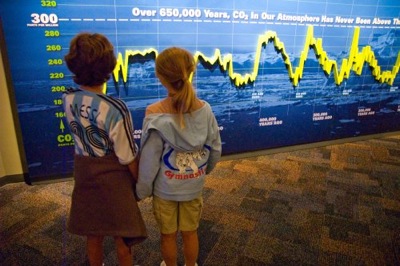
Part of the "Feeling the Heat" exhibit at Birch Aquarium, near San Diego. (Photo: Birch Aquarium)

One of the educators interviewed in her radio feature, Tom Bowman, was among the signatories of a letter published in the journal Science shortly after the story first aired on KQED’s Quest. Bowman’s firm helps develop climate exhibits, including those at the Monterey Bay Aquarium and the Birch Aquarium in La Jolla.

The letter declared that “Because the potential consequences of climate change are so high, the science community has an obligation to help people, organizations, and governments make informed decisions.”

The missive went on to call for a major initiative among scientists to improve public understanding of climate issues:

“The initiative must make concerted efforts to provide people, organizations, and governments with critical information, to address misperceptions, and to counter misinformation and deception.” Continue reading A Call for Better Climate Awareness