Craig is a former KQED Science editor, specializing in weather, climate, water & energy issues, with a little seismology thrown in just to shake things up. Prior to that, he launched and led the station's award-winning multimedia project, Climate Watch. Craig is also an accomplished writer/producer of television documentaries, with a focus on natural resource issues.
If you’re counting on water from the State Water Project, this year is at least starting off better than the last couple.
For the farms and towns that depend on deliveries from the SWP, the outlook for the coming year is better than in recent years, which is not to say ideal.
State water managers today made their preliminary estimate that customers would get one quarter of the water requested from the system. That beats last year’s initial estimate of five percent–the lowest on record. Mark Cowin, who heads the state Department of Water Resources, says these early estimates are intentionally stingy:
“Over the past few dry years, CA has made good progress in improving our ability to conserve water,” Cowin told reporters in a conference call today, but cautioned that “We must continue to promote an ethic of using water efficiently—regardless of the day-to-day outlook for water supplies.”
But Cowin says that between the wet spring and early start to the rainy season this fall, chances are good that the initial 25% projection will rise.
A key reservoir on the system, Lake Oroville, stands at more than three-quarters of its average for this time of year, whereas last year at this time, it was only about half full. By the time the water year was winding up, DWR officials had raised the allocation to 50%. They added that with average precipitation the rest of the way, customers could end up with about 60% of their hoped-for deliveries in 2011. So far this season, precipitation is running ahead of the long-term average.
Water in the State Water Project, like the federally run Central Valley Project, comes in large part from the mountain snowpack of the Sierra and lower Casdade ranges. Growers typically make up for shortfalls by pumping more groundwater.
Science museums, aquariums and other “informal educators” walk a tightrope when it comes to climate change.
By Marjorie Sun
The California Academy of Sciences and the Monterey Bay Aquarium have a big advantage that some educational institutions in other parts of the country don’t: most of their visitors — who tend to be Californians — believe that climate change is real. That means their global warming exhibits can focus on solutions, for example, rather than laying out the basics of atmospheric science.
Californians’ concern about climate change has translated into political support for cutting greenhouse gas emissions. According to survey results released in July by the Public Policy Institute of California, two-thirds of Californians strongly back the pioneering state law known as AB 32. The law requires a reduction of greenhouse gas emissions to 1990 levels by 2020. And the recent defeat of Proposition 23 by 22 percentage points would appear to affirm that support.
Californians appear to buck some national trends on climate change issues. A declining number of Americans say there is solid evidence that the world is warming. The number dropped from 79% in 2006, when AB 32 was passed, to 59% this year, according to a survey just released by the Pew Research Center. The number who think scientists agree that the world is warming due to human activity fell from 59% to 44% over the same period. Even more telling, perhaps, is that the ratio of “yes” to “no” answers to the latter question for Republicans (30:58) is almost the mirror image of that for Democrats (59:32).
New Yorker journalist Jane Mayer details in a recent, in-depth article that billionaires David and Charles Koch, titans of the oil industry, have been spending millions of dollars waging a covert disinformation campaign to thwart climate change legislation in the United States.
Aboard the Bio-Bus
A local organization has launched a mobile counter-offensive. The Alliance for Climate Education, a non-profit based in Oakland, has created a hip, multi-media presentation spiced with animation and rock music to reach teens. Think An Inconvenient Truth goes MTV. The alliance has shown it to more than 420,000 high schoolers across the nation in the past year. The presentation teaches teens the basics about climate change and urges them to “do one thing” to fight it.
Alliance staffers also have tricked out an old school bus with clean tech, driving it to schools and museums to showcase renewable technology. The blue bio-bus runs on used cooking oil collected from restaurants. Solar panels on the bus charge cell phones and computers on board.
Unmasking the Cow
The model cow in the Monterey Bay Aquarium climate change exhibit originally appeared with a gas mask, which has since been removed. (Photo: Craig Miller)
Meanwhile, keeping the climate change exhibits up-to-date scientifically is a concern for the museums. At the Monterey Bay Aquarium, outfitting a life-size model cow with a gas mask was prompted in part by a 2006 study by the Food and Agriculture Organization. The FAO study said that industrial production of livestock in general, including cattle, pigs, and poultry, accounts for 18% of all greenhouse gas emissions. But another FAO study released in April — about the same time the climate change exhibit opened — examined the GHG emissions for the dairy industry alone, not beef production. It concluded that dairy production contributes just four percent of emissions. The study (PDF download), along with howls of protests from the local dairy industry, helped convince the aquarium to unmask the Holstein.
One last tidbit about interactive exhibits: One of the most popular — common to the Academy and the Monterey Bay Aquarium — is surprisingly low-tech. Thousands of visitors write on comment cards about what they can do to fight climate change and hang them on display boards there. One of them, in a child’s handwriting, read “Reduce, reuse, recycle and homework is bad for the environment.”
Hear Marjorie’s companion radio feature on KQED’s Quest radio program, Monday morning. A version of this post also appears on the Quest blog.
Image from an Envrionmental Defense Fund TV campaign
Remember that TV ad that represented climate change as an oncoming train? Polar bears falling from the sky and spattering on the sidewalk? If a new study from sociologists at UC Berkeley is any indication, they probably backfired.
Sociology Professor Rob Willer says more than two years of testing with college students and subjects recruited over the Internet reveal that if projections of severe climate impacts clash with a person’s fundamental view of a safe and stable world, that person is less likely to act on it.
“When you underscore potential ways out of the problem,” says Willer, “Then you can communicate the facts of climate change without threatening people so much that they deny the problem.
Willer says that repeatedly exposing subjects to “negative” messages about climate change affected more than their personal motivation to address it; their belief in the science behind the message was actually eroded. And he says that people in the study tended to be put off by “scary” messages, regardless of their politics.
As part of the negative messaging, Willer showed subjects the “train” spot produced by the Environmental Defense Fund. Willer says it was not a motivator in his study, even though it ends with the message “There’s still time.”
The study’s conclusions came as no surprise to “messaging” experts at the Behavior, Energy and Climate Change conference, wrapping up today in Sacramento.
Anne Dougherty, Manager of Social & Behavioral Research at Oakland-based Opinion Dynamics Corporation, says that motivational messaging in general should steer clear of tones that are bleak, catastrophic, punitive or scary. “There is this tendency to disassociate with messaging when the messaging is bleak,” said Dougherty. “People, in order to be inspired to take action, need to feel a bit optimistic about what they’re going to be doing.”
Dougherty’s company has been involved in developing energy conservation campaigns in California, such as “Flex Your Power” and the upcoming “Engage 360” campaign, sponsored by the California Public Utilities Commission.
Willer says his study focused on personal actions, not what the government should do about global warming. His work will appear in the journal Psychological Science early next year.
California’s Proposition 23 has failed at the polls, so now either the “second Industrial Revolution” may proceed or it’s the end of free enterprise as we know it, or we simply move on to the next front in the assault on California’s emerging carbon regulations.
(Photo: Craig Miller)
The $40 million fight over Prop 23 presented two opposing themes: (a) AB 32 will wreck the economy, or (b) AB 32 will save the economy. Both visions for California’s climate law were hyperbolic. It would be fascinating to be able to tap into some parallel universe where it did pass, just to see what would really happen. More than likely some middle ground would prevail, as it will now, in this Universe. Continue reading The Next Battle Front for AB 32→
Voters reject a measure to set aside California’s landmark climate law.
California’s chief air regulator was jubilant: “They didn’t know who they were messing with,” said Mary Nichols, when the first numbers came in from the polls.
Nichols, who chairs the state’s Air Resources Board, was reveling in the 20-point trouncing that voters gave the statewide ballot measure to freeze the state’s greenhouse gas law, known as AB 32. Governor Arnold Schwarzenegger seized the World Series moment and the locale, adjacent to the San Francisco Giants’ ballpark, to take a swing at the oil companies that financed Prop 23: “Less than 24 hrs later, we are beating Texas again,” proclaimed the Governor, who has made the state’s 2006 climate law a tent pole of his legacy. Continue reading Prop 23 Lands With a Thud→
As the world warms, officials at the National Park Service are starting to sweat: No glaciers at Glacier, no Joshua trees at Joshua Tree. These are part of the long-range forecast for the national parks.
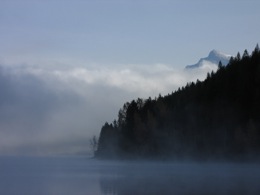
A misty Lake McDonald in Glacier National Park; metaphor for the park's murky future? (Photo: Craig Miller)
Last month, in a post from Glacier National Park, I noted that Park Service director Jon Jarvis was not in a mood to mince words, calling climate change “the greatest threat to the integrity of the national park system that we’ve ever faced.”
That assertion was underscored last week in a new report on potential impacts to the parks from climate change. The collaboration by the Natural Resources Defense Council and the Rocky Mountain Climate Organization, attempted to zoom in on specific parks and projected changes ahead for ten national parks in California, as well as impacts on the state’s economy.
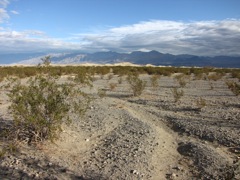
Death Valley is already the hottest spot in North America. The highest recorded temperature there is 136 dF. (Photo: Craig Miller)
Some conclusions under a “medium-to-high” emissions scenario, toward the end of this century: Higher temperatures in Joshua Tree National Park would mean the end of, well, Joshua trees in the park. Muir Woods could be as warm, on average, as San Diego has been historically, making it less hospitable to the park’s legendary coast redwoods. Death Valley, already the hottest spot on the continent, could become virtually uninhabitable during the summer, as average temperatures rise by more than eight degrees, Fahrenheit, over average readings from 1961 to 1990. Continue reading National Parks Wrestle with Warming→
California’s greenhouse gas regulators may ease the pain for companies under an evolving cap-and-trade plan.
Photo: Craig Miller
A staff report issued today by the state’s Air Resources Board provides the first details of how a state-run cap-and-trade program would work. As regulators had warned in recent months, it appears that most emissions permits will be given away, at least initially. Environmental groups had been pressing for a “100% auction,” making industry pay for all allowances.
But Jamie Fine, an economist with the Environmental Defense Fund in Sacramento, says it’s not that straightforward. Fine interprets documents released today to mean that most allowances would be given away to begin with, but by 2015, with the gradual expansion of the program, more than half of the permits would be auctioned off. Continue reading Air Board Likely to Give Away Most Carbon Permits→
In what might signal a final push by Silicon Valley, an environmentally-oriented investor group today released a manifesto from 66 “leading investors” opposed to California’s Proposition 23. The group is said to manage more than $400 billion in assets.
In a conference call with reporters, venture capitalist Alan Salzman called clean technology the “next industrial revolution,” and that “California is at the epicenter.” To prove his point, Salzman pointed to $9 billion invested in “clean-tech” since 2006, in California alone, and he called Prop 23 “antithetical” to the transition that global industry is now undergoing, claiming that 20% of total venture capital funding is flowing to clean-tech, of late. Continue reading Prop 23: No’s Rally, Pros Retreat?→
Couples often remain unhappily married for the sake of the kids. Now they might consider it for the sake of the planet.
Chinese households are outpacing the population by three-to-four times.
Jianguo (Jack) Liu, who directs the Center for Systems Integration and Sustainability at Michigan State University, has been tracking an interesting driver of carbon emissions in China: the explosion of households.
Speaking at the Society of Environmental Journalists‘ annual conference at the University of Montana, Liu said the number of households in China has been growing three-to-four times as fast as the population, which, in turn, is fueling a domestic boom in energy-intensive consumer goods, such as autos, air conditioners and major appliances (though one third of China’s carbon emissions are still due to products made for the export market, with the largest share bound for the US). Continue reading The Carbon Footprint of Divorce in China→
Renewable energy developers will get no special treatment in the National Parks, according to National Park Service Director Jon Jarvis.
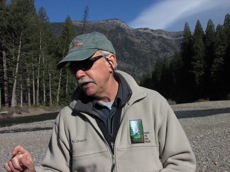
National Park Service Director Jon Jarvis at McDonald Creek, Glacier National Park (Photo: Craig Miller)
Jarvis made the comment yesterday while touring Glacier National Park in Montana, with members of the Society of Environmental Journalists. “Renewables do not get a free ride,” said Jarvis, when asked about how the parks would treat development of renewable energy sources on park property.