Craig is a former KQED Science editor, specializing in weather, climate, water & energy issues, with a little seismology thrown in just to shake things up. Prior to that, he launched and led the station's award-winning multimedia project, Climate Watch. Craig is also an accomplished writer/producer of television documentaries, with a focus on natural resource issues.
Carbon dioxide is “not pollution,” say engineers for the nation’s biggest refiner.
Listen to Rachael Myrow’s radio feature on The California Report.
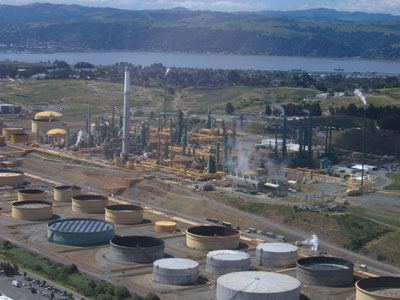
Valero's Benicia refinery in Solano County. (Photo: Craig Miller)
Last week, as the campaign rhetoric for and against Proposition 23 was heating up, The California Report host Rachael Myrow and I spent an afternoon with three of Valero’s environmental specialists at the company’s refinery in Benicia, up the Sacramento River from San Francisco Bay. They briefed us on the refining process in some detail and drove us around the 400-acre refinery site, near the Carquinez Strait in Solano County. Continue reading Prop 23: The View from Valero→
Google makes a billion-dollar bet on offshore wind–but not on this coast.
When Google announced that it was taking a nearly 40% stake in a $5 billion underwater transmission line to serve offshore wind farms that haven’t been built, nobody even seemed to flinch. Such is the effect of having the Google imprimatur on renewable energy projects.
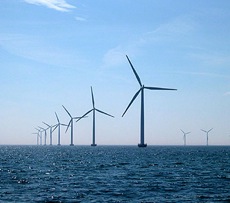
The Nysted wind farm, off the coast of Denmark. The US presently has no offshore wind generation.
According to reports, the cable would run for 350 miles, about 20 miles off the Atlantic coast, connecting yet-to-be-built wind energy turbines to the mainland and to each other. It would not connect the only offshore wind farm to so far win approval from the federal Department of the Interior, the long-contested Cape Wind project off Massachusetts. Continue reading Offshore Wind’s Google Boost→
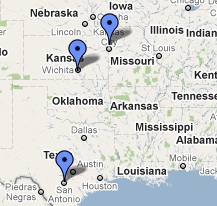
Prop 23 has backing from oil & gas interests in Texas, Kansas, Ohio, and Colorado, among other places.
True, most of the money backing Proposition 23 on California’s November ballot has come from two big oil refiners, both headquartered in San Antonio, Texas. But the opposition has some high rollers in the game, as well. High-profile venture capitalists and tech investors have lined up against the measure with open wallets. In fact, a tally released this week by the California Fair Political Practices Commission reveals that opponents of Prop 23 are outspending proponents by almost a two-to-one margin. According to the Commission, ten different committees have marshaled more than $13 million to defeat the measure, “mainly from individuals.” Continue reading Prop 23 Money Trail→
UPDATE: Since this post was first published, the BLM has also given the nod to another major solar energy installation, the approximately 400-megawatt Ivanpah project, being developed in San Bernardino County by Oakland-based BrightSource Energy.
The federal Bureau of Land Management today issued its first approvals of major solar energy projects in California.
The Tessera project will use "SunCatchers" to concentrate solar power. (Image: Tessera Solar)
Tessera Energy’s 700-megawatt Ocotillo project, located in the Imperial Valley, about 100 miles east of San Diego, and a smaller photovoltaic (PV) project by San Ramon-based Chevron Corp., are both cleared to go forward.
The two projects set a precedent not just for California. On a call with reporters this morning, Department of Interior Secretary Ken Salazar called it a “historic day,” saying the two projects “bear the distinction of being the first large-scale solar energy projects ever approved for construction on our nation’s public lands.” Continue reading First Federal Approvals for Big Solar→
The backers of California’s Proposition 23 can add two significant new names to its list of opponents: Republican Gubernatorial candidate Meg Whitman and the state’s Public Utilities Commission.
Neither should come as a huge surprise. Whitman hinted at a “no” vote weeks ago, when two conservative L.A. radio hosts backed her into a corner. Forced into at least a vague commitment one way or the other, Whitman said she would “in all likelihood” vote “no.” This week it became official when Whitman released positions on all measures that will appear on the statewide ballot. In a statement, Whitman said:
“While Proposition 23 does address the job killing aspects of AB 32, it does not offer a sensible balance between our vital need for good jobs and the desire of all Californians to protect our precious environment. It is too simple of a solution for a complex problem.”
That means there’s at least one thing on which Whitman and her Democratic rival, Jerry Brown, agree. Both oppose 23, though Brown is a staunch supporter of AB 32. Whitman still maintains that if elected, she would use the provisions of AB 32 itself to suspend regulations under the law, until the economy recovers from the current downturn. Continue reading Whitman, Utilities Commission Oppose Prop 23→
At solar-thermal plants, mirrors concentrate solar energy on a central tower, where steam is generated to run turbines. (Image: BrightSource Energy)
Prepare for a solar building boom in the deserts of Southern California. After spending years in the environmental review process and clearing other bureaucratic hurdles, approvals for clean energy producers are picking up steam.
State regulators have now given the green light to four major solar power projects in as many weeks. The most recent was on Wednesday, when the California Energy Commission gave the nod to a 370-megawatt solar-thermal array known as the Ivanpah project (the CEC does not have authority over photovoltaic or “PV” solar arrays). Developed by Oakland-based BrightSource Energy and built by Bechtel Corp., it will consume more than 3,500 acres near the California-Nevada border, in the northern Mojave Desert. Continue reading California: The “Solar Saudi Arabia”→
How long would California’s climate law be frozen under the ballot measure to suspend AB 32? It depends on how you read the state’s labor statistics.
There were moments during Monday’s Forum program on KQED when I thought I’d stepped through the Looking Glass.
The two principal guests were, by design, on opposite sides of the campaign for Proposition 23, the upcoming ballot measure to suspend California’s 2006 greenhouse gas law. So I didn’t expect the “Yes” campaign’s Anita Mangels and Solaria VP David Hochschild to agree on much. But I never expected a dust-up over California’s historical unemployment rate. I mean, that’s a pretty easy one to settle — a matter of public record, right? Nevertheless, the two duked it out over just that. Continue reading Prop 23: The Statistical Maze→
Hear our radio feature on wetlands restoration in San Francisco Bay, to be aired Friday afternoon on The California Report.
As my colleague Paul Rogers reported this week, earth has begun to move in the biggest wetlands restoration ever undertaken on the West Coast. This week I took a brief tour of the Eden Landing Ecological Reserve, near Hayward.
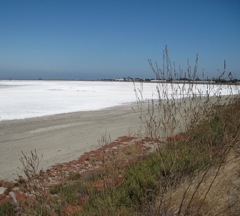
What is and what will be: Hundreds of acres of salt evaporation ponds, in the background, are being restored to tidal wetlands, as seen in the foreground of this scene from Eden Landing in Hayward. (All photos: Craig Miller)
Scanning much of the scene, “Eden” wasn’t exactly what came to mind. Vast, white expanses of salt and gypsum deposits are more reminiscent of Utah than a bay estuary. These are the remnants of a once booming salt harvesting industry.
But fueled partially by federal stimulus funding, bulldozers and backhoes are now reshaping levees there as part of the larger South Bay Salt Pond Restoration Project, which will eventually return 630 acres of abandoned salt flats into tidal wetlands at Eden Landing, and thousands more in an arc around the south end of San Francisco Bay. Continue reading Rebuilding a Buffer Against Climate Impacts→
Hear my radio feature on geothermal energy and the rest of a five-part collaboration on renewable energy between NPR and KQED, on NPR’s Morning Edition.
It may be a distant second to California now, but Nevada is making a run to become the nation’s largest producer of geothermal energy.
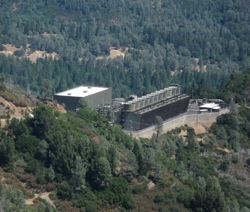
A conventional geothermal power plant at The Geysers complex in Lake County. (Photo: Craig Miller)
California still produces an estimated 80% of the nation’s geothermal power (used to produce electricity*), with more than 40 plants online. But according to a summary from the Geothermal Energy Association (GEA) this summer:
“Nevada could become the leading geothermal energy producer in the coming years if growth and production trends continue on their current trajectories. Nevada’s 86 planned or developing geothermal power plants have the potential add up to 3,686.4 Megawatts of geothermal power to Nevada’s energy portfolio, power for 2.6 million homes – enough to meet the electricity needs of 100% of the homes in the Las Vegas metropolitan area.”
GEA describes 14 Nevada projects as being “in latter stages of development.” Meanwhile, says the group’s executive director, Karl Gawell, development in California is slowing down. “Everything’s relative,” Gawell told me in a phone interview. “Projects are moving forward in California, they just take longer.” Continue reading Clean Energy from Below→
On Monday, US energy secretary Steven Chu became the latest high-profile voice against California’s Proposition 23, the statewide initiative to suspend AB 32, the state’s four-year-old climate strategy.
“AB 32 was a good bill and continues to have California in a leadership role in developing clean energy and the efficient use of energy,” Chu told reporters at a dedication in Menlo Park. “From the middle 1970s California played that role and it would just be a terrible setback.”
Last week the trend was given full voice by Mary Nichols, who, as chair of the California Air Resources Board (CARB), is charged with getting AB 32 fully implemented in the next two years, called Prop 23 a “very serious threat,” not just to the core programs of AB 32, but to an array of regulatory programs that support the state’s attack on greenhouse gases. Continue reading The Overspray from Prop 23→