
In what are believed to be his first public remarks on the subject, US Energy Secretary Steven Chu came out against California’s Proposition 23 today. Chu said passage of the measure, designed to suspend the state’s landmark climate law known as AB 32, would be “a terrible setback.”
Continue reading DOE Secretary Opposes Prop 23
All posts by Craig Miller
Nichols: No Solo Cap-and-Trade
Cap-and-Trade is a lonely business these days. But according to the state’s top regulator in charge of implementing it, California won’t go it alone.

Mary Nichols, who chairs the state’s Air Resources Board, made the remark in a Silicon Valley panel discussion today. The ostensible topic of the event was renewable energy but it turned into a pep rally against Proposition 23, the statewide ballot measure designed to halt California’s comprehensive climate law, AB 32. Nichols was joined on the panel by executives from Google, PG&E and venture capitalist Vinod Khosla, all of whom voiced strong opposition to Prop 23.
When asked about the cap-and-trade provisions of AB 32, Nichols said: “We won’t launch this program without partners to trade with. It doesn’t make sense for an economy even as big as California, to try to do this all by ourselves.” The comment came days after congressional leaders threw in the towel for the summer, on a federal bill to address climate change and energy security. “To get the kind of leverage that you really need to make this program succeed, the US has got to step in,” said Nichols.
California is part of a nascent regional trading pact known as the Western Climate Initiative. But among the seven US states and four Canadian provinces signed on to the WCI, only California, New Mexico and Quebec are prepared to move forward with a working carbon trading market. Others still lack enabling legislation, and Arizona has overtly pulled out of the carbon trading plan, raising the question of how many “partners” California will have, even with WCI in the mix.
“I don’t expect to be faced with this dilemma,” Nichols told me after today’s event, “but if the worst were to happen and none of these states were able to move forward with their own programs, I think we would think long and hard about whether we would actually start enforcing the program, unless and until we were really confident that our state had the ability to do it in a way that would not put us at a competitive disadvantage.”
Proponents of Prop 23 contend that full implementation of AB 32 will give other states and nations a competitive edge over California, resulting in “leakage” of jobs and businesses to regions with fewer regulations.
The panel, entitled “Electric Bills and Oil Spills: Will California Continue To Be a Clean Energy Leader?” was held on the Google corporate campus in Mountain View.
Whitman Commits on Prop 23 — Sort of
The mystery of whether Republican gubernatorial candidate Meg Whitman does or does not support Proposition 23 would appear to be solved. After weeks of steadfastly refusing to take a stand one way or the other on the ballot measure to freeze the state’s climate law known as AB 32, Whitman conceded on a radio broadcast that “In all likelihood I will vote ‘No’ on Prop 23.” Continue reading Whitman Commits on Prop 23 — Sort of
Wind Picks Up Nationally, California Lags
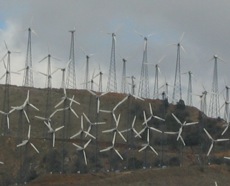
Wind power generators added nearly 40% to their total capacity in the US last year, as several states blew past California, according to a new report from the Department of Energy’s Lawrence Berkeley National Lab. According to the tally, four states now generate more than 10% of their total electricity (excluding exports) from wind.
Texas is the undisputed leader in the wind race, installing nearly 2,300 megawatts of capacity last year alone. Other Midwestern states such as Indiana, Iowa, the Dakotas and Minnesota have also been aggressive installers of wind farms. Continue reading Wind Picks Up Nationally, California Lags
Poll Shows Support for Climate Law
An expansive new poll on environmental attitudes suggests that despite the recession, Californians are holding fast to their environmental priorities.
Among the findings in the report released this week by the non-partisan Public Policy Institute of California is that support for the state’s climate change strategy remains strong, even in the face of a well-financed campaign against the law known as AB 32. Two-thirds (67%) of the respondents support the 2006 Global Warming Solutions Act, aimed at reducing greenhouse gas emissions in California–about the same level as when PPIC polled the question last year. Continue reading Poll Shows Support for Climate Law
Climate Action May Be Up to the States
Just a couple of weeks back, some stalwarts still held out hope for a federal climate bill this summer. But with the capitulation by congressional leaders on Thursday, this week the legislative landscape looks undeniably bleak. And with flagging expectations for multinational climate talks, the heat is now turned up once again on the so-called “sub-national” actors, like states and provinces. It also lends more gravitas to efforts like Governor Schwarzenegger’s announced third climate summit for sub-national leaders, scheduled for November at UC Davis. Continue reading Climate Action May Be Up to the States
The Biggest Solar Project in the World
It’s just outside Phoenix. No, it’s in the Mojave. Wait, no, it’s in San Benito County.
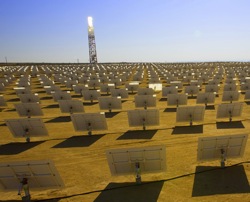
On a media call this week in which executives and investors from the solar industry stumped for extensions to key federal incentives, I heard Fred Morse of Abengoa Solar say that the company’s Solana project in Gila Bend, Arizona, will be, as described on the project website, “the world’s largest solar plant.” Later that same day, an email came in from Oakland-based BrightSource Energy, (not in response) touting its Ivanpah project as “the largest solar project in the world.” Similar terms have been used to describe Solargen’s proposed 4,700-acre photovoltaic array in San Benito County. Continue reading The Biggest Solar Project in the World
Schneider’s Legacy: Speaking Truth to Power
There’s been much hand-wringing of late over the disconnect between science and “Main Street.” When it comes to communicating complex concepts to the general public, even many scientists admit that they haven’t been making the light bulb come on.
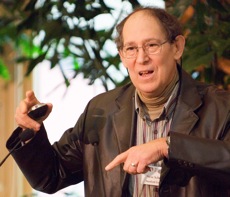
That was never an issue for Steve Schneider. He never had any problems communicating. Most colleagues of the Stanford climate scientist, who died this week, remember him not just for his science resume, but also for his laser-like approach to getting the point across. Continue reading Schneider’s Legacy: Speaking Truth to Power
Climate Science Loses a Bright Light
Shock spread through the climate science community today with the news that Stanford’s Stephen Schneider has died.
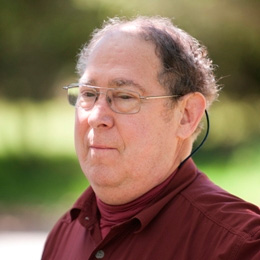
Schneider reportedly suffered a heart attack on a flight from Stockholm to London. Schneider founded a scientific journal on the subject of climate change and was a vocal advocate of the need for policy action, to respond to the threat posed by global warming.
A release issued by Stanford today reads, in part:
“Steve, more than anything, whether you agreed with him or not, forced us to confront this real possibility of climate change,” said his colleague at Stanford’s Woods Institute for the Environment, Jeff Koseff.
Schneider was influential in the public debate over climate change and wrote a book, Science as a Contact Sport: Inside the Battle to Save Earth’s Climate, about his experiences. He also wrote a book about his battle with leukemia, Patient from Hell.
He had been a White House consultant in the Nixon, Carter, Reagan, George H.W. Bush, Clinton, George W. Bush and Obama administrations.”
Schneider last appeared on KQED’s air just after the UN climate talks ended in last December, with what many considered a whimper. His disappointment was palpable as he spoke with Forum host Dave Iverson over a tenuous cell phone connection from Copenhagen (Schneider joins the program about 30 minutes in). He also made Forum appearances in programs in 2007 and 2004.
On his widely read Dot Earth blog for the New York Times, Andrew Revkin offers a personal perspective on Schneider, his work, and his bigger-than-life personality.
Intersolar Chair: CA Losing Solar Race
Despite frequent pronouncements by the outgoing governor of the Golden State, the chair of the giant solar industry expo that winds up in San Francisco today says “California and the US are losing badly in the global race” for solar energy deployment.
Eicke Weber of Germany’s Fraunhofer Institute for Solar Energy Systems made the comment on KQED’s Forum program this morning, during an hour devoted to solar energy prospects.
Weber said that California will represent a tiny fraction of the world’s growth in photovoltaics this year; just 200 of the 10,000 megawatts that he projects will be installed globally. California remains ahead of all other states in the deployment of solar panels. Weber’s forecast for California still represents two thirds of his projected total for the US. That’s “far below what could be expected from a country that’s as rich and sunshine-filled as the United States,” added Weber.

The global face of solar was impossible to miss at the Intersolar conference at San Francisco’s Moscone Center. Three levels of exhibition space were crammed with industry exhibits. To get there, attendees had to jostle for space on the escalators. Though this was billed as the “North American” conference (following an even bigger one in Europe), the halls included major product exhibits from China, Germany, Spain, South Korea, and other nations. Organizers told the trade publication Solar Industry that they booked 30% more exhibitors than last year for the expo.
While speakers at the conference were calling for more government support for solar and other renewable energy sources, state officials in California were going to the mat to save what’s already in place here. On Wednesday attorney general/gubernatorial candidate Jerry Brown said he is suing key players in the mortgage markets, in an effort to save the vaunted PACE program, which finances residential solar projects through property tax assessments. The announcement came even as the California Public Utilities Commission said it was suspending some solar incentive programs for schools and community organizations, after being overwhelmed with applications.
During the Forum discussion, Weber was sometimes at loggerheads with a former colleague from UC Berkeley, where Weber taught for more than 20 years. Weber predicted that rooftop solar could be cost-competitive with fossil fuels within seven years. But Severin Borenstein, who co-directs the Energy Institute at Berkeley, said he considered that forecast to be “at the very optimistic end of the range.”
Borenstein said he was not surprised that the PACE program is in trouble. He said that from the outset, mortgage lenders had been queasy about the program because when properties end up in foreclosure, the banks could find themselves second or third in line for their money, behind counties that finance the PACE energy upgrades.