All posts by Craig Miller

Craig is a former KQED Science editor, specializing in weather, climate, water & energy issues, with a little seismology thrown in just to shake things up. Prior to that, he launched and led the station's award-winning multimedia project, Climate Watch. Craig is also an accomplished writer/producer of television documentaries, with a focus on natural resource issues.

Some “Low-Hanging Fruit” Still Hanging

(Photo: Craig Miller)

California’s commercial buildings suck up more than a third of all the electricity used in the state–and that’s too much.

That’s among the conclusions of a new report from the San Francisco-based think tank Next 10. The 12-page report points out that on average, such buildings could cut energy use by 30% just by upgrading insulation, and another 18-to-20% with more efficient lighting.

Though California leads the nation in its stingy use of electricity overall, the report notes that efficiency standards for new construction are “well below what is possible” and what standards are in place are not met by 40% of new buildings. Study co-author Tracey Grose says that’s partly because even if state-of-the-art equipment is installed, it isn’t always used as intended. There are no energy efficiency standards at all for existing buildings. In general, the study finds that energy use in most buildings could be cut by 80% with some basic upgrades.

The report, compiled by the consulting firm Collaborative Economics in Mountain View, and largely a compilation of existing work, also implies that there’s a built-in way to pay for some of these improvements. The authors cite studies showing that commercial tenants are willing to pay higher rents for “greener” space. The report also cites figures from the Building Owners & Managers Association, that some basic improvements in energy efficiency offer a three-to-one return on investment.

Power consumption varies widely within the commercial sector. Next 10 notes that restaurants are the biggest kilowatt hogs per square foot, followed by supermarkets and hospitals (when’s the last time you had to wear a sweater while grocery shopping because the frozen food section was chilling the whole store?).

According to the report, while raw consumption has continued to rise, efficiency in these buildings has leveled off in recent years. Overall, the nearly 6.8 million square feet of commercial space accounts for 37% of California’s electricity use, compared with 40% for commercial buildings nationwide. The latter accounts for more than a quarter of the nation’s carbon dioxide emissions, according to the report.

Next 10, which describes itself as an “independent, non-partisan organization” has been a vocal promoter of the economic benefits from greening the state’s economy.
Clock Ticking for Solar Developers

The “33 x 20” series continues Monday on Quest Radio, with the first of two parts on the proposed Solargen project in San Benito County. The reports will be repeated on The California Report weekly magazine.

Well hidden among the coast ranges of San Benito County, there’s a valley where, as one ecologist put it, “the hammer is hitting the anvil.” Mike Westphal of the Bureau of Land Management’s Hollister field office was describing the current tension playing out in Panoche Valley between two environmental goals: the mandate to combat global warming with a transition to renewable energy, and the desire to conserve the habitat of endangered animals, as well as California’s remaining ag land.

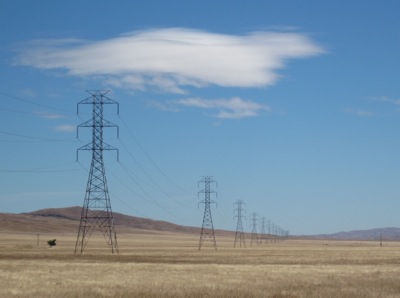
Solargen argues that Panoche Valley is a rare combination of great sun, proximity to population centers, and existing transmission lines to get the power there. (Photo: Craig Miller)

As part of our collaborative series: “33 x 20: California’s Clean Power Countdown,” Quest Senior Editor Andrea Kissack and I have been exploring the effort by Solargen Energy to develop Panoche Valley as a utility-scale solar power array (the state defines “utility-scale” as any facility that produces 200 megawatts of electricity or more).

Like many developers, Solargen CEO Mike Peterson is racing to break ground by the end of this year, in order to cash in on up-front stimulus money from the federal government. He says Panoche Valley presents a rare alignment of attributes for solar power: high solar potential (he says 90% of the Mojave), relative proximity to population centers, and existing transmission lines to get the power there. Peterson told me that the lines already in place have enough available capacity to handle his 420 megawatts of solar power, though a spokeswoman for PG&E says that question is still under study.

Meanwhile, some farmers and wildlife advocates have opposed the plan, saying big solar “farms” are better placed on “degraded” land. Ron Garthwaite, who runs Claravale organic dairy, says “This is just not the place to put it. There’s other places which have no ag value and which have less of a natural value where they could put it.”

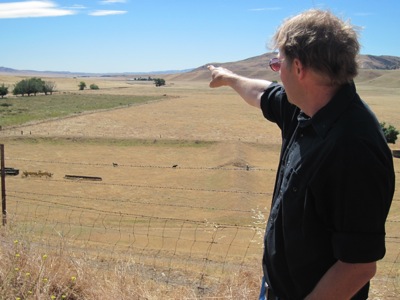
Standing at the valley's north end, BLM ecologist Mike Westphal points to where 2,000 acres might be covered in PV solar panels. (Photo: Craig Miller)

Westphal, whose agency is not directly involved in assessing the project, sees the valley as a rare microcosm for the once unspoiled habitat of the San Joaquin Valley, just over the hill. “What we really need to think hard about is do we want to risk ecosystems to get energy,” he told me, scanning the valley from Shotgun Pass at the north end.  “That’s what’s going on here in Panoche Valley is we’re making this equation: how much do we want to risk the continued endangerment or extinction of this ecosystem in order to get more energy? That’s the crux of this conflict here.”

In this video clip, BLM ecologist Michael Westphal gives Craig Miller an overview of the valley, looking south from Shotgun Pass.

Solargen is shelling out for a $1.3 million-dollar environmental impact report, which Peterson says does not include measures such as the two dozen biologists and a detachment of scat-sniffing dogs, trained to track down the droppings of other critters for DNA analysis. The results help determine what species are there. Peterson says the total tab in “preparing and preparing for the EIR” now tops $7 million.

In Part 2 of our Panoche Valley “case study,” Andrea Kissack will have a closer look at the wildlife issues. That report runs next Monday, June 28, on Quest Radio.

As for the Governor’s ambitious goal to have renewable energy sources account for one third of the state’s electrical generation by 2020, Peterson describes the process as “surprisingly harder than you would expect.” He says he ponders how to “get this done in a way that is able to meet the mandates, but also be a good steward to the environment, and try to make people happy. And we won’t be able to please everybody.”

He’s right about that. Dairyman Garthwaite says of the state’s quest for renewables: “Just because somebody in Sacramento says something, doesn’t mean that it can happen–or should happen. I mean there’s all kinds of political things involved in that, there’s lobbyists involved in that. People want to make money.”

Climate Watch intern Chris Penalosa mapped some of California’s larger solar projects in development, below.


View Utility Scale Solar Projects in California in a larger map

What Will it Take?

An interesting confluence of events this week: A Senate committee votes down a contentious amendment to the “climate” bill, a new Stanford survey shows rising concern about global warming, and pundits gather in Pasadena to sort through it all.

87496035The survey, conducted by Jon Krosnick’s Political Psychology Research Group with funding from the National Science Foundation, suggests that some climate pollsters have been getting it wrong. About three in four respondents to the Stanford poll (74%) acknowledge that the “world’s temperature” is rising, and though they appear to be divided on the cause (with a slight edge to human causation), roughly the same majority (76%) favor federal limits on “the amount of greenhouse  gasses thought to cause global warming.” Krosnick summarized some of his findings in an editorial for the New York Times.
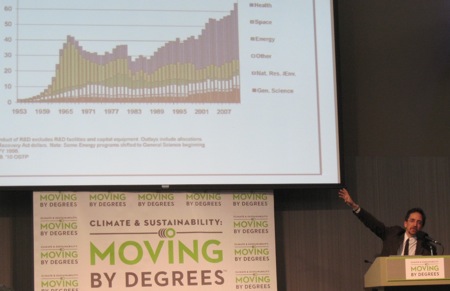
Meanwhile eminent climate scientists, social scientists and journalists assembled in SoCal this week, in part to ask the question: “What will it take to precipitate meaningful policy responses to climate change?” The answer from author Stewart Brand was succinct: “It takes warfare.” Brand was part of a panel at “Moving By Degrees,” a day-long forum hosted by American Public Media’s Marketplace program. Brand, who describes himself as an “ecopragmatist,” has concluded that when the planet’s “carrying capacity” is strained to the point where nations and peoples are fighting over dwindling resources, only then will coordinated international action begin in earnest.

Brand’s dim view was shared by physicist-turned-blogger Joe Romm, who said that while current US policy is driven by “denial,” he sees a coming shift in which people move “from denial to desperation.” That, says Romm, will be the catalyst. “Denial makes easy things hard and desperation makes hard things easy,” he said. Romm says he expects the desperation phase to set in about a decade from now, when extreme weather events and other likely manifestations of climate change intensify and become more frequent. Romm challenged the notion that technology will provide an easy solution to climate change and defied the gathering to come up with one “game-changing” technological breakthrough in energy, over the past three decades.

New York Times blogger Andrew Revkin points to a graph that shows the relatively low level of US R&D funding devoted to energy.
New York Times blogger Andrew Revkin points to a graph that shows the relatively low level of US R&D funding devoted to energy (it's the little green squiggle in the middle). Photo: Craig Miller

Romm and Brand were joined by two high-profile climate scientists, Ben Santer of Lawrence Livermore National Lab and Michael Mann, who directs the Earth System Science Center at Penn State; social scientists Naomi Oreskes of UC San Diego and Eileen Claussen, President of the Pew Center on Global Climate Change and Strategies for the Global Environment; as well as commentators from business and investment groups.

Most agreed that “putting a price on carbon,” through cap-and-trade or some other means, is an essential, if overdue policy step. Analyst Bruce Kahn of Deutsche Bank issued a plea for a coherent policy on carbon pricing. “You can’t put a policy in place today and change it tomorrow,” said Kahn. “A carbon price needs longevity and certainty so companies will add it to their business models.” Once that happens, Kahn said there’s “a massive amount of capital out there looking for a place to go,” and that investment capital will flow to where stable policies exist. Mindy Lubber, president of the CERES investor group, went a step further: “We are losing the jobs and opportunities right now in the clean tech sector,” said Lubber, “because we don’t have the right market signals in place.”

Brand also had some advice for environmentalists, which he says have become “the cohort of the Left:” Brand said “We need to de-tribalize,” and he offered that “The best thing Al Gore could do is shed the Democratic party.”

All of the day’s sessions are archived at the Marketplace conference website.

Bay Area Planners Get Greenhouse “Guidelines”

The San Francisco Bay Area is among the first metropolitan areas in the nation to set up local developer guidelines for greenhouse gas (GHG) emissions.

Craig Miller
Photo: Craig Miller

The new rules, passed Wednesday by the Bay Area Air Quality Management District, mean that developers planning anything that will produce GHG emissions above certain thresholds will face an environmental impact review. For “stationary” sources, projected emissions above 10,000 metric tons (tonnes) per year will now trigger an EIR under the California Environmental Quality Act (CEQA). For other, “non-stationary” projects, the trigger is set at 1,100 tons per year or 4.6 tonnes per person affected, such as residents or workers.

The GHG thresholds are coupled with similar triggers for local pollutants such as particulates and for some emissions that play a role in both local air quality and warming, such as nitrous oxides (NOX). Air District spokesman Aaron Richardson couldn’t confirm that the first-in-the-nation status applied to the GHG guidelines, but that it placed the Bay Area “among the first.”

District chief Jack Broadbent said, in a release, that they “provide a blueprint for local agencies to use in making smart development decisions that protect residents from harmful air emissions and greenhouse gases.” Broadbent said the rules will be “especially protective of communities that already have significant air quality concerns.”

Exactly how they’ll be applied is something that even Air District staffers had a tough time explaining. Abby Young, an environmental planner at the District, who worked on the guidelines, explained that 10,000 tonnes per year is a benchmark that might be associated with a major expansion of an oil refinery. She said 1,100 tonnes per year is more or less the level of GHG emissions associated with a typical 50-home suburban housing development, but that vehicle trips in and out of the neighborhood would also be counted toward the threshold. “It’s a very complex, multi-layered thing,” she said.

The complete guidelines are available as a PDF download from the Air District’s website.

Fire Data: Dry Winters Mean More Charred Acres

Tim Walton
Photo: Tim Walton

Last year around this time, I asked some state fire officials what to expect in terms of the fire season and got a definite “It depends.” On the one hand, scant precipitation over the winter had left behind a dry landscape. On the other hand, spring rains had given a boost to rebounding vegetation, providing more fuel for later in the season. I was reminded of the old joke about politicians searching for a “one-handed economist” and found myself wishing for a one-handed forester.

Whether a good spring dousing is more likely to inhibit wildfires or feed them is a common source of confusion, which San Jose Mercury News writer Paul Rogers has sought to extinguish. By dipping into four decades of fire data, Rogers and his researchers at the Merc conclude that dry winters generally make for more intense fire seasons in California.

Rogers writes that “the worst fire seasons come after dry winters, not wetter ones like the one we’ve just had.” That would seem to bear out a conversation I had in 2007 with Crawford Tuttle, Chief Deputy Director at CalFire, fire protection arm of the state’s department of forestry. Walking through the burn zone of a Sierra wildfire that broke out in May of that year, Tuttle said that early-season fire was “a great demonstration of how (the) fire regime–fire severity is expanding in California.” Tuttle told me that when moisture levels in the air, vegetation and soil are lower, earlier in the season, it’s likely that the fire season will be intense.

The preceding winter had been dry by historical standards, with just over half the normal amount of precipitation and indeed, wildfires went on to char almost a million acres in the state that year.

Population: The “Other” Climate Debate

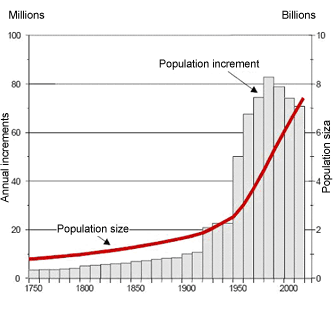
Recently I saw a startling graph, plotting world population from the Middle Ages to projections for 2050. The red line remains relatively flat for several centuries, starts ramping up around the time of the 19th century Industrial Revolution, and then takes off like a Roman candle right about the time of my own birth, in the mid-1950s. Granted, the steep rise was enhanced by the drawn-out time scale of that particular graph. As you shorten the time frame you’re looking at, the slope flattens out. But the numbers paint a sobering picture on their own.

A world population graph similar to the one I saw. Image: United Nations
World population from 1750 to 2020. Extending the curve leads to 9 billion people by 2050. Source: United Nations

I decided to plot some of my own family history against that curve. When my father entered the world on the eve of the Great Depression, there were barely two billion people populating the globe. By the time I came along, the number had nudged above three billion.  This was America’s legendary Baby Boom and the beginning of the Roman candle phase (an exponential growth trajectory which continues today). Should I be so fortunate (or unfortunate) to make it to my own century mark, demographers project that by then (2055), the Earth will be asked to support more than nine billion people. That’s a tripling of the world’s population just in my (theoretical) lifetime.

Population growth seldom takes center stage in discussions of climate change, though the connection is undeniable (heck, nine billion people just breathing is a lot of CO2).

Pakistan87712955_blogBiologist William Ryerson, President of the Washington-based Population Institute, says that population growth is “not an inconsequential impact on the climate crisis.” But breathing is not the problem; it’s consumption. Appearing on KQED’s Forum program with Michael Krasny, Ryerson said that were that prediction of nine billion people by 2050 to be realized, it would be “the climate equivalent of adding two United States to the planet.”
Ryerson, who also heads the Population Media Center in Vermont, says we’ll be lucky to make it to nine billion. Ryerson said that in his view, “the resources just aren’t there,” for a doubling of the current population. He cites research by Stanford biologist Peter Vitousek, indicating that humans are already appropriating half of the total global “products of photosynthesis, i.e. all green plants.”

It seems that after decades of being dismissed by mainstream economists, 18th-century philosopher Thomas Malthus is getting a fresh hearing. Malthus made his reputation as a doomsayer in 1798, when he wrote that “the power of population is indefinitely greater than the power in the earth to produce subsistence for man.”

As procreation and climate change accelerate in tandem, the two forces may place a double bind on basic resources like water (see also Gretchen Weber’s post on “peak water“). Ryerson, who recently visited Pakistan, says that nation currently has 20% of the water that they had 50 years ago, on a per-capita basis, and “they’re on a 30-year doubling time,” meaning 368 million people by 2040.

The entire Forum program is available online.

The Solar Jobs Solution: Some Perspective

As anyone who got stuck in the traffic knows, President Obama made a call at one of the Bay Area’s new darlings of green tech, Fremont-based Solyndra Inc., which he called a “testament to American ingenuity and dynamism.”

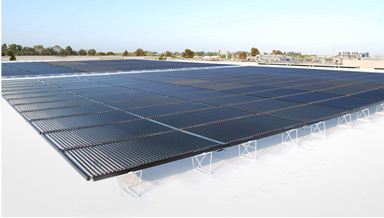
The firm is tapping more than a half-billion dollars in federal loan guarantees to build a manufacturing plant for its photovoltaic (PV) technology. Governor Schwarzenegger and Energy Secretary Steven Chu have also used Solyndra as a backdrop for showcasing California’s burgeoning clean tech sector. The company has developed a new type of PV technology designed for commercial rooftops.

Solyndra's rooftop solar panels use a new type of cylindrical module. Image: Solyndra, Inc.

Today in Silicon Valley, the big, green hype machine was running at full tilt. Solyndra’s CEO, Chris Gronet, talked up the California location. “If our factory was someplace else (outside the US), we probably would not have the supply chain across 29 US states,” he told KQED’s Cy Musiker today.

Mike Mielke of Silicon Valley Leadership Group added to the frenzy: “Clearly California’s leadership in the emerging trillion-dollar clean energy technology market has put us in an ideal investment position,” he said in a statement issued after the Presidential appearance.  “We would not be as competitive without the state’s landmark clean energy policies like AB 32.”

But some temperance was injected into the festivities by Severin Borenstein, co-director of the Energy Institute at UC Berkeley’s Haas School of Business. Asked if investments in solar panel production necessarily translate to permanent job growth, he told Musiker: “The evidence from a longer-run perspective really doesn’t support that.”

Borenstein says what history does demonstrate is that dominance in a given technology lasts just about as long as the government subsidies supporting it. He pointed to both Germany and Spain, both of which have recently lost some of their edge in production of solar components. Much production of solar and wind energy products has already moved to China.

“This idea that you’re going to create a permanent competitive advantage in producing green technology by subsidizing it now is really not very well born out in the data,” said Borenstein, who doesn’t deny that federal stimulus funding has “helped push forward” some key technologies. In the absence of a meaningful price mechanism for carbon emissions, Borenstein says that “pushing forward on some of these alternative technologies is the best thing we can do.”

Regarding California’s landmark climate law, the aforementioned AB 32, Borenstein agrees with the state’s Legislative Analyst that implementation would not have a significant impact on California’s overall economy, in either direction. But Borenstein doesn’t see the point in abandoning the state’s primary comprehensive climate strategy to save jobs, as some have suggested it would. “Climate change is real and it is potentially catastrophic,” said Borenstein. “If every time we have an economic setback, we put the environment second, we’re never going to make any progress.”

Series Explores 33×20 Renewable Energy Goal

California has set some ambitious targets for ramping up renewable energy sources. Some say too ambitious. Utilities won’t make the first milepost of 20% renewable power by this year, and many are skeptical that the longer-term goal of 33% by 2020 is doable, either, the executive order signed by Governor Schwarzenegger in 2008 notwithstanding.

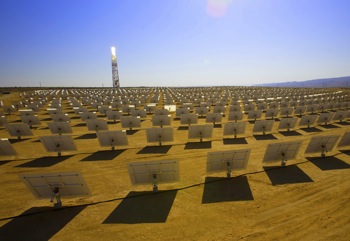
A thermal-solar array of the type planned for southern California. Photo: Brightsource Energy
A thermal solar array of the type planned for southern California. Photo: BrightSource Energy

A major hurdle is the permitting process for large “utility-scale” solar and wind installations, described by the Governor’s own senior advisor as “tortuous.” In the months ahead, we’ll take you through some of the obstacle course in a multimedia series called “33 x 20: California’s Clean Power Countdown.” A collaboration of Climate Watch and Quest, KQED’s science and environmental initiative, the series of radio reports and web features explores the promise and pitfalls of the state’s 33 x 20 plan.

The series begins Monday with Lauren Sommer’s review of California’s clean power legacy and an assessment of the present push. Future reports will look at a solar siting case study in central California, as well as prospects for major development of wind and geothermal sources. California currently leads the nation in solar generation but trails Texas and Iowa in the race for wind power. See Lauren’s interactive map for an overview of how California stacks up against other states in its ambitions toward renewable energy.

Future reports will examine the potential impact of large-scale power generation on deserts and tribal lands and the progress toward what some consider the “holy grail” of energy technology; large-scale storage of electricity. In June, Quest Senior Editor Andrea Kissack and I will team up for a kind of case study in one company’s ambitions; the 4,700-acre photovoltaic array planned by Solargen Energy for Panoche Valley in San Benito County.

Northern California listeners can hear the radio series as part of KQED’s Quest radio service (airs Mondays during NPR’s Morning Edition on KQED and KQEI in Sacramento) or statewide on The California Report. You can follow the entire series and see the related web features as they appear on our “33 x 20” series page.

California Slogs Toward Cap-and-Trade

Dispatch from the bureaucratic trenches:

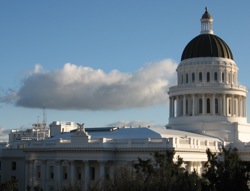
A cloud settles over the state capitol. Photo: Craig Miller
Clouds linger over California's cap-and-trade future. Photo: Craig Miller

The notion may be losing momentum in Washington but in Sacramento, California’s Air Resources Board continues the trudge toward a carbon trading program mandated under the state’s 2006 climate law, AB 32. This week its staff held the latest in a series of public meetings to discuss “program development” and “allowance allocation.” The topic may be a certified snore for most people but the CalEPA auditorium in Sacramento was nearly packed with representatives from utilities, environmental groups, public health advocates and an assortment of other interested parties, many with diametrically opposed views of how carbon allowances should be meted out for trading.

One of them was Chris Busch of the Center for Resource Solutions, who gave voice to a contingent disillusioned with what they read as momentum toward giving away allowances to industry. Busch coined what was probably the phrase of the day, accusing the Air Board of some “creative re-framing” of how carbon allowances might be distributed. Environmentalists have been pushing for something close to a “100% auction” of permits, while many business interests are hoping to get them free of charge, at least in the early stages of the program.

To many in the room, the update from the Air Board staff appeared to indicate a drift toward free permits. The Board’s Kevin Kennedy stressed that the staff had never come out officially for a 100% auction and said they’re “taking a close look” at how best to distribute them. His colleague, Matt Zaragoza put it more bluntly, saying “We’re strongly considering the need for free allocations.”

Regarding the state’s plan to join in a regional carbon market with several other states and some Canadian provinces known as the Western Climate Initiative, Kennedy insisted that “reports of it’s death have been greatly exaggerated.” But when pressed on how many US states are actually prepared to move forward, he confirmed that only New Mexico is in lockstep with California. Arizona’s governor recently signed an executive order pulling that state out of the proposed regional carbon market.

Here in the Golden State, industry is still angling for anything it can get to keep emissions fees to a minimum. Some complain that valid considerations are being left out of the plan.

“A lot of us are producing products today that are very focused on energy savings.,” said Phil Newell, who heads energy and environmental affairs for Guardian Industries, a maker of “low-E” glass products which promote energy efficiency. Newell says that a system of traded carbon permits and offsets should account for the energy savings achieved by his company’s products. “Every time we use a unit of energy in producing a coated product, we’re reducing 500 units of pollution elsewhere,” Newell claimed in a hallway interview. “We need some recognition of that.” Newell said that without that recognition, the high cost of carbon allowances might force his company to shut down manufacturing in California. Guardian operates a plate glass manufacturing plant near Fresno.

The Air Board’s staff says it is pushing for a “design document” describing a plausible allowance system by mid-summer.

The Rain in May Falls Mainly Near the Mean

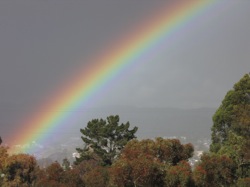
Rainbow following late spring rains in Vallejo. Photo: Craig Miller

Just a passing admonishment from meteorologist Jan Null, who keeps meticulous, often eye-opening records of weather patterns in northern California: We can stop talking about the “unusual weather” we’ve been having.

In California’s Mediterranean climate, precipitation tapers off to virtually nothing between June and October. So any rain this close to the end of “the rainy season” tends to create some buzz.

But Null, a former forecaster with the National Weather Service and founder of his own weather consulting firm, pointed out in an email this week that “the amount and number of days (with rain) so far in May are right near the 30-year normals for San Francisco and San Jose.” Null confirmed for me this morning that:

“So far in May, San Francisco has had three days of rain for a total of 0.44 inches.  The May normal is 3.3 days of rain for a total of 0.54 inches.  Last year, there were 5 days of rain for a total of 0.80 inches.  Even if there is a little more rain (this week), it will be pretty close to a normal May.

Similarly in San Jose the normal is 0.44 inches in 3.0 days. So far in May 2010 there have been three days of rain totaling 0.19 inches.  Last year San Jose had 0.09 inches over three days.”

By George, I think we’ve got it.

The Bay Area’s weather has been unusually cool, however. Null says the April-May period could end with “dramatic cool averages.” He says average daily highs for the two months could be “on the order of three to five degrees below normal.”

Null regularly updates local weather statistics on his website.