All posts by Craig Miller

Craig is a former KQED Science editor, specializing in weather, climate, water & energy issues, with a little seismology thrown in just to shake things up. Prior to that, he launched and led the station's award-winning multimedia project, Climate Watch. Craig is also an accomplished writer/producer of television documentaries, with a focus on natural resource issues.

National Panel Backs State Climate Efforts

A hefty stack of reports issued by a top national science board appears to affirm California’s response to the challenges of climate change.

The National Research Council, an arm of the National Academies of Science today released three reviews of the current climate science, each focusing on a different aspect of it. The first report, a 400-page assessment of the state of the science, affirms the prevailing view among scientists that global warming is proceeding apace, propelled largely by emissions of greenhouse gases, and that some of the early impacts are already upon us.

Stanford’s Pamela Matson, a specialist in biogeochemical ecology and lead author of the science assessment, said these conclusions are supported by “multiple lines of evidence” and have “stood firm” in the face of intense scientific scrutiny. Matson conceded, however, that much uncertainty remains in the science, and that the credible range of global warming projections runs from two, to eleven degrees, Fahrenheit, by the end of this century.

Two companion reports focused on mitigation and adaptation strategies, respectively (for a closer look at the latter, see Nicole Heller’s post at Climate Central).

Robert Fri, who led the NAS panel on “limiting the future magnitude of climate change,” said that federal policies should “enable flexibility and experimentation in policies at state & local level.” Fri cited California and Alaska as leaders in climate response policy at the state level. Mary Nichols, who chairs California’s Air Resources Board and effectively heads the implementation of the state’s climate strategy, also sits on the “Limiting Panel” of the NAS review. Nichols has been a vocal promoter of state and regional efforts, such as the Western Climate Initiative.

When queried about pending federal legislation that might nullify state programs to regulate carbon, Fri said that “the bar ought to be pretty high for federal preemption. States have already done a lot,” he said, and it’s important not to act in a way that reverses the progress.”

Likewise Fri’s colleague, Tom Wilbanks, head of the study’s adaptation panel, said that what’s needed is “not a federal response but a national response,” and that Washington’s role should be to “create a framework” of policies and resources that “reinforce each other rather than get in each others’ way.”

The recommendations come as California’s sweeping 2006 climate strategy, known widely as AB 32, is under attack from Republican gubernatorial candidates and a well-funded initiative campaign to suspend most regulations under the law. Likewise both the House and Senate bills pending in Washington would either preempt or temporarily freeze state programs to reduce carbon emissions.

Fri also provided the morning’s most eyebrow-raising moment when he said that current technology will not be up to the task of reducing warming.  “We can’t get there by just deploying what we know how to do,” he said, noting that brand new technologies will be required. “And we probably won’t be doing it at least cost,” he added.

The NAS reports released today do not recommend specific targets for GHG emissions. The three reports are the first in a series of five requested by Congress as part of the program called America’s Climate Choices.

A webcast of the one-hour public rollout of the reports is available at the NAS website.

Another Whack at a Federal Climate Bill

87767226The latest version of a federal climate bill sets a series of national targets for greenhouse gas emissions and would halt California’s plans for state and regional carbon trading.

Unveiled by Senators John Kerry and Joe Lieberman today, the American Power Act aims to push GHG emissions down to slightly below 2005 levels by 2013, then sets a longer-term reduction timetable of 83% (of 2005 levels) by 2020, 58% by 2030, 17% by 2050 (or to flip it around, an 83% reduction from 2005 levels by 2050), in line with the promise that President Obama made following the “Copenhagen Accord.”

The 987-page bill regulates seven greenhouse gases, with room for the Environmental Protection Agency to add others under the Clean Air Act. The cap-and-trade provisions focus on “7,500 factories and power plants,” which is to say those that put out more than 25,000 metric tons of carbon per year. That’s the same benchmark used by the federal EPA in its proposed regulations.

Like previous drafts, this one nullifies state and regional carbon regulation, setting up “one clear set of rules” for industry and providing “compensation for the revenues lost as a result of the termination of their cap-and-trade programs,” such as California’s AB 32, and regional efforts, such as the Western Climate Initiative. California’s Legislative Analyst has estimated that the state has committed about $120 million so far, to the implementation of its 2006 climate law. California regulators have already weighed in on the concept of “federal preemption,” warning against leaving the job of carbon reduction to the federal government alone. The Kerry-Lieberman bill requires “consultation” with states that currently have their own emissions plans.

Significantly, the first several sections of the Senate bill address development of energy sources. The reduction goals for greenhouse gas emissions aren’t even spelled out completely until page 265. Energy provisions that may come to bear on California policy include:

Agribusiness:

– All farms appear to be exempt from cap & trade but benefit from offset programs

Oil Industry:

– According to a summary of the bill from Kerry’s office: “Producers and importers of refined products” will get a fixed price for their carbon allowances.

– Offshore drilling is included as part of the energy strategy but states can prohibit leasing within 75 miles of the coast

Nuclear Power:

– Provides several incentives, including an “expedited procedure for issuing combined construction & operating licenses for qualified new nuclear reactors.”

– Increases loan guarantees to $54 billion

Missing from the bill is a comprehensive national strategy for storage of spent nuclear fuel, an unresolved issue that prevents California utilities from any expansion of nuclear power.

Governor Schwarzenegger issued a statement that barely acknowledged federal preemption, saying only that “California has been an unparalleled leader in clean energy, pioneering policies that have benefited the entire nation, and we must be able to continue our important, groundbreaking work that will both improve the environment and help our economy.”

Some environmentalists have already responded with raspberries. In a statement based on draft summaries of the bill, the group Friends of the Earth called it “dangerous,” claiming that the bill would “scrap crucial tools for solving the climate crisis” and provide “billions in giveaways to corporate polluters.” In a statement from the Environmental Defense Fund, on the other hand, its western regional vice president said that the bill’s announcement “marks real progress in the fight against climate change.”

Andrea Seabrook reported on the bill’s rollout and prospects for NPR’s All Things Considered.

California Scientists Join Climate Appeal

More than 50 California-based scientists are among those who signed a letter protesting “McCarthy-like” attacks on climate scientists in the United States.

The letter was published in this week's issue of the journal Science.

The letter, circulated as a kind of petition to selected members of the National Academy of Sciences (NAS), is both a defense of established climate science and a counter-offensive against an increasingly vocal community that rejects that science and some of the proposed policy responses. The letter asserts that the signatories are “deeply disturbed by the recent escalation of political assaults on scientists in general and on climate scientists in particular.”

Steering the core group of scientists behind the letter (full text and list of signatories available as a PDF download) was Peter Gleick, who heads the Pacific Institute in Oakland. Gleick, whose primary focus is on water policy issues, has been an outspoken defender of the prevailing climate science and has, on occasion, answered critics on this blog. Gleick declines credit as the sole author, saying it was written by a group of a half-dozen co-authors.

Other excerpts:

“Many recent assaults on climate science and, more disturbingly, on climate scientists by climate change deniers, are typically driven by special interests or dogma, not by an honest effort to provide an alternative theory that credibly satisfies the evidence.”

“The Intergovernmental Panel on Climate Change (IPCC) and other scientific assessments of climate change, which involve thousands of scientists producing massive and comprehensive reports, have, quite expectedly and normally, made some mistakes. When errors are pointed out, they are corrected. But there is nothing remotely identified in the recent events that changes the fundamental conclusions about climate change…”

The letter concludes by calling for “an end to McCarthy- like threats of criminal prosecution against our colleagues based on innuendo and guilt by association, the harassment of scientists by politicians seeking distractions to avoid taking action, and the outright lies being spread about them.”

A total of 255 scientists signed the letter, which was published this week in the journal Science (available by subscription only). High-profile signers include Paul Ehrlich and Stephen Schneider, both based at Stanford.

Perhaps just as interesting as who signed the letter is who did not. Missing are several luminaries in California climate science circles, such as Dan Cayan and Richard Somerville of the Scripps Institution, and Ben Santer at Lawrence Livermore National Lab. Santer has participated in media calls organized to defend findings of the IPCC. Santer has served as an IPCC lead author.

Gleick explained to me that the letter was circulated only to NAS members listed in climate-related disciplines. From a check of the proprietary NAS member database, it appears that Cayan and Santer are not members. Also missing from the signatories is Stanford’s Chris Field, who is engaged in preparing the next IPCC report. Field has been an NAS member since 2001.

According to Gleick, a few declined to sign as they were “involved in ongoing assessments” for NAS when the letter was circulated and wished to avoid any apparent conflicts of interest. Gleick admits that scientists walk a precarious line when they cross over from research into activism, but says sometimes it’s justified. “It’s important that scientists speak out when an issue is as important as climate is,” he said.

AB 32 Stopper Headed for Ballot

It looks like there will be a measure on November’s statewide ballot to block full implementation of California’s greenhouse gas regulations.

Groups supporting the measure they call the “California Jobs Initiative” claim they gathered more than 800,000 signatures, nearly twice what they needed to qualify the proposal as a statewide referendum.

The existing climate law, known widely as AB 32, allows for the Governor to declare an emergency suspension of up to one year. But John Kabateck, who heads the California branch of the National Federation of Independent Businesses, says small businesses in particular can’t wait to see what the next governor might do; that the measure is needed to “stop the madness.” Kabateck said it’s time to “just push the pause button and please stop loading small businesses with new costs, new mandates and new regulations at a time when we need to crawl out of the hole.”

Studies have reached varying conclusions about what effect the state’s current regulatory path for carbon emissions would have on the California economy. Opponents of the measure have already formed their own campaign, trying to keep momentum behind the three-year-old climate law known as AB-32.

Steve Maviglio, who works for the the pro-AB 32 Californians for Clean Energy and Jobs, formed to oppose the ballot initiative, says he doesn’t think all those signatures necessarily signify broad support. “I think what that represents is the travesty of the initiative system and how out-of-state oil companies can buy their way onto the ballot,” he told me, in a telephone interview. The push to get the measure on the ballot has been financed largely by Texas-based oil companies and a somewhat obscure organization called the Adam Smith Foundation, based in Missouri.

“It took them $2 million to round up these signatures” said Maviglio. “And if you look at every single poll, you can see that Californians know we can have both clean air and a strong economy, and that we’re not going to be fooled by Texas oil companies,” he added.

The proposed ballot measure would freeze AB-32 until the state’s unemployment level dropped to five-and-a-half percent—or lower–for one full year. That’s something that’s happened only three times since the mid-1970’s: once in the late 1980s (for about ten quarters), a similar stretch in the late ‘90s, and once in 2005-06. After the deep recession of the early ‘80s, it took the state’s unemployment rate about four-and-a-half years to move from its 11% peak back to the 5.5 percent threshold.

Governor Arnold Schwarzenegger today called the effort to halt AB-32 “the work of greedy oil companies.”

East Coast Leads Offshore Wind Derby

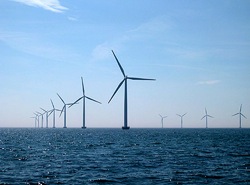
The Nysted wind farm off Denmark. Image: Cape Wind Assoc.

The nation’s first offshore utility-scale wind farm has won federal approval but it was no slam dunk. The Dept. of Interior has approved the 130-turbine Cape Wind project, off Nantucket.

The plan launched such an epic debate that at least one book has been written about it. Today’s nod comes just weeks after a federal advisory panel recommended against approval and doesn’t necessarily mean the project will go forward. Opposition groups have already vowed to go to court.

Cape Wind is just one of numerous offshore wind projects under consideration for the East Coast and Great Lakes region.

Permitting for most wind projects in California comes under local jurisdiction but a spokeswoman at the California Energy Commission told me that to her knowledge, no offshore wind projects are currently under review for California. An obstacle often cited is the extreme ocean depths off California, which make construction difficult. Various wave power projects have been proposed for the coastline.

A (PDQ) PDO Primer

The term “PDO” is coming up more often in climate discussions. What it is and why it’s being bandied about are explained in this post from our content partners, Climate Central.

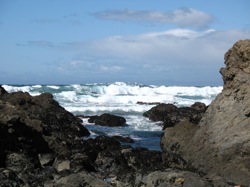
Surf along California's Mendocino Coast. Photo: Craig Miller

Did Someone Say “PDO”?

By Heidi Cullen, Phil Duffy and Claudia Tebaldi

Earlier this month, The New York Times ran a page-one story looking into why climatologists and TV meteorologists are at odds over global warming.

The article, which quoted one of the authors of this post, pointed out that while climate scientists almost universally agree that human activities, such as the burning of fossil fuels, are warming up the planet, a significant percentage of TV meteorologists do not. In fact, a recent study from George Mason University and the University of Texas at Austin showed that out of 571 TV meteorologists surveyed, only about half believed that global warming was happening and fewer than a third accepted the proposition that climate change was “caused mostly by human activities.” The survey also suggested that TV meteorologists view climate change as mostly a natural phenomenon.

Joe Bastardi, a senior meteorologist at AccuWeather, stands squarely in the natural causes camp, and he offered up his own explanation recently on Comedy Central’s The Colbert Report. On the comedy show, Bastardi said the global warming trend is just temporary and caused by a mix of volcanic activity, solar cycles, warmer ocean temperatures and specifically a natural climate pattern known as the “PDO” or Pacific Decadal Oscillation.

Bastardi has provided a great opportunity to educate the public about climate change. And as climate scientists, we’d like to take a moment to talk about natural climate variability specifically.

The solar cycle and volcano arguments Bastardi gravitates toward are fascinating. But when it comes to climate change, these natural sources of climate variability are incapable of doing the heavy lifting. In fact, they’ve been raised, tested, and solidly laid to rest by the climate science community. Variations in solar output are too weak, and in any case repeat every 11 years, and so cannot explain a steady warming trend over 40+ years. As for the volcano argument, eruptions are also too puny. Globally,volcanoes, like Iceland’s Eyjafjallajokull volcano as well as those under the sea release a total of about 200 million tonnes (metric tons) of CO2 annually.

That may sound like a lot, but it’s trivial when compared to human activity. According to the U.S. Department of Energy’s Carbon Dioxide Information Analysis Center (CDIAC), global fossil fuel CO2 emissions for 2003 tipped the scales at 26.8 billion tonnes—over 100 times more. Let’s just say human activity can bench press a whole lot more warming than the sun’s variations and volcanoes combined.

Before we move on to the role of the Pacific, we want to first thank Bastardi for daring to mention the phrase P-D-O on television. While geeks like us find the Pacific Decadal Oscillation fascinating, alphabet soup has a tendency to make the public’s eyes glaze over.

The PDO is just one of many natural oscillations in the climate system. It is characterized by a positive or “warm”  phase, and a negative or “cool” phase, which refer to the pattern of anomalies in sea surface temperatures and air pressure between the north central Pacific Ocean and the northeastern Pacific. The El Niño/La Nina cycle, for example, is another natural oscillation. Its period, about three-to-seven years, is shorter than the PDO’s, but in fact, the PDO is often thought of a slower version of El Niño, as some of the manifestations are similar.

Image: NOAA

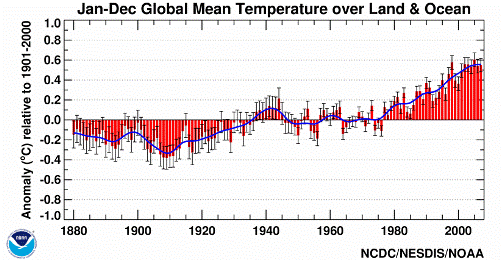
For example, in the warm phase of the PDO, temperatures in the northwest region of North America tend to be warmer than average, while the southeastern U.S. tends to be cooler than average. Bastardi believes the warming trend (shown below) is only temporary because the phase in which the PDO has predominantly been at the same time, with its warmer than average tropical Pacific Ocean temperatures, is temporarily juicing the system. He forecasts the global temperature trend will dip back down once the PDO shifts back.

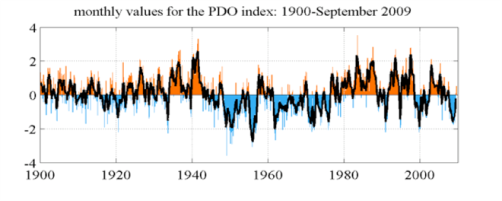
blog_monthlyPDOHere’s the problem. First and foremost, while the PDO is important in driving regional climate variations, it has no clear effect on global temperatures. And although the PDO was in its warm phase during the majority of the time from the mid 1970s to the present, it also shifted sharply in multiple instances (see chart), which is inconsistent with the steady global warming trend during the same period. For example, the decade from 2000 to 2009 was the warmest on record globally, but the PDO was not positive throughout that period.

It has been said that the truth is stubborn. This idea gives climate scientists a small sense of relief in that eventually, the stubborn truth will be recognized; that the recent global warming trend is real and caused mostly by human activities.

References for this article are shown in the original post at Climate Central.

States Bridle Against “One-Size” Carbon Rules

Next week the US Senate will take the wraps off a long-awaited national energy and climate bill, which–even before its unveiling–is already making California businesses and regulators nervous.

Though exact language has not been revealed, the compromise bill reportedly includes sections that would nullify state and regional programs to regulate carbon emissions. That does not sit well with Mary Nichols, California’s chief carbon regulator. “When it comes to energy policy and the environment, one size truly does not fit all,” Nichols told reporters in a Tuesday conference call. Nichols chairs the California Air Resources Board, which is the lead agency charged with implementing the state’s Global Warming Solutions Act, passed in 2006.

The state has already invested three years and more than $100 million dollars (approximately $40 million per year, according to a policy brief issued last week by the state’s non-partisan Legislative Analyst’s Office), laying the groundwork for sweeping new regulations, including a carbon trading scheme with several other Western states. The regional cap-and-trade program known as the Western Climate Initiative could also be jeopardized by the current Senate bill, though from most appearances, the program is already languishing.

Businesses also have much at stake. Jan Smutny-Jones heads the Independent Energy Producers Association, whose members generate almost half the electric power produced in California. “My members are making literally billion-dollar decisions about infrastructure that’s going to be around in California generating electricity or transporting electricity to customers for the next 40-50 years, and they kind of need to know sooner rather than later, in terms of what the actual rules of the road are gonna be,” Smutny-Jones told me in his Sacramento office on Monday. “Having the rules change is disruptive,” he said.

California Senator Barbara Boxer, who co-sponsored the first Senate version of the bill last fall, says she does “not support federal preemption” but also wants to avoid overlap between the state and federal systems. “It depends on how the bill is written,” Boxer told reporters at the recent state Democratic Convention. “I’ve had environmentalists say ‘Well if we do a trading system on the credits, we want one system, we don’t want two systems,’ so there’s some areas where it may make sense.”

Nichols offered little latitude in her remarks on Tuesday.  “We need to put down a marker here and remind the senators that they will not have an effective climate program without the states,” she said. “We don’t want there to be any room for doubt about whether states are permitted to do things that advance their economic and energy agendas.” Nichols cited large amounts of “green” venture capital flowing into California as fruit already borne by the state’s actions toward reducing carbon emissions.

The Senate bill is expected to be rolled out on Monday. Optimists are hoping that a finished bill could reach the Senate floor by June or July, according to a report from Reuters news service.

Stop-AB 32 Drive Draws Money from Farther Afield

87606151Environmentalists have registered much consternation over the fact that out-of-state oil companies have been bankrolling a ballot measure to freeze implementation of AB 32, backbone of the state’s climate strategy.
Today Anthony York updates the situation with the latest intrigue on his Capitol Weekly website.

The latest major contribution–nearly a half-million dollars–reportedly comes from a Missouri foundation with tenuous links to climate policy.

Planning Questions Persist Over Sea Level Rise

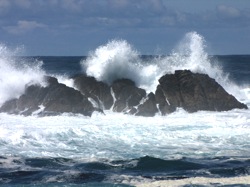
Heavy surf along the Monterey Peninsula. Photo: Craig Miller

Speakers at this week’s sea level planning conference in Oakland cited everybody from H. L. Mencken to Yogi Berra (“You can observe a lot just by watching”). But the primary insight from the event may have been courtesy of Robert Frost: “…miles to go before (we) sleep.”

About 225 representatives from industry, government and academia gathered at the behest of the non-profit Bay Planning Coalition.  The effort was to push forward a planning agenda to help prepare the Bay Area and coastal California for rising sea levels due to the changing climate. There is considerable uncertainty surrounding how much sea level rise we should expect in the decades to come. There were indications at the conference that planners were starting to coalesce around predictions of 16 inches by 2050, and 55 inches by 2100, projections embraced by the state’s formal climate adaptation plan.

Greater still is the uncertainty surrounding how governments, businesses and public agencies will respond to the challenge. Estimates are that rising seas threaten $100 billion of “economic assets” statewide, half of which are in the Bay Area. While most speakers seemed to agree on the urgency of mobilizing a coordinated planning effort, few seemed certain where to start.

The palpable frustration in the room was voiced  by, among others, Calla Rose Ostrander, Climate Action Coordinator with the City and County of San Francisco. “I think we’ve set ourselves up to need certainty, to make decisions,” she told me, saying that public agencies in charge of roads and development feel paralyzed. “When we apply for funding for these things,” explained Ostrander, they (potential funders) say ‘How are you planning for it?’ And we haven’t been advised yet on how to plan for it.” That dilemma was echoed by Paul Thayer of the California State Lands Commission: “You can’t engineer for a range of sea level rise,” he said. And yet that would appear to be the task.

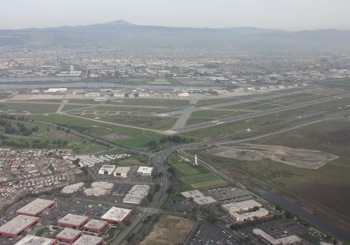
Oakland Int'l Airport, like much of the Bay Area's critical infrustructure, lies barely above sea level. Photo: Craig Miller
Oakland Int'l Airport, like much of the Bay Area's critical infrastructure, lies barely above sea level. Photo: Craig Miller

Funding is another area that remains fuzzy, amid all the inter-agency discussions, and one that was not substantively addressed at the conference. It is expected that rising seas will require billions of dollars in infrastructure upgrades. The Port of Oakland, for example, is awaiting the outcome of a study to determine what “perimeter defenses” will be needed to keep runways at Oakland International Airport above water.

Several speakers raised concern about rallying public support to confront a threat that is so diffuse. Will Travis, who heads the San Francisco-based Bay Conservation & Development Commission, predicted that “bringing it home” to households with more immediate worries will be the biggest challenge. And yet we can’t wait, warned Travis. “The longer we wait, the worse the problem becomes.”

Scientists as well as policymakers are pondering how to respond to rising sea levels. Nicole Heller of our content partner Climate Central recently attended a conference aimed at that end of the issue, and wrote about it in the Climate Central blog.

Sea Otters May Lose Taxpayer Buoy

This is the second in a series of posts on recent developments at the Monterey Bay Aquarium and its sister research institute.

A snoozing sea otter at Moss Landing. Photo: Craig Miller

An important source of funding for California Sea Otter research may be in jeopardy.

Since 2007, the California Sea Otter Fund has been one of several options for which state taxpayers could earmark money on their returns. That option may disappear. In order to maintain its slot on state tax forms, annual contributions need to attain a threshold set by the Franchise Tax Board. Lately, those donations have fallen about 25% short of the mark, currently set at more than $258,000. “It’s got to be the economy,” said Jim Curland, when I asked him if he could account for the lag. Curland works on marine programs for the non-profit Defenders of Wildlife, an organization that works closely with scientists investigating recent declines in the number of sea otters along the California coast. The otter fund competes with about a dozen other programs seeking donations on state tax forms.

Two California sea otters doze in the yacht basin at Moss Landing. Photo: Craig Miller
Water mummies: Two California sea otters doze in regal repose in the yacht basin at Moss Landing. Photo: Craig Miller

The Monterey Bay Aquarium spends about a million dollars per year on sea otter research, according to spokesman Ken Peterson, who notes that female otters in particular, have been in decline. Scientists are trying to fund tagging and tracking programs to better understand changes in sea otter populations. “Any money out there that helps get answers is critical to their survival,” he told me. The California sea otter is listed as “threatened” under the federal Endangered Species Act and has “fully protected” status under the California Fish & Game Code.

Curland says proceeds from the tax form donations are split between the state’s Department of Fish & Game and the Coastal Conservancy, which has helped fund a key study off of Big Sur.

If you’re looking for the climate connection here, don’t strain for it. I’ll confess to just being a sucker for the cause. But there may be one. Wildlife biologists at the US Geological Survey (USGS) and UC Santa Cruz, have postulated that as custodians of giant kelp forests, the otters may help optimize carbon sequestration.

Curland says the next three months will be crucial for the fund, as donations trickle in from late filers.