
Speakers at this week’s sea level planning conference in Oakland cited everybody from H. L. Mencken to Yogi Berra (“You can observe a lot just by watching”). But the primary insight from the event may have been courtesy of Robert Frost: “…miles to go before (we) sleep.”
About 225 representatives from industry, government and academia gathered at the behest of the non-profit Bay Planning Coalition. The effort was to push forward a planning agenda to help prepare the Bay Area and coastal California for rising sea levels due to the changing climate. There is considerable uncertainty surrounding how much sea level rise we should expect in the decades to come. There were indications at the conference that planners were starting to coalesce around predictions of 16 inches by 2050, and 55 inches by 2100, projections embraced by the state’s formal climate adaptation plan.
Greater still is the uncertainty surrounding how governments, businesses and public agencies will respond to the challenge. Estimates are that rising seas threaten $100 billion of “economic assets” statewide, half of which are in the Bay Area. While most speakers seemed to agree on the urgency of mobilizing a coordinated planning effort, few seemed certain where to start.
The palpable frustration in the room was voiced by, among others, Calla Rose Ostrander, Climate Action Coordinator with the City and County of San Francisco. “I think we’ve set ourselves up to need certainty, to make decisions,” she told me, saying that public agencies in charge of roads and development feel paralyzed. “When we apply for funding for these things,” explained Ostrander, they (potential funders) say ‘How are you planning for it?’ And we haven’t been advised yet on how to plan for it.” That dilemma was echoed by Paul Thayer of the California State Lands Commission: “You can’t engineer for a range of sea level rise,” he said. And yet that would appear to be the task.
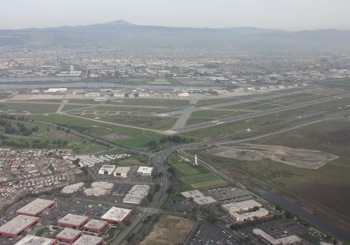
Funding is another area that remains fuzzy, amid all the inter-agency discussions, and one that was not substantively addressed at the conference. It is expected that rising seas will require billions of dollars in infrastructure upgrades. The Port of Oakland, for example, is awaiting the outcome of a study to determine what “perimeter defenses” will be needed to keep runways at Oakland International Airport above water.
Several speakers raised concern about rallying public support to confront a threat that is so diffuse. Will Travis, who heads the San Francisco-based Bay Conservation & Development Commission, predicted that “bringing it home” to households with more immediate worries will be the biggest challenge. And yet we can’t wait, warned Travis. “The longer we wait, the worse the problem becomes.”
Scientists as well as policymakers are pondering how to respond to rising sea levels. Nicole Heller of our content partner Climate Central recently attended a conference aimed at that end of the issue, and wrote about it in the Climate Central blog.