All posts by Craig Miller

Craig is a former KQED Science editor, specializing in weather, climate, water & energy issues, with a little seismology thrown in just to shake things up. Prior to that, he launched and led the station's award-winning multimedia project, Climate Watch. Craig is also an accomplished writer/producer of television documentaries, with a focus on natural resource issues.

The Escalating Conflict Over AB 32

Bearfight_blogCalifornia has had a climate change mitigation law on the books for more than three years now–but getting that law’s regulations fully in place is proving to be a tough slog.

Fans and mortal enemies of California’s Global Warming Solutions Act (AB 32) all exude certainty about what the carbon emissions-cutting law will do for–or to–the state’s economy. Lately the debate has escalated into full-scale PR warfare. Major battlefronts include:

– A signature campaign for a ballot initiative to suspend the law

– An online campaign to boycott oil companies funding the above

– Studies & surveys from both sides proclaiming their case

– A gubernatorial candidate who has vowed to suspend AB 32

This week both sides weighed in afresh.

The California branch of the National Federation of Independent Business today announced support of what proponents still call the “California Jobs Initiative,” even though the measure has been renamed by Attorney General Jerry Brown, who supports AB 32.

The measure would suspend most provisions of the climate law until the state’s official unemployment rate improves substantially from its current 12.5% level. NFIB statements say “the measure is headed for the November ballot” but only if proponents gather more than 400,000 required signatures.

John Kabateck, executive director of  NFIB/California said in a conference call with reporters today that his organization would help gather signatures to qualify the measure. He called the climate law “one more arrow in the quiver of damage and pain inflicted on small business right now.” In a companion news release, Kabatek ventured that full implementation of AB 32 would cost California more than a million jobs.

California’s non-partisan Legislative Analyst has concluded that while the exact job impact is hard to pin down, AB 32’s overall effect would be relatively minor compared to the state’s total economy.

Meanwhile, pro-AB 32 activists are circulating an online petition calling for a boycott of Valero and Tesoro, two Texas-based oil companies that are helping bankroll the suspension measure in California.

The NFIB announcement followed by one day the unveiling of a new poll showing support for AB-32 among California voters. The survey shows 58% of Californians “favor” the law either “strongly” (34%) or “somewhat.” One in four surveyed said they strongly opposed the measure. Sixty-four percent said they supported charging industry for excess emissions, while 31% opposed that. The poll was conducted in March by Field Research for Next 10, a public policy think tank that strongly supports AB 32.  Field polled about 500 voters for the survey, which has a margin of error of 4.5%.

Business is sharply divided over AB 32. The viewpoint of those wary of it is generally represented by the AB 32 Implementation Group. Other business leaders strongly support the law, including it’s cap-and-trade provisions. An outspoken example is Barry Cinnamon, CEO of Akeena Solar, who recently laid out his position for Alison van Diggelin, publisher of the Fresh Dialogues blog site.

In that conversation, Cinnamon skewered the “inane commentary” of  gubernatorial candidates calling for the undoing of AB 32. Republican candidate Meg Whitman has pledged to order a one-year “moratorium” on regulations under AB 32, on her “first day as governor,” calling the policy “wrong for these challenging times.”
NASA Looking More Earthward

Rachel Cohen is a Bay Area freelance writer, presently serving an internship with Climate Watch.

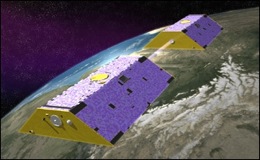
NASA's GRACE satellite is equipped to gather ice and water data on the Earth's surface. Image: NASA

To boldly go–where we already live

By Rachel Cohen

NASA will likely be focusing more attention on the “pale blue dot” in coming years, with a reinvigorated Earth Science Program. California’s freshwater supply and sea level change are among the features that will be studied by replacing an aging satellite.

The proposed White House budget for the National Aeronautics and Space Administration includes billions of dollars for satellites and other tech tools to help scientists investigate Earth-bound problems, especially climate change. Part of the program will be steered from Pasadena’s Jet Propulsion Laboratory, which will manage two key missions connected with the program. JPL spokesman Alan Buis says the White House support may provide stability for gathering the kind of long-term data sets needed to study gradual changes in earth systems.

As Jon Hamilton reports in his  story for NPR’s Morning Edition, the centerpiece of the program will be the GRACE satellite which will collect data critical for a variety of models and applications, including:

· The changing mass of polar ice caps
· Changes in water resources on land
· Shallow and deep ocean current transport mechanisms
· Sea level change resulting from ocean temperature and water mass changes
· Exchanges between the oceans and atmosphere
· Forces that generate Earth’s geomagnetic field, and
· Internal Earth forces that move tectonic plates and result in earthquakes and volcanic eruptions

GRACE has been in orbit since 2002 and is due to be replaced. NASA suffered a severe setback when its Orbiting Carbon Observatory (OCO) satellite crashed after its launch early last year. The White House budget includes funding to rebuild the vehicle and relaunch in February of 2013. The OCO2 satellite is designed to measure carbon dioxide in the atmosphere, specifically comparing sources of CO2 to “sinks,” where it is stored.

Research Vessel Docked for Lack of Funds

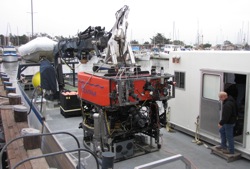
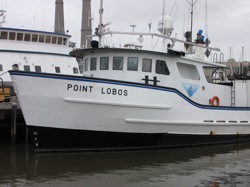
The research vessel Point Lobos, docked at Moss Landing. Photo: Craig Miller

Update: Since this original post, the status of the Point Lobos was updated by Paul Rogers in the San Jose Mercury News. The article also adds detail on the finances of MBARI and its primary funder.

The Monterey Bay Aquarium Research Institute (MBARI) has been forced to dock the workhorse of its research fleet, the R/V Point Lobos.

For years the vessel has ventured out three-to-five times a week, to conduct short-term experiments in the deep canyons of Monterey Bay. The ship serves as a platform for the Institute’s remote-control submarine, ROV Ventana. The Point Lobos and its robo-sub have played critical roles in recent experiments to study the effects of ocean acidification, among other endeavors.

In the late 1980s, MBARI converted the 110-foot vessel from its original duty as an oilfield service boat in the Gulf of Mexico. Since then it’s completed more than 3,500 missions, with its seven-person crew and various teams of scientists.

The remotely operated sub Ventana, perched on the afterdeck of the Point Lobos. Photo: Craig Miller

Institute spokesman Kim Fulton-Bennett says that as of April 1, the Lobos is “mothballed” for the time being, its future uncertain. “It means we won’t have as frequent access to the ocean as we did,” Fulton-Bennett told me, as we stood on the dock at Moss Landing.

“By going out several times a week, we’ve got a database of observations that goes back 20 years.”

But the Wall Street woes of the past couple of years have taken their toll on the investment portfolios of many foundations, including MBARI’s primary funder, the David and Lucile Packard Foundation, which Fulton-Bennett says has reduced it’s funding for MBARI.

H-P co-founder David Packard launched MBARI in 1987 with the goal of applying advanced technology to marine research. The Institute relies on the Packard Foundation for 80% of its funding, typically $30-to-40 million per year, according to the MBARI annual report.

The Institute has two other vessels in its research fleet, a converted pilot boat called the Zephyr and the 117-foot Western Flyer, a twin-hulled, ultra-stable vessel that resembles a catamaran-style ferry. The Flyer is deployed on longer-duration missions in open sea, usually with project-specific funding.

The Point Lobos is featured in Lauren Sommer’s radio report/audio slide show for KQED’s Quest series.

Hope, Skepticism at Renewables Conference

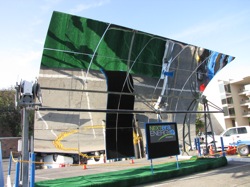
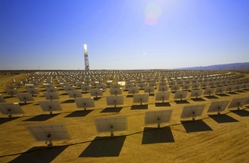
One section of a solar-thermal array on display at UC Riverside. Thousands of these mirrors gather solar radiation to heat a synthetic oil, which drives electrical generation at huge desert facilities. Photo: Craig Miller

Perhaps the most telling moment at the Governor’s Renewable Energy Policy Conference this week, was when the Governor’s own senior advisor on renewables, Michael Picker, asked for a show of hands. How many present, he wondered, actually thought that California would attain its goal of 33% renewable power by 2020. Amid the 370 or so gathered on the campus of UC Riverside, about a dozen hands went up. How many, he asked, thought we’d make it to 33% by 2050? Another dozen or so hands.

Bear in mind that this was a room containing some of the most knowledgeable people on the topic, from government, industry and environmental organizations. These were people invested in getting there, yet most seemed to doubt that we would.

Their pessimism was not entirely shared by the questioner. Picker told me afterward that he expected about 8,000 megawatts of new power to be approved by year-end. That’s approved, not necessarily financed. Solar arrays that generate 250 MW or more are considered large-scale operations.

Meanwhile, developers are pushing to get major projects approved before the year is out. To qualify for federal stimulus dollars, projects have to break ground this year and spend a certain percentage of project costs.

“It’s a hard state to develop in,” said Matt Handel, a vice president with NextEra Energy Resources. The Florida-based company is already a major player in both solar and wind generation in California, and Handel says the stimulus money is essential for two major new projects that NextEra has in mind for the southern California deserts.

“There is hope,” Handel told me. “It is difficult. There are a lot of constituencies out there pulling in different directions.”

Virtually all of those stakeholder groups were present in Riverside, in some form. Local (especially desert) communities, environmentalists, Indian tribes and representatives from federal agencies such as the Bureau of Land Management and National Park Service were there.

Identifying the most appropriate sites for large-scale wind and solar plants has been complicated by more than bureaucracy, said Kim Delfino, California Program Director for Defenders of Wildlife. “The landscape we’re working in is already changing due to the effects of climate change, which presents a challenge as to which areas to protect,” said Delfino in a panel discussion.

Picker says he’s “not so sure” that the state is doing the best possible job of moving projects efficiently through the pipeline (to borrow a metaphor from the fossil fuels era), and he conceded that some developers will be left standing in line as the year-end deadline expires. But he calculated that if, over the next five years, 20% of the biggest projects on the drawing board can get approved, the state should make its 2020 goal.

Governor Rejects LAO Jobs Report on AB-32

Governor Arnold Schwarzenegger said today that he’s “absolutely convinced” that California’s climate law “will create jobs more than kill jobs.”

“Unlike others that only have theoretical opinions,” he said, “I travel up and down the state and see first-hand.”  By “theoretical opinions,” the Governor appeared to be dismissing last week’s analysis by the non-partisan Legislative Analyst’s Office of the likely economic impact of the climate mitigation law, usually known by it’s legislative shorthand, AB-32.

But the report was hardly an unqualified downer. While the LAO concedes that “certain individual businesses and households…would be seriously affected,” the ten-page analysis presents a mixed bag of pluses and minuses, costing jobs in the near term but with potential long-term benefits. According to the report:

“The effects of the SP (Air Board Scoping Plan) on California jobs are difficult to accurately predict but would be mixed, with gains in some occupations and industries (including so-called” green” jobs) and losses in others (primarily involving fossil fuel-related energy production). On balance, however, we believe that the aggregate net jobs impact in the near term is likely to be negative, even after recognizing that many of the SP’s programs phase in over time.”

The report, issued in response to a request from state Senator Dave Cogdill (R-Fresno), is an assessment of California’s Global Warming Solutions Act, passed in 2006 to reduce greenhouse gas emissions, and set for full implementation in 2012. The law is under attack as a potent job killer, by a gubernatorial hopeful and a nascent ballot measure. Business groups are divided on AB-32’s overall effects.

The LAO report concludes that the law’s cap-and-trade program of carbon pricing “would almost certainly raise the near-term prices of electricity, gasoline, and certain other energy sources,” but at the same time, tighter energy efficiency standards for buildings would lower utility bills. Another measure, the low-carbon fuel standard, would raise the price of new cards but also reduce their operating costs.

Netting out the opposing effects of all these components is tricky business, involving a “complex model with hundreds of equations,” as described in the report. The LAO concludes that farther out on the time horizon, economic effects of AB-32 become fuzzier:

“In the longer term, its net effect on jobs-potentially either positive or negative-is unknown and will depend on a variety of factors. In a relative sense, however, its effect on jobs in both the near term and longer term will probably be modest in comparison to the overall size of the state’s economy.”

The Air Resources Board, California’s lead agency in implementing AB-32, initially projected the law would produce a net gain of 120,000 jobs in California by 2020. “They could be exactly correct,” LAO staff economist James Nachbauer told me, though his office isn’t putting its own number on the jobs effect. In it’s report, the LAO “questions the reliability” of the estimate in the scoping plan and concludes that the Air Board’s models “are not able to provide reliable estimates of the jobs impacts” in 2020. To meet it’s goals, AB-32 requires cutting emissions by about 15% from current levels, by 202o.

The Air Board has promised to provide a revised analysis, which LAO staffers say they expect to receive later this month. But as Nachbauer sums it up, “These weren’t created as jobs programs.”

DOI Setting Up Regional Climate Centers

Rachel Cohen is serving an internship at Climate Watch. She has written for the Oakland Tribune and San Mateo County Times.

AK_87676111_blogBy Rachel Cohen

The federal Deptartment of the Interior has selected the University of Alaska to host the first in a network of eight “regional climate centers” around the country.

In making the selection, Interior secretary Ken Salazar called Alaska “ground zero for climate change,” citing “rapidly melting Arctic-sea ice and permafrost, and threats to the survival of Native Alaskan coastal communities.” The center will be located in Anchorage.

Salazar said that in the weeks to come, DOI will be screening proposals for the next four centers, targeted for the Northwest, Southeast, Southwest and North Central regions.

The first center follows quickly the announcement in February that NOAA is establishing a National Climate Service. Modeled on its century-old National Weather Service, the NCS will also have a regional emphasis.

“The new service will give more structure and visibility to NOAA, changing the way money moves around, and resources can be brought to bear,” said Kelly Redmond, a climatologist with NOAA’s Western Regional Climate Center in Reno.

Redmond, who has been involved with the creation of the Climate Service for the past couple years, said the new service aims to provide decision makers, including state and local planners and policymakers, with the kinds of information they’ve been asking for.

That ranges from answers to “backyard questions,” such as looking up the climate of a new home’s location or whether to fodder for major business investment decisions.

Officials say the new federal service will work within the existing budget and appoint a director to each of six regions.  The Western Regional Climate Center, in Reno, where Redmond is based, is affiliated with the University of Nevada’s Desert Research Institute.

Roughly half of the total land area in the western US is federally managed. Much of it is arid and mountainous, with its own set of climate issues.  NOAA works with a matrix of state and federal agencies, some with overlapping jurisdictions.  The Climate Service will pull research from diverse sources under one umbrella.

Redmond says coordination of climate information is evolving along a path similar to that which led to the  creation of NOAA in the 1970s.  While national and local weather systems are well connected, climate programs remain fragmented. By creating a single conduit for climate information, Redmond says NOAA may be better able to prioritize research efforts.

Likewise, Salazar says his department’s Regional Climate Science Centers “will provide science about climate change impacts, help land managers adapt to the impacts, and engage the public through education initiatives.”

“In short,” said Salazar in his statement, “Climate Science Centers will better connect our scientists with land managers and the public.”

Latest Snow Survey Offers Hope

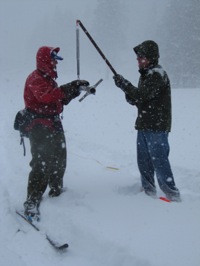
Frank Gehrke, left, weighs snow near Echo Summit, to measure water content. Photo: Molly Samuel

His clipboard doesn’t have quite same gravitas as a pair of stone tablets. Nonetheless, Frank Gehrke is sort of the Moses of California water. Once a month he comes down from the mountaintop with a pronouncement on the state of the snowpack in the Sierra Nevada. Today’s message: Whew.

The Department of Water Resources announced today that on average, the water content of California’s Sierra snowpack stands at 107% of “normal” for this date. The figure is derived from a combination of electronic sensors and manual surveys, including Gehrke’s, taken at various points along Highway 50. It’s the first time this season that the statewide average has clocked in above normal.

In the monthly DWR news release, Director Mark Cowin expressed some relief, while warning that the state is still struggling to overcome three abnormally dry winters prior to this one. DWR reports that Lake Oroville, the primary reservoir for the State Water Project, still stands at just 55% of it’s long-term average level for this date. Shasta Lake, however, the biggest reservoir on the federal Central Valley Project, is now above its normal level.

Cowin says the latest readings offer hope that water managers will be able to increase projected allocations to state water customers, currently set at 15% of requested amounts. DWR estimates that final allocations will be “in the range of 35-45%.” Over the past ten years, customers have averaged about two thirds of requested water. Farms often make up for shortfalls by pumping costlier groundwater.

Our interactive map shows the current status of California’s key reservoirs. We also have a short video that takes you into the field with Frank Gehrke, to see how he does his manual surveys.

Huge Federal Boost for Oakland Solar Company

BrightSource Energy
Doing it with mirrors. Image: BrightSource Energy

Oakland-based BrightSource Energy is reportedly the beneficiary of a $1.37 billion federal boost for its planned solar-thermal plant in Southern California.

The New York Times reports today that it’s the biggest loan guarantee so far for a single solar project and that the Ivanpah array would be the largest of its type, potentially generating 2,600 megawatts of power for PG&E and SoCal Edison. The loan guarantee does not mean that the project is fully funded but federal loan guarantees are considered a potent inducement for investors.

The California Energy Commission has a chart of all solar projects currently under consideration, on its website. The CEC lists 28 solar-thermal projects and another dozen or so utility-scale photovoltaic arrays either announced, approved, or currently under review.

Hot Topics in San Diego

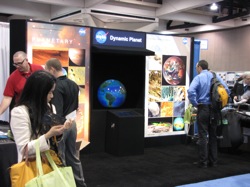
NASA's "Dynamic Planet" exhibit at the San Diego Convention Center. Photo: Craig Miller

SAN DIEGO –The annual meeting of the American Association for the Advancement of Science (AAAS) draws “thousands” of scientists in virtually every endeavor, from astrophysics to zoology. In climate science circles there was no lack of topics to choose from this year. Among them:

Geo-Engineering

Several sessions were devoted to the notion of fending off climate change by tinkering with earth systems. In technical sessions and news briefings, there was a range of opinion on display, from “Let’s try it” to “Let’s look at it,” to “Don’t even think about it.” There seems to be general agreement that techniques like seeding the atmosphere with particulates could yield rapid results–but the idea is fraught with political controversy and legal pitfalls. Stanford’s Ken Caldeira likened the idea to a cancer patient who accepts the risks of chemotherapy, in order to avoid worse consequences. Philosophy professor (and Caldeira’s former teacher) Martin Bunzl, firmly rejected that analogy, saying that unlike cancer therapy, the risks are not well known and “You can’t just turn it off.” Bunzl directs the Climate and Social Policy Initiative at Rutgers University.

At Climate Watch, we’re preparing an explanatory radio feature on geo-engineering, for broadcast in the coming weeks.

Oceans

The plight of the planet’s oceans was a focus of the conference, with numerous discussions of acidification, marine reserves and the newly implemented concept of “marine spatial planning,” an effort to map the oceans’ topography, biota and habitat, then translate that into a kind of zoning plan for human use (an approach specifically mandated by the Obama administration last year).

In October, researchers will formally conclude the Census of Marine Life, a 10-year collaboration among scientists in 80 countries, to “assess and explain the diversity, distribution and abundance of life in the ocean.” During a media briefing at AAAS, census Co-Chief Scientist Ron O’Dor estimated that the final tally would include 5,000 newly discovered species (“not counting the microbials”), from flying sea cucumbers to the “Rasta sponge,” which, according to O’Dor’s colleague, Shirley Pomponi, appears to sport dreadlocks and also “produces an anti-cancer compound.” O’Dor said one general conclusion from the census would be that while it is “large and resilient, we can’t keep insulting the ocean forever.”

Science & Policy

In keeping with the meeting’s theme of “Bridging Science and Society,” and reflecting the current angst over credibility in science, there were overflow sessions with titles such as “A Wobbly Three-Legged Stool: Science, Politics and the Public.” While people spilled out the door of that room, hard-science lectures in adjacent rooms drew just a smattering of people. In an interview with Climate Watch, Brad Allenby, a professor of engineering and ethics at Arizona State University, lamented that “the climate change discussion has become so polarized, even among scientists, that it’s difficult to present the public with factual information that is credible.”

European Union exhibit at AAAS. Some attendees commented that the exhibit hall seemed sparse this year. Photo: Craig Millerl
European Union exhibit at AAAS. Some attendees commented that the exhibit hall seemed sparse this year. Photo: Craig Miller

National Climate Service

NOAA chief Jane Lubchenko used the occasion of the conference to talk up her agency’s new National Climate Service, funded by legislation last year. The new branch will provide one-stop shopping for climate research and tools for policymakers, including those at the state and local level. Lubchenko says she hopes to have the new unit operational by October, when the federal fiscal year turns over.

Bridging the Science Gap

SAN DIEGO — Scientists from 50 nations are gathered here this week for the annual meeting of the American Association for the Advancement of Science (AAAS). This year’s theme is “Bridging Science and Society”–not surprising as recent surveys reveal there’s a lot of bridge building to do.

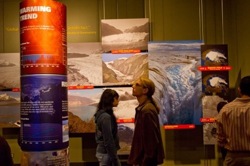
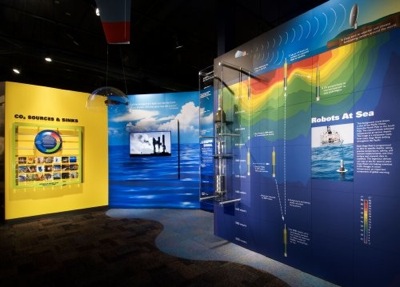
Birch Aquarium's "Feeling the Heat" exhibit. Photo: Birch Aquarium, La Jolla

During a two-day pre-conference for “informal educators” (science museums, aquariums, zoos, and the like) on “climate literacy,” speakers painted a mostly grim picture of Americans’ understanding of climate in particular and science in general. Jean Johnson of the nonpartisan research organization Public Agenda pointed to research in which, when asked to “name a fossil fuel,” only four in ten could. Similarly, 56% surveyed thought that nuclear power contributed to global warming. There is still considerable confusion between climate change and the much publicized ozone “hole.”

Speakers from Yale, George Mason University* and the Pew Research Center all highlighted the recent trend toward rejection of contemporary climate science, despite several decades of accumulated evidence that affirms human impacts on climate. Several speakers, including former IPCC climatologist Richard Somerville (Coordinating Lead Author in Working Group I, for the 2007 Fourth Assessment Report) laid the blame for this chiefly on what was characterized as a well-coordinated, well-financed campaign of disinformation, organized by industries opposed to regulation of carbon emissions.

Some noted other factors, such as topic “fatigue” (people tired of hearing about it) and the current dismal state of the economy, which has shuffled personal priorities. Layered on all of that, “We live in an age of skepticism,” said Johnson of Public Agenda, in which trust in traditional institutions like government (and the media) is flagging. She pointed to the need for “credible neutral explainers” to act as translators between working scientists and the public. Anthony Leiserowitz of Yale, co-creator of the Six Americas project, noted that despite growing skepticism, there is still strong public support for climate and environmental education.

Birch_Heat2_blog

Frank Niepold, education coordinator for NOAA’s Climate Program Office, pointed to what he calls the “solutions barrier.” He noted that while the likely effects of climate change are often discussed in K-12 classrooms, there’s a lack of attention to potential solutions. Other speakers said climate impacts and solutions should be more closely linked to issues that are consistently rated as high priorities among households, such as energy independence and public health.

*Climate Watch partnered with Yale and George Mason researchers to create our climate survey, “A Matter of Degree,” which is featured on Facebook and on the Climate Watch website.