All posts by Craig Miller

Craig is a former KQED Science editor, specializing in weather, climate, water & energy issues, with a little seismology thrown in just to shake things up. Prior to that, he launched and led the station's award-winning multimedia project, Climate Watch. Craig is also an accomplished writer/producer of television documentaries, with a focus on natural resource issues.

States at Crossroads for Climate Action

Tom Banse is a Seattle-based public media reporter and a regular contributor to Climate Watch.
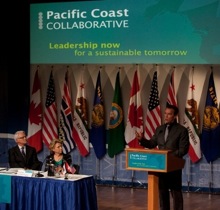
West Coast governors meet in Vancouver. Photo: Office of Gov. Arnold Schwarzenegger

By Tom Banse

When two West Coast governors sat down with the head of British Columbia’s provincial government for a pre-Olympic confab today, the occasion brought to mind some things I’d picked up during a short fellowship in Denmark and Germany last week.

Two months after the chaotic United Nations climate summit ended, edgy “Hopenhagen” posters are one of the few visible reminders of the high-stakes gathering of world leaders, recently concluded in Copenhagen.  Ironically, the summit dashed the hopes of many climate activists for a legally binding treaty to reduce global warming emissions.

They’re not giving up, but in the aftermath acting locally may gain more prominence than acting globally.

“The Copenhagen hangover is over.  Now countries including the United States have to act,” said Denmark’s energetic Minister of Energy and Climate Lykke Friss.

The Danes are engaging other countries to try to revive momentum for international climate negotiations. “We should fight all the way for a deal in Cancun,” where the next United Nations climate summit will convene at the end of this year.  “But that depends on the will of the moment,” she said.  “There is no doubt this is a difficult process,” Friss acknowledged.

In European capitals, policymakers are eager for any clues or cues regarding the willingness of American lawmakers to regulate greenhouse gases. Cap-and-trade legislation has been stalled in the U.S. Senate for the past five months.

“If it’s not realistic that the U.S. would sign a binding international [climate] treaty, what is below this?” asked a German parliament member in Berlin.  The answer may not lie in Washington, DC.

“We do think the pendulum is starting to swing back to states,” said the former co-chair of the Western Climate Initiative Janice Adair.  In 2008, seven Western U.S. states and four Canadian provinces developed a framework to regulate greenhouse gas emissions independent of their national governments.  The plan has not taken effect.

“More and more, the UN and the national governments recognize that the ‘sub-national’ governments are really the ones that, in the end, can put the pressure on and create the action that is needed,” said Governor Arnold Schwarzenegger, on Friday.  Schwarzenegger spoke in Vancouver, Canada after a mini-summit of Pacific Coast leaders timed to coincide with the opening of the 2010 Winter Olympics. British Columbia Premier Gordon Campbell hosted the meeting to discuss common environmental topics. Washington Governor Christine Gregoire and Oregon Secretary of State Kate Brown also attended.

Gregoire said when it comes to cap-and-trade, she still maintains that a national program is better than a regional one.  Yet state and local governments can do other things to control emissions, namely what policymakers such as Adair call “complementary” measures. Schwarzenegger specifically mentioned California’s Million Solar Roofs Initiative, which seeks to attain that number of rooftop solar arrays by 2016.  Some other examples include creating incentives for consumers to buy electric cars, increasing recycling or improving rail service.  Oregon and Washington have recently toughened their building codes to increase energy efficiency in new construction.

Gerry Pollet, the director of the Seattle-based environmental watchdog group Heart of America Northwest, recently urged his members to write Oregon and Washington’s governors and legislators, “saying you want Northwest states’ climate change legislation put back on the front burner – which is a good investment for our economy as well as for the health of our planet and children.”

As in Congress, there is hesitancy in state legislatures. “Our concerns are very much is this going to put us at a distinct competitive disadvantage,” said Shelly Short, a conservative legislator from Northeast Washington. [Ed. Note: Arizona Governor Jan Brewer cited the same concern in her executive order ending that state’s participation in the WCI cap-and-trade plan]. Short says she is given pause by current controversies involving climate scientists, notably the one involving hacked e-mails that has been dubbed “Climategate” by global warming skeptics. “I’ll be honest and say some of the issues that have come forward really leave it up to whether this is something we need to be doing,” said Short.

Meaningful climate change legislation has not come up for debate this winter during the short 2010 sessions of the Washington and Oregon Legislatures.  But all the players on this issue expect global warming to return to the forefront in Salem and Olympia in 2011.

WCI Shows More Signs of Unraveling

88367460On Ground Hog Day, Arizona saw the shadow of regional carbon trading looming over it…and retreated.

In an executive order issued on February second but not widely reported until yesterday, Arizona Governor Jan Brewer rejected the regional cap-and-trade program known as the Western Climate Initiative (WCI).

In April of last year, Climate Watch first called attention to the apparent lack of momentum within the WCI, an agreement among 11 US states and Canadian provinces, in which Arizona was a founding partner.

In her order, Governor Brewer wrote that imposing cap-and-trade at this time would “cost investment and jobs in Arizona” and put the state at a “competitive disadvantage,” as industry would be forced to pay fees for their carbon emissions.

Arizona relies on coal for about a third of its electricity production (36% as of 2007, according to the US Energy Information Administration’s tally) and its renewable energy goals (15% by 2025) are less ambitious than California’s (30% by 2020). But Arizona also has a larger nuclear power component. Governor Brewer cited this in last week’s executive order, as part of the reason why Arizona’s per capita greenhouse gas emissions are “about one third less than the national average.” The Governor’s order affirms that Arizona seeks “pragmatic” approaches to climate change mitigation and implies that Arizona officials would rather wait and see what carbon regulation develops at the national level, than proceed with a regional plan.

The state’s move comes as several energy companies mount an eleventh-hour push for a national cap-and-trade program, which has languished in the Senate.

The WCI comprises both “partner” and “observer” states. The Brewer order says that Arizona will “continue to be a member of the WCI to ensure that Arizona’s unique perspective will be advanced,” but that the state will not implement regional cap and trade. As of this morning, Arizona was still listed on the WCI website as a “partner” and there was no mention of the action.

California officials have long said that while a regional carbon trading pact would be preferable, California could “go it alone” if necessary.

UC Scientist: Don’t Blame the Cows

Cody Sheehy is a rangeland ecologist and independent documentary producer.

87736822By Cody Sheehy

A couple of months ago, nearly lost amid the “Hopenhagen” hype,  the University of California, Davis (UCD) put out a press release with an admonition: “Don’t Blame Cows for Climate Change.” The release was a first look at some work conducted by UCD Associate Professor and Air Quality Specialist Frank Mitloehner. His study examines the greenhouse gases, or GHGs, emitted by the livestock sector.  As California’s air regulators turn more attention toward methane in particular, the report remains timely.

Mitloehner’s paper is entitled: “Clearing the Air: Livestock’s Contributions to Climate Change,” and was published in the peer-reviewed journal Advances in Agronomy. The paper is a synthesis of current science on the cattle-climate connection. Mitloehner has been updating some of that science in recent years.

In 2008, I stopped by his cluster of “bio bubbles;” airtight domes that serve as high-tech stables for cows. Inside, Mitloehner had set up simulated dairy operations, measuring GHGs emitted by the cows’ digestive process and decomposition of the manure. The numbers then in common use had been generated in the 1930s.

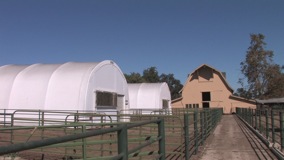
Research "bio-bubbles" at UC Davis. Photo: Cody Sheehy

Mitloehner says cattle gets a bum rap in the media, and points to some examples, including a 2007 story in Time magazine, which included assertions like: “Which is responsible for more global warming: your BMW or your Big Mac? Believe it or not, it’s your Big Mac,” and “A 16-oz T-bone is like a hummer on a plate . . ”

In many cases, Mitloehner says the statements are crafted from an influnencial 2006 United Nations report entitled: “Livestock’s Long Shadow.”  According to the executive summary, “The livestock sector is a major player, responsible for 18 percent of greenhouse gas emissions measured in CO2 equivalent. This is a higher share than transport.”

But Mitloehner points to a quote deeper in the report:

“The respiration of livestock makes up only a very small part of the net release of carbon that can be attributed to the livestock sector. Much more is released indirectly by other channels, including: the burning of fossil fuel to produce mineral fertilizers used in feed production, methane release from the breakdown of fertilizers and from animal manure, land-use changes for feed production and for grazing, land degradation, fossil fuel use during feed and animal production and fossil fuel use in production and transport of processed and refrigerated animal products.”

Mitloehner cautions that the transportation number they use only accounts for tailpipe emissions. To be even-handed, he says, the authors should’ve incorporated emissions from the entire oil industry, including refinement of the oil and production of cars. In the UCD release, Mitloehner calls it a “lopsided ‘analysis” and “a classical apples-and-oranges analogy that truly confused the issue.”

Meanwhile, the Bio-bubbles have been generating some interesting numbers. Mitloehner found that the amount of methane the cows respire (belch) and how much is released in the breakdown of animal manure is quite different from what previous research had calculated. In combination, these two sources represent the most direct GHGs from the livestock industry, even if they’re not the largest GHG emitter associated with the industry. They’re also the most out of date.

Emission factors used in “Livestock’s Long Shadow” provide an estimate of methane respiration of about 86 million tonnes (metric tons) of methane (CH4) and 17.5 million tonnes of CH4 annually from manure decomposition. In the annex of the UN report, the authors write: “Obviously, great improvements to the estimates of emission factors could be made if more data on nutrition and production were available.” And so it is that inside his bio-bubbles, Mitloehner has come up with numbers much lower than those that represented the conventional wisdom since 1938.

All in all, we’ve got a discussion about comparing apples and oranges (more appealing than manure, granted) and some updated numbers that lower the emissions of livestock in one category. As with any scientific paper, there will probably be debate on both of these points and new ones, but let’s look at the broader consequences. Will industry look at this study and see an incentive to update and revise carbon emission numbers all across the board?

According to Emilo Laca, an agricultural ecologist at U. C. Davis, some of these questions will be fodder for policy debates that lie outside the realm of science. He says “The real question is, ‘How are we going to split this up?'” Laca used a hypothetical problem to explain: Let’s say that a certain livestock industry consumed 30% of soybean production as a food source. Livestock producers might concede that they should be accountable for 30% of carbon emissions related to soybeans. It makes sense. It’s what the numbers say. Others might counter that without this certain livestock industry, the soybean market would behave differently and some amount–lets guess 70%–wouldn’t need to be planted. Therefore, the livestock industry in this example is responsible for 70% of the emissions, not 30%. Science can support both interpretations. As Laca says, the decision is how to “split” things up. And ultimately, those decisions may fall to policy wonks.

Air Board: GHG Sniffers for Research, Not Enforcement

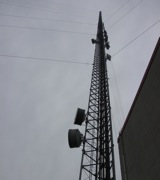
This tower in Walnut Grove is decked out with equipment to detect and measure atmospheric gases. Photo: Craig Miller
This tower in Walnut Grove is rigged with equipment to detect and measure atmospheric gases, monitored by NOAA. Photo: Craig Miller

A companion radio piece to this post aired on The California Report.

Scientists in California have begun setting up a statewide network of monitors to track California’s greenhouse gas emissions. Similar equipment has been in place for years as part of a continental network established by the National Oceanic & Atmospheric Administration (NOAA). But officials at the California Air Resources Board (CARB) say this new system will be the first of its kind.

“The unique thing about this is that we’re actually looking at the local emissions, rather than the global average, says Jorn Herner, who heads the Greenhouse Gas Technology & Field Testing Section of CARB’s research arm. “Nobody has done that before.”

Scientists have been systematically tracking atmospheric CO2 on a broad scale since 1958. California’s network of GHG sniffers will be capable of tracking CO2, nitrous oxides and other known greenhouse gases, and will initially focus on methane.

But CARB officials say the network is not part of a “Big Brother” strategy for emissions compliance. “This is initially a research project,” said Herner. He says the new network will provide a “second data point” to augment the state’s current method of estimating GHG emissions. Currently California’s current climate law, AB-32, relies on a “bottom-up” system of estimating emissions from individual sources, then adding them up to arrive at total emissions for the state.

“The modeling won’t tell you each individual source but what you’d be able to do is develop a gridded inventory. So you’ll be able to say in this square mile of land over here, it looks like emissions are much higher than in this square mile next to it.”

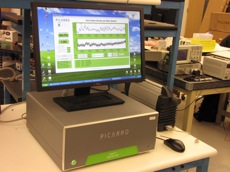
The greenhouse gas analyzers are about the size of a desktop computer. Photo: Craig Miller

The Air Board has purchased seven “next-generation” analyzers from Picarro Instruments in Sunnyvale. Five will go to fixed locations, such as a tower on Mt. Wilson, above the Los Angeles Basin. The two others will be on “mobile platforms;” electric vehicles that can roam the state taking ground-level readings. The units cost about $50,000 apiece but Picarro executives say they are self-adjusting and require far less human intervention than previous models, which will ultimately make them more cost-effective.

Picarro’s CEO, Michael Woelk, says a nationwide network of 500-to-700 detectors could yield a comprehensive GHG map of the US with resolution down to ten kilometers (a little more than six miles).

If California regulators are successful at putting in place a statewide or regional cap-and-trade system for greenhouse gases, industrial emitters will have to pay fees for the carbon they pump into the air. Horn agrees that at that point, some kind of check on the current system of self-reporting will “probably” be needed, but, he says, “that’s not the goal of this monitoring network at this time.”

“The science is really young,” he explained. “We’re really just trying to find out the potential of what we can do with this network. How it’s used in the future is still up in the air.”

…so to speak.

This animation below shows the methane levels detected by a Picarro analyzer as it is driven from Livermore, CA, to Sacramento.

Storms Offer Big Boost to Sierra Snowpack

For a more expansive analysis of California’s current water picture, and an interactive map of current reservoir conditions, see Dan Brekke’s drought update, posted earlier this week.

State water officials expressed “cautious optimism” after the season’s second survey of the Sierra snowpack.

After a series of Pacific storms dumped several feet of fresh snow on the mountains, today’s (officially the “February”) survey reveals that the snow’s average water content is 115 percent of “normal” for this date (compared to 61% of normal at this time last year).

Water managers say even so, there’s more catching up to do and they still can’t rule out a fourth consecutive year of relatively dry conditions. Nor have they re-evaluated earlier tight allocations planned for agricultural water this year. With a lot of the recent precipitation still locked up in the state’s “frozen reservoir,” Shasta Lake and Lake Oroville are both still hovering around half of their normal levels for this date.

According to today’s release from the Dept. of Water Resources:

“DWR’s early allocation estimate was that the agency would only be able to deliver 5 percent of requested SWP (State Water Project) water this year, reflecting low storage levels, ongoing drought conditions, and environmental restrictions on water deliveries to protect fish species.  The agency will recalculate the allocation after current snow survey results and other conditions are evaluated.”

By the way, if you’ve never had the chance to see how the “manual” component of the monthly snow surveys are done, take about four minutes and watch this video from 2008, when I joined surveyor Frank Gehrke at the Tamarack Flat survey site, off of Highway 50. This is not the site you usually see on the local news. That’s Phillips Station, chosen for media photo ops because it’s right off the highway. Getting to this site takes a little more doing, as you’ll see.

California Storms: A Dent in the Drought

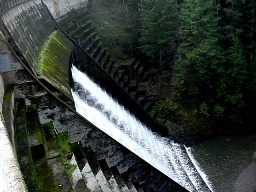
Spillway at Alpine Lake on Mt. Tamalpais. File photo: Marin Municipal Water District

A version of this post also appears on Dan Brekke’s personal blog, Infospigot. Also see our updated map of reservoir conditions at the end of this post.

By Dan Brekke

Is California’s drought over? OK, let’s take a step back. Yes, I realize one could debate whether the last three years in California actually constitute a drought. But that’s a discussion for another time. For now, I think everyone can agree that we’ve had lower-than-average precipitation for the past three years.

The only reason to ask the question is that, after the first half of the wet season delivered only spotty rain, we’ve had a pretty solid week of downpours. Water is sluicing into our reservoirs, and the hills are greening up. Some counties, like Marin, have water tumbling down the spillways. All of that is a sign of what we think winter should be here.

My favorite water statistic from last week: when the storms were at their heaviest around Lake Shasta, California’s biggest reservoir, water was flowing into the lake at about 500,000 gallons per second. That’s 1.5 acre feet, or about enough for two-to-three “average” households for a year, every second.*

Amazing numbers like that aside, the people who get paid to think about whether the drought is over say “not yet.” Last week, Quest managing editor Paul Rogers wrote a good summary of the situation, for The San Jose Mercury News.

Rogers’ story does contain one bit of quirky California thinking about rain and water, though. He quotes a well established local meteorologist, Jan Null, about where we stand in terms of normal rainfall, saying: “This is a great start, but we need to keep it going.”

Of course, Null recognizes better than most that the amount of rain we get and when we get it is out of anyone’s control. But once you understand the importance of water in California, once you get how crucial the winter rains are, there’s a score-keeping aspect to weather-watching here. It becomes second nature to study the rain gauge and the seasonal precipitation table as an index of performance, a reflection on whether a great collective goal is being attained. Lots of rain means we’re doing well (and that we can put the complexities of water supply out of our minds). A dry spell means we’re failing (and the prospect of hell to pay, or at least the strong possibility of stringent conservation measures).

But in reality, there’s no performance going on. The rain is the rain, and the climate is the climate. California’s rainfall is famously variable. Dry spells can be counted on and the current run of dry years is the third we’ve had since I arrived in Berkeley in the 1970s.

My first California winter, 1976-’77, was bone-dry and was in fact the second year of the driest two-year period ever recorded here. A decade later, from roughly 1986 through 1992, we had another run of dry years. And if our winter rains were to stop now, we’d be in the fourth year of drier-than-normal years. In between these periods we’ve had average years and very wet years and years that didn’t quite hit the average. That might not be too different from anywhere else. The reason it’s a bigger deal here than it might be in, say, Wisconsin, is that we have a six-month dry season. We need to store water to get through that. We have 37 million people and millions and millions acres of farmland that need water, whether it’s falling from the sky or not. Thus the need to believe we can wish the rain to keep going during the wet season and the tendency to feel disappointment when the winter turns into a string of dry, sunny days.

*500,000 gallons per second. Here’s the arithmetic: California Department of Water Resources figures show that in the hour between noon and 1 p.m. on Tuesday, January 19, net inflow into the lake was 66,288 cubic feet per second. That’s the highest inflow figure for any single hour that week. One cubic foot equals 7.48 gallons. 66,288*7.48 = 495,834.24 gallons. One acre-foot = 325,851 gallons. And 495,834.24/325,851 = 1.52 acre-feet. Per second. For the entire 24 hours of the 19th, Lake Shasta’s inflow averaged just over 1 acre-foot a second.


View KQED: California Reservoir Watch in a larger map

Nature Always Bats Last

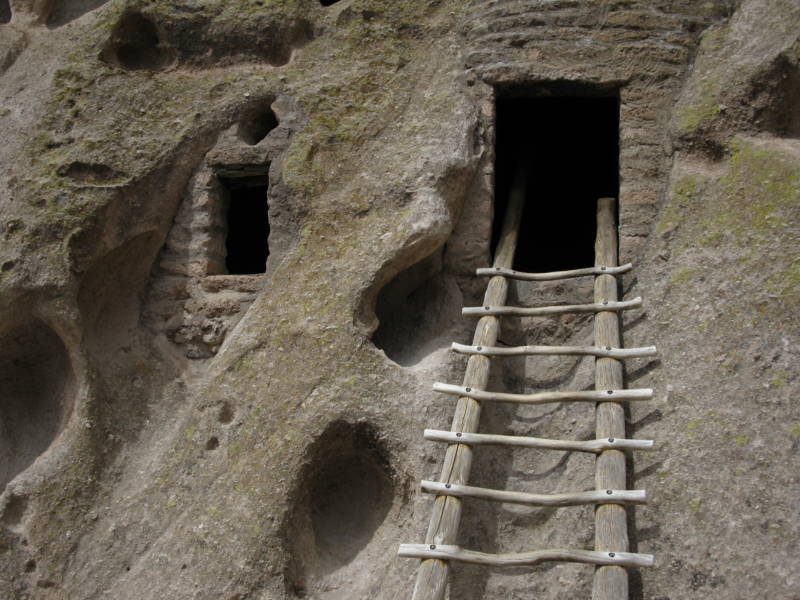
Cliff dwellings at Bandelier National Monument, New Mexico Photo: Craig Miller

Mike Newland is an archeologist at Sonoma State University’s Anthropological Studies Center. A version of this essay was originally broadcast as part of KQED’s Perspectives series.

Nature Always Bats Last

By Mike Newland

I’ve been pondering a 3,000 year old mystery that makes me uneasy about our current plight. Starting around 2,000 B.C., people in the Great Basin and Mojave Desert really got into big-game hunting.  We see this in the archaeological record—all of this big-horn sheep and antelope bone shows up in larger quantities.  Up in the mountains, great panels of rock art are chock full of hunters chasing sheep, and evidence of their hunting camps is tucked in shelters and around springs.

Big-game hunting isn’t that efficient.  You’re better off going for a wide range of edibles close by.  You get more food for less work.  This is an important point, because after 3,000 years of this big game hunting, this culture died out, and was replaced by folks that hunted and collected a broader range of food.

Bill Hildebrandt and Kelly McGuire, two archaeologists from Far Western Anthropological Research Group in Davis, have made a compelling argument about why people were so obsessed with hunting—they did it for status.

Good hunters were revered for their abilities to provide food and hunting trips could serve political and social functions.  But big game hunting was eventually done at the expense of the rest of the population: archaeologists still discuss whether the bow and arrow, probably introduced to California by groups coming out of Oregon, was such an effective hunting tool that the hunters wiped-out most of the big game, or whether the devastating effects of the Medieval Climatic Anomaly, which caused major droughts throughout the Great Basin and desert areas, pushed these people over the edge.  But it is clear that serious changes took place, and big game hunting became unsustainable.  By the time the next group of folks came along, the big-game hunters were on the verge of collapse.

This is one of the reasons why archaeology is important—we can look at past cultures and see how we, as a species, have dealt with big problems.

This research makes me uneasy because archaeology has shown repeatedly that cultures not in balance with nature die out.  For millennia, people have sat around campfires debating whether to make the changes necessary to adapt to a shifting climate or depleted resource base, and invariably they said no. As a result, the graveyards of history are full of the corpses of cultures that failed to change when they needed to.

Now it’s our turn. History shows that nature won’t hesitate to take us out.  We’re lucky in that we have probably one of the most adaptive cultures in history: we’ve made major changes—abolition of slavery, passing of environmental legislation, the Equal Rights Amendment—when we thought it was in our collective best interest. Even still, these landmark changes required decades of hard work and dedication to educate the broader population.  We have our work cut out for us.  We can either rise to the occasion, and make the investments necessary to stem climate change, or we can take our place with the rest of the dead in the graveyard.

State Senators Hear Cap-and-Trade Caveats

Craig Miller
Photo: Craig Miller

The dark underbelly of cap-and-trade was somewhat exposed in a four-hour hearing today before the Senate’s Select Committee on Climate Change and AB-32 Implementation. AB-32, of course, is shorthand for California’s Global Warming Solutions Act of 2006, which mandates a carbon trading program be in place by 2012.

Here’s my “highlights reel” from the panel of experts who testified, in order of appearance:

Mary Nichols, Chair, California Air Resources Board

– On carbon pricing: “There is no approach that does not involve administrative costs & headaches” but cap-and-trade “seems like a pretty good mix” of certainty provided by an enforced cap and market flexibility (versus an outright carbon tax of some sort).

– On California going “solo” with carbon trading (i.e. without the other states and provinces currently signed to the Western Carbon Initiative): The larger the territory, the more potential for “bad actors” but the greater the potential for meaningful savings & benefits to the economy.

Michael Wara, Stanford Law Professor

– On carbon offsets: “…difficult to administer;” to ensure real reductions, changes in behavior, has proven to be “a significant and ongoing challenge, in practice.”

– California appears to be “opting for prudent limits” on allowable offsets, at an anticipated 4%, versus more than 30% in the Waxman-Markey bill that has cleared the US House of Representatives.

– “Very few [offset] programs have been run without controversy.”

Ken Alex, California Attorney General’s Office

– On enforcement: “Every system has cheaters, especially where billions of dollars are involved.”

– Cap-and-trade provides “a permanent incentive for cheaters.” Unassailable data is essential for regulators.

– Regulators “must have sufficient authority” to assess meaningful penalties. Alex, who was involved in sorting out the state’s energy crisis of 2000-2001, recalled that “million-dollar penalties were irrelevant.”

Dallas Butraw, Economist, Resources for the Future

– Warned against a “phone book-sized” regulation.

– Cost of carbon emissions permits will be passed along to consumers but could be offset by tax breaks or a dividend system similar to what oil & gas companies pay to residents of Alaska.

David Harrison, Economist, NERA Economic Consulting

– On lessons from Europe: Despite a rocky start for the EU’s “pilot” program, the system for carbon trading in 27 countries has “evolved over time” to become “very successful.”

– The EU experience “really does show that cap & trade works. Emissions have been reduced.”

– There is “no silver bullet” for determining allocations; that in Europe has been a “messy” and “contentious” process.

– In spite of it all, the EU experience demonstrates that cap-and-trade is “not perfect but it really is better than the alternatives,” and provides a good laboratory for California.

The committee, chaired by Fran Pavley (D-L.A.), also heard from several business and environmental groups. At one point a speaker from the Natural Resources Defense Council (NRDC) argued briefly with a utility representative about whether electric rates are actually higher or lower in California, compared to the nation as a whole (apparent compromise: rates may be higher but average bills are lower).

Utilities complained that the system, as proposed, forces power companies to bear the brunt of the burden. Business interests warned that unbridled implementation of AB-32 “could add to an already alarming increase in job losses,” claimed that the state has no authority to hold carbon permit auctions under AB-32, and asked for initial permits to be given away to industry. Environmentalists asked for the opposite, urging that 100% of initial permits be auctioned off, i.e. that emitters be made to pay for them.

Numerous speakers expressed nervousness over validity of carbon offset programs. Regarding the various schemes for carbon storage in forests or soil, Assemblyman Jared Huffman (D-San Rafael) said “This one makes my head hurt.” There’ll be a lot of Excedrin passed around before this is through.

No Surprises in Season’s First Snow Survey

California’s Department of Water Resources (DWR) today released the first of the season’s surveys of snow conditions, an indicator of how much runoff we can expect to fill reservoirs in the spring.

Snow surveyor Frank Gehrke at the Phillips Station survey site. Photo: Gretchen Weber

At the Phillips Station survey site, just off U.S. Highway 50, lead surveyor Frank Gehrke found about the conditions he expected; water content of the accumulated snowfall there weighed in at 75% of normal. For the five survey sites in the region defined by DWR as the Central Sierra, and for all Sierra survey sites combined, water content was a slightly healthier 85%. While the average represents a slight improvement over last year at this time, when statewide water content clocked in at 76%, DWR officials emphasized that conditions are still below normal. And with the accumulating effects of three prior relatively dry years, some major reservoirs remain at low levels. A sobering example from today’s DWR release:

“Lake Oroville, the principal storage reservoir for the State Water Project (SWP), is at 29 percent of capacity, and 47 percent of average storage for this time of year.”

With several months remaining in the state’s traditional “wet” season, the January survey is perhaps the least reliable indicator of final runoff. According to Gehrke, the season can “go either way from here.”

In a 110-page California Drought Update just released, DWR wrote that:

“Impacts being experienced in the present three-year drought are relatively more severe than those experienced during prior dry conditions – such as the first three years of the 1987-92 drought.”

As such, the agency says it “will move aggressively forward to plan for a potentially dry 2010…”

In February Governor Schwarzenegger declared a drought state of emergency for nine counties that is technically still in effect, though appeals to the federal government for disaster relief have gone unanswered. The Governor has also called on all urban water consumers to cut back their use by 20%.

Not Giving Up on Central Valley Nuke

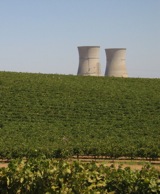
Cooling towers from the defunct Rancho Seco nuclear power plant rise above vineyards near Lodi. Photo: Craig Miller

According to a report in the Fresno Bee, the notion of building a nuclear power plant near Fresno is still alive, if on life supports. California still has an effective ban on new nuclear plants. That hasn’t stopped some from pushing the plan, as Amy Standen reported for Quest last spring.

And apparently some French investors haven’t given up, either.

Maybe they were inspired by the juxtaposition of vineyards and cooling towers at the site of the Sacramento Municipal Utility District’s (SMUD) decommissioned Rancho Seco nuclear plant, near Lodi.

Last summer I reported on the prospects for expanded nuclear power as part of California’s low-carbon energy push. Then in November, the advocacy group Environment America issued a report down-playing the potential role of nuclear. The report, bluntly entitled “Generating Failure,” made the claim that: “Even if the nuclear industry somehow managed to build 100 new nuclear reactors by 2030, nuclear power could reduce total U.S. emissions of global warming pollution over the next 20 years by only 12 percent.”

Proponents of nuclear point to its mportance as a steady source of “base load” power, generated 24/7, as opposed to the intermittent or cyclical nature of many renewable sources.