All posts by Craig Miller

Craig is a former KQED Science editor, specializing in weather, climate, water & energy issues, with a little seismology thrown in just to shake things up. Prior to that, he launched and led the station's award-winning multimedia project, Climate Watch. Craig is also an accomplished writer/producer of television documentaries, with a focus on natural resource issues.

Climate Lobby Bulks Up

Some California corporations figure prominently in a new tally of climate-related lobbying activity.

A continuing study from the non-partisan Center for Public Integrity (CPI) shows that climate-relating lobbying reached a fever pitch in the third quarter of this year, with 140 new organizations showing up in government-required registrations. That brings the total number of registered climate lobbyists to 1,160, with most activity centered on two climate bills–one passed by the House and another pending in the Senate.

The Center’s latest report is called “The Climate Lobby from Soup to Nuts”–and they mean it literally. CPI reports that registered climate lobbyists now include such diverse interests as the makers of Campbell Soup and Blue Diamond Growers (“a can a week” may not be all they ask, after all).

Not surprisingly, “Big Oil” is a big spender. San Ramon-based Chevron Corp. clocks in at more than $36 million since 2003. And PG&E, one of California’s largest utilities, is shown spending more than $34 million just in the last two years ($19 million in the third quarter of 2008 alone).

Silicon Valley is well represented on the list, including some firms whose stake in climate policy is less obvious; eBay, Google, Hewlett-Packard and Intel are all in the half-million-plus club. Government records show Intel declaring more than $12 million on climate lobbying since 2003.

Marianne Lavelle, a staff writer who helped compile the figures for CPI, says that companies with a stake in green energy technologies are seeking more of a voice in the process, to counter fossil fuel interests, and that technology-oriented venture capital firms are becoming more of a visible presence on the lobbying radar.

The CPI data also includes major environmental lobbies such as the San Francisco-based Sierra Club, which logs $1 million over the past two years. Lavelle says what it doesn’t capture is lobbying at the state level, nor does it reflect spending on “grassroots” organizing or money spent on advertising campaigns designed to steer public opinion on climate issues.

The CPI study site includes a searchable database of all federally registered climate lobbyists.

Polar Bears and Sea Ice: Sorting it Out

87514496A recent post I wrote to highlight a radio discussion of the current plight of polar bears, drew a challenge from Russell Steele, one of our regular readers. Steele questioned some of the scientific conclusions underlying dire predictions for the bears.

To help sort some of this out, I asked for responses from two highly regarded scientists in the field. Here’s a response to the specific reader challenge from Mark Serreze, Director of the National Snow & Ice Data Center, in Boulder, CO:

It is unclear what Mr. Steele is trying to get at with reference to the seasonal cycles in sea ice extent from the AMSR-E data. The AMSR-E data, while valuable, only go back to 2002. Through combining SSM/I and SMMR satellite data with other information sources for earlier years, we have a decent record of Arctic sea ice extent going back to the early 1950s. The relevant issue is the long-term decline in end-of-summer (September) ice extent evident in this record, with the extreme September minima of recent years (represented in the short AMSR-E record) serving as exclamation points. The observed rate of September ice loss exceeds expectations from nearly all climate models.

I also turned to Waleed Abdalati. Now director of the Earth Sciences Observation Center at the University of Colorado, Abdalati is a veteran of the Cryospheric Sciences and Terrestrial Hydrology programs at NASA, and one of the most articulate people I’ve heard speak on the subject of polar ice. He offers the following:

I am not an expert on polar bears, but I do think it is safe to say that
 their primary habitat, the Arctic sea ice, is severely threatened.  I, and 
most of my colleagues believe we are well on our way to an ice-free Arctic
 in summer any time between this decade and the next 40 years.

This
 is because of two things:  1) it will be decades before the ocean has 
finished its response to present-day greenhouse forcing, so the impacts of 
what we’ve done already have not been fully realized; and 2) the loss of
 sea ice is self-compounding: when it starts to shrink, exposing a 
darker more (heat) absorbing ocean underneath, the likelihood of its continued
 shrinking is greater (ice melts, exposes darker ocean, absorbs more heat, 
melts more ice, exposes darker ocean, and so-on).

Of course the flipside
 of this is that as ice starts to grow, it is more inclined to grow, but
 against the backdrop of the increased warming, the former is far more likely 
than the latter. Finally, as thick multi-year ice disappears, it is
 replaced with thinner and younger ice that is more vulnerable to surface 
melt from the atmosphere, bottom melting from sea water, and being carried
 away to lower, warmer latitudes by ocean current and wind.

So back to the polar bears: If their habitat disappears and they are unable 
to hunt seals, their main source of food, they seem to stand little or no
 chance of survival. I am not a wildlife biologist but its hard for me to 
believe they as a population can sustain themselves on land and with only a
 seasonally-present ice cover. In some cases, the fact that they face more
 challenges on sea ice than in the past, has driven them to forage inland,
 creating the illusion in some people’s minds that their populations are 
increasing, because there are more sightings on land. Who knows? Maybe 
they’ll evolve to hibernate in late summer, when there is no ice, and hunt
 the rest of the year.

There is an added effect that doesn’t get much attention.  There was a 
fascinating study by a Canadian Biologist (Ian Stirling) and a sea ice
 expert (Claire Parkinson) [Stirling, I., and C.L. Parkinson. 2006. Possible 
Effects of Climate Warming on Selected Populations of Polar Bears (Ursus
maritimus) in the Canadian Arctic. Arctic 59(3): 261-275.], which suggested 
that the bears are also losing weight, and approaching the weights at which 
they have historically not been able to bear cubs.  So not only is the
population threatened by starvation, the ability to replenish the population
 seems diminished.

I don’t believe we can say anything with absolute certainty,
 so I, myself would not make the statement that the polar bears are doomed–but I will say that the outlook for them, in my view, looks very, very bad.

After All That, Disappointment in “Hopenhagen”

Delegates to the UN climate conference in Copenhagen have officially “taken note” of the deal squeezed out on Friday by major carbon-emitting nations, an action that seems to fall short of a ringing endorsement.

President Obama’s own summary of the climate deal reached at–almost literally–the eleventh hour in Copenhagen, was laden with the language of muted disappointment. While describing the arrangement hammered out by the US, China, India and Brazil as “meaningful and unprecedented” and stressing that for the first time, “All major economies have come together,” he also used terms like “first step” and “not enough.”

Some bullet points from the President’s news conference, right before be bolted for the airport:

– Accord contains the three key elements: transparency, mitigation and finance

– Mitigation goal to stop warming at 2 degrees (C) “…by action consistent with science.”

– Nations have “much farther to go.”

– Accord is “not legally binding” and sets no deadline to achieve one that is*

– A legally binding pact was “not achievable at this conference.”

– Getting to a legally binding agreement will be “very hard and is going to take some time.”

– “This is hard within countries. It’s going to be even harder between countries.”

And here’s one to set a cheery tone for the coming year:

– “Kyoto was legally binding but everybody fell short, anyway.”

*Earlier drafts of the agreement reportedly set the end of 2010 as a deadline for signing something binding.

The US President and other heads of state left the Bella conference center before the agreement was actually signed. He said negotiators will remain in Copenhagen and attach many of the details to the deal in an “appendix,” before signing. President Obama said he was confident that as he departed, delegates were “moving in the direction of a significant accord.”

Here’s an early reaction from a major environmental group, in this case Friends of the Earth:

– “Sham Deal Requires Nothing, Accomplishes Nothing.”

Prepare for more of that.

The outcome of the fifteenth “Conference of Parties” in Copenhagen would seem to lend prescience to the speech given there by California Governor Arnold Schwarzenegger on Tuesday, the theme of which was: Don’t wait for national and international bodies to solve this problem. They haven’t–and may not.

Aboard the Roller Coaster in Copenhagen

88363083Louis Blumberg directs the California climate program for The Nature Conservancy. He’s also been keeping us posted as an official observer to the UN climate conference.

Copenhagen, December 16

Amidst the protests, the deliberations, the 24/7 schedule and battling what has been dubbed the “COP 15 flu,” the collective energy and sense of import in Copenhagen is still motivating us all to keep at it.

The atmosphere at the Bella Center has been a roller coaster this week. One thing I’ve realized is that it’s tricky to keep up with the constant changes that are happening so rapidly. At one point, we heard that negotiators had included in the draft text a global goal to reduce emissions from deforestation by 50 percent by 2020 and to achieve zero emissions by 2030. This would have been unprecedented. Unfortunately, we later learned that this text was only a placeholder but still could come through in a final agreement.

Adopting a global goal to stop deforestation would certainly be one important measure of success for this conference. It is alarming that the destruction of the world’s forests is the second highest source of greenhouse gas emissions — more than the emissions from all planes, trains and automobiles combined — yet a role for reducing emissions from deforestation and degradation (known as REDD) was not included in the 1997 Kyoto Protocol. This left countries with few economic incentives for preserving their forests, while they stood to make a fortune selling the timber, clearing forests for development or converting them to agriculture.

Enter the forest carbon market. Meeting an ambitious global goal on deforestation will take a lot of resources. A global market that gives value to forest carbon can generate the funding required each year to reduce deforestation at the scale needed to address climate change, while providing cash-poor, forest-rich countries the financial incentives they need to protect their forests rather than destroy them. While it is not the only tool to reduce emissions, it is a crucial one.

California has been a leader in this arena by both establishing a credible, prescriptive method for certifying forest carbon projects and including a role for forest offsets [PDF download from Stanford] in the state’s cap-and-trade program. This is a model that COP 15 negotiators can point to while framing the global solution to reducing deforestation. Let’s hope they come to an agreement soon.

Louis

Schwarzenegger’s Speech in Copenhagen

Here is a transcript of Governor Schwarzenegger’s speech to the UN climate conference in Copenhagen. It’s provided by his media relations staff, as insertion of the “laugh track” and applause notations may suggest.

Thank you so much for this great introduction, Governor Campbell, or Premier Campbell. It’s exactly the way I wrote it. That’s right. (Laughter) Just joking. He has been a terrific partner and a great, great friend and of course we will see each other up there at the Olympics, which is going to be probably the best-organized Olympics, knowing you. So thank you very much also for your invitation.

I also want to thank Governor Jose Serra for the wonderful speech and the very profound things that he said. And you have been also an extraordinary leader, so thank you very much. Let’s give him also again another big hand for the great work. (Applause)

And then Ivo de Bóer from the U.N., we want to thank him for organizing this and being a great leader and believing in the subnational governments.

And also we have from California here some people like Linda Adams, who is in charge of the EPA. Where’s Linda Adams? Stand up, Linda. Let’s give her a big hand. (Applause) Then Senator Fran Pavley, who is a great, great leader. Where is she? Can you get up? OK, right there. (Applause) Extraordinary leader in California. Without her we wouldn’t have been able to go as far as we did with the reduction of greenhouse gases and so on. And then we have Assemblywoman Nancy Skinner. Where is she? She is also here. Let’s give her also a big hand.

I love giving this speech here just simply because I’m not the only one that has an accent. It’s a good place to come. (Laughter)

But anyway, it is wonderful to be back here again. So before I say anything and do anything, let me just thank the U.N. and the people who have worked very hard on this to make this whole meeting happen. Let’s give them a big hand for their great, great organization. (Applause)

I especially want to thank Secretary General Ban Ki-moon for his early attention to the threat of global climate change and I want to congratulate him on his great, great leadership on the issue that has brought us all together.

I am delighted and honored to be with you in Copenhagen. This is not the first time I’ve been here; I’ve been here many, many times before, if it is for my movie promotions or for coming here for bodybuilding and weightlifting seminars, or just on vacation and so on. But I never thought then that one day I will get here as the governor of the great state and talk about climate change, so this is really terrific. So it’s great.

And this city, of course, distinguishes itself by being so clean you can actually swim in its harbor, even though I wouldn’t recommend it right now because it’s a little cold, of course. But how happy we would be if all the world’s harbors would be as clean.

As everyone knows, also in the harbor there is the “Little Mermaid,” the statue based on the Hans Christian Andersen fairy tale. When I was a boy in Austria, the Andersen fairy tale that I always liked best was “The Ugly Duckling.” And looking back, I think the reason that I liked it was because it was a tale of transformation and that spoke to me inside. I have always believed in the tremendous power of personal transformation.

The desire, the hope, the desperate need for planetary transformation is what brought us together here. And the question is: is this also a fairy tale? Is it a dream? Is it a false hope? And if it is not, how do we make it real? Is that something that we ought to discuss? And this is something that I do want to discuss here while I’m here with you. Look around this carbon-conscious city and you should feel hope. Copenhagen is often voted as one of the most livable cities in the world.

So the question really is, how do we make the world itself livable and sustainable? Certainly, it would be terrific if the world’s governments reached an agreement and put hard caps on greenhouse gases while generously helping poor nations, who are least responsible for and least able to respond to climate change. Attempting to reach such an agreement is good and is actually very, very important.

But why do we put so many hopes and eggs into the big international agreement basket when, according to the UN itself, up to 80 percent of greenhouse gas mitigation will be done at the subnational level?

In recent weeks, the prospects for this gathering here have gone up and down, up and own, like a roller-coaster ride. And everyone was in fear, of like what will the U.S. do? What will China do, or not do? Is it going to be 20 percent reductions or a 17 percent reductions? Is the base 1990 or 2005? Should it be 350 parts per million or 450 parts per million?

But what if I said that international agreements, as critical as they are, will never do enough? What if we took that as a given? Wouldn’t that expand the possibilities and approaches for progress we would consider?

I mean, my late mother-in-law, Eunice Kennedy Shriver, the remarkable woman who started Special Olympics, an organization that dedicates itself to people with intellectual disabilities, gave me an insight on this. She was the sister of John F. Kennedy and Robert Kennedy and Teddy Kennedy and she knew everyone in American power and politics.

But she once told me that while the federal government was important for policies related to Special Olympics — such as health care, equal rights, job creation, dental care and so on — but she never would have relied on the federal government to build Special Olympics. She said you need all kinds of different elements and entities like local government, state government, volunteers, corporate sponsors, coaches, celebrities and, of course, the families.

She said that no one from government is going to be there at the sports events and hug those kids when they come through the finish line, or organize the competition so there is a finish line in the first place. No one from government trains those kids so they don’t hurt themselves or so they know how to perform those sports. She said, no, that is up to many of us, many different entities. And she built a movement, a worldwide movement that has spread to 180-plus countries.

So history tells us that movements began with the people, not with government and then, when they became powerful enough, government responds. In the U.S. the labor movement, the women’s suffrage movement, the civil rights movement, the Vietnam anti-war movement — they did not begin in the corridors of power in Washington.

So there’s a lesson in this for our cause. While national governments have been fighting over emission targets, subnational governments have been adopting their own targets and laws and policies. While national governments have been trying for years to define what Kyoto means, businesses are pursuing cutting-edge technologies to solve energy and environmental problems. While national governments debate how carbon caps will affect their economies compared to others, many of their citizens are seeking greener lifestyles on their own.

Government clearly has a major role, there are no two ways about that. But I also believe in the power of the iconoclast and the entrepreneur and the individualist. I believe in the power of the scientists, the capitalists and the activists. I believe in the power of the cities and the states and the provinces to be laboratories for new ideas, which the national governments then can go and study and adopt.

I mean, too often, I think, we fail to see the potential and the progress that is being made on all those different levels. By putting all of our eggs in one basket, we fail to see the eggs in the other baskets.

Let me give you a few quick examples.

Dr. Rajendra Pachuari, who came to our environmental summit in California just recently, he has his own target. He is replacing kerosene and paraffin lanterns with solar light for 400 million rural people in India — 400 million people in India. Think about that. So if the nations of the world do not sign a carbon agreement, does that mean the doctor’s transformative work in India doesn’t count?

In the U.S., in the small town of Roscoe, Texas, a German company has completed the world’s largest wind farm. If we don’t reach a major carbon agreement, does that mean the Texas wind farm doesn’t really count?

With the assistance of Greenpeace, four of the world’s largest meat producers agreed not to buy cattle from newly deforested areas of the Amazon. That doesn’t count?

The head of an energy company in China recently said of renewable and efficient energy, “We think that this is a new business for us, not a burden.” And China now is becoming the leader in developing and manufacturing renewable energy equipment. That doesn’t count?

Yes, sure, they all count. And they reveal that something is happening, something that is happening below the national level.

California, for instance, is working with cities and with states and provinces and regions and nations, including Mexican states, Canadian and Chinese provinces and European nations. We’re even working with the U.N. to assist developing countries, especially in Africa. We are trying to foment change and collaboration and movement. We’re doing everything we can to change the balance of power on the environment.

And of course when I talk about California, I realize that while we may lead America and many other countries environmentally, Denmark here is already one-third more energy efficient. Isn’t that fantastic? And Europe is a great leader in this whole thing.

But the reason for discussing my adopted home state of California is because, first of all, I’m the governor of the great state of California and I have a little right to brag about our state, right? And also, California is the seventh largest economy in the world and also America’s trendsetter, so what we do has consequences. Now, maybe when you look at the globe it is just a little dot, or maybe you cannot even find California. But the power of influence we have is equivalent to a continent. And we in California do not believe and we do not behave, as if progress has to wait for Washington or Beijing or Kyoto.

In California, we are proceeding on renewable energy requirements and a cap and trade system for greenhouse gases. We are moving forward. As a matter of fact, we are making great progress. If hydro is included, we will get 45 percent of our energy from renewables in ten years from now and we are already at 27 percent.

We are proceeding on the world’s first low carbon fuel standards and limiting greenhouse gas emissions from cars which, by the way, the Obama Administration has now just adopted. We are proceeding in a major way on green tech, no matter what happens in Washington or in Copenhagen. Billions of dollars, nearly 60 percent of all venture capital in America, flows to California and this is creating the critical mass of money and intellect to develop new green technologies.

Leaders from around the world are coming to California to see what we’re doing. I took the French Foreign Trade Minister to a business in San Francisco called Solazyme, which was just recently named the most innovative bio-energy company. They have come up with a way to convert algae into a fuel that is 90 percent cleaner than petroleum-based fuels. The U.S. Navy has just signed an agreement with them and is going to use that fuel to power some of its ships.

So from what I see in the research labs and venture capital start-ups around the globe, I believe that the world’s businesses will move to solar and to wind and alternatives much faster than the people expect.

Kenya, for instance. Kenya already gets nearly three-quarters of its power from hydroelectric and from geothermal — three-quarters. And next month it will begin work on a $760 million wind farm that by 2012 will increase Kenya’s power supply by about 30 percent.

Now, the uplifting thing is that the developing nations will be able to leapfrog into the green economy and skip the fossil-fueled industrial revolution. Isn’t that wonderful?

I believe that we have economics on our side. Since the supply of wind and sun and algae is unlimited, their prices will not jump. That cannot be said of oil, the supply of which is limited and declining. That cannot be said of coal, whose costs of extraction and labor and transportation are bound to rise.

So I believe technological and economic forces will overtake the political and the regulatory efforts of national governments. We are beginning one of history’s great transitions – the transition to a new economic foundation for the 21st century and beyond.

Shouldn’t we organize to encourage this transition even as we continue to work toward international compacts? Of course we should. Now, if this conference does not get a strong agreement, some will say that Copenhagen has failed, that we talk grandly but we are fooling ourselves, much like the fairy tale, “The Emperor Has No Clothes.”

And others will say that any agreement that is being reached isn’t enough because the world is going to melt and we’re going to die anyway.

Others will say, “Look at those crazy people trying to wreck the global economy.”

No, ladies and gentlemen, this conference is automatically and already a success.

Kyoto brought the world’s focus to what must be done. It brought the focus to that whole subject. We didn’t know then what we know now. We didn’t have as much experience with the science that we would research or the hurdles we would face. But Kyoto made us think differently about the world.

And perhaps the real success of Copenhagen is to give us the opportunity to think differently again. Perhaps the success comes in realizing that something different needs to be done and in fact is already being done. It’s being done at the sub-national level.

And I would ask the U.N. to convene a climate summit like Copenhagen but for cities, for states, for provinces and for regions. And I will be more than happy to host such a summit in California or anywhere else the U.N. wants to hold it but I recommend strongly in California. (Applause) People like coming to California. They love our state.

So ladies and gentlemen, the world’s governments alone cannot make progress, the kind of progress that is needed on global climate change. They alone cannot do it. They need everyone coming together, everyone working together. They need the cities, they need the states, they need the provinces and the regions. They need the corporations, the activists, the scientists and the universities. They need the individuals whose vision and determination create movements. They need everybody out there.

So ladies and gentlemen, let us regain our momentum, let us regain our purpose, let us regain our hope by liberating the transformative power beneath the national level.
That can be the great contribution of Copenhagen — that could be the great contribution of Copenhagen.

So thank you for inviting me. Thank you for your kind attention and warm hospitality. And thank you for the great passion and for the hard work that you all do. And it is very important that we continue with this work.

So thank you very much and I’ll be back. Thank you.

The Schwarzenegger Solution: R20

Drawing on the G(X) model of international cooperation (as in the G-20 group of nations), California Governor Arnold Schwarzenegger is proposing that subnational governments band together to advance climate policy, in their own “R20,” or “Club of 20 Regions.” According to the Governor’s office, officials from four other nations have already signed on to the idea of  “a new regional coalition to fast-track the results of the Copenhagen Climate Change Conference and push their respective national governments into more rapid actions and stronger commitments to fight climate change.”

According to a concept document released on Monday, the group aspires to “demonstrate the feasibility” of the arrangement by 2012, which coincides with some key international conferences and is also when California’s climate legislation is scheduled to take full effect.

Founding members of the group include provincial officials from Canada, Nigeria, France and Algeria, including Premier Jean Charest of Quebec, who said the arrangement would, among other things, “allow for the transfer of expertise and green technologies to developing countries.”

Quebec is one of four Canadian provinces participating in the embryonic regional carbon trading cooperative known as the Western Climate Initiative.  The Governor’s announcement provided no indication that the other Canadian provinces or the half-dozen other US states in the WCI had signed on to R20, as of Monday (the “20” is apparently “symbolic” thus far).

Following his speech to the climate conference on Tuesday, Governor Schwarzenegger is scheduled to meet with the governors of some WCI partners in Copenhagen.

Schwarzenegger to Rally Subnationals

Meanwhile Rob Schmitz, our reporter in Copenhagen, sets the scene with a look at how the state’s anchor climate legislation is playing here at home, three years after its passage. That report airs Monday morning on The California Report.

Governor Arnold Schwarzenegger is expected to arrive in Copenhagen on Monday, ready to rally the world’s “subnationals” in the fight against global warming. This is the first time that UN climate talks have created a formal role for states, provinces, cities and the like, and California’s governor will be loaded for bear.

In the weeks leading up to Copenhagen, the Governor turned up the heat on climate rhetoric, with a series of related media events. On Treasure Island, a low-lying man-made rectangle on San Francisco Bay that he said “could be under water” by the end of the century, Schwarzenegger unveiled the state’s climate adaptation strategy with a video tour of California’s climate vulnerabilities, powered by graphics from Google Earth (if you just want the gist, there’s a shorter version available).

The Governor also seized the occasion to preview his trip to Copenhagen, saying we “can’t wait” for national and multi-national efforts to save us from the potentially catastrophic effects of climate change; that “subnational” actors like California–perhaps led by California–should stay focused on their own efforts to both reduce greenhouse gas emissions and prepare for the changes already on the way. The Governor’s speech to COP 15 delegates on Tuesday will be a chance to do some crowing about California’s climate leadership, on an international stage, before a media gallery that’s been estimated at somewhere between 3,500 and 5,000 members.

Copenhagen: The California Contingent

Here’s a list of prominent Californians either in or heading for Copenhagen next week. Compiled by Climate Watch intern David Ferry, it’s not intended to be exhaustive, but reflects responses from numerous queries we sent out prior to the conference:

Government:

Governor Arnold Schwarzenegger
Addresses the conference on Tuesday, with a call to rally “subnational” players to continue local and regional efforts to curb greenhouse gas emissions.

Linda Adams, Sec. for Environmental Protection,California Environmental Protection Agency
Linda Adams, former director of the California Department of Water Resources, was appointed by Governor Arnold Schwarzenegger in May 2006 as Secretary of the California Environmental Protection Agency – making her the first woman to serve as head of the agency. Immediately upon appointment, Secretary Adams was designated as Governor Schwarzenegger’s lead negotiator on AB 32, the Global Warming Solutions Act of 2006. Adams is now working closely with states, provinces and countries around the world to develop a network of climate initiatives to achieve the greatest global reductions.

Mike Chrisman, Secretary for Natural Resources, California Natural Resources Agency
As a member of the governor’s cabinet, Mike Chrisman serves as his chief adviser on issues related to the state’s natural, historic, and cultural resources. In leading the Natural Resources Agency, Chrisman oversees the policies and activities of 25 departments, commissions, boards and conservancies. The issues run the natural resources gamut from conservation, water, fish and game, forestry, parks, energy, coastal, marine and landscape.

A. G. Kawamura, Secretary for Food and Agriculture, California Dept. of Food and Agriculture
Prior to his appointment, Secretary Kawamura was active as a produce grower and shipper from Orange County. As an urban agriculturist, he has a lifetime of experience working along and within the expanding urban boundaries of Southern California. On issues of domestic and international importance, Kawamura was an early supporter of renewable energy as well as being a vocal proponent of invasive species prevention, trade promotion and farm bill reauthorization.

Mary D. Nichols, Chairman, California Air Resources Board
Mary Nichols has devoted her entire career in public and private, not-for-profit service to advocating for the environment and public health. In addition to her work at the Air Board, she has held a number of positions, including: assistant administrator for the U.S. Environmental Protection Agency’s Air and Radiation program under the Clinton Administration, Secretary for California’s Resources Agency from 1999 to 2003, and Director of the University of California, Los Angeles Institute of the Environment.

Eileen Tutt, Deputy Secretary, California Air Resources Board and CalEPA*
Eileen Tutt, who has been with the ARB and CalEPA since 1990, currently serves as Deputy Secretary External Affairs. Prior to that, she worked in the ARB’s Executive Office managing three projects: the California Hydrogen Highway Network Blueprint Plan, Motor Vehicle Climate Change regulations, and joint effort with the California Energy Commission to make recommendations to the Governor and Legislator addressing the issue of California’s petroleum dependence.

*Tutt recently announced that she’s resigning from state government to become executive director of the California Electric Transportation Coalition.

Tony Brunello, Deputy Natural Resources Secretary for Climate Change and Energy

Marcia McNutt, Director, United States Geological Survey
Marcia McNutt, the recently appointed USGS director, is a California native. She has published 90 peer-reviewed scientific articles and also chaired the President’s Panel on Ocean Exploration convened by President Clinton to examine the possibility of initiating a major US program in exploring the oceans.  She is a fellow for the American Geophysical Union, the Geological Society of America, the American Association for the Advancement of Science and the International Association of Geodesy.

Nancy Skinner, State Assembly Member, California’s 14th District
Nancy Skinner is the Chair of the Assembly Natural Resources Committee and is the founder of ICLEI-Local Governments for Sustainability.

Fran Pavley, State Senator, California’s 23rd District
Fran Pavley chairs the Senate Natural Resources and Water Committee, and authored California’s tailpipe emissions reduction bill and, as an assemblymember, AB 32.

NGOs:

Derek Walker, Director, California Climate Initiative, Environmental Defense Fund
Derek Walker develops and coordinates legislative and communications campaigns in target states throughout the U.S. to generate support for strong global warming and clean energy policies. His primary responsibility is managing a team of policy and legal experts working on implementation of California’s Global Warming Solutions Act (AB-32).

Dan Jacobson, Legislative Director, Environment California
Dan Jacobson directs policy development, research, and legislative advocacy for Environment California. He led efforts to pass the California Clean Energy Act, the strongest renewable energy law in the country.

Louis Blumberg, Director, Climate Change at the Nature Conservancy
A self-described policy wonk, Blumberg leads the Conservancy’s climate change work in California.

Gary Gero, President, California Climate Action Registry
Gary Gero serves as president of the CCAR, which serves as a voluntary greenhouse gas registry to protect and promote early actions to reduce GHG emissions by organizations.

Academics:

Dan Kammen, Professor, UC Berkeley School of Public Policy
Dan Kammen is an expert in national and international energy policy and has testified before Congress about energy and environmental issues.

Jayant Sathaye, Lawrence Berkeley National Laboratory
Jayant Sathaye is internationally recognized for his work on climate change project-related issues in transportation, land-use change and forestry, and energy demand and supply in the developing world.

Healy Hamilton, Biologist, California Academy of Sciences
Healy Hamilton’s “interests range from researching the effects of climate change on biodiversity to the evolution and conservation of cetaceans and seahorses.”

Oran Young, Professor, UC Santa Barbara Bren School of Environmental Management
Oran Young’s scientific work encompasses both basic research focusing on collective choice and social institutions, and applied research dealing with issues pertaining to international environmental governance and the Arctic as an international region.

Stephen Schneider, Senior Fellow, Woods Institute for the Environment at Stanford
Editor of the interdisciplinary journal Climatic Change, Schneider’s recent work has centered on the importance of risk management in climate-policy decision making, given the uncertainties in future projections of global climate change.

Christopher Field, Senior Fellow, Woods Institute for the Environment at Stanford
The director for the Carnegie Institution of Washington’s Institution’s Department of Global Ecology, Field’s research emphasizes impacts of climate change, from the molecular to the global scale.

Terry Root, Senior Fellow, Woods Institute for the Environment at Stanford
Terry Root primarily works on large-scale ecological questions with a focus on impacts of global warming.

Rob Dunbar, Senior Fellow, Woods Institute for the Environment at Stanford
Rob Dunbar’s studies focus on global environmental change with an emphasis on air-sea interactions, tropical marine ecosystems, polar climate, and biogeochemistry.

Lisa Curran, Senior Fellow, Woods Institute for the Environment at Stanford
Lisa Curran’s current interdisciplinary programs examine the effects of land use change, climate, drought and fire on carbon dynamics and biodiversity; and impacts of governmental policies and industrial practices on ecosystems and rural livelihoods in Asian and Latin American tropical forests.

Michael Wara, Center Fellow, Woods Institute for the Environment at Stanford
An expert on environmental law and policy, Wara’s research focuses on climate policy and regulation, both domestically and internationally.

Meg Caldwall, Senior Lecturer, Woods Institute for the Environment at Stanford
The Director of the Environmental and Natural Resources Law and Policy Program at Stanford Law, Caldwall’s scholarship has focused on the environmental effects of local land use decisions, the use of science in environmental and marine resource policy development and implementation, and developing private and public incentives for natural resource conservation.

Michael Mastrandrea, Research Associate, Woods Institute for the Environment at Stanford
Michael Mastrandrea’s research focuses on the physical, biological, and societal impacts of climate change, policy strategies for reducing climate risks, and their accurate and effective translation for the general public, policy makers, and the business community.

Business:

John R. Fielder, President, Southern California Edison
President of SCE since 2005, Fielder is going to Copenhagen with the Climate Registry, a non-profit organization working to set standards for reporting greenhouse gas emissions.

Amit Chatterjee, CEO, Hara Software
Amit Chatterjee, who runs an environmental and energy management software company backed by Al Gore, told AFP that he was attending the conference to help define a “post-carbon economy” and “articulate the view from Silicon Valley” about climate change and cap-and-trade legislation

Google contingent
CEO Eric Schmidt is not going but representatives will be presenting sessions on web technologies and outreach strategies.

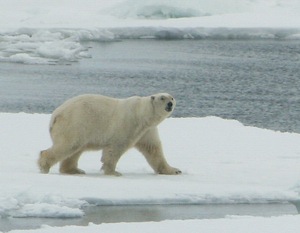
Author: Polar Bears Doomed No Matter What We Do

US Fish & Wildlife Service
Photo: US Fish & Wildlife Service

Because our charter at Climate Watch is to examine climate change from the California perspective, you don’t see a lot here about melting ice caps and imperiled polar bears. But Michael Krasny’s interview with Richard Ellis on KQED’s Forum program is well worth an hour of your time.

Ellis is the author of On Thin Ice: The Changing World of the Polar Bear (Random House, 2009) and it’s fair to say that he managed to stun Krasny with a declaration that the species is “doomed,” no matter what we might try to do to save it at this point. Ellis says there is already too much warming in the pipeline (what scientists call “committed” warming) to reverse the disintegration of the bears’ arctic habitat.

Polar bear populations have been a topic of persistent confusion, recently amplified in an op-ed piece written by former Alaska governor Sarah Palin for The Washington Post.

According to the advocacy group Polar Bears International, there is little room for doubt about the animal’s decline. The organization’s website breaks down the numbers, which point to a “scientifically documented decline in the best-studied population, Western Hudson Bay, and predictions of decline in the second best-studied population, the Southern Beaufort Sea.”

The PBI analysis goes on to explain that:

The Western Hudson Bay population has dropped by 22% since 1987. The Southern Beaufort Sea bears are showing the same signs of stress the Western Hudson Bay bears did before they crashed, including smaller adults and fewer yearling bears.

At the most recent meeting of the IUCN Polar Bear Specialist Group (Copenhagen, 2009), scientists reported that of the 19 sub-populations of polar bears, eight are declining, three are stable, one is increasing, and seven have insufficient data on which to base a decision. (The number of declining populations has increased from five at the group’s 2005 meeting.)

Regardless of whether you share the conclusions of Ellis and PBI about the future of the “poster child for global warming,” the Forum interview is a fascinating hour.

Everything You Know (About Water) is Wrong

If Dan Brekke isn’t editing newscasts at KQED Radio, chances are that he’s poring over charts full of arcane statistics from the state Department of Water Resources. Call it a hobby. Okay, call it an obsession. Either way, we frequently turn to Dan for his insights into California’s water conundrum.

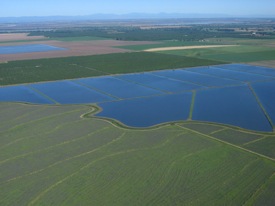
Flooded rice fields in the Sacramento Valley. Photo: Craig Miller

Everything You Know is Wrong

By Dan Brekke

California is home to 37 million people—and to 37 million water experts. If no one’s ever said that, someone should have.

There’s nothing more central to life here and no subject that excites stronger opinions. Recent events have shown that those opinions can easily harden into certainty about what needs to be done to solve all of California’s water problems—the needs of those 37 million people, the needs of the state’s incomparably rich agricultural industry, the needs of native fish and ecosystems.

We’ve long since learned that one person’s “solution”—to build dams and divert water for farms and cities, say—can be another’s nightmare—for instance, the communities that depend on healthy fisheries for their well-being. The conflicts over water are so deep and longstanding that they can make rational discussion difficult or impossible.

This week, though, the Public Policy Institute of California published a report that aims to inject some understanding into the water debate by challenging opinions and misconceptions. The report tests eight widely-held beliefs about water against the complex realities that underlie them. The first myth is fundamental to how we see water issues: “California is running out of water.” The reality the PPIC and its all-star panel of water experts propose is a sobering one: “California has run out of abundant water (our italics) and will need to adapt to increasing water scarcity.”

There’s something in the list of myths to rankle just about everyone. One myth goes like this: “[Insert villain here] is responsible for California’s water problems.” The report goes on to assess several villain-candidates, including:

– Wasteful Southern California homeowners with their lush lawns and luxurious swimming pools,

– Farmers who get federally subsidized (read “cheap”) water, and

– Protections for endangered species (as in “Why are we giving water to that Delta smelt?”).

In reality, the report says, coastal Southern California does an excellent job of limiting residential water use; farmers getting cheap water are in fact paying a price for the subsidy and are becoming more efficient water users; and actions taken to protect the smelt has had a comparatively small impact on water shipments through the Delta.

The PPIC says in the introduction to “California Water Myths” that a “policy based on facts and science is essential if California is to meet the multiple, sometimes competing goals for sustainable management” of water for the rest of the century. No one can argue with that, though it’s certain that squabbles over water will persist. Maybe the best we as Californians can hope for is an honest effort to try to understand the needs of all other water users, and to give each of them the benefit of the doubt when considering solutions to our water problems.

The PPIC report: “California Water Myths,” is available on the institute website or in an excellent interactive version put together by the UC Davis Center for Watershed Sciences.

Meanwhile, how are we doing this winter? Not great. Below is an interactive map of California’s major reservoirs, comparing their current levels to average or “normal” levels for this time of year.

View KQED: California Reservoir Watch in a larger map