All posts by Craig Miller

Craig is a former KQED Science editor, specializing in weather, climate, water & energy issues, with a little seismology thrown in just to shake things up. Prior to that, he launched and led the station's award-winning multimedia project, Climate Watch. Craig is also an accomplished writer/producer of television documentaries, with a focus on natural resource issues.

Delegate’s Dispatch No. 2

Louis Blumberg directs the California climate programs for The Nature Conservancy. He’s also been keeping us posted as an official observer to the UN climate conference. And yes, views expressed in his guest posts are his and not necessarily those of KQED or the Climate Watch staff.

Things Heat Up Copenhagen
By Louis Blumberg

Emotions erupted at the Bella Center today during the United Nations climate change conference in Copenhagen, Denmark. Demonstrations, street theater, leaked documents, heated words, threats of walkouts and huge crowds all collided to increase the energy level throughout the massive hall. Frustration was driven in part, according to one of the key treaty negotiators, by the fact that little progress has been made.

At this point in the process, the open meetings have stopped and negotiators are meeting in private to work out their differences. This loss of transparency was exacerbated when demonstrators disrupted one of the last public plenary sessions of the week and the organizers threw out representatives from all non-governmental organizations–including me.*

As discouraging as this emerging gridlock is, my optimism remains because I see that three key pieces, which are falling into place, can produce a real deal:

– First, for the first time ever, key countries, including the U.S., China, India, Brazil and Korea, have all put numerical proposals on the table to reduce emissions.

– Second, as I reported before, the U.S. is providing real leadership, in part by proposing a $10 billion annual fund to help developing countries reduce emissions and adapt to climate change while continuing to grow their economies.

– Third, President Obama and 110 other heads of state will arrive next week for the final negotiation.

In the meantime, the process of creating a new international treaty amps up…

Yesterday I joined 200 activists in a standing ovation for EPA Director Lisa Jackson as she confirmed U.S. leadership by listing the administration’s actions to fight climate change, including this week’s official finding that greenhouse gas endangers human health. [Ed. Note: This creates authority for the EPA to regulate greenhouse gases on its own, with or without enabling legislation].

African countries called for more forest protection. Delegates from one island nation faced with imminent destruction by flooding due to sea-level rise, threatened to walk out on the talks unless the developed countries exhort to cut emissions by 95 percent.

I, alongside a coalition of forest activists, struggled (in what may be a futile attempt) to close a new loophole in emissions reporting rules proposed by some European countries.

And finally, the energy, passion and idealism of demonstrators in costume–walking trees, polluters dressed in red, vegans for climate, and Mr. Green (you can figure that one out on your own)–were both captivating and inspiring.

The frenetic pace is both tiring and energizing and will only increase as we move toward the conference closing on December 18. But there is much more to come before then. Stay tuned.

*Ed. Note: We’re using the term “delegate” somewhat loosely here. Blumberg is a member of The Nature Conservancy “delegation” in Copenhagen but technically he’s an official observer, as are all NGO reps. That’s why he can be tossed out of sessions.

Hopenhagen II: A Delegate’s View

Louis Blumberg is a COP 15 delegate and Director of Climate and Forest Policy for the Nature
Conservancy in California.

Update from Hopenhagen

By Louis Blumberg

The sense of possibility pervaded the halls Monday, infusing energy and 
optimism into the delegates at the UN climate change conference in
 Copenhagen, Denmark. As in prior years, the sheer magnitude of the event 
was inspiring. More than 10,000 participants attended today, thousands 
of whom (including this participant) waited patiently in line for hours
 to get inside.

In one room, representatives from 192 nations sat shoulder-to-shoulder
 in the discussions, and each country was given an equal voice. Two seats
 were allocated to Gabon and two for the U.S., two for China and two for
 Monaco, and so on.

At home in San Francisco, much of my work is focused on addressing
 climate change in California, and we have made great progress as a
 state. Now, seeing the whole world gathered in one room (figuratively
 speaking), it is a powerful reminder that the work we are doing in 
California can be applied anywhere, whether in Australia, Peru or China.
 We are all in this together and can learn so much from one another.

This is the 15th meeting for the “Conference of Parties” (hence “COP 15”), a follow-up to 
the 1992 UN Framework Convention on Climate Change, which resulted in the first global climate agreement ratified by 192 nations, including the U.S. Each year preceding that conference, global delegations have 
met to discuss how to address climate change. The most notable agreement
 happened in 1997 in Kyoto, Japan. Dubbed the Kyoto Protocol, it 
ordered 37 industrialized nations to cut greenhouse gas emissions. The
 U.S. rejected that pact, and since then our federal government has shown little-to-no leadership on the issue.

But what a difference a year makes. In its first public statement at the 
conference, the United States addressed two key issues head-on with commitments for action: First, a pledge to reduce emissions of
 greenhouse gases by 17% by 2020; and second, a $10 billion pledge with
 other nations intended to help developing countries grow their economies
 while cutting emissions. U.S. envoy Jonathan Pershing spoke forcefully,
 signaling that a new regime in Washington meant real leadership on
 climate change for the world.

Despite public skepticism, it has become clear that something is going
 to happen here. People from all over the world have come together to solve the most serious problem of our lifetime. Nothing less than the 
future of nature and humanity is at stake. I just hope the agreement is
 sufficiently strong and that action happens quickly.

Climate Watch in Copenhagen

Earthshine_NASAClimate Watch begins it’s coverage of the UN’s COP 15 climate talks in Copenhagen this evening, when KQED’s This Week in Northern California airs my recently taped interview with former Vice President and Nobel Laureate Al Gore. The original 20-minute interview has been “edited for TV,” down to about nine minutes. The full interview is to be posted on This Week’s website.
The interview begins with Gore’s assessment of the upcoming climate conference and then moves on to California’s role, the hype surrounding “green jobs,” controversy over climate science, his new book, and other topics. Regrettably, the interview was recorded before the eruption of the email scandal now known as “Climategate,” so I wasn’t able to get his take on that.

It’s pretty hard to spring anything on Gore. He’s heard every question there is to be asked about a thousand times and has carefully crafted, well-rehearsed answers to all of them. He did seem slightly off-balance when I asked him about FactCheck.org’s conclusions about some of the green job creation hype.

On Monday, our radio and online coverage begins in earnest when the first of Rob Schmitz’ reports from Copenhagen airs on The California Report. Schmitz, KQED’s Los Angeles Bureau Chief, arrives there on Saturday and will be there for the entire two weeks of events and negotiations. He’ll provide radio reports and frequent blog posts, covering–among other things–the appearance of California Governor Arnold Schwarzenegger on “Subnational Day.” In a climate-related media event on Treasure Island this week, Schwarzenegger said his mission in Copenhagen would be to rally governors, mayors, provincial leaders and other subnational players, to continue their own progress toward greenhouse gas emissions and not wait for national governments and international bodies to take action.

Also on Monday, Rob and I will join host Michael Krasny and NASA climatologist James Hansen on KQED’s Forum program. Hansen was the original climate whistle-blower, complaining that the Bush administration was muzzling climate scientists. Hansen has since taken a hard line against the upcoming efforts in Copenhagen, saying that cap & trade is the wrong path to climate intervention (both Gore and Hansen are promoting new books of theirs).

Invasion of the Electrics

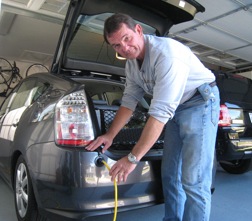
If the electric car was indeed “killed,” as a popular documentary suggested not long ago, the floor at the Los Angeles Auto Show this week would suggest a mass resurrection not seen since Night of the Living Dead. Climate Watch contributor Alison Hawkes reports on some implications for the power grid. Her radio report airs Friday on The California Report.

By Alison Hawkes

Electric vehicles may be few in number over the next few years, despite the hype around the release of off-the-assembly line EV models in 2010. It takes several decades to flip the American vehicle fleet.

Robert Susich offsets his charging with rooftop solar.  "This is the way of the future," he says. Photo: Alison Hawkes
Robert Susich offsets his charging with rooftop solar. "This is the way of the future," he says. Photo: Alison Hawkes

But there’s little doubt that EVs are coming, pushed on by anxiety over foreign oil and unexpected spikes in gas prices, growing environmental awareness, and government incentives. Starting at the end of December, EV buyers get a federal tax credit of between $2,500-to-$7,500 per vehicle, depending on the battery size. There are other tax credits for plug-in conversions and even electric motorcycles and electric three-wheelers. Now who doesn’t like a tax credit?

All this may sound promising but energy planners have some serious head-scratching to do as Americans begin switching their transportation fuel from gasoline to electricity.

For starters, how do you avoid building extra power plants? Who pays for infrastructure upgrades to electrical substations and transformers? How do you get EV drivers to charge during off-peak hours when the energy supply is now wasted?

Pacific Gas & Electric’s smart grid director Andrew Tang says utilities have faced similar problems before with the advent of air conditioners in the 1970s and plasma screen TVs in the 1990s. New technologies add to the demand on an already tight energy market. “It’s a form of load growth and we’ve managed to deal with it without having sudden power outages,” says Tang.

But, Tang admits, EVs could bring a heavier strain on the grid than any seen before. One EV can draw as much energy as a house. Put another way, that’s doubling a household’s demand for power. Fortunately, it sounds like the utilities have some time, and capacity, to see how the EV market develops.

PG&E is expecting to support some 250,000 vehicles by 2020, which may not seem like much for a 70,000 square-mile service territory. But they won’t be spread out evenly. The northern California utility is expecting EV drivers to congregate in certain neighborhoods, potentially sending substations and transformers into overload (read: blackouts) if not properly managed. Tang said PG&E did a study of hybrid electric vehicle registration over the last four years and found that Fresno’s portion of hybrids was 2.4 percent, while Berkeley’s was 18 percent. “That’s much more concentration,” says Tang. “We think that’s a fair proxy of what we could have with electric vehicles.”

So the California Public Utilities Commission is now exploring ways to regulate EV’s. The basic question is how to influence consumer behavior so EVs do not add to peak energy demand. No one wants blackouts, and no one wants to build more power plants. One idea bandied about is a differentiated rate system that encourages EV drivers to charge during off-peak hours at deeply discounted prices, called a “time of use rate.” Another idea promoted by the PUC’s independent Division of Ratepayer Advocates is a five-dollar monthly fee on EV drivers that would go into upgrading grid infrastructure, like adding or upgrading local transformers, as needed.

“If electric vehicles need (additional) infrastructure, they should pay for it and not spread the cost across all ratepayers,” says DRA’s deputy director Dave Ashuckian.

EV drivers may bristle at being treated differently than other power users, especially when they feel they’re doing society a favor by switching to a cleaner fuel source. Early adopters may be happy to help optimize the grid. But if EVs go mainstream, energy planners know the public is going to want a more convenient system.

Automated smart metering (you’re not in charge of your charging) may help. The hybrid plug-in Chevy Volt coming next year is supposed to come with a smart meter.  But planners eventually foresee public charging stations that will allow EV drivers to juice up quickly (through high-wattage charging equipment) and when they need to, during daytime peak hours. Already some California companies that want in on the emerging charging station business are fighting the idea of PUC regulation of their potential market.

A California PUC staff white paper reported that the benefits of lowered greenhouse gas emissions with an electrified transportation system are realized only when some 76 percent of EV drivers charge off-peak. And only if any extra power demand is met by renewable energy sources – not coal or oil. That’s a tall order.

Ed. Note: One thing EV’s already have going for them: a lobby. This week it was announced that after 16 years, deputy director Eileen Tutt is leaving CalEPA to become executive director of the California Electric Transportation Coalition.

Sierra Snow: Scientists in Heated Agreement

Loot from the recent invasion of email servers at the Climatic Research Unit (CRU) in Britain has raised questions about whether scientists who dissent from the prevailing views of climate research are being muzzled by their colleagues.

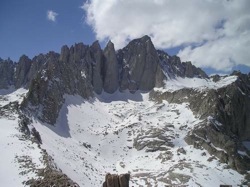
Snow on Mt. Whitney. Photo: USFS

An interesting example of this arose this week in a report by Richard Harris for NPR’s All Things Considered. It’s worth a listen, if only for the back-and-forth between two climate scientists over snowfall in the southern Sierra Nevada mountains. John Christy of the University of Alabama, Huntsville, tells Harris about trouble he’s had publishing research that appears to counter the mainstream view that the Sierra snowpack is endangered. For a response, Harris goes to Philip Mote at Oregon State University, one of the scientists who reviewed Christy’s research.

Also interviewed are Gavin Schmidt of NASA and Judy Curry from Georgia Tech.

The head of the UN’s climate panel finally issued his own statement on the email flap, which was part condemnation of the hackers, part defense of the science and peer review process.

Scientists Respond Cautiously to Hijacked Email

I’ve spent several days dithering over whether to weigh in on the recent email heist from a server at the University of East Anglia in the UK. For those who choose to read it that way, the hacked email originally passed among climate scientists worldwide has, rightly or wrongly, provided those who reject the prevailing climate science with enough radioactive ammo to fill Yucca Mountain.

Some high-profile California researchers figure prominently in the material. In a searchable database of the messages, for example, the name of Ben Santer, a climate modeler at Lawrence Livermore National Lab came up 173 times. Stanford’s Steve Schneider came up 71 times. Both are outspoken defenders of science supporting the human contribution to global warming.

Another scientist quoted or referred to (99 times), Kevin Trenberth, is a name familiar to readers of this blog and listeners to Climate Watch radio coverage. Trenberth is a climatologist at the National Center for Atmospheric Research (NCAR) in Boulder, CO.  I’ve interviewed him mostly about the role of the Pacific oscillation known as El Nino in climate patterns. After the decade’s worth of email came to light, I wrote Trenberth for a response. His reply may not be entirely original. Some lines have also been attributed to a spokesman for the university whose servers were invaded. In any case, here’s Trenberth’s response to Climate Watch:

It is a matter of concern that data, including personal information about individuals, appears to have been illegally taken and a criminal investigation is underway. The selective publication of some stolen emails and other papers taken out of context is mischievous and cannot be considered a genuine attempt to engage with this issue in a responsible way. The volume of material published and its piecemeal nature makes it impossible to confirm what proportion is genuine.  Many elements have been published selectively on a number of websites. Generally the items are out of context, incomplete and very misleading. Some others are wildly misinterpreted and have a simple explanation.

The material published relates to the work of the Climatic Research Unit (CRU) and other scientists around the world.  Many of the scientists featured in the emails with [Phil] Jones [of East Anglia] have web sites and freely and openly make available their papers, presentations, blogs and other information. Several of the emails document the detailed procedures used in the IPCC AR4 Fourth Assessment report for Chapter 3 (for which Phil Jones and Kevin Trenberth were coordinating lead authors) and other chapters. They actually reveal the integrity of the process and the hard work that goes into such an assessment.

Trenberth then went on to cite some specific “examples of misinterpretations:”

From Kevin Trenberth, interpreted as a failure of computer models:

“The fact is that we can’t account for the lack of warming at the moment and it is a travesty that we can’t. The CERES data published in the August BAMS 09 supplement on 2008 shows there should be even more warming: but the data are surely wrong. Our observing system is inadequate.”

This refers to the inability of our current observations from satellites and in situ to account for where all the energy has gone. A paper on this is available here:

Trenberth, K. E., 2009: An imperative for climate change planning: tracking Earth’s global energy. Current Opinion in Environmental Sustainability, 1, 19-27, doi:10.1016/j.cosust.2009.06.001. [PDF]

This paper tracks the effects of the changing Sun, how much heat went into the land, ocean, melting Arctic sea ice, melting Greenland and Antarctica, and changes in clouds, along with changes in greenhouse gases. We can track this well for 1993 to 2003, but not for 2004 to 2008. It does NOT mean that global warming is not happening, on the contrary, it suggests that we simply can’t fully explain why 2008 was as cool as it was, but with an implication that warming will come back, as it has. In 2008 there was a La Nina event.  We now have an El Nino underway.

Kevin Trenberth

Meanwhile, the university’s Climate Research Unit has posted a series of rebuttals. Still, this digital hijacking is disturbing on a lot of levels. Whether you accept the prevailing climate science or consider the email damning evidence to the contrary, it is a distraction from the business at hand in Copenhagen and a public relations train wreck for the IPCC and many of its most eminent contributing scientists. You can bet that it won’t be forgotten when a major climate bill hits the floor of the U.S. Senate for debate, early next year. Oklahoma Republican James Inhofe, vocal critic of global warming science, is already calling for an investigation.

Sketchy First Look at California Cap & Trade

On Tuesday the California Air Resources Board put out a sneak preview of the carbon cap & trade system mandated by the Global Warming Solutions Act of 2006 (AB 32). Couched as a “preliminary draft,” the 132-page plan is intended as a broad outline for a final Cap-and-Trade regulation scheduled to go before the board late next year.

As such, the draft lacks a few key components, such as how many allowances the state plans to auction off to industry, versus give away. Air Board chief Mary Nichols says her agency is still waiting on recommendations from an expert committee on how to best handle allowances.

Environmentalists have been pushing for polluters to pay for allowances up front. In an email to me on Tuesday, in anticipation of the draft, Bernadette del Chiaro of Environment California wrote that her group is “slightly disappointed that ARB staff are punting on the issue of auctions. ARB in the scoping plan said they are committed to getting to 100% auctions. I hope the draft rules at least repeat this commitment.”

The draft appears to stop short of an outright commitment, reiterating that “transition to a 100 percent auction was a worthwhile goal.” In a conference call with reporters, Nichols said she anticipates at least a partial auction. Also undetermined is how to deploy the funds that emitters may pay for allowances. Nichols said a $10 per ton price for carbon could produce a two-to-four-billion-dollar pool of money, which could be used for such things as “buying down” utility costs for low-income families or creating incentives for development of renewable energy technology. Nichols declined to project what a cap & trade system would end up costing households in California.

You can download a PDF file of the complete report at the CARB website (under “What’s New). A public meeting is scheduled for December 14 in Sacramento, to get feedback on the Preliminary Draft Regulation released this week.

Also on Tuesday, the Governor’s Office announced that Quebec, one of California’s partners in the Western Climate Initiative for regional carbon trading, has set a target “to reduce its greenhouse gas emissions 20 percent below 1990 levels by 2020 and the introduction of a clean-car emissions standard equivalent to California’s Vehicle Tailpipe Emissions Standards.”

The WCI includes seven western states and four Canadian provinces. Any progress from the state’s WCI partners is welcome at this point, as most have been reluctant to set their intentions into law.

Check out our interactive map of California’s largest industrial emitters of greenhouse gases.

Thousand-Year-Old Trees Get a Growth Spurt

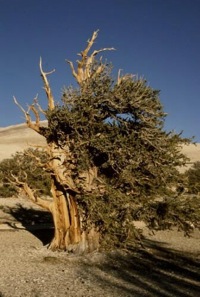
Bristlecone pine. Photo: US Forest Service
Bristlecone pine in the Inyo National Forest. Photo: US Forest Service

There’s a lot of history packed into a tree with more than 4,000 annual growth rings. Scientists who count them (dendrochronologists) have been able to learn a lot about the drought history of California and the West.

The Great Basin bristlecone pines that grow along the spine of the Sierra are the oldest living things on Earth–older, even, than the giant sequoias. Studying the uppermost trees, around 12,000 ft., researchers stumbled on a strange trend. The trees, legendary for their slow rate of growth, have been growing faster over the last 50 years or so, than at any time in the last three millennia.

If you missed it this week, Malcolm Hughes, one of the study’s lead researchers and a professor of dendrochronology at the University of Arizona’s Laboratory for Tree-Ring Research, spoke to NPR’s All Things Considered about the possible cause.

There’s more on the study in a recent post on the RealClimate blog.

You can see these astonishing trees for yourself in the Ancient Bristlecone Pine Forest of Inyo National Forest–but you might want to wait until spring. The visitor center is not staffed between November and May and winter access is iffy at 10,000 feet. Worse yet, the original vistor center burned down in the fall of last year. The Forest Service is using a temporary (trailer) facility until a permanent one is rebuilt. According to the Forest Service website:

“…the visitor center is being designed to be a model of energy efficiency, utilizing the latest in “green” building practices.   According to Bristlecone Pine Forest Manager John Louth, some of the improvements that visitors will see will be a state-of-the art solar power system, updated exhibits addressing the impacts of global warming on the ancient trees, a small research library, a slightly larger theatre room and a fire/intrusion detection & suppression system.”

California’s Biggest Carbon Emitters

Carbon addiction is the same as any other in at least one respect: the first step to recovery is admitting you have a problem. For greenhouse gases, reducing emissions requires knowing what you’re putting out to begin with.

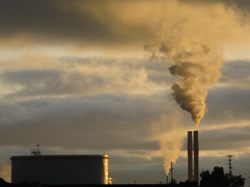
The Conoco Phillips refinery in Rodeo, north of Oakland, is a relatively small player at 1.9 million metric tons of CO2 per year. Photo: Craig Miller
The Conoco Phillips refinery in Rodeo is a relatively small player, as refineries go, at 1.9 million metric tons of CO2 per year. Photo: Craig Miller

It was toward this end that this week the California Air Resources Board released the first comprehensive data on large-scale industrial carbon emissions in the state. Not surprisingly, the top emitters tend to fall into two categories: power plants and oil refineries, with cement manufacturers not far behind.

Individually, major oil refineries have the largest carbon footprint. Two of Chevron’s refineries–in Richmond and El Segundo, BP’s Carson refinery and the Shell refinery in Martinez, all clocked in at more than three million metric tons (tonnes), CO2-equivalent, for 2008.

Use the interactive map below, prepared by Climate Watch intern David Ferry, to locate the largest industrial emitters and see how they sort out by industry (We’ve been having difficulty with embedded maps vanishing from the blog, so if you don’t see the map below, just click on the link to it).

(Click here for a larger map and a list of all the largest emitters.)

View KQED: California’s Biggest Industrial CO2 Emitters of 2008 in a larger map

Cumulatively, electric power generation is California’s biggest emitter, despite the virtual absence of coal-powered plants in the state. The ARB report lists nearly 20 utility or industrial cogeneration plants in the million-plus club. Several plants put out more than two million tonnes, including Dynegy’s gas-fired plant at Moss Landing, the LaPaloma McKittrick plant, Southern California Edison’s Mountainview plant in Redlands, and the L.A. Department of Water & Power’s Haynes Generating Plant.

The federal EPA considers anything above 25,000 tonnes to be a large emitter. But with carbon emissions, “large” is a relative concept. California imports power from other states and we can get a clue to “large” from the carbon output numbers on some of the mostly coal-fired plants feeding the California grid from states like Utah and Wyoming. Some fossil fuel plants in those states weigh in at a hefty six, ten–even 15 million metric tons. Los Angeles still depends on out-of-state fossil plants for roughly half of its electric power.

A few large cement plants are also in the million-plus column. To find out why, listen to Amy Standen’s report for Quest.

Of course, all this careful accounting leaves aside the elephant in the room: transportation, which has a bigger footprint in California than all electrical generation combined, including imports from other states–and is about equal to total industrial emissions.

The industrial tally released this week is subject to revision and will be used to set caps and allowances for the carbon trading (cap & trade) system mandated by the state’s 2006 Global Warming Solutions Act, commonly known as AB-32. There’s more on the emissions report and what it means in Paul Rogers’ story for the San Jose Mercury News.

When Will Lake Mead Go Dry?

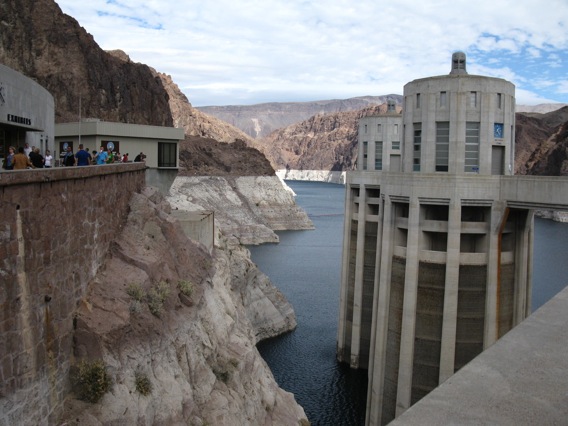
Exposed turbine intakes and the "bathtub ring" at Lake Mead. Photo: Craig Miller

You can see a slide show of the retreating waters at Lake Mead and Hoover Dam and listen to my radio feature from The California Report. Also, The American Experience will rerun its documentary on Hoover Dam, Monday night on most PBS stations.

The Las Vegas Sun has a digital clock on its website, counting down to a theoretical doomsday when the city’s principal source of water would go dry. Wagering on that question may not have found its way into the sports books on the Strip–but it did become a lively pastime among engineers and hydrologists, when a report emerged from San Diego’s Scripps Institution, with a dire forecast. The paper, by climate physicist Tim Barnett, put the odds at 50-50 that Lake Mead, the giant reservoir behind Hoover Dam, would reach “dead pool” by 2017. That’s the point at which the dam shuts down and neither hydroelectric power nor water emerges from it.

The Barnett study “definitely raised eyebrows throughout the basin,” admits Terry Fulp, deputy director of the U.S. Bureau of Reclamation’s Lower Colorado Region, which operates Hoover Dam and Lake Mead. As it turns out, Barnett was a bit pessimistic. Subsequent work by him and others revealed that he overestimated the evaporation rate at Lake Mead, and omitted inflows below a certain point on the river.

The bottom line, according to Balaji Rajagopalan at the University of Colorado: Doomsday is not quite that near at hand. But that doesn’t mean it’s not on the horizon. “After 2027, the demand increase outpaces the supply decrease,” Rajagopalan told me in a recent interview. “And that’s why much of the risk explodes from 2027 to 2057.”

All of these studies are couched in probabilities, much in the same way that the Corps of Engineers talks about a “100-year” flood. Rajagopalan says: “Even in our study, we have a 50% risk [of dead pool], but that occurs in 2057. And that makes a big difference in terms of water managers, what they can do.”

One of those managers is Pat Mulroy, who directs the Southern Nevada Water Authority. Her constituents rely on Lake Mead for 90% of their water, so she says she’s not inclined to wait around for a consensus. “I mean, during the entire period of the ‘90s when we were bickering with our friends in the lower basin over surpluses, there was zero probability that the drought that we’re currently in was going to happen,” Mulroy told me.  “I’ve lost confidence in probabilities.”

The Bureau’s Fulp says the Colorado system leans heavily on the huge water storage capacity of Lake Mead and its sister reservoir upstream, Lake Powell. “We’ve known for decades that this system is highly variable and that’s why so much storage was built.” When filled to capacity (which it was, more or less, 10 years ago), Lake Mead alone can hold enough to put an area the size of Pennsylvania under a foot of water. But a 10-year drought has left Mead at just over 40% of capacity (so think of flooding something more the size of Costa Rica). Just as current evidence and climate models both point toward lessening flows on the Colorado, many parts of the southwest still see relatively high population growth.

Scientists continue to run their statistical models aimed at handicapping the Colorado’s demise as a dependable bringer of water. But as Fulp sums it up, “It’s really a debate about when. It’s not really ‘if.”

I regret an error of my own that appeared in the radio feature. I misstated the number of people in southern Nevada who are dependent on water from the Colorado. The correct number is about two million.