All posts by Craig Miller

Craig is a former KQED Science editor, specializing in weather, climate, water & energy issues, with a little seismology thrown in just to shake things up. Prior to that, he launched and led the station's award-winning multimedia project, Climate Watch. Craig is also an accomplished writer/producer of television documentaries, with a focus on natural resource issues.

Yosemite’s Fiery Future

Tim Walton
Photo: Tim Walton

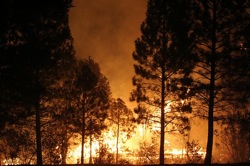
California’s Yosemite National Park has been scarred by several big fires in recent years—the latest contained less than two months ago. But new research affirms that this crown jewel among national parks is likely to have even more fire in its future.

In late August, when fire crews attacked the Big Meadow Fire in Yosemite, it was hard to blame nature for the 74-hundred acres lost. That was a “prescribed burn” that got out of hand (or “escaped,” as the official report puts it). But nine out of ten wildland fires in the Sierra start with a lightning strike. Newly published work suggests that as California’s climate changes, the combination of warmer temperatures, less snow and more lightning strikes could mean 20% more fires by mid-century.

USGS research forester emeritus Jan van Wagtendonk co-authored the study with James Lutz at the University of Washington. He says they studied 20 years of Yosemite fire data to identify a trend. The mechanism starts with the oft-cited warming scenario, causing more rain and less snow at upper elevations.

“What happens in the mountains is that, as snow recedes in the spring the moisture in the fuels follows,” says van Wagtendonk. “The fuel starts drying out earlier and we extend the fire season by having more days available for fires to burn.”

But there’s another wildcard in the deck: lightning. Separate studies suggest that higher concentrations of atmospheric carbon dioxide will set the stage for more lightning strikes.

The study assumes a 17% reduction in snowpack by 2050—under the relatively modest B1 warming scenario, drawn from IPCC models. The results are in line with other climate studies that imply not just more fires, but more intense fires as the climate warms. It’s a trend, says van Wagtendonk, that has already started:

“We were able to trace, through satellite imagery, the change that we’ve seen in the severity of those fires just over the past 20 years, so it’s been obvious to us from those data that whatever temperature trends are occurring today are already having an effect on increased severity.”

“We see more of the same,” said the forester, “and a continued increase in both size, number and severity of fires.”
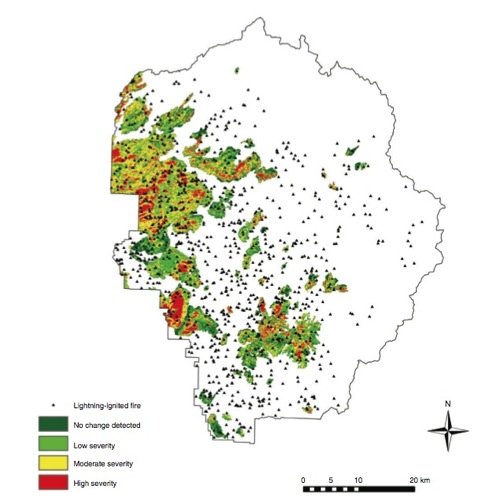
Yosemite fires from 1984-2005. The black triangles are fires sparked by lightning. Image: International Journal of Wildland Fire.
Yosemite fires from 1984-2005. The black triangles indicate fires sparked by lightning. Image: International Journal of Wildland Fire.

Scott Stephens, an associate professor of fire science at UC Berkeley, says lightning is changing the landscape in more ways than one.

Stephens recently told KQED’s Central Valley Bureau Chief, Sasha Khokha: “In Yosemite and Sequoia-Kings Canyon, they manage quite a few lighting fires in the wilderness area, away from people, and they allow these things to burn for months and months and months to try to allow that lighting fire to begin to shape the landscape again like it did 100 or 200 yrs ago. Those types of events probably increased the resiliency of the forest to deal with climate change and other impacts.”

The article is published in the current issue (10/27) of the International Journal of Wildland Fire.

KQED’s Central Valley Bureau Chief, Sasha Khokha, contributed to this post, as well as to the radio report.
Wind Picks Up While Solar Costs Drop

Solar Gain

In green building circles, the term “solar gain” refers to how much a place heats up during the day, from sun exposure. This week marked “gains” for both solar and wind energy development in California. For years, the buzz around solar power has centered on how rapidly the cost of photovoltaic systems would drop enough to make it truly competitive.

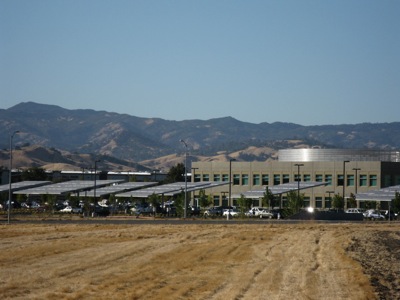
Solar panels shade the parking lot at Genentech in Vacaville.
Solar panels shade a corporate parking lot in Vacaville, CA.

Lawrence Berkeley National Lab released its second annual “Tracking the Sun” report this week, which actually tracks the cost of harnessing the sun’s energy in the U.S. It finds that the last decade (1998 to 2008) has seen the cost of installed photovoltaic power drop by 30%, averaged nationwide, although there were some short-term quirks. Among the “key findings:”

Preliminary cost data indicates that the average cost of projects installed through the California Solar Initiative program during the first 8½ months of 2009 rose by $0.4/W (per watt) relative to 2008, while average costs in New Jersey declined by $0.2/W over the same period.

That’s an interesting quirk at a time of generally low inflation and would seem to resonate with our recent report from Rob Schmitz, comparing the “red tape” cost factors between California and Japan (sorry, we didn’t get to New Jersey). Of course in markets, as in climate science, short-term fluctuations aren’t necessarily meaningful.

While the authors surveyed data from 16 states, they note that the results are “heavily skewed towards systems in California and New Jersey, where the vast majority of PV systems in the U.S. have been installed.” So clearly, California is participating in the longer-term trend of declining costs.

Average installed costs vary widely across states; among ≤10 kW systems completed in 2008, average costs range from a low of $7.3/W in Arizona (followed by California, which had average installed costs of $8.2/W) to a high of $9.9/W in Pennsylvania and Ohio. This variation in average installed cost across states, as well as comparisons with Japan and Germany, suggest that markets with large PV deployment programs tend to have lower average installed costs for residential PV, though exceptions exist.

The report noted three incentive programs in California that are encouraging solar installations in new construction: the Emerging Renewables Program, the New Home Solar Partnership Program, and the California Solar Initiative, and confirms that solar has gone mainstream, with 88% of systems connected to the grid. The LBNL report finds that overall, the main driver in recent cost declines has been the cost of PV panels themselves, as opposed to other components that solar systems require.

The report contains a wealth of charts and graphs to fascinate the solar wonk. You can download the 50-page report as a PDF file.

Wind picking up

Also this week, the American Wind Energy Association (AWEA) released third-quarter figures (PDF download) for large-scale wind energy  installations, logging 1,649 megawatts (MW) of new power generating capacity. The figure shows growth from the previous quarter and a running total of 5,800 MW of new capacity for the year, so far.

California clocks in at third among states with the most installed wind capacity, behind Texas and Iowa–but the Golden State does not place in the top five, in recent growth.

AWEA continues to voice consternation over a longer-term tailing off in wind turbine construction and manufacturing, especially in the U.S:

…the 5,000 MW now under construction is nearly 38% lower than the over 8,000 MW under construction at this time last year. A firm, long-term national commitment to renewable energy is still needed for the U.S. to become a wind turbine manufacturing powerhouse and create hundreds of thousands of jobs.

AWEA calculates the total operating wind power capacity in the U.S. to be about 31,000 MW, enough to power “the equivalent of nearly 9 million homes, avoiding the emissions of 57 million tons of carbon annually and reducing expected carbon emissions from the electricity sector by 2.5%.” Average power consumption per household varies considerably from state to state.

Brower Youth Award

For the past three years, Adarsha Shivakumar has worked nights and weekends to run a non-profit dedicated to helping impoverished Indian farmers produce biofuels. He has formed an alliance with an NGO and a biotech company to ensure that growers get a good price for their product. And he has used personal funds to purchase seedlings for villagers willing to try a sustainable crop.

Not a bad resume for a 16-year-old.

Earth Island Institute
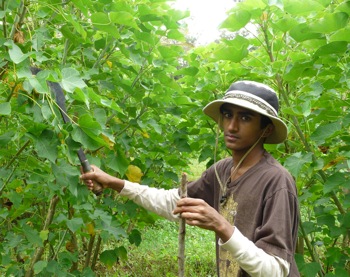
Brower winner Adarsha Shivakumar. Photo: Earth Island Institute

This week the Pleasant Hill native received the prestigious Brower Youth Award for “environmental leadership,” at a ceremony in San Francisco. He is being honored for mixing economics and environmentalism, in his efforts to aid tobacco farmers in India’s Karnataka region.

Shivakumar, who acts as though founding a non-profit is something most high school juniors do in their spare time, grew up visiting the region annually with his family. While there, he was taken aback by the hard life of the local tobacco farmers. His Indian relatives told him that the workers were at the mercy of the crop’s unstable price.

By the time he was twelve he had another realization: the farmers’ over-reliance on tobacco was leading to the slow-motion demolition of a nearby national forest.

“When we went there each year, what we noticed was that more and more sections of forest were just disappearing on the outskirts,” the Oakland College Preparatory High School student said. “This was due to tobacco growing, because what happens is the farmers have to cure the tobacco that they grow, and that requires firewood–a lot of firewood: two kilograms plus of firewood for one kilogram of tobacco.”

“It’s having a huge impact on the wildlife there. Each year…the forest is just steadily being destroyed,” he said.

So the American pre-teen decided to do something. Biofuels were big news in the United States at the time, but corn-based ethanol was getting a bad rap for causing food shortages. So he hunted around for a crop that could produce biofuel, but didn’t double as dinner for families in the developing world. Eventually he settled on Jotrapha curcas, a semi-poisonous plant that is hearty enough to survive the occasional drought and produces seeds that contain about 35% oil.

By encouraging villagers to plant Jotrapha, as well as the tobacco they traditionally grow, Shivakumar would aim to increase the farmers’ income and protect the ecologically sensitive forests nearby (Shivakumar took mild offense at a recent report on NPR about the harsh realities of Jatropha growing in Kenya. He says it’s important not to rely solely on Jatropha as a cash crop, and has learned from his time in Karnataka that, like any plant, Jatropha must be watered and cared for.)

At 13 he teamed up with his younger sister, Apoorva Rangan, and the two of them scrounged together what money they had to buy seedlings and get “Project Jatropha” off the ground. “When I was in the seventh grade I’d won the California State Spelling Bee and I got around $600 from that as a cash prize and I used that money to jumpstart the project,” Shivakumar said. “Apoorva and I had some funds that we had from baby sitting and all, and we used that as well,” he added.

The two worked with the farmers for weeks, trying to gain their trust and convince them to mix a little Jatropha in with their tobacco. In a culture where respect comes with age, Shivakumar said, this was no easy task.

But with the help of a local NGO called Parivarthana (Sanskrit for “change”) and the biotech company Labland Biotechs, he secured a deal that he hoped would make Jatropha planting profitable. Parivarthana would help teach the farmers sustainable agriculture, and Labland–which converts Jatropha into biofuel–would pay the growers for every kilogram of the crop they produced.

Shivakumar said that two years on, Project Jatropha is expanding and going strong. He still devotes hours of his days to communicating with workers in India, but said that lately much of his time has been swallowed up by media requests. He takes on these interviews, he said, to remind others that they can make a difference.

“We have to take action now–that’s the main thing,” he said. “And I hope Project Jatropha will show that it’s possible to take action and affect people in greater ways, and we hope to motivate and inspire others to take action as well.”

The Brower Youth award comes with a $3,000 prize, and it’s not hard to guess how Shivakumar will spend his winnings. “When I found out that we won, I was shocked yet very happy to say the least, because the $3000 cash prize we got is being reinvested into the project,” he said.

California is also home to two other Brower Youth Award winners. Ventura resident Alec Loorz, the youngest recipient this year, won for spreading the word about climate change. Inspired by Al Gore’s “An Inconvenient Truth,” the 15 year old has given at least 75 presentations on global warming to more than 10,000 people.

In his spare time, Loorz founded an organization dedicated to educating young people about climate change (Kids vs. Global Warming, penned a Declaration of Independence from Fossil Fuels, and is set to launch the California Climate Council of Youth, or C3Y, an effort to bring precocious kids together to brainstorm and learn how to combat global warming.

Hai Vo, a 22 year old University of California, Irvine graduate, was honored for a project to bring more sustainable food to his college campus. He worked to bring “real” food, i.e. “ethically produced, with fair treatment of workers, equitable relationships with farmers (locally and abroad), and humanely treated animals” to Irvine, and eventually convinced the entire UC system to offer 20% sustainable food at its campus dining facilities by 2020.

This post was reported and written by Climate Watch intern David Ferry.

An Hour with Amory Lovins

In case you missed it amid the flurry of climate-related news last week: On September 30, Amory Lovins, founder and chief scientist of the Rocky Mountain Institute, and an honest-to-goodness energy guru to many, spent an hour in conversation with Michael Krasny and callers to KQED’s Forum program. You can listen to the entire archived broadcast or scan some of the highlights here, compiled by Climate Watch intern David Ferry.

On China:

“We can count on China to lead the world out of the climate mess…Even though the U.S. has led the world in wind installations the past three years, this year China’s going to pass us so fast we won’t even hear them go by. China’s doubled its wind installation each of the past four years, and there’s a new paper in Science from Harvard and Tsinghua in September saying that China can meet all its electric needs–not the growth but the total–till at least 2030, cost effectively, from its wind resources.”

On Nuclear Power:

“Basically nuclear and coal plants are getting walloped in the global marketplace by efficiency and renewables and cogeneration because they’re a lot cheaper and they have less financial risk so they can attract private investment.”

Grading the Obama Administration on Renewables:

“Greatly improved and I think on the whole doing very well.”

On the Upcoming UN Climate Talks in Copenhagen:

“I’m cautiously optimistic…But remember that governments are usually the last to figure these things out. Most governments still think climate protection is costly. They haven’t figured out yet that economic theorists got the sign wrong and actually climate protection is profitable. Once you change the conversation from cost, burden and sacrifice to profit, jobs and competitive advantage it makes the politics a whole lot easier.”

On Energy Efficiency & Steve Chu’s “Low-Hanging Fruit” metaphor:

“The technologies keep improving faster than we use them, so efficiency is an ever bigger and cheaper source–it’s as if the ‘low hanging fruit’ had fallen on the ground; it’s mushing up around the ankles, it’s spilling in over the tops of our boots and the efficiency tree keeps dumping more fruit on our heads.”

On Large-Scale Solar Farms v. “Distributed” Power Generation:

“The sun is distributed for free. Why gather it in one place and then pay to spread it out again? The National Renewable Energy Lab says if we put solar cells on seven percent of the structures in this country it would run all our electric needs without using any land. And for that matter, the wind potential on available windy land in this country is several times our total electric need and the footprint is actually very small.”

On Whether Climate Change is Irreversible:

“There are a half-dozen known mechanisms of rapid climate change. Several of them show like they may be starting up, so it’s urgent to reverse that…we have plenty of technology already available to stabilize climate to the extent that irreversible changes have not already started. We don’t know what that extent is, so we ought to go full bore on best buys first and hope that we’re in time.”

You can also take a virtual tour of Lovins’ home in Colorado, which doubles as a laboratory for energy innovation.

Diatoms Have Their Day

Everybody’s got a summit nowadays. Last week, while the governors were doing their climate summitry in L.A., scientists and policy wonks convened at U.C. Davis for an ag-and-climate “summit.” The discussions seemed interesting and productive, despite (or perhaps because of) the fact that no world leaders appeared. This week the gods of green goop are gathered in San Diego for an Algae Biomass Summit. Climate Watch contributor and climate scientist Abbie Tingstad explains why algae deserves a summit.

tingstaddiatom2_blogThe Power of Pond Scum

By Abbie Tingstad

The slimy yellowish brown muck known as “pond scum” may soon help fuel your car, make your airplane trips more environmentally friendly, and power your home. Scientists and start-ups around the world are now looking to tap into this unsightly source to produce ethanol, biodiesel and jet fuel, and even more efficient solar cells. This sustainable energy source consumes carbon dioxide and can be developed without competing with food crops for land.

Yellow-brown pond scum is composed of diatoms; single-celled algae with elaborate silica-based cell walls (green films on water are made up of other types of algae and small water plants). These primary producers are ubiquitous: they inhabit a wide range of environments, requiring only sufficient light for photosynthesis and enough moisture to prevent desiccation. Worldwide, there may be 100,000 species living in oceans, lakes, estuaries, rivers, swamps, moist soils, and other damp environments.

Climate and environmental researchers have taken advantage of diatoms’ cosmopolitan living habits to reconstruct past climates and infer recent environmental changes related to pollution and climate warming. Since different locations tend to have unique diatom community compositions, these tiny algae have also helped forensic investigators solve crimes.

Now, diatoms and other types of algae and small aquatic plants like duckweed and watermeal might be used to generate ethanol, biodiesel, and jet fuel. A number of start-ups, such as Aurora Biofuels and SunEco Energy in California, have begun developing technologies to “farm” algae on non-agricultural land, using salt-or lower-quality fresh-water and also just happens to consume carbon dioxide. This research has seen renewed interest at large laboratories such as the National Renewable Energy Laboratory (NREL). Big private-sector players, such as ExxonMobil, Chevron, Dow Chemical, and Honeywell International, have begun investing in research as well.

Diatoms may also be able to make solar cells more powerful, according to recent research out of Oregon State University and Portland State University. Unlike more conventional silicon-based cells, dye-sensitized solar cells, which absorb photons on a dye molecule thin-film joined to a layer of titanium oxide on glass or plastic, are made from environmentally neutral materials and work well in lower light conditions. Using diatoms to coat the dye-sensitized solar cells could triple their efficiency, making them more competitive with silicon cells.

These diatom-based technologies are still in their infancy so it’s difficult to determine whether they’ll make a meaningful contribution to a new wave of renewables. However, California may well benefit if they do become more widespread because these can potentially be operated on dry land and, in the case of fuels, using salt water.

With these technologies still in their infancy, it’s not clear how soon, if ever, they’ll become widespread. However, with its surfeit of sunshine and lots of available desert land and access to saltwater, California stands to benefit from an algae boom, should investors wade in.

Abbie Tingstad is finishing her Ph.D. in the Department of Geography at UCLA, where she specializes in the analysis of tree-rings and diatoms (environmentally-sensitive unicellular algae) to infer information about climate and environmental change.

Behold the power of pond scum in the recent television segment produced by KQED’s Quest.

And Now, the Senate Show Begins

Senators Barbara Boxer (D-CA) and John Kerry (D-MA) have released their climate bill into the maw of Senate committees. Their Clean Energy Jobs and American Power Act is designed to cut greenhouse gas emissions by 20% from 2005 levels by 2020, with a long-range goal of 80% by 2050.

Sen. Boxer told me in an interview today that five committees have jurisdiction over various pieces of the legislation, which runs about 800 pages at this point (versus 1,400 for the version that narrowly passed the House). She conceded that it’s unlikely to clear the committee gantlet and get to the Senate floor in time for the next major round of U.N. climate talks, set for December 7 in Copenhagen.

Given multiple major distractions such as economic recovery, health care reform, and two ongoing wars, Boxer predicted that it would likely be late December before a version of the climate bill could come to the floor. She said “I have a hunch we’re going to be in until Christmas Eve, frankly.”

Box says she and her colleagues have “broadened the coalition” since a House version of national carbon legislation squeaked through by nine votes over the summer. “We think at the end of the day, they (skeptics) will realize that this is the most flexible way to stand up and fight this challenge called global warming.”

Boxer counterposed this “flexibility” with what some consider the likely alternative; non-legislated regulation of greenhouse gases by the Environmental Protection Agency, under the decades-old Clean Air Act. Coincidentally or not, EPA took a step in that direction today by announcing proposed new requirements for large industrial emitters of carbon dioxide.

EPA’s proposed “tailoring rule” covers six known greenhouse gases produced by power plants, oil & chemical refineries and other large-scale operations. Boxer says she doesn’t see the announcement as competing with Congress. “I think this is a very important signal to my colleagues that the EPA wants to work with us. They’re just going after the biggest polluters and that’s following our lead.”

As for “subnational” initiatives like the Governors’ Climate Summit, going on this week in L.A. (and where EPA chief Lisa Jackson chose to announce the new rules), Boxer said her bill “should encourage the Governors to keep on going. Keep on keepin’ on because the more we all do, the easier it will be in the end.”

Boxer said “We have to step up here or we’re going to see the terrible results of unchecked global warming. This is the moment,” she said. “We’re losing the window.”

Lauren Sommer is covering the L.A. summit for Climate Watch. Watch for her daily posts.

A Climate of Quietude

This week conservationists issued their annual list of the “most endangered” national parks, including two in California (Joshua Tree and Yosemite). There are many ways to measure the health of a park; the air, the water. This week on Quest radio, I examine an often overlooked vital sign: the sound. Thanks to Climate Watch contributor Sasha Khokha, Bob Roney, Bernie Krause and the staff at NPS Ft. Collins for many of the sounds you hear in that segment, nicely mixed by Ceil Muller.

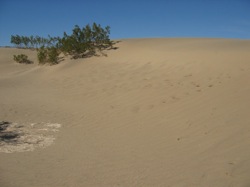
Sand dune near Stovepipe Wells, Death Valley. Photo: Craig Miller

The quietest place I’ve ever been was in a national park and I don’t think I’ll ever forget what it was like.

Okay, “quiet” is a somewhat subjective thing. When I lived on the upper (way upper) west side of Manhattan in the 1980s, any interval without hearing a car alarm seemed like blessed relief. Quiet can be measured, of course, with sound pressure meters. Anything below about 40 decibels is pretty darn quiet for most people’s purposes (a state that I doubt was ever attained in my apartment on West 119th St.).

The National Park Service (NPS) says the quietest place it has yet measured is a spot in Great Sand Dunes National Park, where Vicki McCusker, who helps oversee the natural sounds program for the Park Service, says it was “bottoming out” their meters.

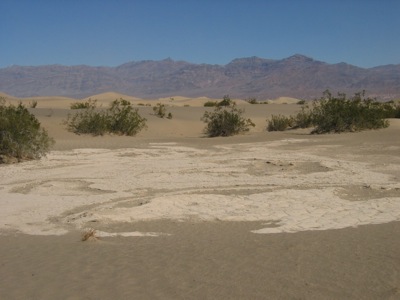
I’ve never been there but it’s hard to imagine greater quietude than an afternoon I spent in Death Valley. Coincidentally this was also on a sand dune, near Stovepipe Wells. It was also Christmas Day, which kept the tourist traffic to a minimum. It was at a point in my life when I was in desperate need of some deep introspection, so I parked my car along Highway 190 and trekked into the dunes, found an accommodating slope and sat down. Occasionally a fly (or something) would buzz by. Other than that, the loudest thing was the buzzing in my own head, which I can only hope would’ve been inaudible to anyone with me.

Looking across the dunes in Death Valley. Photo: Craig Miller

It’s interesting how, when things get really quiet, our bodies try to make up for it with ringing ears and internal chaos. The noted bioacoustician Bernie Krause talks about the time he and his wife, Kat were hosting guests from New York, who literally had to leave the Krause’s semi-secluded Glen Ellen “sanctuary” because the night-time quiet was creeping them out.

I asked Krause what he could draw from that. “Well, it tells me that we’re more insane than I ever thought in the first place,” he mused. “I mean, we’re definitely verging on pathological.  Because it’s exactly those kinds of sounds–the urban acoustic envelope in which we enfold ourselves–that kind of urban noise that’s driving up the numbers of prescriptions for Prozac.”

Surveys of national park visitors would seem to bear that out.  In the early 1990s, NPS surveyed 15,000 visitors in 39 parks, about noise issues (NPS manages 391 “units” nationwide, 58 of which are designated as “parks”). More than nine out of ten visitors surveyed cited “enjoyment of natural quiet” as a reason for visiting. This survey provided some juice for the ongoing natural sounds program in the parks.

An open question is: where does it go from here? Much of the current effort in the parks appears to be geared toward developing “air tour management plans,” a response to concerns that first arose over the increasingly crowded skies above the Grand Canyon. McCusker told me that while aircraft overflights are the most pervasive noise issue across the parks, the most common complaint is probably over loud motorcycles (note to “straight-pipe” Harley owners).

Krause, who conducted a year-long project documenting soundscapes in Sequoia-Kings Canyon National Park, hopes the research will also be used to develop new rules governing on-the-ground noise pollution. “If the parks can set aside places where people can go and hear the natural world as it is, at any season of the year, then that will be a really big benefit for visitors coming to the parks,” he says. “Otherwise, you’re seeing the parks with the wrong soundtrack. It’s like watching Star Wars without a soundtrack.”

Leave a comment with your own “quietest place.”

In 2003, Bernie Krause & I co-produced a short film for the National Park Service, which takes you on a 4-and-a-half-minute journey from the “urban sound envelope” to a restful spot in Sequoia National park.

Tune in to PBS this week for the premiere of Ken Burns’ new series: The National Parks: America’s Best Idea. Also Quest television explores the Golden Gate National Recreation Area, an urban national park. This program is now available for viewing at the Quest site (see previous link).

A Sea Change in Ocean Policy Promised

Reed Galin
Photo: Reed Galin

A phalanx of high-level federal officials marched into San Francisco today to announce a major shift in the way the federal government oversees the oceans.

The top-level administrators from the White House and several agencies held a public meeting to launch efforts toward a first-ever National Ocean Policy, in which they say restoring a healthy ecosystem will be a top priority.

The newly formed Interagency Ocean Policy Task Force is led by Nancy Sutley, chair of the White House Council on Environmental Quality and one of President Obama’s top advisors on the environment. She arrived surrounded by representatives from the National Oceanic and Atmospheric Administration (NOAA), EPA, Navy, Coast Guard and Dept. of Interior (which, odd as it sounds, is responsible for vast tracts on the outer continental shelf).

Asked why we’re just getting around to a unified national ocean policy, Sutley said that “Too often the federal government sits in its stovepipes,” with each agency taking a narrow view. This effort is an attempt to break through traditional parochialism in favor of a more holistic approach to the challenges.

Task force member Jane Lubchenco, who heads NOAA, said that for the first time, policy makers are saying loudly that “healthy oceans matter.” And right now, she says, they’re not real healthy.

“At a global scale, I would say that oceans are in critical condition,” said Lubchenco. ” Most people are unaware of how much disruption and depletion has occurred within the oceans. We’re seeing the symptoms of much of that. It’s time to get on with the solutions.”

The task force will address a growing array of concerns, from shrinking fisheries to higher acid levels in the ocean—many of which are likely related to climate change.

Lubchenco, who is also an Undersecretary of Commerce, told me that “Climate change is exacerbating many of the existing challenges for ocean uses. There’s very good evidence that climate change is already having very significant impacts on oceans.” Lubchenco also cited “the related problem of ocean acidification,” and reeled off a laundry list of  climate impacts, including “loss of biological diversity, increasing transport of invasive species, nutrient pollution, habitat loss, and over-fishing.”

Lubchenco added “That sum total of stresses on ocean ecosystems means that we need to be taking new approaches.” The most sweeping of those “new approaches” will be “ecosystem-based management,” a term used repeatedly in the Interim Report issued by the task force this month.

According to the report:

“The implementation of ecosystem-based management embodies a fundamental shift in how the United States manages these resources, and provides a foundation for how the remaining objectives would be implemented…It would provide the opportunity to ensure proactive and holistic approaches to balance the use and conservation of these valuable resources. This broad-based application of ecosystem-based management would provide a framework for the management of our resources, and allow for such benefits as helping to restore fish populations, control invasive species, support healthy coastal communities and ecosystems, restore sensitive species and habitats, protect human health, and rationally allow for emerging uses of the ocean, including new energy production.”

The task force will also be taking its own stab at some long-term solutions for the troubled Sacramento River Delta. The interim report is open for public comment until October 10.

Scotland Rising to Carbon Challenge

This dispatch came in from Alison van Diggelen after a recent visit to her home country. Van Diggelen is a freelance writer and interviewer and founder of the Fresh Dialogues website and podcast. Originally from Glasgow, she now makes her home in Silicon Valley.

Scotland Aims to Beat California on Climate Change Action

By Alison van Diggelen

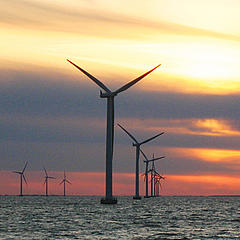
Wind turbines off Scottish coast. Photo: World Wildlife Fund

It’s not often that Scotland is ahead of the game compared to California, but on the issue of climate change, this small northern country has taken a legislative lead that has put it on the green map of the world.

As the California Legislature this week grapples with new laws* requiring utilities to get 33% of their energy from renewable sources by 2020, Scotland is sitting pretty. It is already close to its 31% target of energy from renewables by 2011 and has an even bolder target of 50% by 2020.

On a trip to Scotland this summer, I met with Lena Wilson, CEO of Scottish Enterprise, a government-funded organization that promotes Scottish interests both at home and abroad. She told me that the fight against global warming is a crucial part of the government’s strategy because ultimately a low carbon future is an economic stimulus and job creator for the country.

But how did Scotland muster the political will to set such ambitious targets? Scotland’s First Minister, Alex Salmond is passionate about renewable energy, Wilson told me; and establishing Scotland as a hub of green energy and green-tech is key to his strategy. Part of the plan is to harness its natural resources – powerful wind and wave power, estimated to account for a quarter of Europe’s potential. Salmond recently opened the largest wind farm in Europe to drive home that point. It’s on the outskirts of my home town of Glasgow and makes me rather proud.

Yet, making bold targets isn’t the end of the story. Scotland must create a whole ecosystem to make green growth attractive in Scotland. It launched the Saltire Prize last year to stimulate innovation in wave and tidal power; but still has ground to cover. As well as the financial, administrative and logistical challenges, there’s the issue of NIMBY-ism. Although Wilson insisted they’re pursing a popular green agenda, some of the locals I talked to in Scotland were less enthusiastic about the aesthetics of wind turbines.
And then there’s the “nuclear option.” Just as in California, the issue is red hot. Salmond is publically against it, but if he wants to keep shining his low carbon credentials, he may be forced to rethink his position.

One final note: When I asked Wilson, is your boss, Alex Salmond the Al Gore of Scotland? Her response was enlightening. She almost choked. Being a staunch nationalist, union man and former socialist, she doubted he’d enjoy the comparison. On my next trip, I hope to discuss this with the man himself and find out exactly how his passion for green took root. Stay tuned.

*State legislators passed two bills during their overnight session on Friday. Here’s a summary provided by the advocacy group Environment California:

AB 64 (Krekorian) & SB 14 (Simitian): AB 64 and SB 14 are companion bills that together set California on the path toward producing 33% of its electricity from renewable resources like solar and wind power. While there was much controversy over amendments to the bill that add in language for PG&E to potentially build large hydroelectric dams in British Columbia and call it renewable energy as well as amendments pushed by British Petroleum and Chevron that put 7,000 MW of fossil fuel burning combined heat and power plants ahead of renewable energy, the two bills still stand to become the biggest renewable energy mandate in the country”

Few Surprises as Climate Symposium Opens

A broad spectrum of scientists, entrepreneurs and public officials are meeting in Sacramento this week for the sixth annual Climate Change Research Symposium, sponsored by the California Energy Commission (CEC).

Today and tomorrow are packed with technical lectures on topics ranging from “Decadal Changes in the El Nino Pattern and Impact on the Hydroclimate…” to “Climate and Wine Grape Phenology in Napa Valley.” But yesterday it was up to the policy honchos to set the scene.

There was little in that preamble that hasn’t been heard before. When asked about recently expressed doubts that the state’s utilities can attain a one-third proportion of renewable energy within the next decade, air board chief Mary Nichols said “Not only can we do it, we have to do it.” Nichols, probably the state’s highest-profile point-person on climate policy,  said the the state’s broader, longer-range goal for cutting greenhouse gas emissions simply can’t be achieved without it.

Just as if they’d heard her, legislators tonight passed SB 14 out of committee. The bill requires utilities to meet the 33% renewable portfolio standard (RPS) by 2020 (in other words, to derive a third of their power from low-carbon sources). Green energy activists lamented language in the current version that allows utilities to slip that deadline, if there are delays in bringing new renewable energy sources online.

There was a clear signal from yesterday’s symposium speakers that, as we’ve previously discussed in this space, adaptation is taking center stage on the policy front. California has set targets for “mitigation” of global warming and put some of the wheels in motion. Now attention has turned to preparing for inevitable climate change effects, already in the pipeline.

The CEC’s newest Commissioner, Julia Levin, warned against the onset of “NIMBY” syndrome as measures are implemented across the state, such as the build-out of solar and wind “farms.”

And Stanford scientist Chris Field, who heads the IPCC’s Working Group II, noted that while growing interest in the “other” greenhouse gases (methane, nitrous oxides, etc.) is justified, the focus should remain on controlling carbon dioxide.  “As long as the world maintains an aggressive focus on economic growth,” said Field, “It’s the economic growth that’s the driver of future emissions and that’s why strategies to find ways to grow the economy without increasing carbon emissions are so important.” While some of the other gases are more potent greenhouse gases, Field says they’ll see little or no growth in volume in coming years.

Field previewed some of what he sees as the focal points of the next major IPCC climate report, known as AR5. Field predicted that we’ll see a shift in focus from making the case that global warming is real and human-induced, to providing more and better information that “stakeholders” can act upon. Field cited a recent study projecting that corn yields in Africa could fall 30% by 2040, due to climate forces.