Craig is a former KQED Science editor, specializing in weather, climate, water & energy issues, with a little seismology thrown in just to shake things up. Prior to that, he launched and led the station's award-winning multimedia project, Climate Watch. Craig is also an accomplished writer/producer of television documentaries, with a focus on natural resource issues.
The blog post for today’s broadcast of my nuclear power segment on The California Report weekly magazine has been updated from the original post on August 24.
And don’t forget to check out Amanda Dyer’s interactive “Atomic Timeline,” with key milestones in the history of nuclear power development.
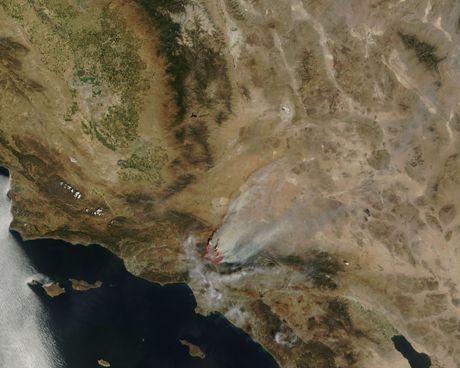
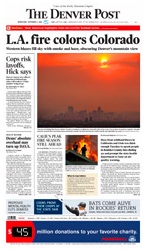
Earlier this week I got an email from a colleague in Boulder, Colorado, remarking on the crimson sunsets and brown haze that had settled across the Front Range, apparently caused by drifting smoke from California’s wildfires. At that point the Station Fire complex in Los Angeles County had already charred nearly 150,000 acres.
Smoke fans out from L.A. fires this week. Clickable image: NASA
My colleague Dan Brekke, an ardent watcher of elemental stuff like water and fire, featured a map of the spreading haze in his personal blog.
By Wednesday evening Brekke relayed that flames had consumed an area about the size of Chicago (and no, he couldn’t resist the low-hanging Mrs. O’Leary reference). With less than 30% containment, smoke had spread over about three-quarters of the state. Beyond California, NOAA had tracked the plumes “northward and eastward…across southern Nevada, Utah, Colorado, and Kansas.”
“Joe Ramey, a meteorologist with the National Weather Service in Grand Junction, said that a high-pressure system is continuing to pump smoke from several California fires and 17 fires currently burning in Utah into the state. He said a fire near Nucla in south-central Colorado also may be contributing to the haze…Most of the smoke, however, is being generated by the 190-square-mile fire burning near Los Angeles, he said.”
Atmospheric scientists classify smoke as an “aerosol” (any airborne particulate matter), which has a complicated set of feedbacks on the climate. For instance, aerosols encourage cloud formation and clouds have both positive and negative feedback effects on global warming. But it’s clear that smoke plumes generate greenhouse gases and also carry toxic air pollutants such as carbon monoxide.
Briefing journalists last month at the National Center for Atmospheric Research (NCAR)–in Boulder, no less–atmospheric chemist Gabriele Pfister said that wildfires have multiple effects on the atmosphere. They “disturb the carbon cycle,” interfering with energy exchanges and generating greenhouse gases. Itinerant smoke can generate ozone pollution far from the initial fires. This presents a challenge for local regulation of “ground-level” ozone, since it’s often likely an import from distant fires.
Thayer Walker is a San Francisco-based freelance writer, who first reported on development of the Wave Glider for The New York Times. His radio segment for Climate Watch, was produced by Nathanael Johnson and is scheduled to air Monday, 8/31 on KQED’s The California Report.
Red Flash in the Sunset
By Thayer Walker
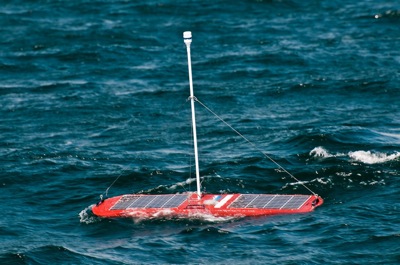
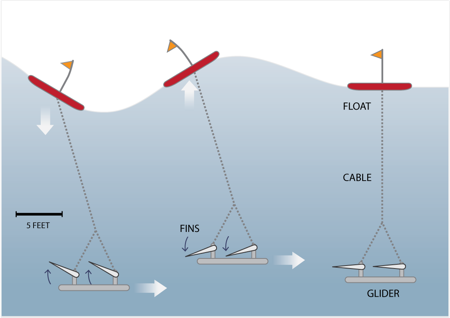
A Silicon Valley engineering firm called Liquid Robotics recently launched a new device called a Wave Glider off the California coast. It’s the latest and perhaps, the most ingenious design in the growing network of “autonomous ocean samplers,” which is to say sea-going science robots. The glider is a sensor-carrying platform powered entirely by wave energy and it has the potential to collect an enormous amount of data about the ocean, which in turn will give scientists a better understanding of climate change.
"Red Flash" at sea. Photo: Liquid Robotics
Jim Bellingham, Chief Technologist at the Monterey Bay Aquarium Research Institute, calls the device a “transformational development” in the field of ocean science and technology, but when the inventors came up with the idea they weren’t trying to revolutionize marine studies, they were trying to eavesdrop on humpback whales.
In 2005, Joe Rizzi, the chairman of Liquid Robotics, wanted to listen to the song of humpback whales off the coast of his home in Puako, Hawaii. He anchored a hydrophone near the shore, but instead of picking up whale song he heard the sound of frying bacon. Snapping shrimp, a small crustacean that uses its powerful claw to generate sound blasts that stuns its prey, had drowned out the call of the whales.
When Rizzi moved the hydrophones into deeper water he captured clear whale sounds, but kept losing the moored devices to rough seas. “The difficulty,” says Rizzi “was holding a hydrophone anchored in 600 feet of water during winter storms.” Rizzi realized that to keep a hydrophone stationary, he would need a powered device. “You’re not going to do that with a battery and a motor and a solar panel,” he explains. “The amount of power to hold station in a 60 mile per hour wind and 10 foot waves is thousands of watts. We recognized that it’s an energy problem.”
Rizzi presented the problem to Liquid Robotics CEO Roger Hine, who quickly came up with a design, and the Wave Glider was born. “We weren’t sitting around thinking this thing would have a lot of scientific uses,” says Rizzi, “but as it turns out, there are a lot more uses for this device than just listening to whales.”
The Wave Glider's passive propulsion system harnesses the up-and-down motion of sea swells for locomotion. Diagram: Liquid Robotics
This is an updated re-post from August 24th, when my radio feature first aired on KQED’s Quest series. That report repeats on this week’s magazine edition of The California Report.
More people appear to be saying “yes” these days, even if grudgingly. The question is: Is it too late?
The Public Policy Institute of California has been tracking public support for expanded nuclear power over the past several years. Survey participants are offered a menu of four potential energy options, one at a time.
The question posed is: “Thinking about the country as a whole, to address the country’s energy needs and reduce dependence on foreign oil sources, do you favor or oppose the following proposals?” Then the four options are offered, including: “How about building more nuclear power plants at this time”
As recently as 2002, adults surveyed in California opposed the idea by a margin of 59% to 33%. But that gap has been closing steadily in the years since and by this July, Californians were split just about down the middle on the question, with 46% in favor and 48% opposed. The poll has a margin of error of about 2%, making it a virtual tie.
When you dig into the numbers a little deeper, some demographic preferences emerge. Support increases with both age and education. Californians 55 and older support more nuclear by a wide margin (58% to 36%) as do college graduates (50%-43%).
Many people use cost as an argument against nuclear but just as the PPIC was phoning around for opinions on the matter, the Palo Alto-based Electric Power Research Institute was finishing up its own report, concluding that trying to reach greenhouse gas reduction goals without baseload technologies like nuclear power, could end up costing much more.
Dan Kammen, who runs an energy lab at U.C. Berkeley, would appear to agree. He said in a recent interview for Climate Watch that “Without knowing exactly where things will come down on nuclear, I think that it absolutely has to be part of the equation in a way that it has not been in the past. Energy costs from fossil fuels are rising at almost 5% a year now, and the damage we are doing and are going to do more of, if we don’t stop our fossil fuel expansion, in terms of greenhouse warming, is so large an issue that these technologies have to be back on the table.
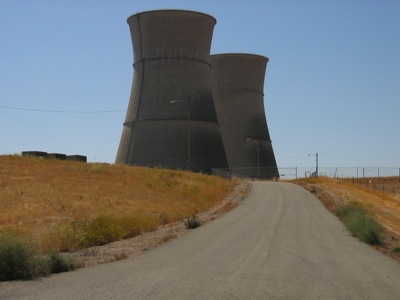
Is the road back to nuclear a dead end? Cooling towers at the decommissioned Rancho Seco nuclear power plant.
But there are serious doubts whether the nation–let alone the state–is in a position to embrace nuclear as it did in the 1960s. Kammen is also a professor of nuclear engineering, and noted with some alarm the rate at which the industry is “graying.” Now in his mid-forties, he told me that when he attends technical meetings for nuclear engineers, he’s often “the youngest guy in the room–by 20 years.” Since the U.S. more or less abandoned its nuclear hopes following the Three Mile Island debacle, the nation has ceded most of its nuclear industrial capacity to other nations, and few young people have chosen to enter the field.
Reports from new projects around the world have not been encouraging of late. Finland is struggling mightily to get its newest reactor up and running. This goes directly to doubts expressed by Kammen and others, that the industry can cowboy up fast enough for nuclear to play a meaningful role in meeting CO2 reduction targets.
The effective ban on new nuclear plants that California has had in place since 1976 could be reconsidered. But ultimately electric utilities will have to want it and I sense a certain “nuclear fatigue” in that arena.
Managers at the Sacramento Municipal Utility District (SMUD) shut down its only reactor in 1989, after a thumbs-down referendum. When I called to ask for an interview on the prospects for a nuclear revival, they declined. They didn’t even want to talk about it. Managers at PG&E, whose twin reactors at Diablo Canyon produce nearly a quarter of the utility’s output, still claim an interest in nuclear. But when I asked CEO Peter Darbee about it recently, he said he had the sense that most people in California would prefer to look elsewhere for energy solutions.
I’m spending the week in Boulder, CO, attending a series of lectures and discussions at the National Center for Atmospheric Research (NCAR). The center is a hub for climate modeling using some of the world’s most advanced computers–but scientists here are working on a dizzying array of projects, from “wind prospecting” models for siting utility-scale wind farms in Colorado, to tracking the ozone drift from California wildfires, to studying the relationship between weather and meningitis in Sub-Saharan Africa.
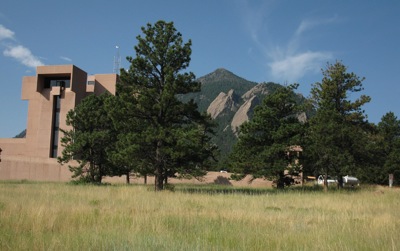
With the Flatiron Mountains as a backdrop, architect I. M. Pei used the Mesa Verde cliff dwellings as inspiration for the NCAR headquarters building, in Boulder. Photo: Craig Miller
While NCAR works closely with NOAA (which also has a major research center in town), it is not part of it. NCAR is funded by the National Science Foundation and managed by something called the University Corporation for Atmospheric Research (UCAR), a consortium of about 75 North American universities, as well as major institutions abroad.
About 400 scientists work under the NCAR umbrella, including Kevin Trenberth, a leading authority on the link between El Nino and global climate. Right before hopping a plane for Australia this week, Trenberth, head of NCAR’s Climate Analysis Section, reaffirmed what NOAA and others have been saying; that we may be in for a significant El Nino event this fall and winter.
“There are good signs below the surface of the ocean in the tropical Pacific that this is the real deal,” said Trenberth. He echoed some of the optimism expressed by many Californians that the result could be an overdue dousing after three years of accumulating drought conditions. “The odds are, if it’s a good El Nino,” said Trenberth, “that there is more likelihood of a southerly storm track that’ll bring a lot of weather systems into southern California in particular. It’s not always clear what happens in northern California but the odds are that there’s a much more active southern storm track right across the U.S. and in particular in California.”
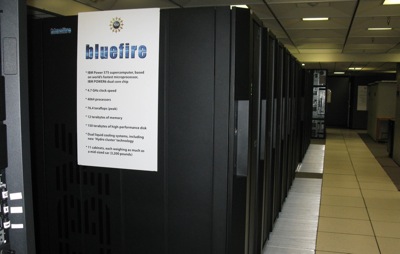
The IBM Bluefire 76-teraflop computer, centerpiece of NCAR's supercomputing center. Photo: Craig Miller
NCAR scientists continue to refine their climate models, which have been downloaded by more than 10,000 scientists around the world. UCAR invests $20-to-$30 million every four years in it’s Computational & Information Systems Lab (CISL), to maintain it’s state-of-the-art status. CISL chief Rich Loft says it’s probably the most advanced supercomputing center devoted largely to climate analysis.
Even so, NCAR is busy building a bigger, faster one–but not here. The new supercomputer, which may be ready by 2012, will be sited near Cheyenne, Wyoming, mostly to take advantage of the cheap, abundant electric power in that area. Loft and NCAR Director Eric Barron both concede the paradox that the most advanced computer assault on global warming is itself a huge gobbler of electricity, much of which comes from coal-fired power plants. The Wyoming facility will suck down 4.5 megawatts of power. Barron says at least there’s a major wind farm “right next door.”
The center’s carbon footprint is probably also swollen slightly by its own air force. NCAR operates two aircraft packed with advanced instrumentation; a hulking C-130 Hercules and a sleek, high-altitude Gulfstream V. Sadly, no rides were offered this week.
Scientists and policy wonks seem to be in general agreement on this: that it’s time to close out the current management epoch on the Sacramento-San Joaquin Delta and begin anew. There’s less accord on how to proceed.
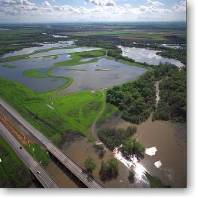
Photo: U.S. Fish & Wildlife Service
Policy makers have assembled “blue ribbon” panels to study the options and make recommendations. Volumes of studies and proposals line the shelves in Sacramento and elsewhere.
Last week a new idea surfaced for moving water through the Delta: Instead of channeling around it, tunnel under it.
This week the non-partisan Public Policy Institute of California released its recommendations for a mechanism to fund the enormous fixes that will be required: Those who benefit pay (ecologists use the term “ecosystem services” for all those bennies we get from natural resources and tend to take for granted).
Whatever the outcome, one thing seems inevitable, with or without human intervention. Driven by warming ocean temperatures, rising sea levels will continue to push saltwater farther upstream, changing the Delta’s character and the “services” it provides.
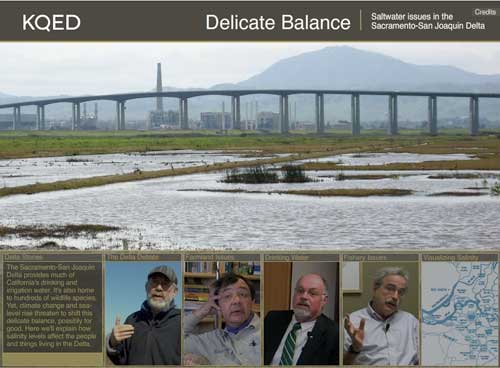
Recently a team of students at U.C. Berkeley’s Graduate School of Journalism produced a Flash presentation on some of the issues raised by advancing salt in the Delta. The multimedia report: Delicate Balance was produced for Climate Watch by Amanda Dyer, Martin Ricard and Jeremy Whitaker. We’re grateful to them for their time and creativity.
This is the way the world ends. Not with a bang but with a whimper. –T.S. Eliot
With the President headed for Mexico for a two-day summit, I was struck last week by the juxtaposition of two headlines that jumped out of a daily environmental news digest.
“With the fight over health care reform absorbing all the bandwidth on Capitol Hill,” Lisa Lerer wrote for Politico, “Democrats fear a major climate change bill may be left on the cutting-room floor this year.”
Granted, Mexico’s contribution to global greenhouse gas emissions is reportedly about 2%, or a tenth of the U.S. contribution, so one might argue that there’s a lesser job to do there. But with less than four months remaining before the next major U.N. climate conference, it raises the grim prospect that while other nations press on, the U.S. could arrive in Copenhagen empty-handed, which is to say without meaningful carbon legislation to show.
At the same time last week, the 16-nation Pacific Islands Forum called for a 50/50 commitment from developed nations; a 50% reduction in greenhouse gas emissions by 2050. Many of those island nations are on the hot seat as rising seas levels could make them among the first to lose substantial real estate before the end of this century.
At his first climate summit for governors last fall, Governor Arnold Schwarzenegger introduced a video from then President-elect Obama, in which he promised that his presidency would “mark a new chapter in America’s leadership on climate change.”
Praising the governors in attendance for their own climate initiatives, the newly elected President declared that “Too often Washington has failed to show the same kind of leadership. That will change when I take office.”
Of course “Washington” includes Congress, which is still dithering over the major carbon emissions bill championed by the new President. It squeaked through the House by nine votes and now looms as a 1,400-page pig that the Senate python will attempt to digest or regurgitate. Either way, what comes out is unlikely to closely resemble what went in.
Meanwhile the whole cap-and-trade concept has been coming under increasing scrutiny and skepticism. Last month, when the non-partisan Public Policy Institute of California polled Californians on the subject, more respondents favored an out-and-out carbon tax than cap-and-trade (56% to 49%). The Western Climate Initiative, a regional cap-and-trade pact that is a keystone of California’s climate strategy, AB 32, remains in limbo while western legislatures wait on Congress.
So when the Governor convenes his second climate summit in L.A. next month, billed optimistically as “The Road to Copenhagen,” he and his fellow “subnational leaders” (Wisconsin, Michigan & Connecticut governors are currently signed up) may find that the ball is still in their court. According to a news release from the Governor’s office, “climate leaders from around the world will come together and collaborate on efforts to further the global fight against climate change.”
They’ll do it with the same question on the table as last year: Can they count on Washington to take up the reins?
A one-fifth reduction in per capita water use by 2020 is among the goals outlined in a new state report on adapting to climate change.
Released by the California Natural Resources Agency (CNRA) as a “discussion draft,” the 2009 California Climate Adaptation Strategy is being billed as the nation’s first comprehensive game plan for adaptation to climate change.
Photo: Reed Galin
Most of the state’s high-profile climate initiatives (and battles) have been about mitigation; how to reduce greenhouse gas emissions to slow down warming. This report swings the spotlight over to adaptation; what needs to be done to accommodate the climate change effects that are already “in the pipeline.”
While the California’s centerpiece climate law was passed three years ago, this week’s CNRA report concedes that “adaptation is a relatively new concept in California policy.” The 161-page white paper comes in response to an executive order from the Governor last fall, calling for a statewide adaptation strategy.
The draft divides the strategy into seven “sectors:” Public health, biodiversity and habitat, ocean and coastal resources, water, agriculture, and forestry.
Tony Brunello, Deputy Secretary for Climate Change and Energy at CNRA, says “This is the first report that really looks at how climate change is going to impact the state and what we need to do about it.”
But Brunello stopped short of conceding that mitigation is a lost cause. “You only have half a deck if you’re only focused on mitigation,” he said. “You need to focus on both mitigation and adaptation to truly be prepared.”
Some strategies attack both. Brunello points to water conservation measures, which save both water and energy (20% of the energy used in the state is deployed moving water around).
The plan is designed to work in consort with the California Air Resources Board’s implementation plan for AB-32, the state’s multifaceted attack on greenhouse gas emissions. CNRA says one of its goals is to “enhance” existing efforts, rather than create new programs and offices that need funding.
CNRA also promises to use the “best available science in identifying climate change risks and adaptation strategies.” Andrew Revkin has a useful overview of the mounting challenges to climate scientists, published this week in the New York Times.
One planned product from the adaptation plan is an interactive website devoted to climate adaptation, with maps and data to assist local planners. CNRA hopes to have that in place by early next year. The draft plan now enters a 45-day period for public comment.
Figures released this week by a national wind power trade association would seem to indicate that the expansion of wind capacity proceeds apace. The American Wind Energy Association (AWEA) reported that more than 4,000 megawatts of new capacity has been installed so far this year, a 38% increase over last year’s pace.
Even so, AWEA CEO Denise Bode seems mildly disappointed by the numbers. Citing a slowdown in manufacturing of turbine components, Bode described the industry as “swimming upstream.”
The contrary current may get even stronger if my recent visit to upstate New York is any indication. Arriving for a family visit, I found that I’d landed in the midst of an uproar over wind farms, both built and proposed. Several times a week, articles were appearing in the Watertown Daily Times, about how area residents from around the state are complaining of ill effects from the utility-scale wind farms nearby and bristling at plans for more.
Wind power has hit headwinds in the past over concerns about birds, bats and its effect on people’s views. In upstate New York, the current objection seems to be noise.
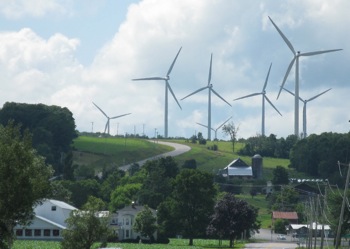
Commercial wind turbines dwarf dairy farms in northern New York. Photo: Craig Miller
At the Maple Ridge wind farm, billed as the biggest east of the Mississippi, I was rendered insignificant by 300-foot turbines, which tower over the farmland in Lewis County. Farther south, in New York’s Finger Lakes region, some turbines top 420 feet. More on this scale are being proposed to stretch out along the St. Lawrence River, which separates New York from Canada. Horizon Wind energy has already erected nearly 200 turbines on Maple Ridge, between the east end of Lake Ontario and the Adirondack Mountains.
Wind companies talk a lot about megawatts and numbers of households served and even tons of greenhouse gases avoided–but not so much about how big these things are. The Cape Vincent-based Wind Power Ethics Group has a graphic on its website that puts some of these numbers in perspective. It shows a 423′ turbine towering over a local lighthouse and the Statue of Liberty.
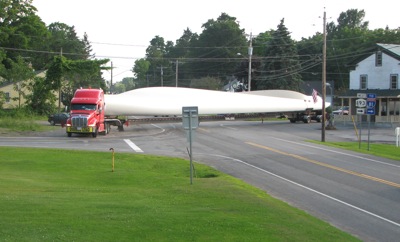
A truck hauling wind turbine blades negotiates a turn onto Route 11 in northern New York. Photo: Chuck Miller
When Californians think about wind farms, they may envision places like Altamont Pass and Tehachapi. California pioneered wind power in the 1970s and 80s and most of the state’s windmills would barely make an impression compared to what’s going up around the country nowadays. California comes in fifth on the AWEA’s latest list of states with the most aggressive wind expansion (Missouri added the most capacity in the last quarter–New York didn’t even make the top 10).
Later this month, in a radio story for Climate Watch, I’ll look at the implications of this scaling-up as companies propose wind farms closer to populated areas in California, such west Marin County (more about that particular situation in our second Quest/Climate Watch television special, which premieres August 25).
New polling suggests that Californians may be wavering slightly in their support of climate response policies. The survey, just released by the non-partisan Public Policy Institute of California (PPIC), also shows a growing rift along party lines, when it comes to climate policy.
Nearly nine in ten Democrats surveyed (86%) said the government should regulate greenhouse gas emissions, while just 54% of Republicans agreed. Among all adults, including “independent” voters, 76% of Californians favored regulation of emissions, similar to a nationwide poll conducted in June by ABC News and the Washington Post.
PPIC chief Mark Baldassare says he thinks that the high-profile debate over national carbon legislation is “splitting Democrats and Republicans in California in a way that they weren’t a couple of years ago, when they saw a Republican governor and a Democratic legislature finding common ground on climate issues.”
Baldassare also observed that the relentless recession and state budget crisis have distracted both voters and their political leaders from environmental concerns.
There was a spike in water concerns compared to last year’s poll, with 18% naming water supply and drought as the state’s most important environmental issue, up 13 points from a year ago, virtually tying air pollution and vehicle emissions (20%) as the top concern. The poll’s margin of error is 2%. The telephone survey was conducted in mid-July.
The PPIC poll also appeared to pick up a groundswell among climate action naysayers. The percentage of respondents saying there’s no need for immediate action was up six points from a year ago, to 23%. Baldassare chalks this up partly to the complex nature of climate science. “People become skeptical when they don’t understand things,” he said.
Overall respondents showed the most concern (59%) over the likelihood of more wildfires, followed by more severe droughts (55%). People seemed less concerned about flooding and coastal erosion brought about by rising sea levels, possibly because they see that as a longer-term threat. Concern over wildfire was strongest in the Inland Empire and L.A. Basin. Interestingly, Angelinos also expressed more intense drought fears (61%) than respondents in the ag-intensive Central Valley, where just 21% described themselves as “very concerned” about the drought threat from climate change. Note that this is not an expression of drought fears in general, just those driven by climate change.
When it came down to the question of what to do about global warming, more Californians favored a “carbon tax” than a cap-and-trade system, by 56% to 49%. California and the nation are currently on a path toward cap-and-trade, at least partly (and paradoxically) because it’s considered more politically palatable than a straightforward carbon tax.