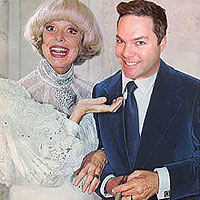
Jason Mecier‘s art is certainly one of a kind. It takes somebody with an unusual amount of imagination and humor, not to mention patience, to create a portrait of Martha Stewart entirely out of vegetables, Demi Moore from dog food, the Spice Girls with candy, and Sigmund Freud from tablets and pills. In the episode “From Life,” Spark visits Mecier in the studio and takes a look at his quirky portraits.
Mecier uses a variety of household odds and ends, found items and food products to create his kitschy mosaics. His artwork has caught the attention of the stars, and he has done artwork for Parker Posey, Bjork and Farrah Fawcett. Phyllis Diller recently sent him a box of her jewelry and personal items to incorporate into his portrait of her.
Mecier often depicts images that come straight from posters, magazines or television. One of his favorite subjects, Tammy Faye Baker, is Mecier’s pen pal. Other subjects of his include Jerry Seinfeld, Willie Nelson and Carol Channing. “A lot of people struggle with being appreciated in the art you do and finding a niche for it, so I feel fortunate that the general mood is, ‘I like it.'” Mecier is represented by Maslov/Weinberg Agents Internationale, and his work has been featured internationally.
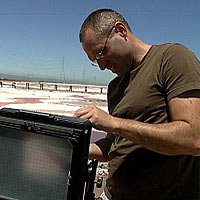
Best known for his international photojournalism, Olivier Laude is making a new name for himself with a series of carefully staged art photographs that explore human images and stereotypes. In the Spark episode “From Life,” watch Laude in action, casting subjects such as lumberjacks, hobos and Inuits.
Laude often casts his friends and acquaintances, and sometimes just people he meets on the streets, as characters in his elaborately conceived tableaux that spoof ethnographic portraits. He goes to great lengths to find the perfect props, costumes and location. For one shoot, he costumed his friend Marisa, a Filipina American, in a blue dress and fur-collared coat. Unconventionally shooting at high noon on the San Francisco Bay salt flats, he conjures up a desolate image of a lone figure, fish in hand, standing against a vivid blue sky on an icy landscape. Laude’s dioramic photographs make ironic commentaries on art, fashion and politics.
Laude’s ever-changing interests have led to exploration of a wide array of subjects. A preoccupation with stereotypes of masculinity led to a series of uproarious lumberjack portraits. Inspired by Chinese propaganda posters, Laude created a series featuring young women as revolutionary peasants, their hair tied neatly in braids, with rifles or Mao’s Red Book in hand. “I choose to portray specific people in specific situations,” Laude says. “But I find it amusing that we’re all stereotypes of each other and we all see each other. I don’t know, I’ve always liked that in life, when someone surprised you. When you have a particular vision of who someone is, or what they’re like, or what they might be thinking, and they completely prove you wrong.”
Born in Corsica, a Mediterranean mountain island, Laude moved to the United States when he was 15. He traveled the world photographing for “The New York Times Magazine,” “National Geographic Adventure,” “Time,” “Newsweek” and many other publications before settling in San Francisco, focusing for the past two years on more personal work. His photographs are often composed of crisp, vibrant colors and always reflect his unique vision of inspiration in everyday situations. Something as simple as the look of someone in his neighborhood, the Haight-Ashbury district, will spark an idea. “Sometimes, I just go scouting, and I’ll see something and, for whatever reason, an image will pop up in my mind. And I don’t know why it’s there or what it’s for.”
Editor’s note: Viola Frey passed away on July 26, 2004.
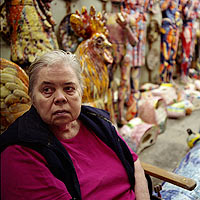
From the mid-1950s to her recent passing in 2004, Viola Frey broke boundaries in ceramics, breaking the association of her medium with small-scale craft to a world of monumental sculpture. In the Spark episode “From Life,” viewers watch Frey working in her studio on a series of colossal clay figures for a show in New York.
Spark followed Frey in the months just before her death when, in her early seventies and physically impaired from a number of strokes, she relied greatly on her studio assistant of 17 years, Sam Perry, to help her realize her seemingly ceaseless flow of ideas. Despite her physical limitations, Frey continued to be prolific until her death, going to her studio six days a week and often working on five or six massive sculptures simultaneously. Producing these figures was so important to Frey that it was her work in the studio that helped her recover from her physical setbacks, and kept her going.
Frey’s sculptures are at a scale nearly unprecedented in ceramics. Traditionally, ceramic artists produce small objects either by hand-building or working on a potter’s wheel. But Frey’s figures are nothing short of monumental, many of them standing in excess of 10 feet tall and weighing thousands of pounds. To build her pieces, Frey first allowed the clay of the entire figure to dry. The figure was then sawed into pieces, each of which was individually glazed and fired in a kiln. Once fired, the 100 pound (or more) pieces were painted by Frey and then reassembled into the final sculpture. In contrast to their larger-than-life scale, many of the colossal figures that Frey produced were inspired by the artist’s collection of ceramic kitsch. She reused many of the forms of these much smaller objects in her work.
Frey was a longtime resident of the Bay Area, and her influence is felt on multiple levels. Frey showed her work regularly and had several public artworks, including one at San Francisco’s Moscone Convention Center. Perhaps more significantly, Frey was a member of the faculty of the California College of the Arts from the mid-1960s until her death, teaching ceramics to several generations of artists. In the late 1960s and 1970s, Frey helped to redefine the place of her medium in the art world, along with fellow Bay Area ceramic artists Robert Arneson, Manuel Neri, Peter Volkous, and others. And, lastly, as a woman working in a field often dominated by men and in accomplishing work on a scale taken on by few, Frey distinguished herself as an exceptional artist.
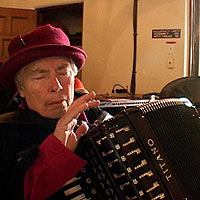
“Hear with your ears, listen with your heart” can be dismissed as fortune cookie musing, but anybody who knows or has heard of Pauline Oliveros will say it’s the pioneering musician and composer’s guiding principle. Spark takes you into Oliveros’s world filled with improvisational jam sessions, accordions, frogs and extreme slow walking (she’ll explain).
Soul music comes in many forms, and nowhere is this taken to its most literal extreme than with Oliveros. The Oakland-based teacher, composer, performer and musical ambassador is deeply attuned to the meditative qualities of sound. Since the ’60s, she has pioneered the electronic and improvisational mediums, creating theories of “sonic meditation” and “deep listening” — accomplishments that have brought her and her Mills College program worldwide acclaim.
Born in Houston, Texas, in the early ’30s, Oliveros learned piano from her mother and grandmother before switching to accordion. After high school, Oliveros moved to San Francisco to attend college and discovered new methods of making music. In 1961, she joined up with like-minded composers at San Francisco Tape Music Center, which pioneered techniques of sound gathering and archiving in electronic music, which later became the Center for Contemporary Music at Mills College. During the ’70s, she sought to strengthen the connection between music (and atmospheric sounds) and the soul leading her to begin a series of performances and practices called “sonic meditations” and “deep listening,” the most minute sound or unintentional noises are amplified in the composition’s importance.
Transmitting from Kingston, New York, Oliveros — now over 70 years old — still teaches music composition at Mills College and practices deep listening techniques with fellow musicians using her bandoneon (an accordion-like instrument). Her performances range from peaceful to restless, thoughtful to transcendent, and ultimately embody a spiritual freedom that defies borders and categorization. She often encourages her audience to not just listen but to participate at recitals. Through her work, Oliveros explores what music and sound means to each individual, something that goes back to the “listening versus hearing” thing — a dichotomy far removed from conventional (fortune) cookie cutter wisdom.
Editor’s note: David Ireland passed away on May 17, 2009.
Internationally renowned Bay Area artist David Ireland‘s retrospective, “The Way Things Are,” at the Oakland Museum of California (November 22, 2003, through March 14, 2004), cuts straight to the heart of Ireland’s work. Instead of manipulating materials in order to create pleasing images and objects, Ireland’s drawings, prints, sculptures, assemblages and environments draw attention to the beauty and poetry of everyday things, inviting his viewers to look more carefully at the world around them. While Ireland has sought to redefine the way that his audiences look at art, his art in turn has managed to alter the way that we perceive the objects in our daily lives.
The Spark episode “The Grey Eminences” looks back on Ireland’s career as the Oakland Museum mounts a 30-year retrospective of the artist’s work. Viewers are offered a rare glimpse into Ireland’s home and studio at 500 Capp St., San Francisco, where the artist has transformed a run-down 1886 Victorian into what he calls an “environmental sculpture in progress.” When Ireland bought the building in 1975, it had been poorly cared for, and as he endeavored to organize the house, he began to collect the remnants of its previous owner. At some point, Ireland began to understand that his actions — the collecting of evidence of the past owner — were not only serving a particular function, but in a sense they had taken on ritual or symbolic meanings as an integral new part of his daily life — something like meditation or prayer. He began to think of this activity as art and recorded his work by preserving this “evidence” into jars, as one might with scientific specimens, and under layers of clear varnish, as one would a painting. Eventually, Ireland applied the same process of collecting to the traces of his own existence, collecting fingernail clippings, hair, toilet paper rolls and more, and rolling them into balls or collecting them in jars, unearthing the aesthetic beauty in the most mundane of objects.
Later, he became interested in the “bones” of the building and began removing the plaster and moldings that surrounded the windows and walls. By revealing the way the house was built, he became more aware of the structure he was living and working in. He finally decided to “exhibit” his work in progress and for a time opened his home to the public, in an effort to heighten others’ awareness of the environment that surrounds them.
Despite the wide attention and critical acclaim that Ireland has received, the Oakland Museum show is the artist’s first major retrospective, and its catalogue is the first sustained analysis of his career. In keeping with the spirit of Ireland’s work, the Oakland show diverges in several ways from most major retrospectives. “The Way Things Are: The Art of David Ireland” covers a gallery space of more than 10,000 square feet, an area usually reserved for more than two exhibits, and features more than 90 works, many of which have never been publicly exhibited before. And while most retrospective exhibits attempt to reconstruct a chronological account of an artist’s career, Ireland has instead used the opportunity to turn the show into a kind of artwork in itself. For the past three years he has met with curator Karen Tsujimoto and exhibition preparator David Rudell to help design the exhibit.
Ireland has also produced a number of new works for the installation, including a 16-foot-tall chair that houses a small reading room where museum visitors can sit and read about Ireland’s work. The form of the chair, an arrangement of simple geometric shapes, contrasts spectacularly with another work installed behind it that Ireland also developed for the exhibition: a pile of debris collected from the demolition of the gallery’s previous exhibition. Like Ireland’s collection of materials from his renovation of 500 Capp St., the debris pile records the process of the artist’s work. But the pile also has an aesthetic function, providing a striking visual foil for the clean white forms of the chair. It causes the viewer to reevaluate what might otherwise be considered worthless and to see in it an intrinsic value, beautiful in its own way.
The breadth of Ireland’s work is particularly amazing considering that he didn’t begin his career as an artist until he was in his 40s after he was a safari guide in Africa. His art has been presented in more than 40 solo exhibitions, at venues including the Walker Art Center, the Hirshhorn Museum and Sculpture Garden at the Smithsonian Institution and the Museum of Modern Art.
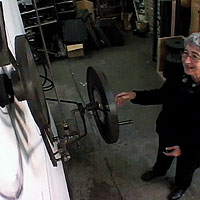
Bella Feldman creates what she calls “anxious objects” — ranging from large-scale, imposing pieces to smaller more intimate pieces. Her art and vision of the world is affected by hearing Hitler’s speeches on the radio as a child. Spark visits Feldman in the studio to see her “War Toys” and mechanical glass and metal sculptures.
Her “War Toys Series 1992” and “War Toys Redux Series 2003” were provoked by the Gulf War and bio-terrorism and are ominous yet playful renditions of weaponry. While the fanciful construction of her missiles and cannons makes them clear parodies of their all-too-real counterparts, Feldman’s toys help remind us of the dangerous human obsession with war and weapons.
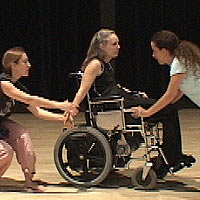
Since 1987, AXIS Dance Company has created an exciting body of work developed by dancers with and without disabilities. The company has become internationally recognized for its high artistic and educational standards and for being on the cutting edge of physically integrated dance. Under artistic direction of Judith Smith, the 10-member company has developed a powerful repertory that includes works by Bill T. Jones, Joe Goode and Joanna Haigood as well as by its own company members.
In the Spark episode “Frontiers of Dance,” AXIS Dance Company members work on a new piece directed by Los Angeles-based choreographer Victoria Marks. With six months between first rehearsal and opening night, the members of AXIS spend a week improvising together to explore how they interact as dancers and to develop different themes and ideas that will inform their movements. Over time, the themes of desire and longing emerge — desire in terms of space and the need to move forward and longing in terms of physical attraction and how the gravitational pull between them as dancers inspires interesting dance dynamics.
After several months, as recipients of the Wattis Artists in Residence award, the company moves to Yerba Buena Center for the Arts. Two weeks before opening night, the piece has no ending or title and the musical score is unfinished. In more traditional dance companies, dances are set to a completed musical score. In the organic process used by AXIS, composer Eve Beglarians is able to finish her score while watching the dancers, incorporating all the sounds of the movement in the final composition, even the hums and clicks of the wheelchairs. And, at long last, the ensemble finds a title for its collaborative work: “Dust.”
One of only a few companies of its kind, AXIS Dance Company challenges our perceptions about what dance is and can be and about disability, without allowing that to be the focus of the dance except to open people’s minds to possibilities of what we are capable of, including our strengths and weaknesses. Like any professional group, they are always striving for excellence, creating performances that are poignant and whose content has weight and humor. As theater and society become more accessible, integrated dance groups will probably be more prevalent, and future generations will find it easier to participate in this art form.
In addition to their professional performances, AXIS Dance Company has an educational outreach program designed to bring physically integrated dance education directly to the community. Called Dance Access, the program comprises a team of eight teaching artists (five with disabilities) led by education director Alisa Rasera. Dance Access offers performances, assemblies, workshops, lecture-demonstrations, in-school residencies and after-school programs to schools and communities around the Bay Area.
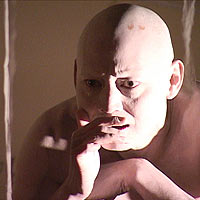
During the social upheaval and rapid Westernization of Japan following World War II, the dance form known as butoh emerged. Unlike anything traditional Japanese or Western culture had seen before, butoh (originally “ankoko butoh”) began as an avant-garde dance practice that offered both a new means of expression to its practitioners and a fundamentally different way of life. At once grotesque and humorous, erotic and violent, the first butoh performers explored a range of issues previously considered inappropriate for the content of dance, such as decay, devastation and the loss of nature in post-A-bomb Japan. Today, almost 50 years later, there are nearly as many ways of performing butoh as there are artists exploring the form.
In the Spark episode “Frontiers of Dance,” the dancers of the Salt Farm Butoh Dance Company and their artistic director Ledoh work on a new piece called “River of Sand,” an exploration of Ledoh’s birthplace. Complete with music and visual projections, the group worked on the various elements of the performance for months before the event at the Headlands Center for the Arts (HCA). As participants in the HCA’s resident artist program, the Salt Farm members have been working on the costuming, set design, lights and music and sharing the activities of their daily lives.
Ledoh was born into the Karen hilltribe of Burma. He relocated to the United States, then returned to Asia in the late 1980s, to Japan, where he first encountered butoh. Ledoh remained in Japan through the early 1990s as a member of the Saltimbanques dance troupe, led by longtime butoh dancer Katsura Khan. Now a resident of the Bay Area, Ledoh is using butoh as a vehicle to uncover his Burmese ancestry while also exploring universal themes of understanding that connect him and his audiences.
Unlike many modern dancers who are also choreographers, Ledoh resists the structure of choreography in his work and the work of his company. Instead he opts to invite the dancers to improvise and explore themes and movements together, alternately leading and following. Ledoh directs and guides the dancers, but ultimately even the performance is not choreographed in the traditional sense.
The success of a Salt Farm butoh performance is also gauged differently than other modern dance performances. One of Ledoh’s fundamental beliefs is that the audience must be physically, mentally and emotionally present, therefore participating fully in the moment. In order for this to occur, the dancers in a butoh performance must also be fully present to draw audience members into the transformative possibilities of the performance. According to Ledoh, “To see a good butoh performance is to be present in the space and be enveloped by it.”
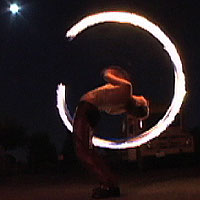
Belva Stone teaches poi, the ancient Maori art of dancing with balls on ropes. However, she takes this performance art to the next level by adding fire to the mix and dancing while swinging flaming wicks around her body.
Like Maori women, who use poi to increase coordination and tell stories, Stone and her female students are both empowered and exhilarated by the practice of fire dancing. Spark follows Stone’s class from rehearsal to performance at The Crucible.
During a trip to Europe in 1975, the artist and librarian John Held Jr. found a store in Amsterdam that sold visual rubber stamps. He bought several and began using them in the pen and ink drawings that he was doing at the time. After returning to New York, he discovered that rubber stamps were commonly being used in a burgeoning network of underground artists involved in mail art.
The variety and heterogeneity intrinsic to mail art makes it difficult to define the practice exactly; however, the term generally refers to a range of artworks that are exchanged through the postal services. The act of mailing the artwork is an essential component of the work, which seeks to establish a network or community of individuals for the exchange of objects and ideas. Many mail artists address social and political concerns, including examinations and critiques of the fine art world, its institutions and traditional channels of circulation. Some of the objects exchanged in mail art include postcards created by or modified by artists, nonofficial postage stamps called artistamps, decorated envelopes, found objects, and one of a kind or limited edition artist’s books.
In the story about John Held Jr. in the Spark episode “The Fine Art of Collecting,” Held takes viewers through some of his expansive collection of mail art, one of the most extensive in the world. For more than 25 years, Held has been collecting art sent to him through the mail, and the collection amounts to well over 30,000 pieces. He has since donated part of his collection to various art institutions, including New York’s Museum of Modern Art, the J. Paul Getty Foundation and the Smithsonian’s Archives of American Art, but Held still keeps much of his collection of correspondences.
Since the only way to receive mail art is to produce it and send it to others, at its core mail art is about communication, exchange and the creation of a kind of virtual community of participants. In this sense, mail art anticipates the cyber communities founded on the Internet. It is not surprising, then, that Held and others believe that the Internet has extended the possibilities and scope of mail art. But even as new technologies transform the practice, introducing email lists, message boards and online exhibitions, Held contends that mail art continues in its material, postal form, renewed by and working hand in hand with new means of digital communication.
At the heart of Held’s interest in mail art is the way the art form merges fine art with the experiences of everyday life. With more traditional forms, art objects are exhibited in galleries and museums — places far removed from people’s daily experience. By using the post office as a means of circulating their works, mail artists sidestep the usual means of artistic distribution, effectively turning a regular aspect of daily life — collecting and opening mail — into an opportunity for an artistic encounter.
In this spirit, many artists find similar ways of turning aspects of their everyday life into works of art. Spark talks to Held’s other mail artists friends — like Robert V. Rocola, who has been involved in this art form since his army days in the ’60s, and Diana Mars, who has been hosting a dinner every week for 10 years, turning the meal into a means of generating art objects. Mars, who is also involved in mail art, produces materials relating to her dinners each week, including invitations, artist’s postage stamps, photographs, a guest book and other kinds of documentation of the event. The dinners themselves are also catalysts for collective performances, which are then also documented by Mars.
Exchange your own art with mail artists: John Held Jr. P.O. Box 410837 San Francisco, CA 94141
Robert V. Rocola 740 Dutton Ave. San Leandro, CA 94577
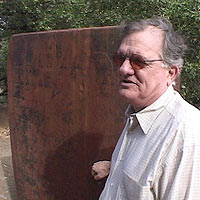
Thirty years ago, building contractor Steven Oliver didn’t give a second thought about art. But since 1985, he and his wife Nancy have assembled at their Sonoma County ranch one of the most ambitious private collections of site-specific sculpture in the United States. In the Spark episode “The Fine Art of Collecting,” get a personal tour of their collection.
When Oliver and his wife became frustrated at the increasing commercialization of art, they decided to take a more proactive approach to encouraging “art for art’s sake” and commissioned art that could neither be moved nor sold. Their first piece was done by artist Judith Shea, and almost 20 years later the Olivers have commissioned 18 more works from some of the world’s most respected artists. However, not just a collector of art, Oliver takes an integral role in the artistic creation process and helping artists create pieces that otherwise would not have been possible.
When Oliver comissioned artist Bruce Nauman to build a quarter-mile-long staircase from the ranch to his home, it took Oliver and his construction crew five months just to pour the concrete for the 289 steps, then Nauman uniquely tailored each step’s height to the hillside. In order to create the pieces “Snake Eyes” and “Box Cars” with artist Richard Serra, Oliver hired Jorgenson Forge of Seattle to accommodate Serra’s exact specifications, as it was one of the only facilities in the world to handle steel blocks of such massive proportions.
In his quest to engender and nurture the growth of art, Oliver forms close, meaningful friendships with the artists he works with. Rather than dealing with a gallery dealer, a museum director or a curator, artists opt to work with Oliver for a more “earthy experience.” As artist and Oliver-collaborator Roger Berry puts it, “A lot of collecting is collecting and then standing in front of the thing you colllected. In Steve’s case, he’s standing behind it. He’s embracing it.”
Oliver also personally gives weekend tours to visitors throughout the spring and fall months. Touring the Oliver Ranch and seeing one-of-a-kind works is no cheap ticket, but all the proceeds go to nonprofit arts organizations such as SFMOMA. Contact your local Bay Area visual arts organization to set up a tour.
Artists with site-specific work on the Oliver Ranch include Terry Allen, Miroslaw Balka, Roger Barry, Ellen Driscoll, Bill Fontana, Kristin Jones, Andrew Ginzel, Andy Goldsworthy, Dennis Leon, Jim Melchert, Bruce Nauman, Martin Puryear, David Rabinowitch, Jim Jennings, Fred Sandback, Richard Serra, Judith Shea, Robert Stackhouse and Ursula Von Rydingsvard. Currently, Ann Hamilton is working on the next Oliver Ranch installation.
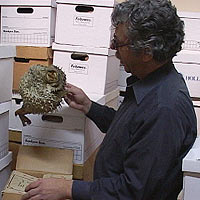
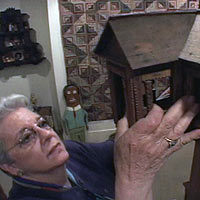
Bonnie Grossman has been collecting tramp art, kitchen utensils, walking sticks, and other craft and folk art for more than 30 years. In fact, she acquired so much that she founded a public gallery in a residential area of Berkeley in order to share her collection with others.
Her home-turned-gallery, The Ames Gallery, primarily exhibits pieces by self-taught or outsider artists, as well as folk art and Americana. Grossman gives Spark a tour of her space highlighting some of her favorite pieces.
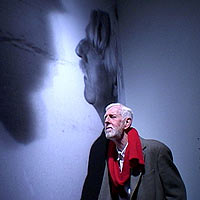
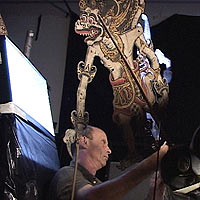
Spark follows puppet master Larry Reed as he and the Gamelan Sekar Jaya orchestra prepare for a performance of “Wayang Bali: Dangerous Flowers” at the Julia Morgan Theatre. For more than 30 years, Reed has studied, performed and developed the ancient art form of Balinese shadow play, producing unique performances that have stretched the bounds of the tradition.
Wayang kulit, or Balinese shadow puppet theater, is a tradition that has been passed down through generations for more than 1,000 years. Mythic tales and archetypal characters are played out, blending high drama, improvisation and slapstick comedy. In one performance, more than 20 intricately carved leather puppets are manipulated by one puppeteer, the “dalang” or “shadowmaster,” who assumes the role of the conductor, director, actor and all the voices. The shadow puppets are animated atop a banana log in between a large screen and a coconut oil flame so that their images cast shadows onto the screen.
The traditionally wayang kulit shadow plays are accompanied by an ensemble of two to four gamelan musicians, who respond to every move of the dalang. Gamelan, meaning “orchestra,” refers to the instruments themselves, which exist as an inseparable set. Each bronze key and gong of the gamelan instrument is forged at the same time. They are then tuned and blessed as a whole and cannot be individually sold.
Introduced to shadow plays in the ’70s while in Bali, Reed found himself drawn to the complex spiritual and ancient tradition and the powerful ephemeral nature of shadows. Reed spent the next 10 years learning the art form in the traditional manner, apprenticing himself with shadowmasters. Today, Reed performs in the traditional style, but he has also created his own company, ShadowLight Productions, a changing ensemble of actors and puppeteers who create modern shadow puppet works on a cinematic scale with scene changes, lighting cues and a larger music ensemble.
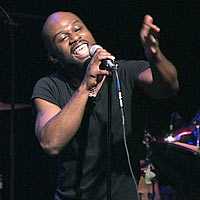
Marc Bamuthi Joseph is one of an emerging class of hip hop theater artists who combines a variety of art forms in his work. Bamuthi uses theater, West African and tap dance, spoken word, poetry, and live music to stretch the bounds of traditional hip hop and create a new forum for expressive performance art. His works challenge audiences of all ages to reevaluate the relationship between spoken language, body language and the body politic.
Bamuthi has been a performer since childhood, working on commercials at the age of 5, Broadway stage by age 9 and a television series when he was 12 and 13. At 21, Bamuthi found himself in San Francisco, entering the arena of spoken word and performance poetry, first in poetry slams, then as a playwright. Bamuthi has already received four spoken word poetry awards and was featured on Russell Simmons’s Def Poetry Jam in 2003.
In the Spark episode “Telling Stories,” meet Bamuthi as he prepares for his first solo theatrical work based on his experience of becoming a father. “Word Becomes Flesh” is a highly personal piece that is a performed series of letters from a single unwed father to his unborn son. Bamuthi translates the words from the page to the stage, narrating his very personal experience through creative expression that combines spoken word with movement, visual art and music.
Bamuthi is also the current artistic director for the Living Word Project and program director for Youth Speaks. Through the spoken word medium, he leads students through a process of examining their world and the issues that are important to them and turning their perspectives into meaningful expression. His mission to be an agent for social change fuels much of his work, taking him far beyond the need for recognition into the realm of spiritual and personal expression.