Asides

Opera San Jose

Far removed from the designer reality-show sets, a different “real world” plays out, a short distance away from the overpriced bungalows of Silicon Valley. Each year, Opera San José chooses budding vocalists for its resident company. They live in a 14-unit apartment complex and pursue the dream of becoming a professional opera singer. Spark drops in on this unique solution to the affordable housing crisis: a generous arts organization enabling gifted singers to live and work together full time as they prepare for their débuts. Currently in production is the 19th-century George Bizet opera “The Pearl Fishers.”

A principal artist at New York’s Metropolitan Opera for 20 seasons, general director Irene Dalis founded Opera San José in 1984. With support from a dedicated subscriber and sponsor base, the company acquired two 24,000-square-foot operations facilities and two apartment buildings (14 units total) for free artist housing. The singers participate in the equivalent of opera boot camp: They perform at least four feature or leading roles in Opera San José productions during one season. All the singers receive an annual salary, benefits and free housing.

Dalis and music director David Rohrbaugh patterned this residency after Dalis’s experiences as a youth in a German opera company whose singers were housed together. The arrangement allowed residents to completely immerse themselves in their art without worrying about rent. It is this spirit of community and creativity that Dalis successfully transplanted to San Jose.

In its explorationof the Opera San José company, the Spark episode “Making Room for Art” shows that drama isn’t limited to the stage. Six of the company singers live in an apartment building located a 15-minute drive from the rehearsal hall. A husband and wife singing duo live with their two children (it is rare in the opera world to be parents because of the high risk of catching colds). They all take vocal lessons, experience a pending theater relocation, and go through production issues and wardrobe malfunctions. When they return to their apartments, it’s back to bills, dirty diapers (for some) and what’s for dinner.

The program accelerates the learning process and prepares singers for the rigors of a professional opera career. They don’t have to deliver pizzas or singing telegrams to make a buck. What Opera San José has accomplished is one of the most innovative artists-in-residence programs in the country — a program that enables artists to work on their craft 24/7. In a unique twist to reality programming, nobody gets voted off.

  • Array
  • Array
  • Array

Phantom Galleries

The Phantom Galleries program in San Jose was launched in 2000 as a partnership between Two Fish Design, San Jose Downtown Association, and the San Jose Redevelopment Agency. The program utilizes empty downtown storefronts as exhibit spaces for local artists.

  • Array

Alonzo King

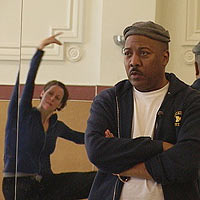
Choreographer Alonzo King has created contemporary ballets for more than 50 international dance companies as well as dozens of pieces for film, television, opera and his own company, LINES Contemporary Ballet. Easily one of the most sought-after ballet masters in the world, Alonzo King is often living out of a suitcase, traveling to multiple locations in short order. Spark travels with King to New York City as he mounts new ballets with the Alvin Ailey American Dance Theater and the Cedar Lake Ensemble.

LINES has grown steadily since founding its in 1982. The company has received international recognition for choreographic innovation, creative collaborations and world-class dancers. King’s choreography adapts the forms and disciplines of classical ballet in ways that appeal to contemporary audiences. One of the hallmarks of Alonzo’s method is how he communicates his ideas: rendering the abstractions of complex choreography into directions that the dancers can feel and see, activating all their senses, and demanding that the dancers dig deep within themselves to expose their true emotions. For him, it is not about the steps. He wants to create “what is real.”

The drive to make art is what keeps King on such a rigorous travel schedule and why he continues to search for new ways of sharing and expressing his art. In 1989, under the direction of King, LINES founded the San Francisco Dance Center, which serves as a resource for the entire Bay Area dance community. It has become the largest public dance space on the West Coast, offering a wide variety of movement and dance forms, including ballet, modern, Jazz, flamenco, Afro-Latin, East Indian, Brazilian, yoga and pilates. In 1994, LINES launched a major initiative to expand the involvement of world-renowned artists in the creation of new work and became one of the resident companies at San Francisco’s Yerba Buena Center for the Arts.

Array

  • Array
  • Array
  • Array
  • Array

Flemming Flindt

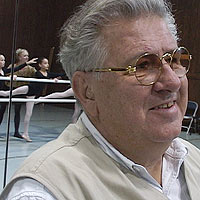
Born in Copenhagen in 1936, dancer and choreographer Flemming Flindt is one of dance world’s most distinguished artists. Trained at the Royal Danish Ballet School, Flindt joined the main company at the age of 19, quickly rising to the rank of international star. One of the most courtly and gifted premier danseurs of the 1950s, he was made etoile at the Paris Opera Ballet, starred at the Royal Ballet and the London Festival Ballet, and in 1950 he danced at the celebrations of Grace Kelly’s wedding.

By 1963, his attention had turned to choreography with his highly regarded balletic adaptation of Eugene Ionesco’s “The Lesson,” and in 1966, at the age of 29, Flindt was appointed director of the Royal Danish Ballet, a post he held for twelve years.

Like many of the dancers of the Danish tradition, Flindt himself was as at home interpreting the characters of the 19th century narrative ballets of August Bournonville as he was in contemporary work of Birgit Cullberg and Roland Petit. And during his tenure at the Royal Danish Ballet, he was credited with carefully shepherding the historical heritage of the company while expanding the repertoire to include the work of modern choreographers such as Paul Taylor, Murray Louis and Glen Tetley.

Flindt’s own works, like the great ballets of the classical era, derive their strength from dramatic stories, but his choreography, nevertheless, has always had a modern edge. In “The Jet Set” Spark follows him to San Jose, where he recreates his ballet “Out of Africa” for Ballet San Jose of Silicon Valley, a company for whom he has restaged many of his works.

Based on Isak Dinesen’s novel of the same title, Flindt’s ballet, a shorter version of which he initially created as a gift for Queen Margrethe and Prince Henrik of Denmark on their Silver Anniversary, encompasses an even larger theatrical vision than it did in 1992.

Staged in only three and a half weeks, under a highly compressed and grueling rehearsal schedule, “Out of Africa” explores both the psychological as well as the romantic aspects of Dinesen’s life as an ex-patriot in Kenya. Assisted by San Jose ballet master Raymond Rodriguez, who originally danced in the ballet, Flindt expands his original work adding not just new scenes, but lavish costumes, vividly dramatic sets, and a full choir along with expanded music by Danish composer Carl Nielsen.

  • Array
  • Array

Midori

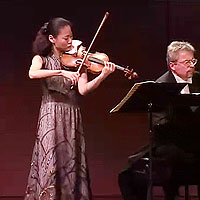
Born in Osaka, Japan in 1971, Midori received her first violin at the age of 4 years old, when she began studying violin under the direction of her mother. In 1981, they moved to the United States so that Midori could further her studies at the Aspen Summer Music School and the pre-college division of the Juilliard School.

Midori began touring the world in 1986. Today, she performs over 100 concerts worldwide each season. However, despite her rigorous performing schedule, Midori finds time to engage the community and founded the non-profit organizations, Midori & Friends in New York City and Music Sharing in Japan.

When she is not on the road, Midori lives in Los Angeles. Spark caught up with the violinist for a one-night appearance at San Francisco Performances.

  • Array
  • Array

Ken Goldberg

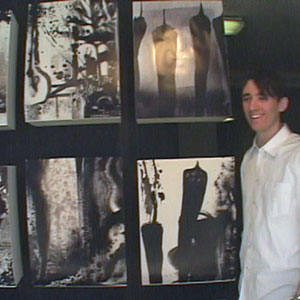
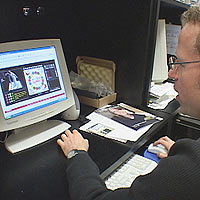
Conceptual artist Ken Goldberg is considered a pioneer in the growing genre of Internet art. A professor of industrial engineering at the University of California at Berkeley, Goldberg combines his skill in robotics and his fascination with the social behavior of Internet communities. The result is a series of whimsical artistic experiments in which strangers use the Internet to jointly control and monitor real-life events and activities. In the Spark episode “Technophiles,” join Goldberg as he explains several of his pioneering works in the emerging field of Internet and tele robotic art.

On selected Fridays at noon, Goldberg and his students organize a game of Tele-Twister at the Alpha Lab at U.C. Berkeley. As in the original Twister game, Tele-Twister participants contort their bodies in order to place their hands and feet on colored dots — except in this version, remote players log in via the Internet and collectively decide how the participants move.

Goldberg began experimenting with using machines to make art while completing a Ph.D. in robotics at Carnegie Mellon University in the late 1980s. For the installation “Power and Water,” in 1992, Goldberg and his students at the University of Southern California built a robot programmed to paint on large paper during the exhibition. Because the piece combined robotics and painting — a medium usually associated with a unique style produced through an artist’s hand — “Power and Water” raised many questions about the uniqueness, authenticity and even authorship of art.

Though the exhibition had been well attended, Goldberg was frustrated with the limited audience reached through a gallery show. So in 1994, with the emergence and widespread popularization of the Internet, Goldberg assembled the first tele-robot in a work called “Mercury Project,” an interactive online scavenger hunt. The work reached an audience unimaginable in a gallery context, receiving more than 2.5 million hits in the seven months it remained online.

Goldberg’s next project, “Telegarden,” which is still online and offers participants use of a robot to tend and monitor a remote garden. There are no behavioral restrictions on the project; however, participants are never entirely sure whether others are watching them or not. In this way, “Telegarden” is concerned with the behavior of users who are aware that they may become objects of scrutiny.

In the vein of “Telegarden” and in time for the 40th anniversary of the Free Speech Movement in October (2004), Goldberg’s team launched another webcam project. In the “Demonstrate” project, the camera provides a 360-degree view of the activities at Sproul Plaza on the UC Berkeley campus, a location which has been traditionally used for political demonstrations and rallies. This installation is implemented by using advanced networked robotic camera, a visual database, and a mathematical model of socio-ocular behavior. The Web site can handle up to twenty simultaneous users and allows each user to zoom into the scene and to take still photographs.

Since 1995, Goldberg has been teaching computer science at U.C. Berkeley, where he also co-founded the Art, Technology and Culture Colloquium. His artwork has been shown internationally at Ars Electronica in Austria, ZKM in Germany, Pompidou Center in France, Tokyo ICC Biennale, Artists Space, the Kitchen, the Walker Art Center and the Whitney Biennial (2000).

Array

  • Array
  • Array
  • Array
  • Array

Paul DeMarinis

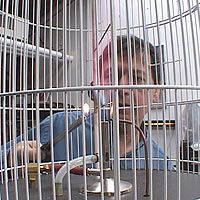
In the Spark episode “Technophiles,” viewers encounter Paul DeMarinis‘s art which is filled with things both simple and magical. People experiencing his art might be standing outside, listening to the music created by a sound-modulated water jet against the fabric of an open umbrella, or they might be seeing a gas flame, flicking in lockstep to the breaths of dictators’ recorded radio addresses.

Ever since watching atomic tests light up the Nevada sky as a young boy, DeMarinis has been fascinated by the human relationship with technology. In 1971, he began working as a multimedia electronic artist, becoming one of the first to use a personal computer as an art-producing tool. He has since created numerous performance works, sound and computer installations, and interactive electronic inventions. His art has taken him around the world — DeMarinis has performed and displayed his art in galleries from New York to Tokyo, at the 1996 Olympics in Atlanta and at the 1998 World Expo in Lisbon.

DeMarinis works in the intersection of tradition and progress, striving to cover modern knowledge’s bases. He is a Renaissance man in the tradition of Benjamin Franklin, a person comfortable in both the arts and the sciences, whose kind is slowly disappearing as society becomes increasingly specialized. Aside from being an artist, he is a historian, an experimenter, a chemist, a physicist, an engineer, a programmer, an inventor, a computer scientist and an archaeologist. A multidisciplinary approach helps him distill technology’s many facets into art installations that aim to be at once comprehensible and profound.

The interplay between current and “orphaned” technologies is of particular interest to DeMarinis as he looks back in time and sees forward to our present state, achieving a perspective that unlocks secrets otherwise lost in the zeal for progress. As Peter Richards of the Exploratorium museum in San Francisco has written about DeMarinis, “His is the job of exploring the relationship between questions being asked in our culture and the tools being developed to find the answers.” Questions as large as these sometimes require a person like DeMarinis, who can take history and technology together in his arms and nurture it into art.

  • Array
  • Array
  • Array
  • Array

Yerba Buena Center for the Arts

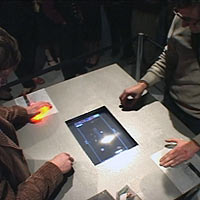
The “Bang the Machine” exhibit at the Yerba Buena Center for the Arts (YBCA) from January 17 through April 4, 2004, brings a whole new dimension to digital gaming. For example, those brave enough to play “Painstation” have their hands shocked, whipped, and burned for making mistakes in a game of Pong. As Spark tours the exhibit, artists discuss gender in the world of interactive technology and the connection between visual artistry in digital games.

Incorporated in 1986, YBCA was built by the San Francisco Redevelopment Agency to help transform a once dilapidated area of the city into an urban cultural center. The YBCA presents contemporary work by visual and performance artists from the Bay Area and around the world.

  • Array

Enrique Chagoya

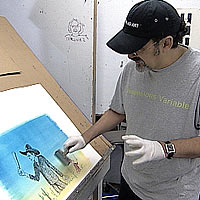
In his prints, drawings and other works on paper, Mexican-American artist Enrique Chagoya appropriates and reorganizes images taken from the American mass media, Mexican folk art and religious sources, using them to create biting and often very humorous political and social satire. Spark follows Chagoya as he works on a new series of satirical prints aimed at George W. Bush entitled “Saint George and the Dragon.” In the new series, Chagoya is experimenting with new printing techniques with master printmaker David Salgado from Trillium Graphics in Brisbane, California.

Born in Mexico City, Chagoya credits the nurse that helped raise him with his first exposure to the culture and history of the Mexican indigenous peoples. He earned a bachelor’s degree in political economics at the Universidad Nacional Autónoma de Mexico in 1975. As a student, he worked on several rural development projects, which helped cement his interest in political and social activism. In 1977, Chagoya immigrated to the United States, where he worked as a freelance illustrator and graphic designer, sometimes in the service of farm laborers in Texas. In 1984, he graduated with a B.F.A. from the San Francisco Art Institute, then went on to earn an M.A. and an M.F.A. from the University of California at Berkeley. Chagoya worked as director of Galeria de la Raza, helping to establish the gallery as San Francisco’s premier venue for Chicano art. Since 1995, Chagoya has been teaching printmaking at Stanford University.

Chagoya uses his work to critique the manner in which history has traditionally been written by those nations that have dominated and colonized others. He calls his practice “reverse anthropology,” and he intends to overturn the direction of influence in Western art. For centuries, Western artists have mined folk and indigenous cultural production to use in their own work — Pablo Picasso incorporated African tribal masks to develop the cubist style; British sculptor Henry Moore turned to Aztec sculpture as an influence in his modernist bronzes; and American architect Frank Lloyd Wright used forms derived from Mayan structures. Each of these artists appropriated these forms but removed them from their original context, recasting them in terms of the development of Western high art. In his work, Chagoya reverses this process, taking images from the dominant American culture and placing them within the contexts of indigenous and developing-world perspectives.

Ambivalence about American culture plays into Chagoya’s work, which also seems to revel in the diversity of the United States, a world where, as Chagoya notes, “all cultures meet and mix in the richest ways, creating the most fertile ground for the arts ever imagined.” Chagoya’s complex and colorful prints often reflect this melding and mixing of cultures and influence, ripe with potential for new expressions and provocative humor.

Array

  • Array
  • Array
  • Array
  • Array

Julie Chen

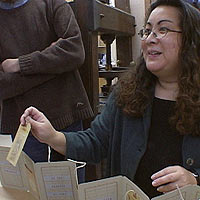
Julie Chen is a groundbreaking innovator in the growing field of the artist’s book. Her works defy traditional definitions of bookmaking, combining original works of poetry and three-dimensional paper techniques to stunning effect. Spark visits her in the studio and classroom and accompanies her on the hunt at Flax for materials for her latest work.

Inexplicably drawn to the book art form after completing a degree in printmaking, Chen entered the book arts program at Mills College in 1984 with no formal training and not a single book project in her portfolio. Initially intrigued by the language, the equipment and the materials, she worked diligently to learn the tricks of the craft. Today, Chen’s books are considered exceptional for their craft and quality. Chen regularly gives lectures on bookmaking and teaches workshops in cities across the nation.

The Spark episode “Works on Paper” gives you a chance to survey the startling variety of Julie Chen’s books — constructed as shells, eggs and boxes or designed as playful sculptures meant to be assembled. Each one holds embedded messages to be discovered and journeys to be taken, in form and text. Her experimentation has brought her to her newest work, “Personal Paradigm,” a game the readers play by moving pieces and recording their actions in a logbook.

Chen works like a conceptual artist, allowing an idea to determine its form and content. Her book forms reflect the variety of concepts that fascinate her, including language, history, memory and time. Every element — structure, shape, color, material — is in symbiotic relationship with the concept. To read one of Chen’s books is to engage with a complete, discrete experience that is simultaneously literary and sculptural.

Array

  • Array
  • Array
  • Array
  • Array

Southern Exposure

Editor’s note: Southern Exposure has moved since this video was released. Their new address is listed below.

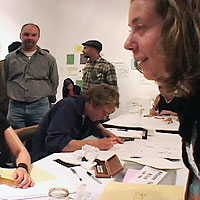
Southern Exposure, a non-profit artists organization as part of Project Artaud, has been an integral part of the arts community for over thirty years. Their large and open space occupies 2,400 square feet and has two galleries. Artists contribute to the organization’s policies, planning along with their advisory board. Southern Exposure shows contemporary artwork that is conceptually diverse spanning across several mediums from painting and photography to cutting edge multi-media installations. In addition to their visual art exhibitions, they offer programs such as public lectures, residencies and a youth advisory board.

  • Array

Calligraphy of Thought

In the Spark episode “Fusion,” listen to Calligraphy of Thought as they create and rehearse new works for a performance at the Oakland Box Theater, celebrating the release of several new albums on the Remarkable Current label. Calligraphy of Thought poets Eman Tai and Cathy Espinoza stand proud and speak from the heart about their personal and political concerns as the tight rhythms of rap and its energy and insistent beat transform the power of their words and demand attention.

Calligraphy of Thought is an East Bay Muslim poetry collective whose members transpose the beauty of expression into spoken word, celebrating what it means to be Muslim. Through its various performance forms, Calligraphy of Thought has rekindled the vital link between Islam and poetry while providing a forum for young artists to voice their opinions and ambitions.

Prompted by the discrimination against Muslims following the events of September 11, Calligraphy of Thought seeks to extend the view of Muslims beyond the political conflicts that pervaded the American media. “I want people to get a sense of how we experience love, friendship and frustrations as well as politics,” says Tai.

Tai, who has been writing poetry for many years, became aware of the absence of Muslims at the poetry slams she attended. Inspired by poet and professor June Jordan, she organized the first Calligraphy of Thought event in Oakland in 1999 to create an atmosphere of spiritual consciousness, to give Muslim artists a platform for their voice and to challenge stereotypes, particularly those of Muslim women. Since Calligraphy of Thought has been around, poetry readings, hip hop, rap and funk events have been held in the East Bay and San Jose for Muslims to make their voices heard in a uniquely American and contemporary way.

Array

  • Array
  • Array
  • Array
  • Array

Sha Sha Higby

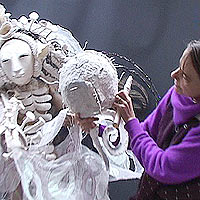
It’s wonderfully difficult to describe the work of Sha Sha Higby. Her costumes, or moving sculptures, are tornados of colors, textures and shapes. They look like everything and nothing at the same time. There are no analogies that can fully characterize Higby’s work, but one might be reminded of a Venetian Carnivale mask, African tribal art or a character in Japanese Noh theater.

That familiar images make up an otherworldly whole in her costumes is perhaps appropriate, given the experience of the artist herself. The path of Higby’s artistic development has been a journey through distant places, landing her here in the Bay Area. When Higby was a child, she made birds, filling her house with paintings and drawings of them. Her parents were divorcing at the time, and she described the birds as “something to divert me, a way out.” This artwork was a form of escape, but it was also the first step in her development as an artist.

After college, Higby’s career took flight, carrying her from her home in Marin to Asia. Her experiences abroad give her work its marked Eastern influence. “I studied with a craftsman who creates for the Noh theater. They have very elaborate costumes — and these heads, these masks — they move so slowly, they’re like sculptures. They have this strong, emotional quality, but it’s very slow. It’s subtle.”

Later, Higby received a Fulbright scholarship to study shadow puppetry and make sculptures in Indonesia, a country whose artistic sensibilities balanced well with Japan’s. “I went to Indonesia to study the elaborateness,” she explains. “Japan is simplicity. Indonesia is the fullness of the ornate. … It’s like a flat landscape when you look at it, but when you peel it away, there’s all this richness and complexity of layers, which I like in my work.”

In the Spark episode “Fusion,” get a glimpse of Higby’s creative process, a process that has wandered through time, leaped over oceans and slowly grown by accretion. Each individual costume that is used in performance can take years to make and is informed by a lifetime of experience. The semi-abstract nature of Higby’s costumes allows viewers to color the experience with their own imagination — one might end up in a place far away that the artist herself may not have imagined. With her art, Higby has found her journey and achieved her escape. The hope is that the viewers will find theirs as well.

Array

  • Array
  • Array
  • Array

Punk Rock Orchestra

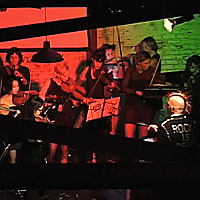
Mohawks and pink hair are not the usual hair-dos for classical musicians, but the Punk Rock Orchestra breaks many stereotypes. The 50+ member orchestra’s musical taste is apparent from the other ensembles they have played with — everything from the San Francisco Symphony and San Francisco Opera to The Dead Kennedys.

Lead by conductor John Gluck and his trusty toilet cleaning brush, the Punk Rock Orchestra plays songs from punk bands like Black Flag and the Sex Pistols on classical instruments. Craigslist brought them together in 2002, and since then the group has recorded an album and played at venues such as Yerba Buena Center for the Arts and the Herbst Theater. Spark caught up with them at one of their rare performances.

  • Array