Asides

Tommy Guerrero

Native San Franciscan Tommy Guerrero is a legend in the skateboarding world. An original member of the famous Bones Brigade skateboarding team, Guerrero pioneered street skating in the 1980s and 1990s. Though he still skates and designs skateboards, lately Guerrero has been following his musical passions. As a solo artist and with his group Jet Black Crayon, Guerrero has been developing a hypnotic, pulsing style of music that is echoed in the sounds of the city he lives in. In “Up from the Street,” Spark checks in on one of San Francisco’s most versatile performers.

Guerrero made his name in skateboarding in 1984 when, as a young teenager, he entered the first streetskating competition, held in Golden Gate Park. The only amateur involved in the event, Guerrero won, beating out 15 well-known professionals. Propelled by this unprecedented success, Guerrero went pro, signing to the Powell Peralta skate team. Over the following years, Guerrero remained at the forefront of street skating, and in 1990, he helped found Real/Deluxe Skateboards, a San Francisco-based company that designs boards for skaters by skaters. Still a part owner in the company, Guerrero works as a designer for Real/Deluxe, creating graphics for decks, stickers, T-shirts, caps and other gear.

These days, though, Guerrero has been putting much of his energy into his musical projects. He has recorded several down-tempo, trip-hop records under his own name and two full-lengths with Jet Black Crayon, as well as doing guest spots on a number of other projects. Though writers and critics are fond of calling him an ex-professional skater turned musician, Guerrero is quick to point out that music has always been a part of his life, a track that has run parallel to his more public persona as a skater.

Just as Guerrero’s skating style took him to the city streets, rather than to skate ramps or empty swimming pools, so does his music turn to the urban environment for inspiration. Using music that evokes the sounds that might intertwine and drift through the streets, Guerrero’s moody, atmospheric music perfectly captures the tenor of San Francisco’s more urban neighborhoods. Listening to a Jet Black Crayon record, one might imagine an experience of the streets: hip hop beats pumping out of passing cars, a street performer strumming a guitar, the cacophony of passing conversations in multiple languages — all melding together into a hypnotic soundtrack for the city itself.

Array

  • Array
  • Array
  • Array
  • Array

Wowhaus

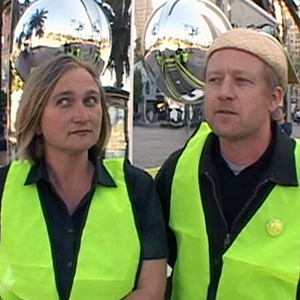
Wowhaus is an artist collaboration between Ene Osteraas-Constable and Scott Constable, whose work is focused on public site specific work. Spark hits the streets with them to check out a public art project funded by the San Francisco Arts Commission called the Art on Market Street Program.

  • Array
  • Array

Gary Stevens

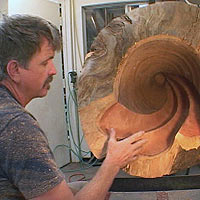
For more than thirty years, Gary Stevens has been working with wood. Since his days sitting at the lathe in his high school’s wood shop, Stevens has endeavored to create works of art that are themselves as moving and ruggedly striking as the wood from which they are made. In the Spark episode “By Hand,” Stevens takes viewers through his creative process, beginning with harvesting unusual pieces of wood from ancient redwood forests and continuing through the painstaking work that produces his uniquely beautiful wood vessels.

Stevens’s wood art begins with a careful selection of material carried out no farther away than the towering redwood forests that surround his Soquel, California, studio. As an artist who is sensitive to environmental issues, Stevens looks for fallen wood and tree stumps left by loggers. Mostly, Stevens searches out rare and unusual knotted and twisted burls often found at the base of trees. Many of these are more than a thousand years old, and their sinewy grain displays a patina that can only be produced by centuries of exposure to the elements. Removing these stumps, which can weigh well over a ton, is no small task. Stevens uses chainsaws, tractors and industrial cranes to get these rare pieces of wood to his studio, where he then faces the daunting undertaking of hoisting them and mounting them onto lathes.

It is the pieces of wood themselves that suggest to Stevens the forms that the finished work will take. Many woodworkers look for even, flawless material for their pieces to facilitate their crafting works that boast smooth, regular forms. Stevens values the eccentricities of his material, working his designs out of imperfections and unique growth patterns. Turning his pieces on the lathe and using chainsaws as well as finer planing and sanding tools, Stevens accentuates his material’s idiosyncrasies to produce challenging and hauntingly beautiful forms.

Stevens got his professional start in carpentry, and even though he has enjoyed a great deal of commercial success as an artist, he has never been tempted to quit his day job. Spark follows Stevens to a construction site in Alabama, where he has been called in to install some very rare antique white oak beams. In maintaining a career as a carpenter, Stevens has never had to rely on his art for his income, which has in turn afforded him a great deal of artistic freedom. Liberated from concerns about public taste and commercial viability, Stevens has been free to create challenging works that are helping to shape the future of wood art.

Array

  • Array
  • Array
  • Array

Pamina Traylor

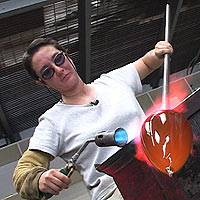
On the Spark episode “By Hand,” glass artist Pamina Traylor turns molten glass into pieces of lyrical beauty. Even though Traylor’s glass work is by hand, her hands initially can’t touch the glass itself. She begins by dipping a pipe into a lake of molten glass the consistency of honey, gathering it out, and starting to shape and blow the glass. Then Traylor often relies on many sets of hands to strike while the glass is hot.

Having received her undergraduate degree in mathematics, Traylor was pursuing an M.B.A. at SFSU and working in the stock transfer department of a downtown San Francisco securities firm. She stumbled upon the art glass program at San Francisco State University and signed up for her first glass course the very next day. The sudden interest turned into passion as Traylor traded a planned career in business for a new life as a full-time artist.

When she told her parents that she wanted to be an artist, they assumed that they would have to support her, but Traylor has been able to earn a living through teaching, producing studio glass work and creating her art. She began a new path in education, receiving her M.F.A. from the Rochester Institute of Technology, and has completed additional studies at the Haystack Mountain School of Crafts, Pilchuck Glass School and San Francisco State University. She was awarded fellowships at the Creative Glass Center of America in both 1995 and 2003.

She is currently an adjunct professor at California College of the Arts, where she was chair of the glass program in 1999 and 2000. She also works at Pinzette Studios for Michael Sosin, producing handmade functional glassware for sale in galleries and museum shops. She produces 50 to 80 pieces a day when working at Pinzette Studios, which works out to about one piece every six minutes. Traylor says the repetitive experience of working in the shop has been the best way to learn. “When you do it over and over again, that’s when you start to get good at it.”

A hot shop requires a furnace to be operating 24/7 at over 2000 degrees Fahrenheit to keep hot glass from hardening and damaging the furnace. Few artists can afford to have their own; working at Pinzette Studios enables Traylor to utilize their hot shop for her own personal work. In addition, she and her partner have just completed the conversion of an old office into a live/work space so now Traylor can do cold work in her home studio, sanding, etching and finishing her pieces.

Traylor’s personal works are now on display in galleries and collections across the country. Much of her current work involves combining other materials with glass. Some of the new pieces have text and photographic images so you can look through the object and see how it magnifies and distorts the words. “It makes you think a little bit about how words are distorted when we speak to each other … how what you say is different from what is heard.”

The ambiguity of language is a common theme in Traylor’s work, often represented by glass shaped into tonguelike forms. She uses tongues as a symbol of language, using extreme versions iconically. Though she tends to have an overall view of the piece before creating it, she is more excited by moving around roadblocks during the process. She says, “The best pieces are the ones that develop because of things you discover along the way.”

  • Array
  • Array
  • Array

Chris Natrop

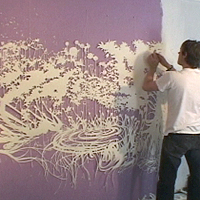
Chris Natrop’s large-scale, hand-cut paper art is inspired by his environment and stream of consciousness. The pieces are unique and comprised of intricate and entwined designs that are reflected into multiple dimensions with the shadows that they cast. He draws directly on the paper with a utility knife, eliminating the possibility of correction and making his work more free-form.

Chris Natrop earned an B.F.A. at School of the Art Institute of Chicago in 1993. He is a Los Angeles-based artist and has exhibited nationally and internationally.

  • Array

Rhodessa Jones

Rhodessa Jones

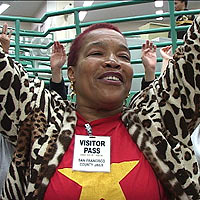
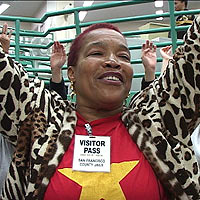
Art as a form of healing is examined in the episode of Spark “Art Frees the Soul,” with Rhodessa Jones. As the founder and director of the Medea Project: Theater for Incarcerated Women, Jones uses improvisational theater to transform the lives of incarcerated women and ex-offenders. Over the past decade, Jones has worked with more than 300 women, helping many of them make a return to society.

When Jones was hired in 1986 to teach aerobics at the city jail in San Francisco, she found that the part of the class that the women enjoyed most was talking. As Jones learned their stories she created the solo work “Big-Butt Girls, Hard-Headed Women” based on their lives. Though her own piece received much critical acclaim, she wanted to find a way to let the women she worked with tell their own stories. In 1989, Jones conducted a residency at the San Francisco County Jail that resulted in the Medea Project: Theater for Incarcerated Women.

Though Jones hopes the women make their return to society, she knows many women who have gone through her program and still return to jail. She says, “I’m just glad to go back inside and they’re alive … not dead. Because a lot of these people — it’s amazing they’re still alive.” Many women, inside and outside the system, report a positive change from the experience. Jones never knows whom she is going to touch.

Jones is no stranger to a difficult path. One of 12 children, a daughter of migrant workers, Jones found herself pregnant at 16; she didn’t marry the father. She eventually ended up dancing nude to pay the bills. Finding the experience more fascinating than demeaning, she knew that there was a story to tell from it. Jones continues to draw on the experiences from her life. Her more recent piece, “Hot Flashes, Power Surges and Private Summers,” speaks about womanhood after 50.

In addition to her one-woman shows and her work with the Medea Project, Jones has taught and lectured at Stanford and Yale and in Italy and East Africa. She collaborated on the documentary film “We Just Telling Stories,” which won Best Documentary at the San Francisco Black Film Festival (2001). She has directed at Theater for the Twenty-first Century and Campo Santo and was featured in Eve Ensler’s award-winning hit play, “The Vagina Monologues.”

The Medea Project is housed by Cultural Odyssey, which was founded by Idris Ackamoor, executive director, in 1979. Jones joined as co-artistic director in 1983. The two first began performing together in a jazz cabaret act; their repertoire now includes solo performances, workshops and nearly a dozen original projects. Over the years, professional actors and students from workshops have joined the troop, blending their performances with the incarcerated women and ex-offenders.

After 15 years, Jones may be coming to the end of directing for the Medea Project. “I’ve stepped out onto the path, and I’m about to head off into my second life.” Through the project, she feels, many of the issues that face incarcerated women have been unearthed. She now needs to shelve some things to make room for others. She is shifting her focus to a younger generation, hoping to help them through theater before they reach a point where it is too late. “I created the Parachute Project with the idea, maybe we can catch them early enough, to challenge them to start to be introspective now.”

  • Array
  • Array
  • Array

Sixth Street Photography Workshop

When George Eastman produced the first commercially available camera, called the Brownie, in 1900, he hoped that photography would become accessible to everyone — providing people from all walks of life with an easy and fun method to document the world around them. In 1992, when photographer Tom Ferentz founded the Sixth Street Photography Workshop, his vision was as egalitarian, but with a specific focus — to bring photography and creative exploration to the residents of San Francisco’s hotels and shelters in the Sixth Street corridor.

Ferentz started the program in connection with TODCO, a SOMA housing/community development nonprofit organization. Today, housed in the somArts Cultural Center, the Sixth Street Photography Workshop serves the residents and residences of Sixth Street, SOMA and the Tenderloin, including homeless, transient residents and other people living below the poverty line. Many people living and working in these neighborhoods are involved in the program whether as photographers, subjects or audiences. Ferentz and program associate and darkroom manager Amanda Herman manage all aspects of this program, from teaching to fund-raising to organizing and hosting exhibitions and openings.

More than 300 photographers have gone through the program to date. Despite the many challenges that face its members, participation in the workshop is consistent. The flexibility of membership enables photographers to take just one class or to stay for months or even years to hone their craft in the weekly sessions. In addition to Ferentz’s and Herman’s facilitation of the program, a group of some 20 experienced photographers volunteer their time to teach participants the technical aspects of framing, composition and exposure and advanced printing techniques. With this focused attention, some Sixth Street photographers commit stridently, developing full series and otherwise investigating of their subjects or ideas.

Beyond the classes and the darkroom, the workshop offers its participating photographers different projects and opportunities to show their work in the community, including exhibitions and portrait events. Each year, exhibitions are held in some of San Francisco’s low-income and transient housing complexes in gallery-like settings — providing powerful works of art for the residents and offering unique and diverse perspectives on a world rarely shown, by artists embedded in its culture.

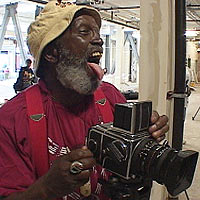
Spark follows a few of the photographers that are part of this program including Robert Farrell and Max Nolan.

Array

  • Array
  • Array
  • Array

Eleanor Coppola

In Circle of Memory, Eleanor Coppola has created a sanctuary for those experiencing painful grief from loosing a child. Spark checks out Coppola’s emotional and thought provoking installation at the Oakland Art Gallery.

Circle of Memory is one of Eleanor Coppola’s first major art installations. However, she is a seasoned veteran within the arts. Her books, films, and costume designs have all earned her praise. Coppola’s first book, Notes on the Making of ‘Apocalypse Now’ is a first-person narrative that describes the intense production of the movie Apocalypse Now, and was later adapted into the Emmy Award winning film called Hearts of Darkness: A Filmmaker’s Apocalypse. Published in 2008, her second book Notes on a Life compiles 30 years of journal writing and letters with friends and also covers the death of her eldest son, Gio, which inspired the creation of Circle of Memory.

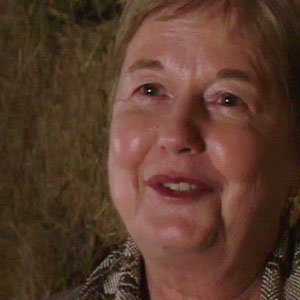
When Coppola visited a friend in Ireland, she was introduced to an ancient tomb used for rituals dealing with birth and death. This powerful experience inspired her and five other artists to reinterpret the passage tombs, and thus, Circle of Memory was created. Coppola created a structure made of straw bales based on the cairns the passage tombs formed. At the center is a circular room for reflection which provides visitors slips of paper to write on and contribute to the work. As Circle of Memory travels around the world, the space evolves with the addition of visitors’ messages left in the straw. Combined with sound and shadow interplay elements, this public space is a multi-sensory experience allowing for the loss and remembrance of children who have died or been lost. Coppola hopes the exhibit provides a universal place of remembrance, especially as the current culture often does not provide a place to reflect on one’s losses.

Upon completing her degree at UCLA in applied design, Eleanor Coppola worked as a freelance designer doing fabric-and-collage murals for architectural installations. In 1962, she was the assistant art director for Dementia 13, a low-budget independent film. There she met writer/director Francis Coppola and the two married the following year. She has designed costumes and stage décor for the ODC Dance Company San Francisco and her drawings, photos and conceptual art pieces have been exhibited in many galleries and museums.

  • Array

Sandra Woodall

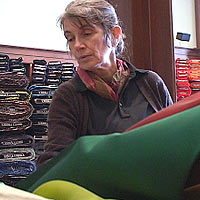
Though Sandra Woodall is not on stage, her costume work is an integral part of stage performances. In the episode “Backstage Crafts,” Spark looks at this costume designer from inspiration to execution. Woodall and her colleagues speak of her process and work, showing examples from a variety of performances. An award-winning costume designer, Woodall works in many genres including ballet, modern dance, performance art and theater.

An Oakland native and graduate of the San Francisco Art Institute in painting, Woodall was taught to sew at an early age by her grandmother. Upon graduation, she became a design assistant at the San Francisco Opera House. Since 1970, Woodall has had a studio in the heart of San Francisco’s SOMA district, where for 18 years she employed up to 35 seamstresses to produce and build costumes for designers from all over the world. Woodall now uses the space exclusively for design.

With more than 200 productions to her credit, Woodall often works on designs for multiple projects at any given time. Organizations like the San Francisco Ballet think of their costumes as major assets that can be used again for future productions or rented out to other companies. For a full-length ballet, the costume budget alone can run as high as $250,000.

Woodall takes all aspects of the production into account, and each piece is injected with her unique perspective and sense of the beautiful and unexpected. She is able to evoke different feelings with even the simplest of details — such as creating a sense of the feminine with the custom placement of delicate lace to the use of black lights to mimic a jellyfish in the ocean.

Woodall often uses motifs of nature and is inspired by the images and objects that she collects. When Woodall was a Fulbright scholar in Taiwan (1999-2000), she began collecting local insect specimens, which became a springboard for her costumes for “Welcome to Shangri-La,” a play about a man whose life was in conflict with nature.

Collaboration for Woodall starts at the beginning of each piece, and she is insistent that even if her vision is correct, the costume can’t be realized if the sketch is not. Because of this, great attention to detail takes place at every step of the process, from the medium in which the sketch is created to the fabrics that she selects. For A.C.T.’s production of Henrik Ibsen’s “A Doll’s House,” Woodall used a collage process in which she combined a photo of a costume of the period with an overlay with sketches of her own.

Though Woodall is still in high demand for her costumes, she has been shifting her focus, returning to her early interest in painting. “When I was growing up, I never imagined I would be working in theater. I always thought I would be an artist.” She continues to work on things that interest her, but states, “I have to really discover what my painting style is going to be.”

  • Array
  • Array
  • Array

San Francisco Opera

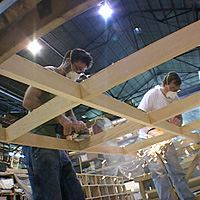
Producing an opera means thousands of hours of hard work and ingenuity, and many of the people that make it happen are not those in the spotlight. In the episode “Backstage Crafts,” Spark goes behind the scenes with the San Francisco Opera as the set construction crew takes on the staggering task of building the ambitiously designed scenery for the production of Ferruccio Busoni’s 1925 opera “Doktor Faust.”

Whereas American operatic productions have mostly stuck with traditional designs for sets and costumes over the last 20 years Europeans have been more interpretive in their art direction. “Doktor Faust,” which is co-produced with the Stuttgart Opera, brings some of the more avant-garde aspects of the new European opera to American shores. Set designer Anna Viebrock came up with a single set that will carry a narrative that takes place in four distinct scenes.

The opera tells the story of a man, whose life is shattered after he makes a deal with the devil, and Viebrock wanted the scenery to emphasize the harsh reality of Faust’s plight. While visiting the Potrero Hill warehouse where the SF Opera’s set construction crew works, she discovered a crumbling industrial scene shop that captured exactly the mood she hoped to create. The carpenters and painters then set about faithfully reproducing the room’s decrepit, ’50s-era acoustic tile ceilings, peeling paint, rusted water pipes, fire sprinklers and industrial windows.

One of the challenges of the design came from Viebrock’s set with more than 1,500 industrial acoustic tiles of the kind that she saw at the warehouse. But those tiles are no longer being manufactured. Moreover, they would have deadened the sound of the singers on stage. So the SF Opera scene shop contracted with an Ohio outfit to manufacture plastic replicas that were painted to look like the real thing. The surface was then painstakingly treated to simulate the stains and peeling paint that result from water damage.

The set for “Doktor Faust” is unusually large. The typical set for San Francisco’s War Memorial Theater, where the opera is being put on, is about 60 feet wide. At 98 feet across at its widest point, the L-shaped set for “Doktor Faust” occupies the entire stage, reaching 60 feet upstage and standing 48 feet tall. The floor, walls and ceiling of the set, an area of 10,000 square feet, required approximately 200 sheets of plywood, all of which were hand-painted by scenic artists to the specifications of the design.

Because the War Memorial Theater puts on more than one production at a time and because the opera will be traveling to the Stuttgart Opera, the set needed to be easy to break down, ship, and reassemble. The set construction team accomplished this by making 100 modular flats that are able to fit into four standard 8x8x40-foot shipping containers. Even the enormous ceiling for “Doktor Faust” is designed to be disassembled. Put together, with its skylights, hanging industrial sprinkler pipes and fluorescent lighting, the ceiling weighs approximately 9,000 pounds.

More about the San Francisco Opera
Founded in 1923 by Gaetano Merola, the San Francisco Opera is now the second-largest opera company in North America. The War Memorial Opera House has been the home of the SF Opera since 1932, when it was inaugurated with a performance of “Tosca.” All of their productions include supertitles — English translations of the libretto projected over the proscenium simultaneously with the action on stage. Additionally, the SF Opera presents an annual free concert in Golden Gate Park on the Sunday following opening night of their fall season.

  • Array
  • Array
  • Array

Best of Broadway presents “Hairspray”

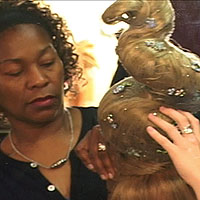
With a name like “Hairspray,” it’s easy to guess what an important part costuming, hair and make-up must play in the success of this Tony Award-winning musical. Spark gets a look at the woman behind the big hair with Best of Broadway’s “Hairspray” wig master Joy Marcelle.

  • Array
  • Array

Kymata

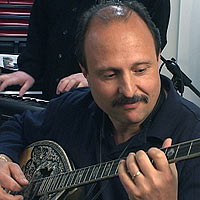
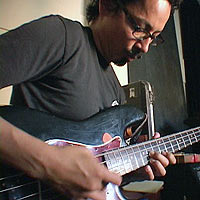
George Mylordos, one of the world’s most accomplished bouzouki players, is taking his band Kymata from playing weddings to recording a CD. Watch it all come together on the Spark episode “Making Their Move” as they practice and perform, working from the rich Greek music tradition and unique American styles to create a whole new sound.

Originally from the island of Cyprus, where he learned to play the bouzouki (a guitarlike instrument similar to the lute originating in Asia Minor, or modern-day Turkey), Mylordos came to America in 1982. He has played professionally in bands and as a backup musician. Right beside Mylordos throughout his career has been drummer George Mihailidis. Born in Thessaloniki, Greece, Mihailidis came to the United States at the age of 19 and went on to play in a wide variety of bands, even appearing at the Rockefeller Center and the White House.

Though Mylordos and Mihailidis both toured professionally, there came a time in their lives where they had had enough. They wanted to leave the constraints of that life and have a life in which, Mihailidis says, they could “create something that we can play whenever we want to and play for higher standards.” There was never any doubt that they would continue to create music together, and in 1994, Mylordos, Mihailidis and Kostas Papamichael formed the band called Kymata, which is Greek for “waves of the sea.” Papamichael started singing as a child, influenced by his father’s and grandfather’s Greek songs. He continues to sing for the band today as well as play the guitar and dumbek.

Over the years, the group has continued to grow, adding new members and refining their skills. The band’s newest member, 24-year-old singer Katerina Clambaneva, was born in Hayward, but moved to Greece at 6 weeks old, where she remained for the next 16 years. She returned, with her family, to attend Diablo Valley College and currently works in marketing. Her first love is Greek music, but she’s performed many other styles as well, including Latin music.

Since their founding more than a decade ago, Kymata has played hundreds of weddings and festivals, becoming a prominent fixture in the Greek community. They have developed a repertoire that tops a thousand songs and spans the full spectrum of Greek styles and musical traditions. Despite success, the band has recently made the decision to begin playing fewer gigs so they can focus on developing their own unique style, along with writing and recording their own music. They’ve blended Greek and other Mediterranean influences with the music that they loved as kids — rock and jazz from Dizzy Gillespie to John Coltrane to Led Zeppelin.

The band knows that making a CD is a risky proposition — there’s no telling how large the audience will be for their brand of musical fusion. For them, however, the rewards are reaped every time they gather together to play, and they see themselves as part of a historical continuum that dates back millennia.

  • Array
  • Array
  • Array

Matt Alber

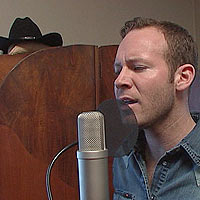
In “Making Their Move,” Spark meets Matt Alber, who has left a secure job to go out on his own as a country western singer. With no manager or agent, Alber is doing whatever it takes to make things happen. When a once-in-a-lifetime opportunity presents itself with a spot on the new television show “American Pride,” a search for the first openly Gay male country western singer, Alber jumps at the opportunity.

Growing up, Alber said, “I know I wanna be a singer, I just don’t necessarily know what kind I’m going to end up being.” Born in Wichita, Kansas, and raised in St. Louis, Missouri, he studied voice at Truman State University in Missouri. With a strong religious background, he thought his future was in Christian pop music. Unfortunately, while traveling with the Christian band Living Word, Alber was faced with hostility because of his sexual orientation. The group disbanded and re-formed without him.

Alber moved to San Francisco and became a full-time professional musician when he joined Chanticleer, a Grammy Award-winning ensemble of 12 voices that perform a diverse range of pieces, including jazz and gospel. Alber was then introduced to country western music and two-step. He found that his voice and writing were well suited to country western, and he has been well received at such venues as rodeos and the Sundance Saloon, a weekly country western event that serves the Lesbian, Gay, Bisexual and Transgender community.

The first original single by Alber, “What Took You So Long?” placed third in Universal Music’s 2002 Songwriting Contest. In 2003, he competed in a revived version of the television show “Star Search.” Although he didn’t win, the competition was close, and the experience led him to make the decision to leave Chanticleer and pursue solo performing as a country western singer-songwriter. Alber had his own studio built and continues to write music, inspired by country, alternative rock, electro, hip-hop and musical theater. He is at work on his first album with Whip Records in Berkeley.

Alber hopes that the show “American Pride” might be what it takes to push him to the next level. He learned of the plan to develop the show from record producer Larry Dvoskin in 2002. After more than a year of waiting, Alber received notification that the show was holding open auditions, so he flew out to New York and was selected for the cast. The show will follow competitors as they audition for a place in the finale in Nashville, where America will vote for the winner. The winner receives a record contract and the possibility of a place in history.

  • Array
  • Array
  • Array
  • Array
  • Array

Ballroom Blitz Junior Dance Sport Championship

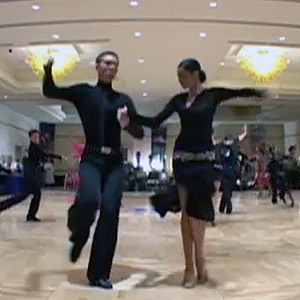
Spark goes behind the scenes with the teenage competitors in the Bay Area’s first Ballroom Blitz Junior Dance Sport Championship. The event features six couples, which are finalists selected from hundreds of junior couples across the U.S. In the course of the evening, these couples will dance rhumba, cha-cha, samba, paso doble, and jive. The winning couple of the event is eligible for the regional competition and will have an opportunity to travel to Europe representing the U.S. in an international competition.

  • Array