Category Archives: Genre

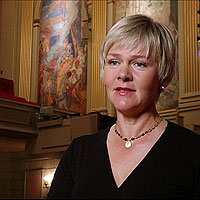
Liebe Wetzel

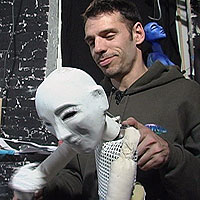
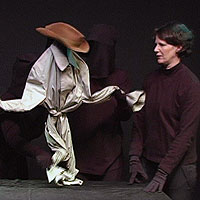
If you were to look up object puppetry in the dictionary, there is a good chance you would find Liebe Wetzel‘s name. In the world of puppetry, Wetzel and her company, Lunatique Fantastique, are pioneers. In Wetzel’s skillful hands, inanimate objects are given breath, movement and focus — the three rules of object puppetry. As she puts it, she is finding the essence of a character in an object. Wetzel’s work is loosely based on Japanese bunraku puppetry, in which the artists dress from head to toe in black so that they disappear and create the illusion that their puppets are moving on their own.

Wetzel was always interested in puppets, but she was not confident in her ability to construct them. This led her to develop a form of object animation that requires nothing more than an interesting object and a manipulator’s skill in bringing it to life. Her first character, for example, was a talented young actress by the name of Fomé constructed of a single strip of beige-colored foam.

Spark reveals the secrets behind Wetzel’s puppetry magic and the profound subject matter of her plays, which could be more difficult for traditional theater with live actors. Without dialogue of any kind and with puppets that are nothing more than mere outlines of living characters, Wetzel has the uncanny ability to tell tragic stories with grace and humor. Wetzel is interested in populations that don’t have a voice, such as Japanese Americans who were interned during World War II, people who have polio and women who are victims of sexual abuse.

In her 2006 project titled “Beauty and the Breast,” Wetzel, in collaboration with longtime Bay Area theater director Jayne Wenger, broaches the subject of breast cancer. Produced by Exit Theatre, “Beauty and the Breast” tells the story of Bresty, a bright purple bra who battles breast cancer and makes the difficult decision to have a mastectomy. For this production, Wetzel and Jayne Wenger decided to get rid of the black outfits of the puppet manipulators and expose them, a first for a Wetzel production. Other objects, such as a flowerpot, trowels and handkerchiefs, fill out a cast of characters that may never have realized their full potential if Wetzel hadn’t come along.

Liebe Wetzel, a Texas native, earned a B.A. in biology and biochemistry from Rice University. After surviving a nearly fatal car crash, she decided to follow her dream and began studying acting all across the continent, including at the Cornish College of the Arts in Seattle, the Dell’Arte School of Physical Theatre in Northern California and the Loose Moose Theatre in Calgary, Canada. Since its founding in 2000, Lunatique Fantastique has gained popularity in theater sectors locally and overseas from such plays as “Reframing the Hourglass,” “The Wrapping Paper Caper,” “Objects in Predicaments” and “Snake in the Basement: The Persecution of Rev. Bill Pruitt.” Wetzel’s innovative work has won many awards, including the “San Francisco Bay Guardian” Goldie Award for Best New Theater Talent, as well as Best of Fringe and Top Box Office Hit in the 2001 and 2004 San Francisco Fringe Festival.

  • Array

Basil Twist

A San Francisco native, Basil Twist first became interested in puppetry through his mother, who was president of the San Francisco Puppeteers Guild. After stints working with designer and Broadway director Julie Taymor and the Swedish Cottage Marionette Theater in New York’s Central Park, Twist became the first American to study at France’s École Supérieure Nationale des Arts de la Marionnette.

He lives in New York’s Greenwich Village, where he dreams up his shows and constructs puppets in a basement workshop. Spark caught up with Twist in San Francisco, where he was collaborating with dancer Joe Goode and playwright Paula Vogel to stage “The Long Christmas Ride Home” at the Magic Theatre.

Twist first made a splash in 1995 with “The Araneidae Show.” Since then, he has won a Bessie Award for the show and been nominated for a Drama Desk Award for “Tell Tale.” Though well versed in traditional forms, Twist often creates his own blended styles, pushing boundaries to adapt them to new theatrical expectations.

Skilled in a wide variety of animating the inanimate, Twist’s work often brings long-forgotten puppetry forms back to the stage. His 1999 “Dogugaeshi” used more than 700 mobile painted screens — of the style of the same name, one which has nearly disappeared from its native Japanese island of Awaji. And for the 2005 Spoleto Festival, he constructed life-sized marionettes for a return to the lost 18th-century art of puppet opera with the revival of Ottorino Respighi’s “La bella dormente nel bosco.”

In Twist’s version of the beloved Stravinsky ballet “Petrushka,” he created the acrobatic steps of a gamut of fantastical characters using Czech black technique, in which puppeteers clad in black velvet move invisibly in the darkness behind their puppets. And later, he turned to a modified style of Japanese bunraku — making the puppeteers a more integral part of the show as both operators and actors — in “The Long Christmas Ride Home.”

Twist has also developed underwater marionettes for his internationally acclaimed “Symphonie Fantastique,” which was performed in a 1,000-gallon, seven-foot-long aquarium. And he worked with film director Alfonso Cuaron on “Harry Potter and the Prisoner of Azkaban,” using his underwater skills to help animators achieve the underwater flow of the merpeople.

Basil Twist notes that although many people think of puppetry as a children’s art form, it is a deeply resonant and metaphorical practice. For him, puppetry is about giving life and soul to objects and telling the stories of the inanimate, while constantly reinventing the art as he goes along.

  • Array
  • Array
  • Array
  • Array

Christopher Brown

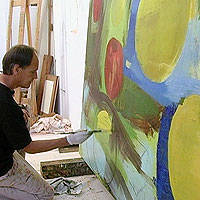
Veteran Bay Area artist Christopher Brown paints scenes drawn from memory. For more than 30 years, Brown’s large canvases have been populated with remembered figures, objects and vistas that the artist continually reuses. Many of the images emanate from photographs that Brown has taken over the years; many reside only in the artist’s own recollection.

Although Brown is primarily a figurative artist, many of his paintings involve formal examinations of relations of scale and depth. Space in Brown’s canvases is often irrational, an almost dream-like landscape where scale and distance fail to cohere. Brown’s collages of memory images and photographic records converge in irrational, even surrealistic juxtapositions — confounding representation and abstraction and testing the boundaries between pictorial modes.

Brown obsessively works and reworks his images, painting over large areas of his canvases to redefine colors, objects and distances. Spark catches Brown in his studio, hard at work on a large painting of a building that will be the centerpiece for a solo show at San Francisco’s John Berggruen Gallery. Inspired by the artist’s tenure in New York in the mid-1990s, the painting depicts an immense apartment block that entirely fills the canvas. Brown painstakingly fills in each of building’s windows, continually changing the shading and color tones.

Midway through his painting, Brown decides to fill a section of the image with a photographically rendered stampede of horses that appear to charge from the picture’s surface toward the building, confusing the building’s assertion of space and stability within the image. The artist continues to work on the painting until the day of the show.

For Brown, exhibitions are rare moments when his normally solitary practice of making paintings gives way to social interactions, wherein his work is exposed to public view. The show is an opportunity for the painter to see his images anew, to experience his own expression reflected back at him.

Christopher Brown was born in Camp Lejeune, North Carolina. Brown earned his B.F.A at the University of Illinois and his M.F.A at the University of California, Davis. He has shown his work in galleries across the United States and is represented in several museum collections, including the San Francisco Museum of Modern Art, the Modern Art Museum of Fort Worth and the Sheldon Memorial Art Gallery.

Array

  • Array

Binh Danh

Each of the faintly rendered faces peering out from Binh Danh‘s leaf prints tells a story, as well as asks questions about history — likewise for Danh, who moved from war-torn Viet Nam as a young child in 1979. His work stems from his own unanswered questions about what happened in his native country. As he attempts to navigate the boundaries existing between personal and collective memories, he has used his work to give a face to the human costs of war.

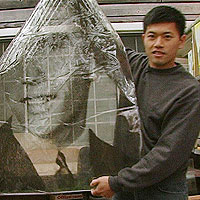
Danh is not a photographer in the conventional sense — instead he works from an existing archive of photographs depicting the war’s many victims that he collects from various sources. Once he finds an appropriate image, he uses digital technology to make a negative transfer. From there, his work takes on a decidedly organic quality.

A lifelong interest in science primed the young artist to invent his own development process, which he coined “chlorophyll prints.” Danh begins by gathering leaves from his garden. Then he takes his negative image transfer and places it over a leaf, sandwiching the items between two sheets of glass. The arrangement is laid in the sun for a period of time (days or even weeks) until the ghostly visage appears. If it meets his approval, he then fixes the leaf in resin. According to the artist, this form of photography mirrors the continuing cycle of nature.

Spark catches up with Danh as he prepares for a collaborative installation with photographer Elizabeth Moy for their exhibition at the Intersection for the Arts (May 3 through June 17, 2006). Moy, whose father served in Viet Nam, shares an affinity with Danh in that her work seeks to reimagine the past. Seen together, their photographs create a space for reflection and contemplation of history that resonates in present times.

Binh Danh earned his B.F.A. in photography from San Jose State University and his M.F.A. from Stanford University in 2004. He has completed a residency at Cite Internationale Des Arts in Paris and has exhibited widely in the Bay Area, including shows at SF Cameraworks, the Kearny Street Project, the Oakland Museum of Art and the Triton Museum of Art. His work is included in the collections of the Oakland Museum of California and the University of California, Santa Cruz’s Special Collection.

  • Array
  • Array
  • Array

Deborah Slater

Spark features Deborah Slater in her element working in collaboration on “Hotel of Memory – More Furniture Dances” with multi-disciplinary performing artists who are known for their dancing, singing, and trapeze work. This piece was inspired by Erik Satie’s “furniture music,” which was meant to be nothing more than ambient sound.

Slater’s dancers perform on and around a living room set. The furniture becomes an integral part of an evening-length narrative that deals with loss and memory. When the furniture disappears, what was once taken for granted leaves a physical and emotional gap in the lives of Slater’s unsuspecting characters. With an eye on the bigger social issue of decreasing government subsidies for the arts, Slater’s “Hotel of Memory” comments on the possibility of life without art.

  • Array
  • Array

Wil Blades

Wil Blades is at the top of the local music scene as a Hammond B3 organ player. The B3 is that big warm sultry, funky tone that provided the groove to many of the 1960s and 1970s R&B recordings. The B3 is experiencing a revival today, particularly among jazz saxophonists who find it a nice complement to a trio.

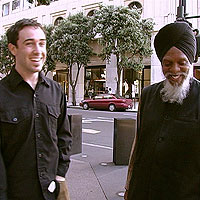
Blades is only in his 20s but plays like a veteran, and his knowledge of the instrument is encyclopedic. He has accompanied the greats, including good friend and B3 legend Dr. Lonnie Smith. Their relationship is based in part on their love of music, but also Smith has been a mentor to Blades.

There aren’t a lot of places besides the Boom Boom Room that have a B3, so Blades owns three of his own organs. For many of his performances, Blades lugs his organ around the Bay Area in his van — as Spark witnesses. As he says, “It’s like a piece of furniture.” Imagine taking a 400-pound desk around with you, and you begin to get the idea.

Originally from Chicago, Blades began playing and studying drums at the age of 8, guitar at 13 and organ at 18. He studied at New College of California. He teaches at Berkeley Jazz School and plays in a number of different groups, including the Wil Blades Trio, O.G.D., Steppin’ and BluesBeat. Blades can be seen performing regularly as the house organist at John Lee Hooker’s Boom Boom Room.

Array

  • Array
  • Array

Barbara Bonney

The New Jersey-born soprano Barbara Bonney has garnered international praise as one of the world’s most accomplished concert artists. She began her professional singing career in the late 1970s when she secured a repertory position with Germany’s Darmstadt City Opera. Since then, Bonney has gone on to perform in the major world opera houses, gaining special acclaim for her roles in works by Strauss and Mozart. But all along, Bonney has had a passion for performing “lieder,” or European classical songs.

Most popular in the 19th century, lieders were traditionally performed in an intimate setting — such as a salon or living room — to a small group of people. According to Bonney, only recently has the art of song recital been developed for the big stage. In lieder recitals, there are no sets, costumes or orchestras, so the singer can achieve a more immediate connection with an audience through song alone. Bonney enjoys being on stage with only her piano accompanist, to tell her audience a story. She calls these songs “little jewels.”

Despite her packed performance schedule, Bonney still finds time to teach classes in many of the cities she visits to share her love of singing. Whereas most master classes cater to students with professional dreams, Bonney gears hers toward amateurs. Following her 2006 recital for San Francisco Performances, Spark sat in on one of Bonney’s master classes, in which each student was given the chance to sing a song of his or her choice on the Herbst Theatre stage.

Barbara Bonney estimates her lieder repertoire now includes more than 460 songs. Over her career she has made 90 recordings, spanning Baroque to 20th-century music, by such artists as Schubert, Mozart and Sibelius. She has performed with the Vienna Philharmonic, the Berlin Philharmonic, the Boston Symphony, the Berlin Radio Symphony and the San Francisco Symphony. Bonney, who lives in London, has been a regular presenter for the Cardiff Singer of the World competition and has hosted “Masterclasses for Amateurs” for the BBC.

  • Array
  • Array
  • Array

Stephen Kent

Composer and musician Stephen Kent has been playing the didgeridoo, a traditional aboriginal instrument, for more than 25 years. In that time, he has created a unique, contemporary style of execution influenced more by his travels than by a desire to continue within the Australian aboriginal musical tradition.

The didgeridoo is created out of hollowed Eucalyptus branches and is played with a technique known as circular breathing, where the musician keeps a constant flow of air through the instrument by breathing in through the nose while simultaneously blowing it out through the mouth.

Kent’s music has evolved from his international lifestyle — he was raised in Africa and England and lived in Australia before relocating to the Bay Area. He has recorded three solo albums as well as collaborated with other artists, and he has toured internationally. His radio show, “Music of the World,” airs live KPFA from 10am-noon every Thursday (PST).

  • Array
  • Array

Bill Dan

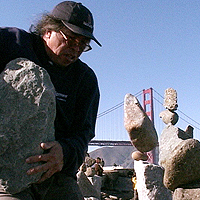
On any given day and in all types of weather conditions, nature artist Bill Dan can be seen balancing rocks at Fisherman’s Wharf, Crissy Field or on the waterfront of Sausalito. Since he began this practice in 1994, he has become a well-known local figure, often attracting large groups of spectators who gather around him while he creates vertical rock sculptures that seem to defy gravity.

Completely self-taught as a rock balancer, he plays upon the possibilities inherent to the interaction of rock, mass and gravity to create his nature art. There are several forces governing his approach: concentration and a positive attitude, along with an understanding of and respect for materials. His philosophy is that balancing rocks is play and work, beauty and craft. Sometimes building up to 10 sculptures in a day, he acknowledges that the act of physical labor, of hours spent stacking heavy rocks, depends upon his being in a good mood.

He keeps his work as simple as possible, to be an antidote to the complications of modern living. His source material is the “stone riprap” for their seemingly endless supply and varying shapes, sizes, colors and textures. The abstract sculptures he leaves behind do not conflict or compete with the beauty of their surroundings — they merely allow viewers to appreciate nature in new ways.

Spark catches up with Dan and witnesses that his work is both public and performance art. The crowds observing him get different things out of it. For some it is meditative and spiritual in its simplicity; for others, Dan’s ability to balance large stones perfectly on small rocks — without the use of any adhesive — is awe-inspiring. Unlike many public art pieces, his are not bound for permanence, and upon completion, the sculptures are left to endure the elements. It is part of his art to accept that his rock formations are temporary and ephemeral, even fleeting.

Bill Dan left his native Indonesia more than 20 years ago. He says that his friends and family back home can’t believe what he does. Still at it, he is out there every day doing what he loves: building sculptures and sharing his simple philosophy with others. Not limited to shores, he has been invited to perform at events and to teach schoolchildren the importance of using creativity and imagination over drugs.

  • Array

Roman Loranc

Roman Loranc works in the great tradition of California landscape photography. His art is as much about preservation as it is about beauty. Like Ansel Adams, who is famous for his commitment to Yosemite Valley, Loranc has been photographing the restoration of the Cosumnes River Preserve for many years.

The Cosumnes is the only river running from the Sierra to the Delta that is not dammed. It is a small river, but during the winter when it reaches the flatlands south of Sacramento, it runs out of its banks across acres of fields. Since the late 1980s, the Nature Conservancy has been buying land and gaining easements in order to restore the natural flood plane and riparian forests of the lower Cosumnes.

Loranc is a patient, thoughtful photographer. He arrives before dawn and waits. There is a brief moment — some days it’s just a minute — when the combination of the early light before sunrise, the mist and the stillness creates the perfect conditions for his images. He captures the reflections off the glass-like surface of the water. Once the sun begins to warm the valley air, breezes come up very quickly and the surface of the water starts to move. Then Loranc is often finished for the day.

The best time to visit the Cosumnes is in the winter when the water has flooded the preserve. In December, the temporary wetlands are filled with migratory birds. There are nature trails for those who simply want to stop by as well as for those who want to make deeper excursions into the preserve.

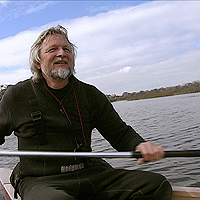
Spark went on a canoe trip with Loranc through the flooded Cougar Wetlands. On that day, heavy winter rains, along with breached levees, had caused flooding all along the lower San Joaquin. The image of water running over its banks across acres of fields gave a clue as to how the wetlands might once have looked and how they might look again. Loranc was very excited and took quite a few photographs that day.

Loranc and his wife, Lillian Vallee, the poet and Czeslaw Milosz scholar, live in Modesto, California. They moved there 20 years ago when they found the Bay Area too expensive. It took them years to begin to appreciate the beauty of the Central Valley; now, they have a profound appreciation of the place and say that people are surprised when they learn where Loranc takes his photos.

Roman Loranc was born in Bielsko-Biala, Poland, in 1956. He immigrated to the United States in 1981. His book, “Two-Hearted Oak: The Photography of Roman Loranc,” features essays and poetry by Vallee. Over the years, Loranc has also been photographing historic architecture and landscapes in Lithuania.

Array

  • Array
  • Array

Gregory Gavin

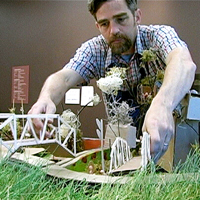
Gregory Gavin is a visual artist with a social cause. His site specific project called “Riveropolis,” was born out of his interest in bringing inner-city people together in a man-made environment reminiscent of nature. With this project, Gavin hopes to create a meeting place for people in much the same way as a watering hole found in nature is a meeting places for animals.

Spark visits Gavin and “Riveropolis” while in progress at the De Young Museum. The unadorned structures for Gavin’s riverscapes are constructed in his studio and then assembled in public spaces. The finishing work is done by people of all ages, who are invited to create riverside towns and attractions out of the materials Gavin provides. In this art-meets-culture installation, Gavin wants people to be reminded of the simple beauty of life, uncluttered by digital gadgetry.

  • Array
  • Array

John Chiara

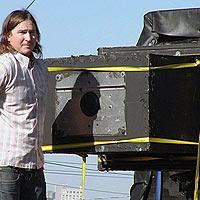
Whereas most of us have embraced digital cameras for their sleek, lightweight design and instant gratification, landscape photographer John Chiara favors his own super-sized camera. In the episode “Experimentation,” Spark catches up with Chiara on location as he sets up his camera obscura atop one of San Francisco’s familiar vista points.

His unique approach is influenced by the early days of photography when artists dealt with heavy, awkward equipment and endured long exposure times and cumbersome developments. Chiara’s own process is a labor-intensive endeavor — often taking him an entire day to get a single image — however, unlike his 19th-century predecessors, Chiara’s images are, like his camera, large, usually measuring 62 inches by 50 inches.

The nature of Chiara’s work is as much about sculpture and performance as it is about photography. His camera, which he designed and built himself, is transported to each location on a flatbed trailer. The pinhole design enables him to shoot and develop simultaneously on oversized photosensitive paper. After making adjustments to orient the camera in the right direction, Chiara must then climb inside it. Immersed in the darkness, he uses the glare of light to help him find the image. Becoming an extension of the camera, he uses his hands, by way of intuition, to control the amount of light entering the lens.

Bearing a strong resemblance to watercolor paintings, his photographs are rendered in soft, faded hues that relay an ephemeral quality. Early in his career he focused on creating pristine, color-saturated pictures. As he began to change his approach, he developed his own processes as well as his own rules. To accommodate the size of his images, he fabricated a drum roll from a sewage pipe to develop them.

His views are not what he considers picture perfect. They seem to be framed as if by accident. The ordinariness of his landscape imagery connects to Chiara’s childhood days spent daydreaming and staring off into the distance. Chiara encourages viewers to spend time with his work in hopes that the images will evoke emotional responses.

Chiara earned a B.F.A. in photography from the University of Utah in Salt Lake City and an M.F.A. in photography from the California College of the Arts in 2004. He has exhibited locally and nationally, including a solo show at the Build Gallery and group exhibitions at New Langton Arts in San Francisco and the Von Lintel Gallery in New York.

Array

  • Array

Matmos

If you aren’t sure how rock salt crunching underfoot, slow kisses and a five-gallon bucket of oatmeal could be instruments, then you probably haven’t listened to Matmos, a musical duo composed of San Francisco sound artists M.C. Schmidt and Drew Daniel. Their special brand of electronica, which melds manipulated audio fragments and electronic beats, has led them to tour with Bjork, to teach in Harvard classrooms and to exhibit work in New York’s Whitney Museum of American Art.

Listening to a Matmos track is something like digesting an intensely colorful collage or intricate mosaic with your ears. The duo’s ability to explore sound and create highly listenable tracks using non-traditional sources has captivated fellow musicians, art institutions and electronic music fans since Schmidt and Daniel began collaborating in 1999.

Whereas many electronic DJs concentrate on pounding, crowd-pleasing tracks for clubs and live music venues, the Matmos sound is more cerebral, introspective and experimental. It should come as no surprise, then, that Daniel and Schmidt have diverse academic backgrounds. Daniel pursued a graduate degree in Renaissance literature at U.C. Berkeley. Schmidt heads up the San Francisco Art Institute’s conceptual art department and dabbles in numerous other avant-garde musical projects, including lao Core and X/I.

When Spark caught up with Matmos in the episode “Experimenting,” the two were finishing a sound installation for the Natural History Museum of Los Angeles County show “Sonic Scenery” to correspond with 17 animal dioramas. But in true Matmos fashion, the final product is no ordinary sound display. Instead of playing the music continuously as museum visitors milled about the show, the exhibit required guests to don headphones and personal music players and walk in a counterclockwise direction so they heard the right tracks at the right time.

In 2006, Matmos released its eighth album, “The Rose Has Teeth in the Mouth of the Beast,” which like every album they produce, has a central theme. Each track on “The Rose” is a biographical sound portrait dedicated to a particular person. The sounds that serve as the minute building blocks for the full-length electronic songs come from things in some way related to the biographical subject. For example, a track dedicated to author Patricia Highsmith incorporates sounds created when snails, her favorite creature, crawl across a light-sensitive theremin (electronic instrument) and trigger changes in the instrument’s pitch.

Previous Matmos albums include “California Rhinoplasty” (2001), “A Chance to Cut Is a Chance to Cure” (2001), “The Civil War” (2003) and “Wide Open Spaces” with People Like Us and Wobbly (2005).

  • Array
  • Array

Kunst-Stoff

Kunst-Stoff is an experimental dance company that plays with boundary-breaking ways of creating dance. Spark spends time with this innovative company as it creates and prepares for the world premiere of “As We Close Their Eyes.” This multidisciplinary work was commissioned by San Francisco’s Yerba Buena Center for the Arts as part of its Bay Area Now 4 performance series.

Kunst-Stoff was founded by Yannis Adoniou and Tomi Paasonen. Both classically trained and former dancers with LINES Ballet, they formed the Kunst-Stoff company to explore the intersection of dance with other art forms. Their goal was to explore a range of subject matter in ways that conventional dance had not. The name Kunst-Stoff is a play on words based on the German word “kunststof” meaning “synthetic material.” When the word is separated, “kunst” translates to “art” and “stoff” to “things.”

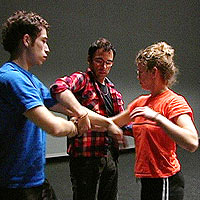
In 2005, Adoniou read an article on a museum designed for the blind, which inspired him to explore how the experience of sightlessness could translate into movement. Through LightHouse for the Blind, he met Khoja Aniksa, who has been visually impaired since birth. In a rehearsal, Aniksa shared with the group his unique awareness of space and how he perceived and interpreted the dancers’ movements. This experimentation formed the basis of “As We Close Their Eyes,” which uses sound and touch to emphasize sensory information other than visual.

In addition to the two principal choreographers, Adoniou and Paasonen, the Kunst-Stoff troupe consists of eight dancers. Since its inception in 1998, the group has premiered more than 20 new works in the Bay Area, toured internationally, and collaborated with visual and media artists and composers. Kunst-Stoff has performed commissioned pieces for the Berlin Tanztage Festival, the Burning Man Festival, the Dimitria International Festival in Greece, and the 2005 Scuba National Touring Network.

Array

  • Array
  • Array