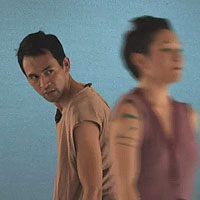
The members of SHIFT>>> Physical Theater share an equal involvement in the development of choreography, narrative and structure for each project. Their work is generated out of the performers’ own stories and use modern dance to examine the relationships between people in contemporary culture. Founded in 1998, SHIFT>>> is currently a resident artist at ODC Theater.
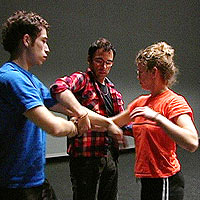
Dancer Manuelito Biag is the artistic director of SHIFT>>>. Spark visits with Biag as they work on “The Shape of Poison,” which was inspired by the Tibetan Buddhist teachings of Klesha, the emotional obstacles to enlightenment. The three main Kleshas are passion, ignorance, and anger.
We watch as Biag works on a duet based on “Passion.” Biag says “When we get too attached to one thing, when we get too passionate about a thing or person or concept … it causes us suffering.” But he says it’s important to forgive ourselves. “We’re human, and that to be aware and to be mindful is the key.”
Passion for the art of dance is perhaps the defining quality of Oakland’s Ronn Guidi, director of the Oakland Ballet Academy and founder of the famous Oakland Ballet. An ever-energetic mainstay of the East Bay dance scene, Guidi created the Oakland Ballet in 1965 and led the small regional company to international attention in the 1970s with his canny choices of repertoire.
Bolstered by a National Endowment for the Arts grant and ambitious world premieres, like Eugene Loring’s “The Tender Land” — for which composer Aaron Copland himself conducted the opening night — Guidi’s enthusiasm and efforts paved the way for the troupe to become a major force in dance as one of the few remaining companies in the world performing the lavish and inventive ballets created for Sergei Diaghilev’s Ballets Russes. It was Guidi who brought in such living legends as Leonide Massine, Frederic Franklin and Irina Nijinska to stage authoritative restorations of “Boutique Fantasque” and “Les Biches.”
Guidi expanded the company’s scope over the next decade with ballets by some of the giants of 20th-century dance, including works that were rarely seen anywhere at the time — Kurt Jooss’s “The Green Table,” Agnes de Mille’s “Fall River Legend,” Ruthana Boris’s “Cakewalk,” Bronislava Nijinska’s “Les Noces” — as well as more than 50 of his own creations and restagings of classics like “Giselle” and “Les Sylphides.” In addition, he commissioned works from notable local choreographers, such as Betsy Erickson, Tandy Beal, Margaret Jenkins and Remy Charlip, all of which inspired several generations of dancers in the Bay Area.
After 33 years at the helm of the Oakland Ballet, Guidi retired from the company in 1998, to be succeeded by Karen Brown, who directed the company until 2005, when it was forced to close its doors after its 40th anniversary season. Spark follows Guidi’s revival of the company he founded and its return to the stage with a triumphant performance of his own “Nutcracker” in 2006.
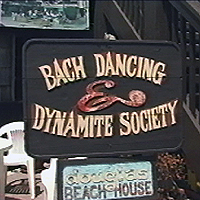
Founded by Pete Douglas in 1964, the Bach Dancing and Dynamite Society is a non-profit organization presenting live concerts of principally jazz, classical and world music. All performances are held at the Douglas Beach House on Miramar Beach, Half Moon Bay on Friday and Saturday nights in addition to Sunday afternoons. To attend, please note that reservations are only taken for current Bach members, but some seating is almost always available at the door.
Spark features Deborah Slater in her element working in collaboration on “Hotel of Memory – More Furniture Dances” with multi-disciplinary performing artists who are known for their dancing, singing, and trapeze work. This piece was inspired by Erik Satie’s “furniture music,” which was meant to be nothing more than ambient sound.
Slater’s dancers perform on and around a living room set. The furniture becomes an integral part of an evening-length narrative that deals with loss and memory. When the furniture disappears, what was once taken for granted leaves a physical and emotional gap in the lives of Slater’s unsuspecting characters. With an eye on the bigger social issue of decreasing government subsidies for the arts, Slater’s “Hotel of Memory” comments on the possibility of life without art.
Kunst-Stoff is an experimental dance company that plays with boundary-breaking ways of creating dance. Spark spends time with this innovative company as it creates and prepares for the world premiere of “As We Close Their Eyes.” This multidisciplinary work was commissioned by San Francisco’s Yerba Buena Center for the Arts as part of its Bay Area Now 4 performance series.
Kunst-Stoff was founded by Yannis Adoniou and Tomi Paasonen. Both classically trained and former dancers with LINES Ballet, they formed the Kunst-Stoff company to explore the intersection of dance with other art forms. Their goal was to explore a range of subject matter in ways that conventional dance had not. The name Kunst-Stoff is a play on words based on the German word “kunststof” meaning “synthetic material.” When the word is separated, “kunst” translates to “art” and “stoff” to “things.”
In 2005, Adoniou read an article on a museum designed for the blind, which inspired him to explore how the experience of sightlessness could translate into movement. Through LightHouse for the Blind, he met Khoja Aniksa, who has been visually impaired since birth. In a rehearsal, Aniksa shared with the group his unique awareness of space and how he perceived and interpreted the dancers’ movements. This experimentation formed the basis of “As We Close Their Eyes,” which uses sound and touch to emphasize sensory information other than visual.
In addition to the two principal choreographers, Adoniou and Paasonen, the Kunst-Stoff troupe consists of eight dancers. Since its inception in 1998, the group has premiered more than 20 new works in the Bay Area, toured internationally, and collaborated with visual and media artists and composers. Kunst-Stoff has performed commissioned pieces for the Berlin Tanztage Festival, the Burning Man Festival, the Dimitria International Festival in Greece, and the 2005 Scuba National Touring Network.
The San Francisco Ethnic Dance Festival is one of the largest cultural dance festivals in the United States. Presented by San Francisco’s World Arts West, this festival attracts more than 9,000 visitors annually and provides ethnic dance companies the opportunity to share their cultural forms of expression as well as their artistic skills.
Every January, nearly 100 dance groups audition for the festival. Each group has 10 minutes to perform, and hopefully, impress the panelists enough to be one of the 30 groups selected to perform in the festival in June. Spark closely follows two groups — Ensambles Ballet Folklorico de San Francisco and the Northern California Korean Dance Association — as they prepare and audition for the 28th annual festival.
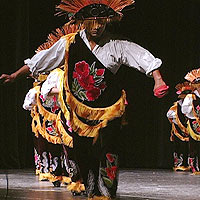
Ensambles Ballet Folklorico has been performing traditional Mexican folk dance since 1992. The 22-member ensemble performs on a volunteer basis. For the 2006 festival, they are preparing a traditional Catholic dance from the Veracruz region of Mexico. The choreography involves precise footwork and complex patterns on stage.
The Northern California Korean Dance Association is led by dancer and choreographer Hearan Chung, the group’s founder. Chung, who is well known in her native country, has performed in the festival before, but as a soloist, never as part of an ensemble. For the 2006 festival auditions, she choreographed an ensemble piece that was inspired by a shamanistic ritual.
The auditions are open to artists residing in Northern California or individual guest artists performing with a local group. The festival’s panel of dance teachers, performers and ethnologists select their top 20 choices from the four days of auditions. The panel considers the dynamics of the pieces, the balance of cultures represented and how well each performance represents the integrity of the dance form. The chosen groups have three months to fine-tune their performances before they get their chance to take the stage in the festival finals.
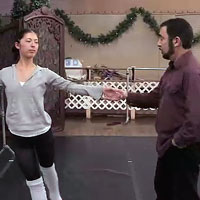
As the host for the Dancer/Musician Improv Extravaganza at the Margaret Jenkins Dance Lab in San Francisco, Kara Davis creates an atmosphere where dancers and musicians can share their talents with each other and the audience. A dancer is paired with a musician — based on names chosen from a hat — to create a three-minute improvisational performance. There are no rules and no mistakes, only a chance to explore creativity with the combination of spontaneous sound and movement.
Davis is a classically trained ballet dancer who now focuses on modern and contemporary dance with Kunst-Stoff. She has taught at Berkeley Ballet and received an Isadora Duncan Award for outstanding achievement in individual performance for her entire 2002 and 2003 season performing with Margaret Jenkins Dance Company, Janice Garrett & Dancers and Kunst-Stoff.
Spark visited Davis at the Dance Lab to see the outcome of her experiment. As expected, unusual but interesting teams such as drummer/ballet dancer were formed. For more information on the Dancer/Musician Improv Extravaganza, which usually occurs the last Sunday of the month, check the Kunst-Stoff’s Web site under “Special Events.”
View Spark segment on Anna Halprin. Original air date: May 2006. (Running Time: 11:04)
View Spark Web extra with an excerpt from Anna Halprin’s “Intensive Care” (Running Time: 3:55)
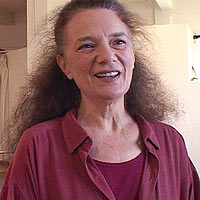
Dance legend Anna Halprin, now in her eighties, has spent more than 50 years challenging the conventions of modern dance. A visionary in the field, she continues to teach, choreograph and perform. In January 2006, she brought a group of dancers to the Jewish Community Center of San Francisco to perform some of her work, including the two well-known pieces “Parades and Changes” and “Intensive Care.” Spark follows Halprin as she prepares for the performances and talks about her lifetime as artist, teacher, health advocate and innovator.
Halprin teaches dance to people of all ages, helping them to build awareness of their bodies. She explores how the mind informs the body and how the body can inform the mind. Through one’s own creative process, Halprin believes, each of us will find a path of personal discovery through movement.
When it first premiered in New York City in 1965, “Parades and Changes” provoked significant scandal because the dancers fully disrobe and redress, three different times. Halprin says the piece is about “the process of undressing, finding your place in space.” Halprin created this piece like she creates most of her dances, using a special set of instructions called a score, much like a musical score that provides instruction for the dancers on what to do, but that allows them to decide how they do it.
Forty years after its premier, “Parades and Changes” is still an audience favorite, and Halprin continues to refine it, keeping it elastic and keeping audiences connected. This ongoing dynamism is just one expression of Halprin’s commitment to continually challenge ideas about what dance should be.
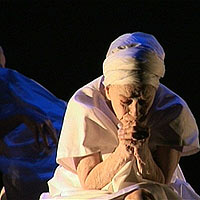
In 2000, Halprin debuted “Intensive Care,” a piece that explores the themes of pain, love, healing and death. “It is not an easy performance to watch,” she notes. Halprin originated the dance while her husband was in intensive care for a month. Over time, the piece has become connected to different ideas. For Halprin, this dance is now connected to the war in Iraq, the suffering in the world and other news items she has read. Halprin says that today, the dance is “dedicated to the suffering and fear and the disasters in the world.”
Halprin also continues to challenge traditional notions about who can dance. In 2005, she began working with seniors in Marin County to create a dance together. She found an island in a lagoon at the Civic Center in San Rafael that would be the site of the dance, and she asked the community for donations, receiving 69 rocking chairs for the dancers to use. She and the seniors then developed a score and created their dance. “I never saw such soulful dancing in my life,” Halprin says.
Born in Winnetka, Illinois, Halprin discovered dance as a child, and as a teenager she studied with Josephine Schwarz, who had been a dancer with Doris Humphrey and Charles Weidman. At the University of Wisconsin, Madison, Halprin became a protégée of Margaret H’Doubler. Following World War II, Halprin moved to San Francisco with her husband, landscape architect Lawrence Halprin. There she extended H’Doubler’s approach to movement discovery into improvisation.
Halprin co-founded the Tamalpa Institute in Marin County, an institute that offers training in the Halprin Process, a movement-based healing arts practice. Halprin has received many awards and honors over the years, including fellowships for choreography from the National Endowment for the Arts, a Guggenheim Fellowship, the American Dance Guild Award, the Balasaraswati Award from the American Dance Festival, the prestigious Dance Magazine Award and the Samuel H. Scripps/American Dance Festival Award. Halprin has also been documented in the Bay Area’s Legacy Oral History Project at the San Francisco’s Performing Arts Library & Museum (PALM).
Since 1995, music teacher and performer Sherlyn Chew has been bringing young people together to learn and play traditional Chinese music. Spark gets to know Chew and her Great Wall Youth Orchestra as they perform at the San Francisco Performing Arts Museum and Library and at Oakland’s Allen Temple Baptist Church.
The Great Wall Youth Orchestra plays Chinese musical instruments and performs a variety of music. One of their specialties is Chinese opera, an art form that combines storytelling, acting, singing, dancing and martial arts and dates as far back as the 12th century. Many of the students are recent immigrants or first-generation Americans, and the orchestra offers a special connection between their origins and heritage and their life in the United States.
For Tyler Thompson, however, the orchestra provides something different. An African American and star singer in the orchestra, Thompson has gained an international reputation for his performances with Great Wall Youth. Though he cannot speak the language, Thompson can sing perfect Mandarin Chinese opera, and he became an international symbol of cross-cultural exchange when Great Wall Youth’s 2005 performance for Chinese New Year was televised in China.
During rehearsals, Chew teaches the orchestra to play a range of styles from throughout the world, including African and European music as well as American ragtime. For Chew, it is about preserving traditions as well as promoting exchange between cultures. Spark was there for Great Wall Youth’s Allen Temple Baptist Church performance, which brought traditional Chinese music to a whole new audience.
Great Wall Youth Orchestra is one of the programs offered by the Purple Silk Music Education Foundation. Founded by Sherlyn Chew, the foundation’s purpose is to teach Chinese music to K-12 students in Oakland. The foundation’s other programs include the Purple Bamboo Orchestra and the Purple Bamboo Chorus.
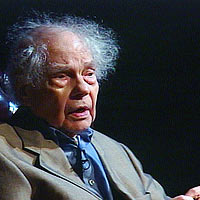
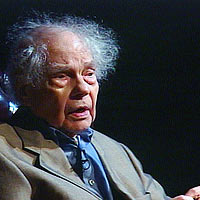
Editor’s note: Merce Cunningham passed away on July 26, 2009.
One of the 20th century’s most original dance-makers, Merce Cunningham has influenced a generation of choreographers with his abstract and complex methods of movement analysis and cerebral yet aesthetic creations. In fact, Cunningham’s love of intellectual engagement and his academic background make his company a natural favorite at colleges and universities. Spark follows the Merce Cunningham Dance Company to Stanford University as he and his dancers take on “Encounter: Merce.”
“Encounter: Merce” was an unusual campuswide interdisciplinary project that took place in March 2005. The event put Cunningham’s decades-long career in context, with exhibits, films, workshops and panel discussions presented not only by the dance division and arts presenter Stanford Lively Arts, but also by the music and visual arts departments and the Stanford School of Medicine.
During the early 1940s, Cunningham performed with the legendary Martha Graham, originating roles in works like “Appalachian Spring” and “El Penitente.” Though he was heavily influenced by the Graham technique of dancing, Cunningham’s own choreography broke away from her mythological, story-based ballets and moved toward a more conceptual approach to dance. By 1953, when his own small troupe of dancers made its formal debut as the Merce Cunningham Dance Company at North Carolina’s progressive Black Mountain College, Cunningham was already crafting works that pioneered new ways of thinking about the mechanics of movement.
Like Cunningham himself, his dancers are often ballet-trained, but their extraordinary physical awareness allows them to tune in to movement with an analytical sensitivity. Cunningham’s love of technology has also led him to experiment with an imaging software program called DanceForms, which he used to create many of his works, but which also allows for an anatomical study of the possible motion of the body.
Over the years, Cunningham has collaborated with a wide range of artists, from Robert Rauschenberg to Radiohead, although he has had no more famous association than with composer John Cage, whom he first met in the early 1940s. With Cage, Cunningham experimented boldly with techniques of dance construction in which the structure relies upon chance procedures, or aleatorics. In his 2003 “Split Sides,” for example, the specific combination of music, set design and even choreographic sequence is determined by a roll of the dice at the start of the show. For Cunningham, these chance encounters of music, dance and art impart a serendipity to his pieces, in his words, allowing “distinct elements to come together to make something that was not possible otherwise.”
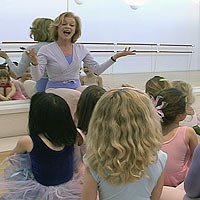
Since 1970, countless generations of youngsters have donned tights and slippers for a weekly ballet class with San Francisco institution Miss Tilly. Teaching preschoolers about dance, however, is much more than pliés and tendus for Tilly Abbe, whose 350 students range from 3 to 7 years old — it’s about giving them skills that will last a lifetime.
Spark visits this veteran teacher at her California Street studios, where she and her daughter Iliza Abbe offer a range of classes in dance, theater, hip hop and yoga, all designed to infuse a love of movement and the arts in their preschool-aged students. Early childhood is a critical time for physical and emotional development, Abbe argues, and she specializes in working with kids at an age when they are not only forming their reflexes and fine motor control skills, but also honing social skills that they’ll need throughout their lives. Indeed, given recent studies that have shown physical fitness is closely tied to a child’s academic abilities and so many parents recognizing the importance of early exposure to the arts, Abbe’s classes are always enormously popular.
A former San Francisco Ballet dancer, who began studying ballet at the age of 11, Abbe discovered early on that she was a born pedagogue with a special love for young children. The daughter of famed war photographer James Abbe, Miss Tilly credits her mother with instilling a passion for teaching. It’s a talent that she has, in turn, passed on to Iliza, who developed a curriculum in theater arts for children when the school moved into its current studios.
Some of their students may go on to dance or perform professionally, but that’s not the point for this mother-daughter team. They hope that all of their students will take with them not only the self-confidence that dance and performance can offer, but also a healthy respect for art and for the abilities of their own bodies. Abbe Studio offers ballet, theater arts (drama and singing) and hip hop classes for young boys and girls.
Abbe Studio Where: 5499 California St., San Francisco Phone: (415) 923-9965
Editor’s note: Heather MacAllister passed away on February 13, 2007.
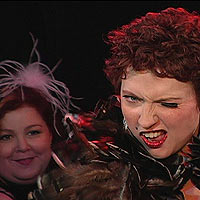
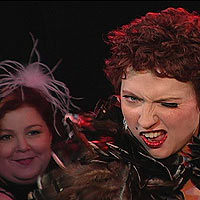
San Francisco’s Fat-Bottom Revue is making it big in the burlesque business — real big. Composed solely of plus-size dancers, the company is the country’s only regularly performing group of its kind. In the episode “Forbidden Territory,” Spark checks out the show and gets an eyeful of all the sexy, hip-grinding, high-kicking action.
Fat-Bottom Revue is the touring company of Big Burlesque, a performance collective of self-described “fat artists and activists.” The show is a spirited revival of the tradition of burlesque performance, a racy style of singing and dancing that saw its zenith in the 1920s. With the proliferation of the modern strip club in the late 1960s, burlesque came to be regarded as tame and old-fashioned and soon died out. In recent years, however, burlesque has enjoyed a resurgence, with a number of clubs opening in metropolitan centers across the country.
Founded by Heather MacAllister (aka RevaLucian), who was a size-acceptance artist and activist dedicated to redefining the contemporary notion of beauty, Big Burlesque challenges Western standards of female beauty including a thin body that is often unattainable, unrealistic and potentially unhealthy for many women. By providing a burlesque act that features only larger-sized women, Fat-Bottom Revue is seeking to widen the current standards of beauty.
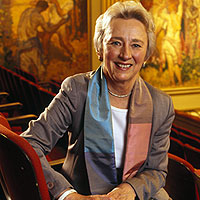
For years, Ruth Felt has worked hard to bring internationally acclaimed classical music and modern dance talent to the Bay Area. As presenter for San Francisco Performances, Felt has helped to turn San Francisco into a destination for some of the world’s most gifted performers. Spark checks in on Felt as she puts together one of her most ambitious shows yet — a gala all-star event for her organization’s 25th anniversary.
Since Felt founded SF Performances in 1980, she has brought more than a thousand artists from around the world to San Francisco stages. Over the years she has introduced Bay Area audiences to world-renowned performers, including cellist Yo-Yo Ma, violinist Anne-Sophie Mutter, pianist András Schiff and violinist Gidon Kremer, as well as the Paul Taylor Dance Company, Ballet Preljocaj from France and Sweden’s Cullberg Ballet. Presenting talent such as this is grueling work, involving every imaginable aspect of production, from coordinating dates to booking venues to managing finances to handling all last-minute, unexpected ordeals.
The overwhelming success that SF Performances has enjoyed over the last quarter-century was far from a sure thing. When Felt started out, friends and critics alike suggested that a rough road lay ahead. SF Performances was faced with multiple challenges, including a dwindling audience for classical music and the lack of a permanent venue. Nonetheless, Felt believed that she had something new to offer by combining the world’s best chamber music ensembles and modern dance with the most promising emerging talents.
Over the years, Felt has hedged her bets by initiating a number of audience development programs designed to bring in new audiences and keep them coming back. The most impressive of these has been her work in placing artists in San Francisco public schools. Each year, SF Performances books as many as 50 performers in schools and sponsors extended residences to musicians so that they can work with students for an entire school year. It is a way of giving back to the community that is also an investment in SF Performances’ future. In a time of waning arts education in the public schools, Felt’s efforts ensure a new generation of audiences and performers.
For more than 30 years, choreographer Margaret Jenkins has been expanding the physical and conceptual boundaries of modern dance in the Bay Area. Her dance company has spawned an entire generation of experimental dancers and artists. In the episode, “Dance Masters,” Spark follows Jenkins from rehearsing “Danger Orange” in San Francisco to conducting workshops on composition and sharing choreographic ideas with the Beijing Modern Dance Company in China.
“Danger Orange,” a 45-minute outdoor site-specific performance in San Francisco’s Justin Herman Plaza, was performed in October 2004 before the presidential elections. Collaborating with renowned visual designer Alex Nichols, sound designer Jay Cloidt, and poet and writer Michael Palmer, Jenkins wanted “Danger Orange” to address the times we are living in. The color orange metaphorically references the national alert systems and evokes danger.
A native of San Francisco, Jenkins began her dance training with Judy and Lenore Job, Welland Lathrop, and Gloria Unti. She continued her studies in New York City at the Juilliard School of Music with José Limón and Martha Graham. After training at UCLA, she returned to New York to dance with a number of modern dance companies, including those of Gus Solomons, Viola Farber, Twyla Tharp and Sara Rudner. She was on the faculty of the Merce Cunningham Studio for 12 years.
In 1970, Jenkins returned to San Francisco, where she opened a school to train professional modern dancers and formed the Margaret Jenkins Dance Company in 1973. In 2004, Jenkins and her company began Choreographers in Mentorship Exchange (CHIME), a program to foster creative interaction and long-term relationships between emerging and established choreographers. Jenkins is the recipient of a Guggenheim Fellowship, an Irvine Fellowship in Dance, the San Francisco Arts Commission Award of Honor and two Isadora Duncan Dance Awards. For her contributions to the San Francisco Bay Area arts community, she was awarded the Bernard Osher Cultural Award in 2002.