California power plants and refineries will likely have an extra year to comply with the state’s proposed cap & trade program, according to Mary Nichols, head of the California Air Resources Board.
In testimony to the Senate Select Committee on the Environment, the Economy, and Climate Change on Wednesday, Nichols said that the program would still begin in 2012 as planned, but that polluters would not be held accountable during that year. The extra slack would give participants and regulators time to “test” the program, she said. Continue reading CA Cap and Trade Compliance Delayed→
Caroline Farrell of the Center on Race, Poverty and the Environment, one of organizations involved in the suit, said she was disappointed by the decision, handed down late Friday. Continue reading California Moves Ahead With Cap and Trade→
Compared to most of the world, California would appear to have a head start in planning for a changing climate.
Cities across the world are not doing enough to protect citizens from the likely impacts. That’s the finding of a new analysis from the National Center for Atmospheric Research (NCAR) in Boulder, CO. The report says cities are unprepared for rising seas, intensified heat waves, while failing to curb their own greenhouse gas emissions. Continue reading Report: Cities Fiddle While World Warms→
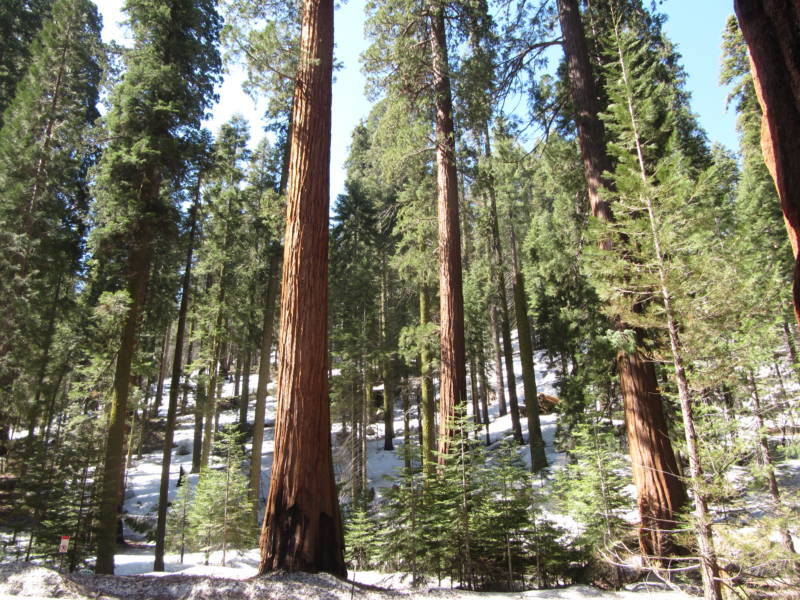
The forests in the state provide water, habitat for animals, lumber and tourism dollars, and they sequester carbon. (Photo: Molly Samuel)
For decades the federal government has touted the nearly 200 million acres of national forests and grasslands under its control as a “land of many uses.” But one “use” that’s seldom discussed is as a huge repository for carbon.
But clearly it’s on the minds of officials and scientists as the Forest Service seeks comments on its proposed new planning rule. National Forests and Grasslands are managed individually, but the planning rule guides how those management plans are developed. This new one is replacing a Planning Rule from 1982. Continue reading California’s Giant Carbon Sponge→
As if drought and wildfires weren’t enough, California’s coniferous forests face another climate-related threat
(Photo: Reed Galin/Lone Tree Productions)
In the last decade, tiny forest-dwelling beetles have wiped out pine trees on millions of acres in the Canadian and American West, including Southern California. The rest of the state has been largely spared, but forest ecologists say that’s likely to change.
This post was originated by our content partners atCalifornia Watch.
Report says driving needs to be more costly to get us out of our cars
By Marie C. Baca
Drivers now pay $6 to cross the San Francisco Bay Bridge during peak traffic hours. "Peak pricing" is one strategy to push commuters to alternative transit. (Photo: Craig Miller)
California faces significant obstacles in complying with a 2008 state law aimed at reducing passenger vehicle usage, according to a report by the nonpartisan Public Policy Institute of California.
The report points to unrealized rail transit investments and resistance to pricing tools like fuel taxes as factors that have slowed reduction in car usage.
The two-year-old SB 375 mandates that California’s major metropolitan areas reduce per capita emissions from driving by 7 percent by 2020 and by 15 percent in 2035. While the primary focus of the bill is a reduction in the greenhouse gases that contribute to global warming, the legislation places a special emphasis on addressing traffic and public health concerns by reducing the number of miles residents drive. Continue reading State Struggling to Reduce Vehicle Emissions→
A high-ranking California official appeared on Capitol Hill today to defend the right of the federal Environmental Protection Agency to regulate greenhouse gas emissions.
James Goldstene, executive director of the state’s Air Resources Board, told members of a House subcommittee that the EPA’s recently released regulations will not create a “regulatory train wreck.”
Goldstene held up a planned power plant in Northern California to advance his case, saying that the Russell City Energy Plant will stand as an example of how power companies can use the “best available technology” for reducing emissions, as required under a recently issued EPA rule. The plant, to be built on the Hayward shore of San Francisco Bay, is a 600-megawatt plant to be fired by natural gas.
Goldstene’s appearance before the Subcommittee on Energy and Power (part of the Energy & Commerce Committee) was to counter Republican efforts to pull EPA’s authority to regulate greenhouse gas emissions, contained in a bill known as the Energy Tax Prevention Act. Goldstene said passage of the bill into law would “send a stark message…that the U-S isn’t serious about being a leader in the future economy.” It would also upstage a ruling by the US Supreme Court affirming the EPA’s authority to regulate carbon emissions under the Clean Air Act.
Greenpeace gives Facebook a deadline to clean up its act…on Facebook.
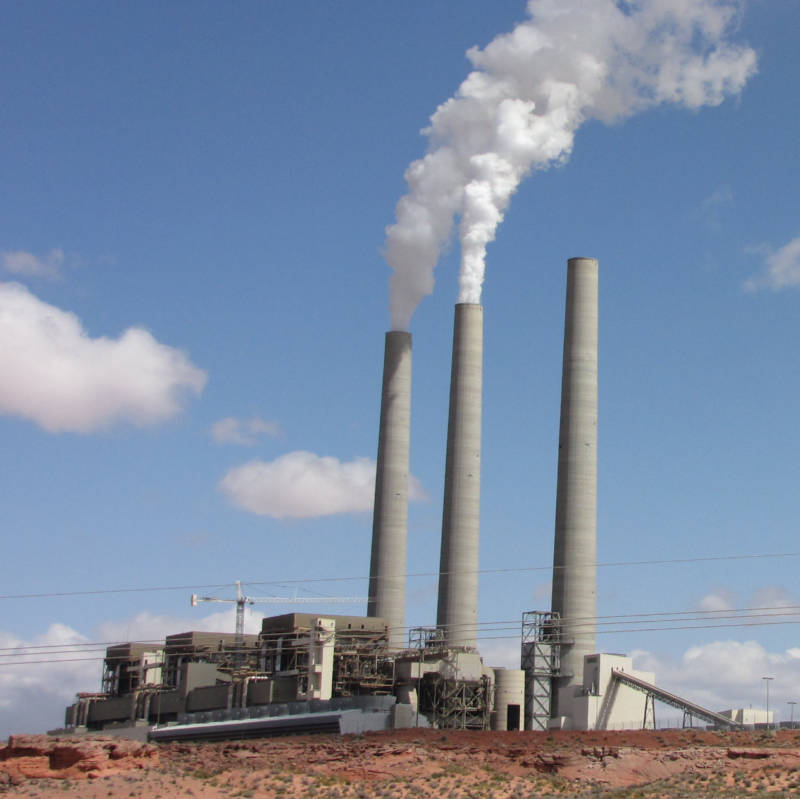
Navajo Generating Station, a coal plant, located near Lake Powell in AZ (Photo: Gretchen Weber)
With its stepped-up “Facebook: Unfriend Coal” campaign, Greenpeace is calling on the Palo Alto-based company to become coal-free by 2021, to be transparent about its carbon footprint, and to advocate for clean energy sources at all levels of government. And it wants a public commitment by April, 22: Earth Day.
“We’re saying, ‘Look, you’re being looked at as a leader in the technology space, and the corporate space, and to be using 19th century technology to power your 21st century company doesn’t make sense,” said Casey Harrell of Greenpeace.
Environmental Justice groups say they support California’s climate law. So why did they sue?
Environmentalists may seem the most unlikely of sources stalling the state’s landmark climate change law. But the case brought by a group of environmental justice advocates is bringing up issues that have been largely overlooked in the zeal of carrying forward AB 32.
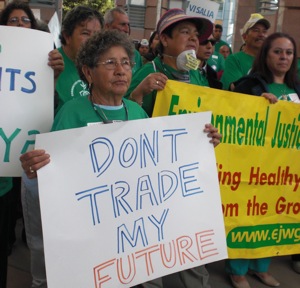
(Photo: Center on Race, Poverty & the Environment)
This means that a California power plant can increase CO2 emissions if it buys allowances from another industry that’s reducing emissions, or offsets from, say, a tree farm in Canada.
“The evidence out there is that cap-and-trade is going to fail these communities and will continue to allow polluters to dump on them, and that’s unacceptable and it’s also illegal,” said Alegria De La Cruz, legal director at the Center on Race, Poverty & the Environment in San Francisco. The Center is a plaintiff in a lawsuit filed by several organizations over the implementation plan for AB 32. Parties in that case are awaiting finalization of a state court ruling that could hold up the scheduled launch of California’s cap & trade plan. Continue reading Why EJ Groups are Leery of Cap & Trade→
I-80 near the Oakland interchange known as "the Maze." (Photo: Craig Miller)
In a strongly-worded letter [PDF] to the CEOs of seven major auto manufacturers, California Air Resources Board chair Mary Nichols defended California’s efforts to curb greenhouse gas emissions from cars and trucks and accused the trade group, the Alliance of Automobile Manufacturers, of misrepresenting California’s cooperation with federal agencies in letters to Congress.
“For the Alliance to suggest we are no longer committed to a cooperative effort is disingenuous at best, and incorrect,” wrote the Air Board chairman.
Nichols called on the executives to “distance” their companies “from future efforts by the Alliance to undermine the achievement of our mutual goals to set standards that will provide American consumers with cleaner and more efficient vehicles.”
The letter comes just as California and federal agencies announced a shared deadline for their collaboration to set national fuel economy and greenhouse gas standards for model year 2017-2025 cars and trucks.
Margot Roosevelt of the Los Angeles Times has more, including a response from an Alliance vice president who reportedly would not address the Nichols letter directly, but did express support for the shared fuel standards deadline.