Wave Gliders are collecting data as they travel across the Pacific
"Wave Gliders" use wave energy to move and solar energy to power their scientific instruments.
Four ocean-going robots called Wave Gliders have made their way from San Francisco to the Big Island of Hawai’i, setting a Guinness world record for distance traveled by an unmanned, wave-powered vehicle. They’re not just long-distance voyagers though, they’re also collecting data on ocean conditions and the weather.
Wave Gliders, created by Sunnyvale-based Liquid Robotics, are about the size and shape of surfboards, but they do more than catch waves. They’re attached to a cable and a set of fins below the surface of the water, which capture wave energy and move the vehicle forward, and they’re equipped with solar panels and scientific instruments. They collect data and send it back via satellite, saving the time and money that go into manned research expeditions.
According to NOAA, 47 of 48 states experienced above-average temperatures in the period between December and February, with the greatest increases seen in the Northeast and Midwest.
After a fire at a California state park, volunteers used satellite imagery to study the recovery
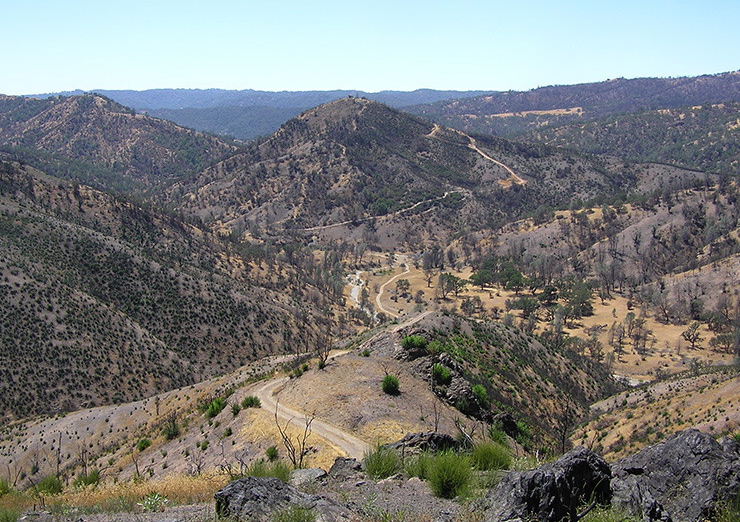
Henry Coe Park in Santa Clara County is big: 87,000 acres of former ranch land, dotted with oak trees, meadows that burst with wildflowers each spring, and vast stretches of chaparral. Given that Coe is nestled near Silicon Valley, it makes sense that the retirees who volunteer here bring a certain technical bent to their appreciation of the place.
Case in point: the Lick Fire of September 2007 (Craig Miller reported on it for The California Report). Named the Lick Fire after it was first spotted from the nearby Lick Observatory, the wildfire burned 47,760 acres in the Mt. Hamilton Range by the time it was contained, eight days later.
Since then, citizen scientists who volunteer for the park have been paying close attention to see how the burned land bounces back. In particular: Bob Patrie, a former project manager in Silicon Valley, and Winslow Briggs, Director Emeritus at Carnegie Institution of Washington’s Department of Plant Biology. Together, they’ve pored over satellite imagery to document the impact of the fire on various plant communities in Coe Park.
La Niña is weakening, but don’t hold your breath for a “March miracle”
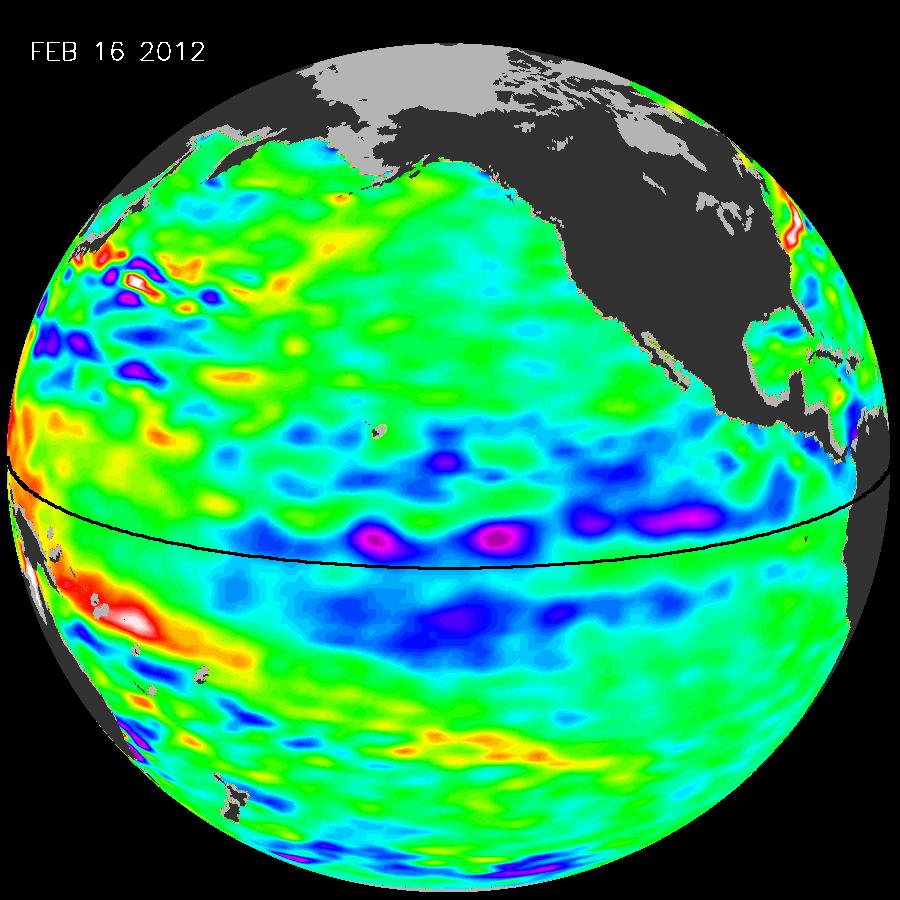
This image shows La Niña conditions from last month, collected by NASA's Jason-2 satellite.
This has been a historically dry winter, dry enough that it’s likely to land a spot as one of the top ten driest since the Gold Rush. And even though La Niña is waning, that probably won’t make much of a difference, because there’s a delay between when ocean surface temperatures change, and when that change actually has an effect on our weather.
“March 20 is just around the corner, and that’s the first day of spring. Our winter — our snowpack and our rain — is essentially over,” NASA Jet Propulsion Laboratory climatologist Bill Patzert told me. Though Patzert’s observation comes as three Pacific storms are poised to potentially bring a week of rain to Northern California, he said, “a weakening La Niña won’t necessarily give us a March miracle in terms of snowpack and rainfall.”
La Niña is caused by colder-than-average ocean surface temperatures in the equatorial Pacific. It typically makes for warm, dry winters in California. But not always. Last year was also affected by La Niña, and it was historically wet.
Beleaguered climate scientist emerges but stays mum on Heartland
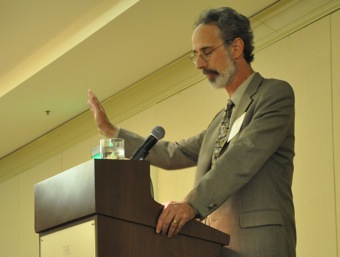
Pacific Institute founder Peter Gleick steered clear of his current controversy in his remarks at a water policy conference in L.A.
Nearly three weeks after admitting that he had faked his identity to obtain documents from a conservative think-tank, noted California scientist and president of the Pacific Institute, Peter Gleick, returned to the public arena.
Gleick spoke at the annual California Water Policy Conference in Los Angeles and was warmly received by a crowd of roughly 300 California scientists, regulators and advocates.
Notably missing from Gleick’s talk — which focused on a wide range of global and regional water issues central to the Pacific Institute’s core mission — was any specific mention of last month’s confession that he had impersonated of a board member of the Chicago-based, libertarian Heartland Institute to obtain internal documents outlining the group’s anti-climate change campaign. Continue reading Pacific Institute’s Peter Gleick Breaks Silence→
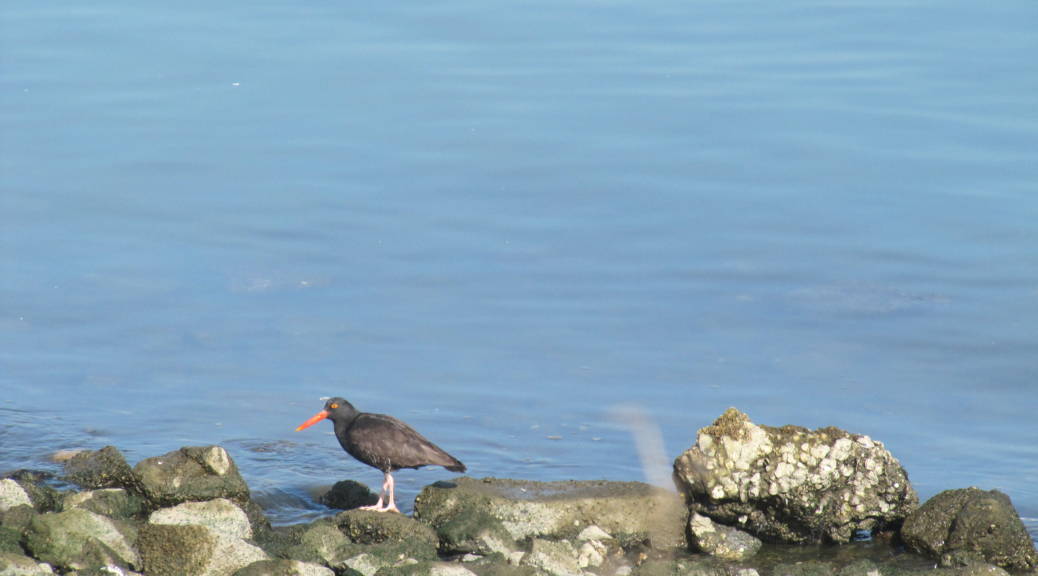
San Francisco Bay is home to the majority of the most vulnerable birds. “That’s primarily because of sea level rise and also because there are already so many imperiled species that use that habitat in the bay,” says Tom Gardali, an ecologist is PRBO Conservation Science.
University of Southern California and 17 others surveyed 300 million years of ocean life
Increasing ocean acidity can also affect nutrients like nitrogen.
The breadth of this study – 18 research institutions and 21 scientists worldwide — and the examination of hundreds of studies stretching so far back into the geologic record makes this conclusion a singularly solid statement about the present trend.
“From everything we know today, it looks like the current rate of carbon dioxide (CO2) emissions” may spell the loss of “organisms we care about — coral reefs, oysters, salmon,” says Bärbel Hönisch, the study’s lead author, who I reached by phone in New York. She’s a paleo-oceanographer at Columbia University’s Lamont-Doherty Earth Observatory. The paper’s being published today in the journal Science.
The danger comes from what happens when CO2 is absorbed by the oceans: CO2 and water create carbonic acid, the stuff that makes soft drinks bubbly. It also makes the oceans more acidic. That acid can dissolve the shells of “keystone” species that are the building blocks for marine life. The world’s oceans are already twice as acidic – a pH drop from 8.2 to 8.1 — as they were at the start of the Industrial Revolution. That’s an acidification rate 10 times faster than anything found in the record over the past 300 million years, according to this new survey.
For her part in the study, USC doctoral candidate Rowan Martindale was looking at the juncture between the Triassic and Jurassic eras, 200 million years ago. It was a cataclysmic time when the earth’s continents were splitting apart, huge strings of volcanoes were erupting, atmospheric CO2 was at one of the highest levels ever and — you guessed it — hardly any evidence of limestone or coral, two things that dissolve in acidic water. It marked one of the five biggest extinction events in the planet’s history. Atmospheric carbon was increasing at the rate of one gigaton – about 2.2 trillion pounds — per year.
[module align=”left” width=”half” type=”pull-quote”]“The modern ocean chemistry is changing, and nobody really knows exactly what’s going happen.”[/module]
Today, atmospheric carbon is increasing at the rate of eight gigatonnes per year — about 17.6 trillion pounds. ‘Something weird was going on in the ocean back then,” Martindale says. “The modern ocean chemistry is changing, and nobody really knows exactly what’s going happen.”
Hönisch says the team cited hundreds of studies — the journal had to put a limit on their end list of 218 items — and looked at many more over the past year-and-a-half. “The strength is that when we compare these different events [in the geologic record], we can see the similarities. We can also see where we need more information.”
Both Honisch and Martindale will tell you the paleo record has its gaps and intriguing questions for further study — exactly how atmospheric warming interacts with ocean acidity, and key ocean sediments they’d love to sample that have disappeared back below the sea floor, for example — but their conclusion is clear: the world’s oceans are acidifying at a rate that has never been seen before.
“Maybe things are not as bad as we think, but we don’t know, says Hönisch. “[And] by the time we do, it may be too late to turn around.”
More people think the climate is changing, and many say the weather convinced them
People cited their experience of warmer temperatures as a major influence in their views of climate change.
Most Americans now say that the climate is changing, according to the National Survey of American Public Opinion on Climate Change (PDF). Nearly two out of three people (62%) answered “yes” to the question, “Is there solid evidence that the average temperature on Earth has been getting warmer over the past four decades?” The primary reasons they gave for that answer? About one in four said it’s because they’ve observed warmer temperatures, and an identical 24% because they’ve observed weather changes — and the survey was taken last fall, before this year’s generally mild winter in the U.S. had entered the national chatter (we recall a recent tweet from NOAA saying that Midland, TX had logged more snowfall this winter than New York, Boston and Philadelphia combined). Continue reading Belief in Climate Change Depends on Which Way the Wind Blows→
Support from Pacific Institute’s board, funders may be wavering
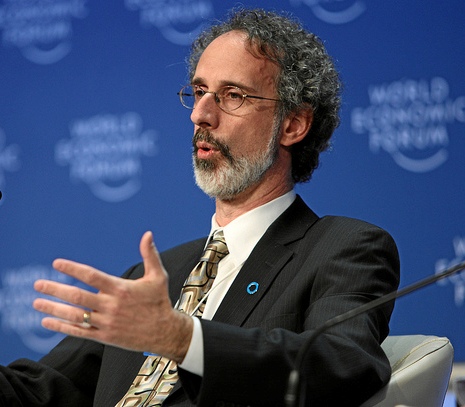
Peter Gleick is a prominent water scientist and a Macarthur Fellow.” credit=”World Economic Forum/Flickr
The furor surrounding Peter Gleick’s admission that he lied in order to get internal documents from the Heartland Institute appears to be gaining momentum, with the board and at least one major funder of Gleick’s Oakland-based Pacific Institute appearing to back-peddle on initial statements of support.
Gleick, who co-founded the Institute, wrote in a blog post earlier this week that he impersonated a Heartland insider to obtain the information, which includes strategy and fundraising details from the organization, a conservative think tank that’s against taking action on climate change.
Gleick has already stepped down from positions with the American Geophysical Union and the National Center for Science Education. Initially the Pacific Institute stood by him, saying in a brief statement posted to its website, Gleick “has been and continues to be an integral part of our team.” That statement is no longer there, replaced yesterday by one that takes a different tone:
The Board of Directors of the Pacific Institute is deeply concerned and is actively reviewing information about the recent events involving its president, Dr. Peter Gleick, and documents pertaining to the Heartland Institute. Neither the board nor the staff of the Pacific Institute knew of, played any role in, or condones these events. As facts emerge and are confirmed, the Board will inform all stakeholders of our findings and of any actions based on these findings.
He’s also stepped down from a position which he hadn’t yet officially begun with the National Center for Science Education, an organization that advocates for evolution and climate change education in schools. Gleick was scheduled to begin serving on its board this week, but tendered his resignation yesterday.