Category Archives: The Science

Latest research from the field and the lab

How Climate Change Makes Trees Sick

Warmer and wetter weather is good for tree diseases, which is bad news for trees
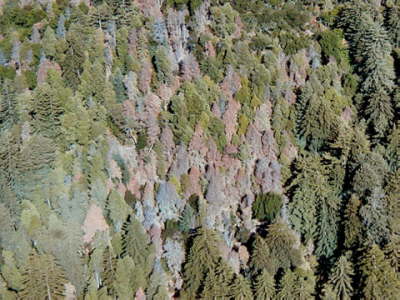
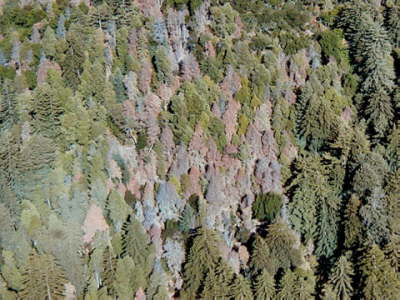
A patch of tanoak, killed by Sudden Oak Death, in the Los Padres National Forest in Monterey County.

Climate change is likely to wreak havoc on California’s forests. Extreme weather, wildfires and insect outbreaks will all take a toll. Add to those another looming threat: disease. Forest diseases like Sudden Oak Death, which has infected trees in 14 counties in the state, stand to benefit from the effects of climate change, to the detriment, obviously, of the trees.

Trees are big and long-lived. Tree pathogens, mostly fungi and bacteria, are the opposite. They’re mobile, able to blow around on the wind. And they reproduce and evolve rapidly. That’s the crux of the problem, according to Susan Frankel, a plant pathologist with the Forest Service.

“When you look at forest health and the balance between forest trees and the pathogens that attack them, it does seem, given climate change, pathogens get the better end of the deal,” she told me.
Continue reading How Climate Change Makes Trees Sick

Jean-Michel Cousteau on Oceans, Energy, and Our Collective Fate

Explorer keeps his father’s legacy alive by shining a light on the world’s oceans

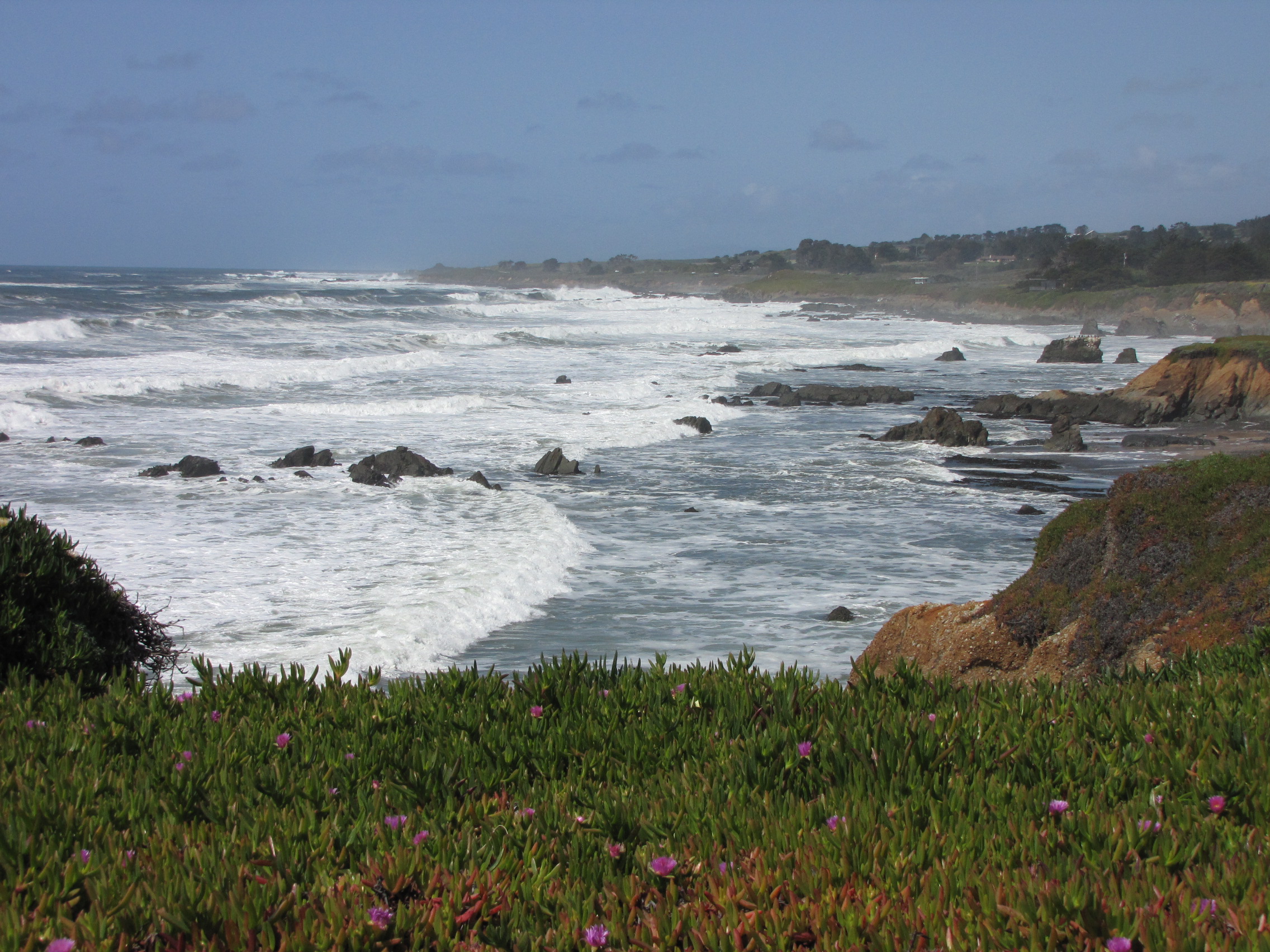
The California coast near Pigeon Point.

When ocean explorer and documentary filmmaker Jean-Michel Cousteau brought his environmental message to Silicon Valley, I caught up with him to discuss climate change; President Obama’s energy policy efforts; and AB 32, California’s response to climate change.

Jean-Michel Cousteau is the son of legendary ocean explorer, Jacques Cousteau, and chairman of Ocean Futures Society, a non-profit dedicated to exploring, protecting and educating people about the world’s oceans. He was vocal in condemning BP for its Gulf oil spill and has frequently highlighted the link between climate change and the state of our oceans and coastline. Continue reading Jean-Michel Cousteau on Oceans, Energy, and Our Collective Fate

Crazy Weather? You Might Be Able to Blame the Arctic

Arctic warming is altering weather patterns, study shows

By Andrew Freedman

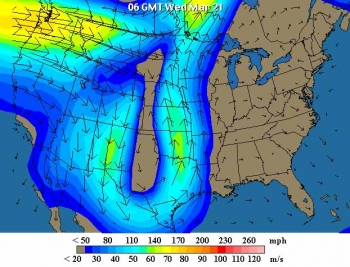
Path of the jet stream on March 21, 2012.

By showing that Arctic climate change is no longer just a problem for the polar bear, a new study may finally dispel the view that what happens in the Arctic, stays in the Arctic.

The study, by Jennifer Francis of Rutgers University and Stephen Vavrus of the University of Wisconsin-Madison, ties rapid Arctic climate change to high-impact, extreme weather events in the U.S. and Europe.

The study shows that by changing the temperature balance between the Arctic and mid-latitudes, rapid Arctic warming is altering the course of the jet stream, which steers weather systems from west to east around the hemisphere. The Arctic has been warming about twice as fast as the rest of the Northern Hemisphere, due to a combination of human emissions of greenhouse gases and unique feedbacks built into the Arctic climate system.

Continue reading Crazy Weather? You Might Be Able to Blame the Arctic

Citizen Science Project Blooms With Early Spring

Contributions to Nature’s Notebook have surged since spring has sprung

Tracking of when flowers bloom--and how the date changes over time--can help provide insight into how they're affected by weather and climate change.

The participative science project known as Nature’s Notebook is closing in on its one-millionth observation. The crowd-sourced program collects data from across the country on the timing of natural events like plants flowering, leaves growing and eggs hatching. The study of those seasonal life stages, called phenology, gives scientists insight into how they’re connected to each other, and how they’re affected by climate and weather.

Jake Weltzin, the executive director of the USA National Phenology Network (USA-NPN), which manages Nature’s Notebook, said he thinks that spring arriving ahead of schedule across much of the country has sparked people’s interest.

Continue reading Citizen Science Project Blooms With Early Spring

Storms and Rising Seas Present New Threats to Unstable SoCal Peninsula

The geologic features of the Palos Verdes Peninsula make it a hotspot for landslides

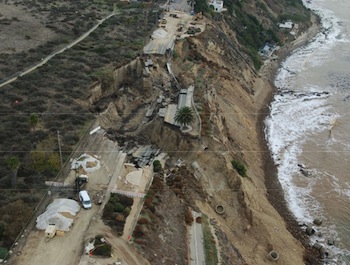
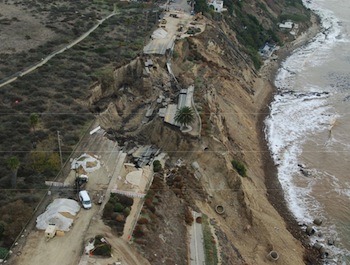
November's sea cliff failure took out 600+ feet of roadway and sidewalks.

The latest Palos Verdes Peninsula slide may calve, and the main slide mass is likely to keep “moving oceanward.” That’s according to a preliminary draft of a geotechnical study commissioned by the City of Los Angeles in early winter, but that’s the extent of the news for now. The same report says based on the studies completed to date, the risk of landslide movement behind last November’s slide — landward into a nature preserve and beyond a new chain link fence — is low.

That’s just the latest from an area southwest of downtown L.A. that has been generating geological news for decades. According to a landslides map by the California Geological Survey, the PV Peninsula boasts 175 slides, 49 of them active.

Continue reading Storms and Rising Seas Present New Threats to Unstable SoCal Peninsula

At the Blunt End of the Hockey Stick: Q&A with Michael Mann

A reluctant combatant in the “Climate Wars” has learned to embrace the role

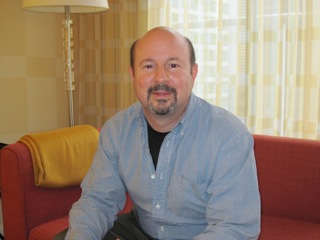
Michael Mann, the climate scientist, not the movie director.

Anti-intellectualism isn’t a new phenomenon in America. But the current war of words over climate science has taken on the tone of a religious war. Comments on this very blog often testify to that. As some scientists have discovered, the war has escalated beyond words, to tactics that include espionage, intimidation, and even attempts at prosecution.

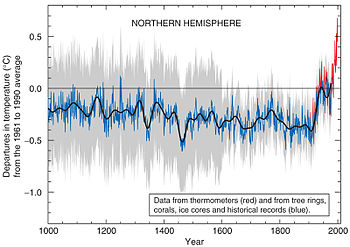
For several years, Michael Mann has been on the front lines of this conflict. Though he says he finds himself a combatant more by conscription than enlistment, the Penn State climatologist has made it the subject of his recent book, The Hockey Stick and the Climate Wars. Continue reading At the Blunt End of the Hockey Stick: Q&A with Michael Mann

How Much Carbon Do California’s Forests Hold?

It’s a tough number to nail down, but a federal program is zeroing in on it

Trees, grasses and freshwater aquatic systems all play a part in the carbon cycle.

The U.S. Geological Survey is developing a series of reports on how much carbon and other greenhouse gases the nation’s ecosystems hold. Trees and plants, soils and rivers, farms and wetlands all sequester carbon to greater or lesser extents. But how much? And how might that number change in the future? That’s the crux of the USGS study, which was initiated by the Energy Independence and Security Act of 2007 [page 223 of the PDF]. (There’s a simultaneous study, also by the USGS, to assess geologic carbon sequestration).

The national assessment will include details on greenhouse gas sequestration nationwide: how much carbon is stored now, how that carbon sink might be altered by different land use scenarios in the future (for example, increased or decreased logging, urbanization, wetland restoration efforts or agriculture), plus impacts from other sources, such as wildfire and climate change.

Continue reading How Much Carbon Do California’s Forests Hold?

Doctors Expect Climate Change to Worsen Lung Diseases

In some parts of California air quality is already a big issue

This post originally appeared on KQED’s State of Health blog.

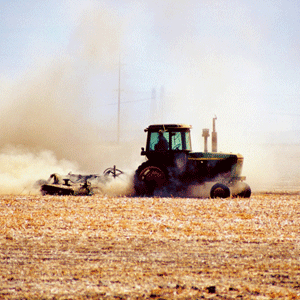
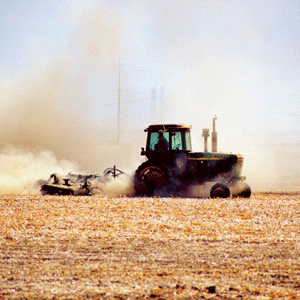
Farming in the Central Valley contributes to the poor air quality there.

As if there wasn’t already enough to worry about, now doctors are predicting that climate change will harm people’s respiratory health. The American Thoracic Society is so concerned it filed a report with two goals. The Society not only wants to raise awareness with doctors so they can take preventive measures with their patients but also is enticing researchers to take on the question for further study. They found that climate change has a direct impact on air quality. A hotter climate, wildfires, more pollen in the air and rates of airborne diseases are worsening respiratory health worldwide.

Climate change will likely affect different places in different ways, but in California it could mean hotter summers and more wildfires. The itchy eyes and sneeze-inducing allergies that plague many people during pollen season could also hang around longer if weather patterns continue to change. All of that is bad for asthmatics, children and the elderly, but also for poor people – as it turns out.

“It was really an eye opener for us,” said Kent Pinkerton, a professor of pediatrics at UC Davis and the lead author on the report. “We were really not aware of the implications of change in temperature on respiratory health. But it really is a global issue. It’s not just a concern for here in our country,” he added. In some parts of Africa and Turkey desertification and increased particulates in the air have already forced people to relocate, often into cramped conditions, which further heightens their risk for respiratory diseases.

Continue reading Doctors Expect Climate Change to Worsen Lung Diseases

Are You in Harm’s Way? Rising Seas Increase Flood Risk in California

San Francisco Bay, the Delta and Southern California are most susceptible in the state

Sea level rise compounded with storm surges and high tides could raise the water level by four feet.

Tens of thousands of Californians will be placed at risk in the years to come as sea levels continue rising along the California coast. The official planning parameter for the San Francisco Bay Area acknowledges a potential 16-inch rise by 2050. But with help from high tides and storm surges, it’s not likely to stop there. A new tool from Climate Central maps out which cities, neighborhoods, and even streets, will be most affected.

The state’s Cal-Adapt site offers a similar tool but the East Coast-based science education group, Climate Central has added a new layer: population. According to Climate Central, which is a content partner with Climate Watch, there’s a one-in-six chance that under the right conditions — sea level rise, plus storm surge, plus high tides — the sea could rise four feet by 2030 in the Bay Area. That effects not just the coast, but also cities around the Bay and farther inland, in the Sacramento-San Joaquin Delta. The cities with the most people at risk are San Mateo, with 35,000 people living in areas that would be flooded under that scenario, and Stockton, with more than 72,000.

In Southern California, the threat is farther off, but by 2060, there’s a one-in-six chance of sea levels topping a four-foot increase with help from a storm surge. If that happens, more than 44,000 people in Huntington Beach would be in harm’s way, and 11,000 in LA.

Will California be a Game-Changer for the Chevy Volt?

GM is hoping new carpool incentives and a green focus will boost Volt sales in the Golden State

The Volt now qualifies for California’s HOV lane status and a $1500 state rebate.

When General Motors CEO Dan Akerson was in San Francisco last week, I spoke to him about the five-week long suspension of the Chevy Volt production — and why he thinks the re-launch of the new-generation Volt could be a winner in California.

The Golden State accounts for one-in-four sales of the Volt, the plug-in hybrid made by General Motors. The car offers a potential solution to the “range anxiety” hurdle many would-be EV buyers face; but to gain traction against rivals like the Toyota Prius hybrid and the all-electric Nissan Leaf, it still has to surmount its red-hot price and fiery reputation.

Akerson says the new Volt qualifies for California’s HOV lane status and a $1,500 state rebate, thanks to changes in the combustion configuration of the engine. The new Volt will have an additional emissions system fan to reduce tailpipe emissions and Akerson anticipates that the average 36 minutes a day that commuters save by using the carpool lane will deliver an effective “California twist” to the vehicle’s marketability here.

Continue reading Will California be a Game-Changer for the Chevy Volt?