The Pacific Institute’s Peter Gleick says he was blinded by frustration when he used subterfuge to obtain and leak the internal documents
Earlier this month, documents were allegedly leaked from the Heartland Institute — a think tank that questions human-caused climate change — which describe elements of the organization’s strategy to discredit climate science, and include background on funders. Now climate scientist Peter Gleick, the founder of the Pacific Institute, has admitted to using deception to obtain the information.
One of the few mammals unique to California is also one of the most threatened by climate change.
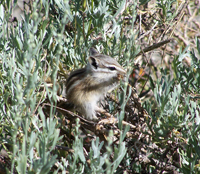
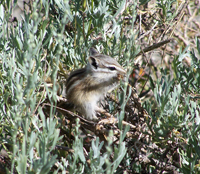
The alpine chipmunk only lives in California, and its habitat is shrinking.
The alpine chipmunk, found in Yosemite’s high country, has moved upslope as temperatures have warmed over the last century.
Now a new study out yesterday from the journal Nature Climate Change shows a warming climate may also be affecting the species’ genetic diversity. Listen to my radio story about the study on today’s California Report.
The alpine chipmunk is one of the smallest chipmunks in California. It’s also got a uniquely striped face. It’s hard to see these chipmunks in the wild unless you strap on a backpack and climb some 10,000 feet high in the Sierra.
That’s what study author Emily Rubidge did as a PhD student at UC Berkeley’s Museum of Vertebrate Geology. She’s part of a team that’s been ambitiously updating Joseph Grinnell’s historic survey of Yosemite’s wildlife from the early 1900s.
New research includes first-ever global death toll from landscape fires: more than 300,000
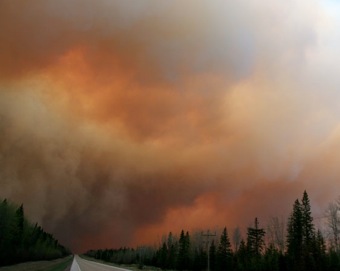
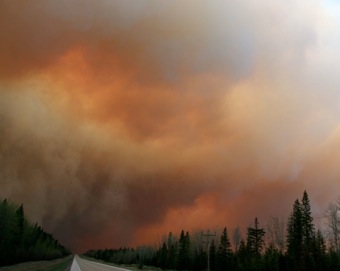
Flames and smoke from the 2011 Slave Lake fire in Alberta. Evacuations are likely to increase, partly from smoke.
Research continues to suggest that this century will be a brutal one for wildfires.
The reasons seem pretty straightforward: “The warmer it gets, the more fires we have,” fire scientist Mike Flannigan told reporters at a major science conference in Vancouver this weekend. Flannigan is a professor at the University of Alberta and also works for Canada’s natural resources agency.
Flannigan says fires already claim an area roughly the size size of India each year (If you’re wondering how that’s even possible, he says the acreage includes grasslands, which can actually burn more than once a year). And he says the toll will rise, driven by three main factors: Continue reading Wildfire Trends: You Ain’t Seen Nothin’ Yet→
Combined QUEST/Climate Watch unit wins for its report on rising seas
A team of producers and editors at KQED was honored this weekend with a prestigious Kavli Science Journalism Award. Only a few projects are selected each year by the Washington-based American Association for the Advancement of Science.
The KQED team, a collaboration of the QUEST and Climate Watch science reporting units, was recognized in the Television Spot News/Feature Reporting category for its segment on rising sea levels in the San Francisco Bay Area.
In its announcement last fall, AAAS noted:
“The QUEST/Climate Watch co-production ‘used the visual medium of television effectively as it laid out the facts—and uncertainties—surrounding rising sea levels,’ said Richard Harris, a science correspondent for NPR who served as a judge.”
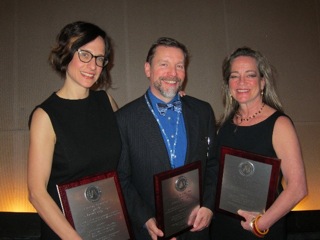
L-R: Amy Miller, Craig Miller, and Rachel Silverman represented the QUEST/Climate Watch team at the Kavli Awards in Vancouver.
Rachel Silverman produced the segment, which I reported. Others honored included QUEST TV series producer Amy Miller, managing editor Paul Rogers, associate producer Lindsay Kelliher, and video editor Linda Peckham.
During the segment, we join scientists for some mud coring along the Marin bayshore, to document prehistoric sea level patterns, review projections for sea levels over the next several decades, talk to urban planners in Hayward who are grappling with decisions on how to protect infrastructure, and visit with residents of the tiny South Bay hamlet of Alviso, which sits several feet below current sea level.
The awards, funded by an endowment from the Kavli Foundation, were announced in November and presented this weekend at the AAAS annual meeting in Vancouver. Winners are chosen by independent panels of science journalists.
Another winner for climate coverage was Christine Peterson of the Caspar Star-Tribune, who, with Kerry Huller and Wes Watson, reported on receding glaciers in Wyoming.
Dust from across the Pacific seeds Sierra snowflakes
Researchers found that heavy snowfall in the Sierra is connected to the amount of dust floating over from Asia.
In a weird twist on the “butterfly effect,” evidence is that Asian dust storms can mean more snow in the Sierra. The strange finding surfaced in research by scientists working on NOAA’s CalWater program. Scientists compared two Sierra storms, and found the one that contained dust particles from Asia had 40% more precipitation than the one that did not. The other storm had more particulate matter from sources in California, for instance, from burning trees or grass.
The researchers, including Kim Prather and Doug Collins from the Scripps Institute of Oceanography at UC San Diego compared the two storms from the air.
Count some birds, shoot a wave, set out a rain gauge — the sky’s the limit
An iPhone can be a field guide, a tool for recording observations and a way to share data.
Today is the first day of the annual Great Backyard Bird Count, when people all over North America tally the birds they see and record their results on the GBBC website. It’s a simple citizen science project to try. Even if you don’t know your birds, you can print out a list of what you’re likely to see in your area to help figure out which bird you’re looking at. And as the four-day project progresses, you can watch results come in from all over the continent.
The Bird Count is important to scientists, too. The information you collect helps answer questions about how bird populations are doing and how migrating birds are responding to the weather or climate change
But the Great Backyard Bird Count is far from the only citizen science project worth trying. While some science is done by people in crisp white lab coats, with specialized tools, a lot of it isn’t. Scientists don’t just work in labs, they don’t just use beakers and Bunsen burners, and most of the time they’re not wearing lab coats.
Also: you don’t have to be a scientist to do science.
A new report says snowfall in the Sierra hasn’t shrunk, but not everyone’s buying it
Snow has been sparse in the Sierra Nevada this winter.
There are good years and there are bad years, but overall, snowfall in the Sierra hasn’t declined in the past century. That’s according to a new study by University of Alabama climatologist John Christy (who, it’s worth noting, has come under fire as a climate change denier).
Bay Area climate scientist named in disputed document
The climate corner of the Blogosphere exploded this week with the alleged leak of numerous documents from one of the nation’s most ardent opponents of action to slow global warming.
A new project to visually map American waterways will start with California’s Sacramento
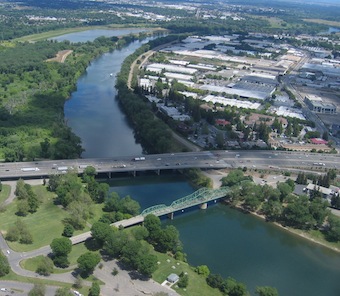
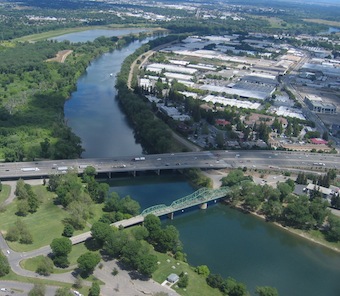
The Sacramento River is a lifeline for California.
By the end of the summer, you may be able to float down the Sacramento River from your computer, thanks to the Riverview Project. It’s an initiative to document and map rivers, using similar tools to the ones Google used to create Street View, and with similar results: the ability to drop into a place on a map, click to move down the street (or float down the river), and take a look around.
“There’s reams of data (about rivers),” Jared Criscuolo, one of the founders of the Riverview Project told me. “But the thing we’ve noticed we’re missing is a visual piece.”
New technology could provide a much clearer picture for water forecasts
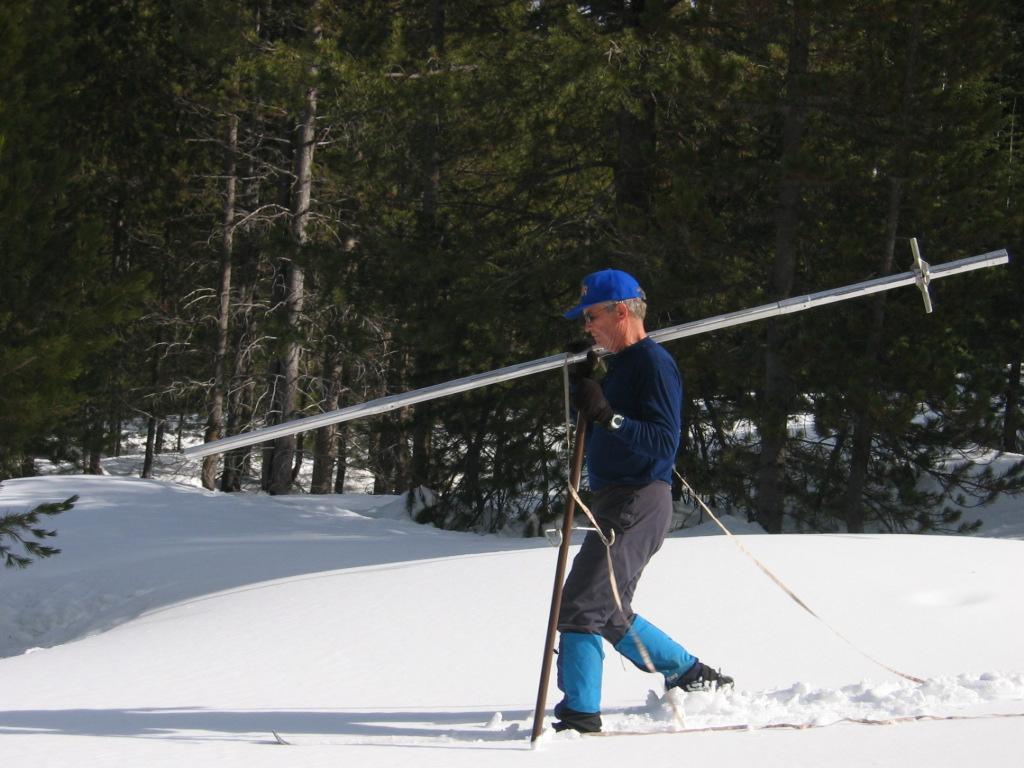
Frank Gehrke conducts a manual snow survey using a "Mt. Rose gauge," essentially a hollow aluminum tube shoved into the snow at predetermined locations.
In California, where most of our water comes from the mountains, being able to accurately measure the snow pack is vital. And it is in outlier years like this — very dry years, though the same goes for very wet ones — when water managers have the hardest time making accurate predictions.
“Knowing the water content of the snow in an entire watershed is the holy grail for snow scientists,” survey guru Frank Gehrke told me.
During the winter, Gehrke trudges into the woods on a monthly basis to do manual snow surveys for the state Department of Water Resources. DWR uses remote snow sensors, too. But even with all that data we don’t get an exact picture of the snow pack. So scientists from National Center for Atmospheric Research (NCAR) and NASA Jet Propulsion Laboratory (JPL) are developing tools to measure snow with lasers. This new technology has the potential to be that holy grail that Gehrke’s looking for.
 Earlier this month, documents were allegedly leaked from the Heartland Institute — a think tank that questions human-caused climate change — which describe elements of the organization’s strategy to discredit climate science, and include background on funders. Now climate scientist Peter Gleick, the founder of the Pacific Institute, has admitted to using deception to obtain the information.