Category Archives: The Science

Latest research from the field and the lab

This is Your Atmosphere on Drugs

A new report on extreme weather compares climate change to steroids

The tornado that tore through Joplin, MO in May was one of the worst of last year's extreme weather events. But tornadoes have one of the more tenuous connections to climate change.

As we’ve noted before, last year was packed with extreme weather events, but it’s difficult to out-and-out blame any particular one of them on climate change. Explanations are often along the lines of, “This is the kind of thing that could become the norm in the future.” The science just isn’t quite there to able to pinpoint any single event and say exactly what caused it.

To try to sort out what we know from what we don’t, the University Corporation for Atmospheric Research (UCAR), a consortium of universities doing earth science research, has a new feature on its website, “In Depth: Weather on Steroids,” about that science: the science of attribution, as in, what can we attribute to climate change?
Continue reading This is Your Atmosphere on Drugs

California’s Rangeland Could Take a Hit from Climate Change

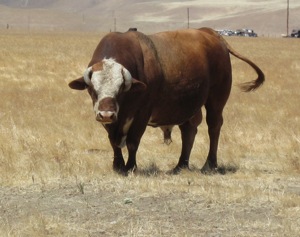
A bull stares down the photographer in California’s Panoche Valley.” credit=”Craig Miller / KQED

California’s ranchers could face a tougher economic future under climate change. The grasslands they depend on to feed their cattle could shrink by almost 40% by the end of the century, according to a study from Duke University and the Environmental Defense Fund.

The researchers modeled two different climate futures for California: a warmer, wetter scenario and a warmer, drier one. The study showed that by the end of the century, California’s shrublands could increase as much as 70% under the worst-case dry scenario, taking over historic grasslands and other ecosystems. Continue reading California’s Rangeland Could Take a Hit from Climate Change

The Latest Breakthrough in Biofuels: Seaweed?

Berkeley scientists bring seaweed biofuels one step closer to the marketplace

Seaweed farms off the coast of Bali. According to one estimate, using just three percent of the Earth’s coastal waters to grow seaweed could produce 60 billion gallons of ethanol.” credit=”nat haru/Flickr

The newest biofuel making a splash is seaweed.

Researchers at Berkeley-based Bio Architecture Lab (BAL) have discovered a way to genetically manufacture a microbe that can break down the sugars in seaweed, so that it can be used as a fuel source. Biofuels from sources other than corn have generated a lot of hype but so far not the large-scale production necessary for them to be considered an integral part of the U.S. energy future (see Lauren Sommer’s recent biofuels “reality check,” for KQED’s QUEST).

There are many kinds of algae. The ones that have received most attention are microalgaes that grow in freshwater ponds. The US Department of Energy has invested heavily in research on microalgaes. Defense officials are looking to oil extracted from the freshwater scum to fuel military machinery. Last week a California Report story highlighted the efforts of researchers in San Diego to scale up production of oil from algae, in order to bring down the cost and make it viable on the energy market. Continue reading The Latest Breakthrough in Biofuels: Seaweed?

Help Document Bay Area High Tides

King tides return to the Bay Area, augmented by a long-awaited winter storm.

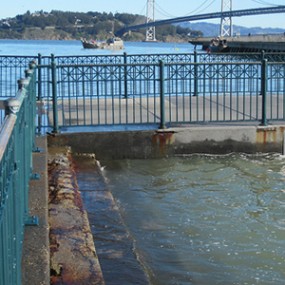
High tide at Pier 14 in San Francisco during the winter of 2011.

No one knows exactly how much sea level rise the San Francisco Bay Area can expect from climate change, but king tides — extremely high seasonal tides — may give insight into what could be normal in the future.

Starting today and continuing through Sunday, king tides are expected in the morning hours around the Bay Area. Recent rainstorms and the accompanying runoff will likely make these tides even bigger. The California King Tides Initiative is again asking for citizens to document the visual effects of king tides and add them to a Flickr photo pool to help give a perspective on how sea level rise might change local landscapes.

Sea levels have risen about eight inches in the last century and the San Francisco Bay Conservation & Development Commission (BCDC) has warned that the area should be ready for 16 inches of sea level rise by mid-century.

It’s Official: 2011 a Record-Breaking Year for Climate Extremes

Two more events added to the dozen with $1 billion-plus in damages

"And it's going to keep on falling," he shouted, "until your whole great marble palace tumbles down!"

From droughts and wildfires to tornadoes and hurricanes – and let’s not forget flooding, hail and that Halloween snowstorm — last year will go down as one of the most extreme weather years on record.

This week the National Oceanic and Atmospheric Administration (NOAA) released the final tally for 2011.

The two latest disasters to make the grim list are September’s Tropical Storm Lee which swept up the East Coast to cause record flooding and 21 deaths, and July’s severe weather that brought high winds, hail, and flooding to the Rocky Mountains and the Midwest, and took two lives.

Across the planet it was the 15th consecutive year of above-average temperatures. Here in the U.S., the portion of the nation in extreme drought or very wet conditions was the highest ever:  58%, and that’s nearly three times normal. No surprise that temperatures in Texas made for the second warmest year on record, with the drought there surpassing the severity of ones in the 1930s and 1960s.  Seven states across the Midwest and Northeast had their wettest years ever. Continue reading It’s Official: 2011 a Record-Breaking Year for Climate Extremes

Climate Science in Schools: the Next “Evolution”

An Oakland group vows to keep climate science in the classroom.

Some science teachers face opposition from students, parents and even administrators when they teach basic climate science.” credit=”Getty Images

As the climate change debate creeps into classrooms across the country, an Oakland non-profit vows to stem the tide of climate denial in California. They also plan to conduct a comprehensive review of science textbooks to help teachers separate the sound from the shaky in climate science.

The Oakland-based National Center for Science Education (NCSE) has announced that it will now offer support to teachers facing resistance to climate science in the classroom, similar to their long-standing work to keep the instruction of evolution in schools. “We’ve already had a couple of calls along the lines of, ‘I know you guys do evolution, but I’ve got this problem with [teaching] climate change and do you have any suggestions for me,’” said Dr. Eugenie Scott, executive director of NSCE.
Continue reading Climate Science in Schools: the Next “Evolution”

A Different Approach to Tackling Climate Change: Sweat the Small Stuff

A new study recommends cutting soot and methane emissions to curb warming and improve health.

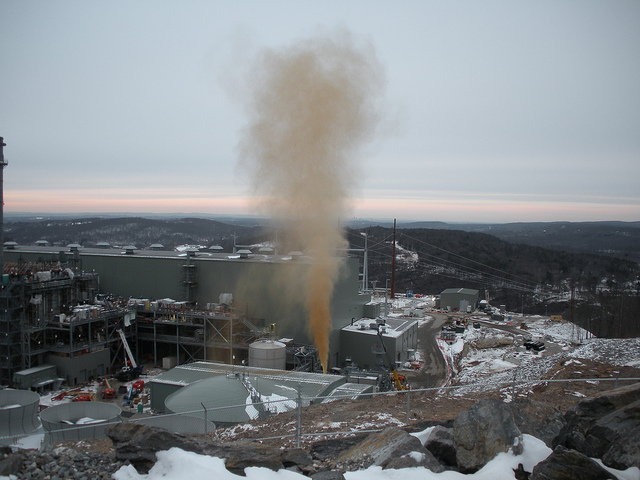
Methane can escape from mines, power plants, farms, and landfills.

Carbon dioxide is the primary driver of climate change, but it’s not the only one. Methane also contributes to warming. In fact, a single molecule of methane causes more warming than a single molecule of carbon dioxide does. But it doesn’t stay in the atmosphere as long, so a new study from NASA affirms what others have suggested for years: that cutting methane emissions would show quicker results than cutting CO2 emissions. The same goes for soot, also known as black carbon. Plus, cutting back on soot would put a damper on the respiratory diseases it causes, and capturing more methane, which is basically natural gas, would save money.

Continue reading A Different Approach to Tackling Climate Change: Sweat the Small Stuff

How Plastic Trees Could Help Pull Carbon Dioxide Out of the Air

We know that real trees soak up carbon from the atmosphere — but fake trees?

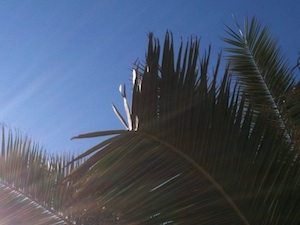
And you thought plastic palm trees had no redeeming value...

A cheap plastic that removes carbon dioxide (CO2) from the atmosphere? “Yes,” says a team of chemists at the University of Southern California’s  (USC) Loker Hydrocarbon Research Institute, led by Nobel Prize winner George Olah. Science Now reports on their work with an inexpensive polymer called polyethylenimine or PEI.

But how to maximize its absorption capabilities? Olah’s team dissolved the polymer in a solvent and spread it out, peanut-butter-style, on fumed silica — you know, like the stuff in those desiccant packets in your electronics packaging (“Do not eat,” by the way).  It’s also used as a stabilizer for lipstick and other make-up.

Continue reading How Plastic Trees Could Help Pull Carbon Dioxide Out of the Air

Who Generated the Most Climate “B.S.” in 2011?

Despite flagging media coverage, there was plenty to go around, says a Bay Area scientist

Despite a dozen billion-dollar weather catastrophes in the US alone, year-end tallies show that overall, coverage of climate change continued to flag in the mainstream media.

That isn’t to say that there wasn’t plenty of public jabber about it, much of it wrong, according to Peter Gleick, who heads the Oakland-based Pacific Institute. Gleick is a hydrologist and one of the more outspoken science figures on Western water and climate issues. As a countermeasure against what he calls climate “disinformation,” Gleick and some colleagues have started handing out yearly Climate B.S. (Bad Science) Awards. In so doing, Gleick doesn’t spare the media itself. His list of 2011 “winners” came out today (gratefully we’re not on it). The following are Gleick’s words. Some of the links are mine. May I have the envelope, please: Continue reading Who Generated the Most Climate “B.S.” in 2011?

American Pika Gets Another Shot at Endangered Status

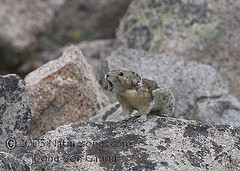
The American pika can only survive in a narrow temperature band and can suffer heat stroke at temperatures as mild as 80 degrees.

The California Fish and Game Commission is asking for public input on the status of the American pika. The small, alpine mammal has been at the center of a prolonged debate over whether to list it under the Endangered Species Act. If the pika ultimately wins endangered status it would be the first species to do so with climate change cited as a major factor contributing to its decline. The Center for Biological Diversity originally petitioned for the pika to receive protected status, considering it to be a bellwether for climate change in California. Continue reading American Pika Gets Another Shot at Endangered Status