All posts by Molly Samuel

Molly Samuel joined KQED as an intern in 2007, and since then has worked here as a reporter, producer, director and blogger. Before becoming KQED Science’s Multimedia Producer, she was a producer for Climate Watch. Molly has also reported for NPR, KALW and High Country News, and has produced audio stories for The Encyclopedia of Life and the Oakland Museum of California. She was a fellow with the Middlebury Fellowships in Environmental Journalism and a journalist-in-residence at the National Evolutionary Synthesis Center. Molly has a degree in Ancient Greek from Oberlin College and is a co-founder of the record label True Panther Sounds.

Birds and Blades: Are Condors and Wind Turbines Compatible?

Lawsuits pit an endangered species against renewable energy development

This California condor, flying near the coast, is one of about 200 condors living in the wild.

Wind is a growing industry in the Tehachapi Mountains in Southern California. Kern County welcomes new wind projects, and Google has gotten in on the action. But some environmentalists say that developers and officials are ignoring the elephant — or, in this case, the enormous bird — in the room.

California condors are beginning to return to the Tehachapis after nearly going extinct in the 1980’s, and birds and wind turbines don’t mix. No California condors have yet had a run-in with a turbine. But they are still endangered — it’s illegal to kill them — and three environmental groups say that Kern County and the US Bureau of Land Management (BLM) are not properly considering the risks. The Sierra Club, Defenders of Wildlife, and the Center for Biological Diversity filed a lawsuit against the BLM today, regarding one wind development in particular. (They have previously sued Kern County over the same project).

Continue reading Birds and Blades: Are Condors and Wind Turbines Compatible?
How Climate Change Makes Trees Sick

Warmer and wetter weather is good for tree diseases, which is bad news for trees

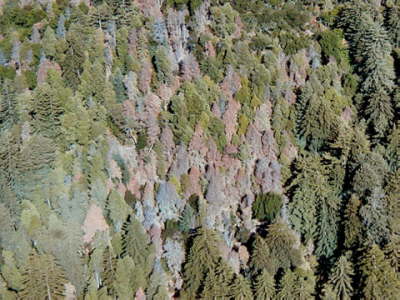
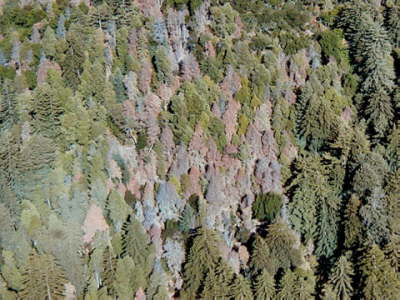
A patch of tanoak, killed by Sudden Oak Death, in the Los Padres National Forest in Monterey County.

Climate change is likely to wreak havoc on California’s forests. Extreme weather, wildfires and insect outbreaks will all take a toll. Add to those another looming threat: disease. Forest diseases like Sudden Oak Death, which has infected trees in 14 counties in the state, stand to benefit from the effects of climate change, to the detriment, obviously, of the trees.

Trees are big and long-lived. Tree pathogens, mostly fungi and bacteria, are the opposite. They’re mobile, able to blow around on the wind. And they reproduce and evolve rapidly. That’s the crux of the problem, according to Susan Frankel, a plant pathologist with the Forest Service.

“When you look at forest health and the balance between forest trees and the pathogens that attack them, it does seem, given climate change, pathogens get the better end of the deal,” she told me.

Continue reading How Climate Change Makes Trees Sick

California Braces for the Complex World of Carbon Markets

In which Air Board chief Mary Nichols performs a dramatic reading of a vintage Jerry Brown speech

As chair of the California Air Resources Board, Mary Nichols is presiding over the nation’s first comprehensive cap-and-trade program.” credit=”California Air Resources Board

When its nascent cap-and-trade program ramps up later this year, California will be the first state in the nation to reduce greenhouse gases by making a broad spectrum of big polluters buy permits to exceed their allotted emissions.

Other governments, industry and scientists will be watching, but there’s still a lot to sort out. That much has been evident at this week’s carbon market and policy conference in San Francisco, “Navigating the American Carbon World.”

The long and winding road to carbon trading was highlighted by Mary Nichols, chair of the California Air Resources Board, in a little prank she played on the gathering. Obviously reading from a script, she stumbled over words, looked up at the audience, then back down at the page, plodding through her replies to moderator Diane Wittenberg. Continue reading California Braces for the Complex World of Carbon Markets

Is Your Town California’s “Coolest?”

Let the Carbon Games begin: cities compete to cut emissions

Sacramento is one of the cities competing to be "Coolest California City."

We must’ve missed the opening ceremonies with the parade of flag-bearing competitors and giant torch-lighting — or maybe it was canceled to save energy. Either way, ten California cities are competing over the next year to reduce their carbon emissions.

Individuals, local governments and businesses will all be involved in the project, called the Cool California Challenge. The Cool California website has a carbon calculator, tips on reducing your footprint and links to rebates. Plus there’s a social media element, so you can envy, goad or cooperate with your neighbors as you see fit.

The competing cities are Chula Vista, Citrus Heights, Davis, Gonzales, Pittsburg, Pleasanton, Sacramento, Santa Cruz, San Jose and Tracy. Participants — whether they’re individuals, companies or other types of organizations — earn points by being more carbon-conscious.

Continue reading Is Your Town California’s “Coolest?”

Citizen Science Project Blooms With Early Spring

Contributions to Nature’s Notebook have surged since spring has sprung

Tracking of when flowers bloom--and how the date changes over time--can help provide insight into how they're affected by weather and climate change.

The participative science project known as Nature’s Notebook is closing in on its one-millionth observation. The crowd-sourced program collects data from across the country on the timing of natural events like plants flowering, leaves growing and eggs hatching. The study of those seasonal life stages, called phenology, gives scientists insight into how they’re connected to each other, and how they’re affected by climate and weather.

Jake Weltzin, the executive director of the USA National Phenology Network (USA-NPN), which manages Nature’s Notebook, said he thinks that spring arriving ahead of schedule across much of the country has sparked people’s interest.

Continue reading Citizen Science Project Blooms With Early Spring

Snow Survey Says: It Could Have Been Worse

Thanks to last year’s wet winter, California’s reservoirs are still in good shape

In January of this year, snow was still sparse at high elevations in the Sierra Nevada.

Researchers from the Department of Water Resources conducted their April manual snow survey today. It’s the most important snow survey of the season, because it’s supposed to capture the Sierra snowpack at its peak. The DWR found that statewide, snow water content is 55% of average for this time of year.

Still, it could have been worse. The previous manual snow survey, which took place on February 28, measured snow water content at only 30% of normal for that date. So the rain in March did help.

“This was certainly a moderately good March at least,” Jeanine Jones, the Interstate Water Resources Manager at the DWR told me. “But the downside is that we are now getting outside of our peak precipitation window. On average about 75% of statewide precipitation comes between November and March.”

Continue reading Snow Survey Says: It Could Have Been Worse

Politics, Climate Change and Human Rights in the Maldives

The Island President tells the story of the former president’s fight for climate action

The new documentary, The Island President, depicts former-president Mohamed Nasheed’s efforts to draw the world’s attention to the plight of his country. The islands that make up the Maldives lie barely above sea level. With a few feet of sea level rise, they will be inundated.

John Shenk, the San Francisco-based director of the film, was a guest on KQED’s Forum last week. He talked about how Nasheed, the country’s first democratically-elected president (he resigned in February), and a former human rights campaigner, became a climate change activist.

“He took office and immediately plunged into the climate debate,” Shenk said. “He’s framing the climate debate as a human rights issue. He very much sees the climate fight, the struggle against climate change, as an extension of his fight for democracy.”

In a quote from the film, Nasheed explains: “When we came to power we thought we won the fight. After twenty years, we thought, ‘Look, OK, we’ll have a happy life.’ But we had our first few cabinet meetings, and most of the pending issues were climate change issues. Weather patterns are changing, and that’s having a very big impact on fisheries. We have lost a lot of the shoreline. Our islands are going to be flooded.”

Continue reading Politics, Climate Change and Human Rights in the Maldives

EPA’s New Carbon Rule Doesn’t Do Much in CA

California enacted similar limits to pollution from power plants in 2006

The EPA's new rule limits carbon emissions from new power plants nationwide.

The US Environmental Protection Agency will, for the first time, begin restricting greenhouse gas emissions from fossil fuel-fired power plants. The EPA’s new standard limits how many pounds of carbon can be emitted per megawatt-hour of electricity generated. It doesn’t apply to existing power plants or to new plants that have already been permitted, and natural gas-powered plants should be able to meet the standard without changes. But coal-powered plants will no longer make the cut without adding carbon capture and sequestration technology.

This won’t have much of an effect on California’s energy industry, Dave Clegern from the California Air Resources Board told me, though he’s not complaining. “It’s always good to see a national standard, and we’re glad the EPA is doing it.”

Former governor Arnold Schwarzenegger signed a similar standard for power plants in California back in 2006. The state gets very little electricity from coal-powered plants, and the coal-fired power California residents do use comes from outside of California.

Continue reading EPA’s New Carbon Rule Doesn’t Do Much in CA

Coastal Erosion in SF Prompts Planning and Debate

City planners are looking at ways to reconfigure the city’s western edge

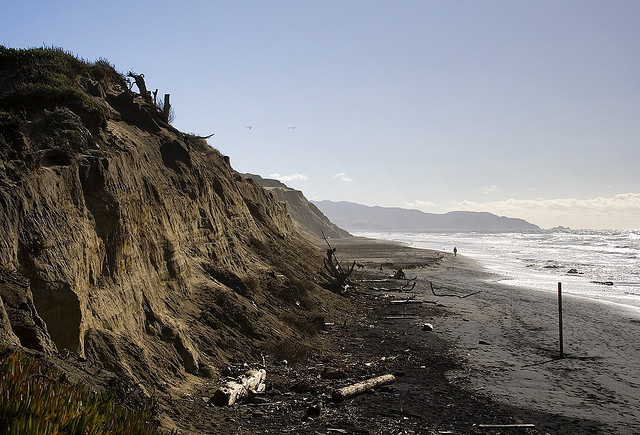
One of the challenges for the Ocean Beach Master Plan is how to slow the erosion of Ocean Beach's sandy cliffs.

San Francisco’s Ocean Beach is eroding; that’s not up for debate. But planners are still figuring out the best way to handle the erosion that’s already happening, and how to prepare for sea level rise. And that’s going to take a lot of planning: Ocean Beach itself is part of the Golden Gate National Recreation Area, managed by the National Park Service, but there are also the nearby residential neighborhoods to consider; plus the Great Highway, a wastewater treatment plant, the parking lot at the beach, endangered species, surfers, dog walkers and the occasional hopeful sun bather.

The Ocean Beach Bulletin, a local news site and one of KQED’s News Associates, has been covering the development of the new plan for San Francisco’s coastline, called the Ocean Beach Master Plan, which will attempt to address erosion and rising sea levels, while balancing the myriad social and environmental needs.

Over the weekend, the New York Times weighed in, too:

Continue reading Coastal Erosion in SF Prompts Planning and Debate

Wet Enough For Ya? California Precip Makes Sprint for the Finish Line

The rainy weather has helped, but the state’s still in deficit for the year

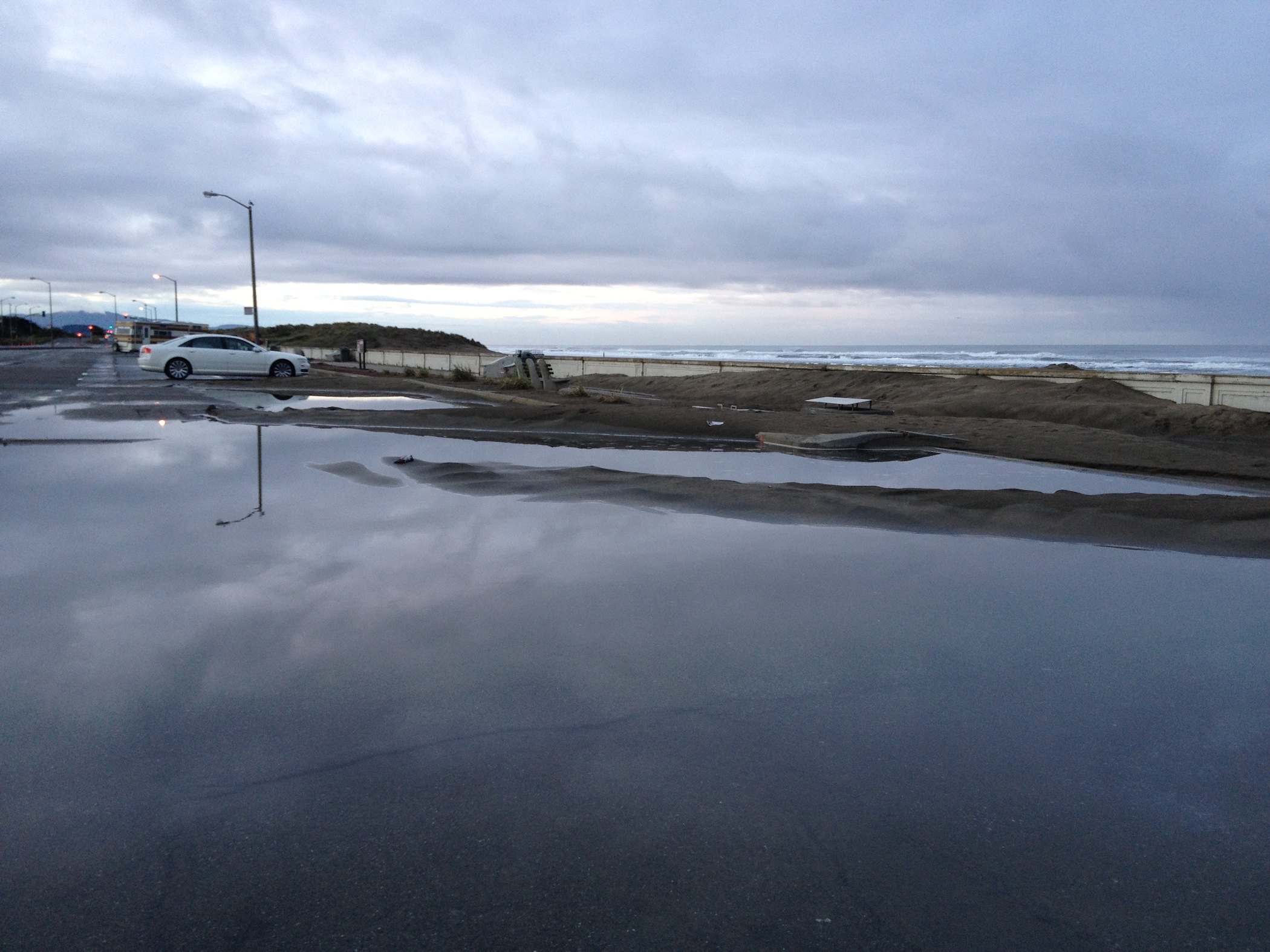
Heavy rain flooded the parking lot at San Francisco's Ocean Beach over the weekend.

California’s water supply is in better shape after this weekend’s storms and the wet weather earlier in the month (though the parking lot at San Francisco’s Ocean Beach is in worse shape). The water content of California’s snowpack is hovering around fifty percent of what’s considered “normal” for this time of year — not quite cause for celebration but much better than it had been; on February 28, the date of the most recent manual snow survey, water content was only 30% of normal.

So this winter isn’t going to be the driest on record, or even the second-driest, but it’s bound to be on the dry side, regardless of what happens now. It’s just too late in the year to catch up, even with more storms heading our way this week.

Continue reading Wet Enough For Ya? California Precip Makes Sprint for the Finish Line