All posts by Molly Samuel

Molly Samuel joined KQED as an intern in 2007, and since then has worked here as a reporter, producer, director and blogger. Before becoming KQED Science’s Multimedia Producer, she was a producer for Climate Watch. Molly has also reported for NPR, KALW and High Country News, and has produced audio stories for The Encyclopedia of Life and the Oakland Museum of California. She was a fellow with the Middlebury Fellowships in Environmental Journalism and a journalist-in-residence at the National Evolutionary Synthesis Center. Molly has a degree in Ancient Greek from Oberlin College and is a co-founder of the record label True Panther Sounds.

How Much Carbon Do California’s Forests Hold?

It’s a tough number to nail down, but a federal program is zeroing in on it

Trees, grasses and freshwater aquatic systems all play a part in the carbon cycle.

The U.S. Geological Survey is developing a series of reports on how much carbon and other greenhouse gases the nation’s ecosystems hold. Trees and plants, soils and rivers, farms and wetlands all sequester carbon to greater or lesser extents. But how much? And how might that number change in the future? That’s the crux of the USGS study, which was initiated by the Energy Independence and Security Act of 2007 [page 223 of the PDF]. (There’s a simultaneous study, also by the USGS, to assess geologic carbon sequestration).

The national assessment will include details on greenhouse gas sequestration nationwide: how much carbon is stored now, how that carbon sink might be altered by different land use scenarios in the future (for example, increased or decreased logging, urbanization, wetland restoration efforts or agriculture), plus impacts from other sources, such as wildfire and climate change.

Continue reading How Much Carbon Do California’s Forests Hold?

Are You in Harm’s Way? Rising Seas Increase Flood Risk in California

San Francisco Bay, the Delta and Southern California are most susceptible in the state

Sea level rise compounded with storm surges and high tides could raise the water level by four feet.

Tens of thousands of Californians will be placed at risk in the years to come as sea levels continue rising along the California coast. The official planning parameter for the San Francisco Bay Area acknowledges a potential 16-inch rise by 2050. But with help from high tides and storm surges, it’s not likely to stop there. A new tool from Climate Central maps out which cities, neighborhoods, and even streets, will be most affected.

The state’s Cal-Adapt site offers a similar tool but the East Coast-based science education group, Climate Central has added a new layer: population. According to Climate Central, which is a content partner with Climate Watch, there’s a one-in-six chance that under the right conditions — sea level rise, plus storm surge, plus high tides — the sea could rise four feet by 2030 in the Bay Area. That effects not just the coast, but also cities around the Bay and farther inland, in the Sacramento-San Joaquin Delta. The cities with the most people at risk are San Mateo, with 35,000 people living in areas that would be flooded under that scenario, and Stockton, with more than 72,000.

In Southern California, the threat is farther off, but by 2060, there’s a one-in-six chance of sea levels topping a four-foot increase with help from a storm surge. If that happens, more than 44,000 people in Huntington Beach would be in harm’s way, and 11,000 in LA.

Marine Robots Break Record for Journey from SF Bay to Hawai’i

Wave Gliders are collecting data as they travel across the Pacific

"Wave Gliders" use wave energy to move and solar energy to power their scientific instruments.

Four ocean-going robots called Wave Gliders have made their way from San Francisco to the Big Island of Hawai’i, setting a Guinness world record for distance traveled by an unmanned, wave-powered vehicle. They’re not just long-distance voyagers though, they’re also collecting data on ocean conditions and the weather.

Wave Gliders, created by Sunnyvale-based  Liquid Robotics, are about the size and shape of surfboards, but they do more than catch waves. They’re attached to a cable and a set of fins below the surface of the water, which capture wave energy and move the vehicle forward, and they’re equipped with solar panels and scientific instruments. They collect data and send it back via satellite, saving the time and money that go into manned research expeditions.

Continue reading Marine Robots Break Record for Journey from SF Bay to Hawai’i

La Niña on its Way Out, but so Is Winter

La Niña is weakening, but don’t hold your breath for a “March miracle”

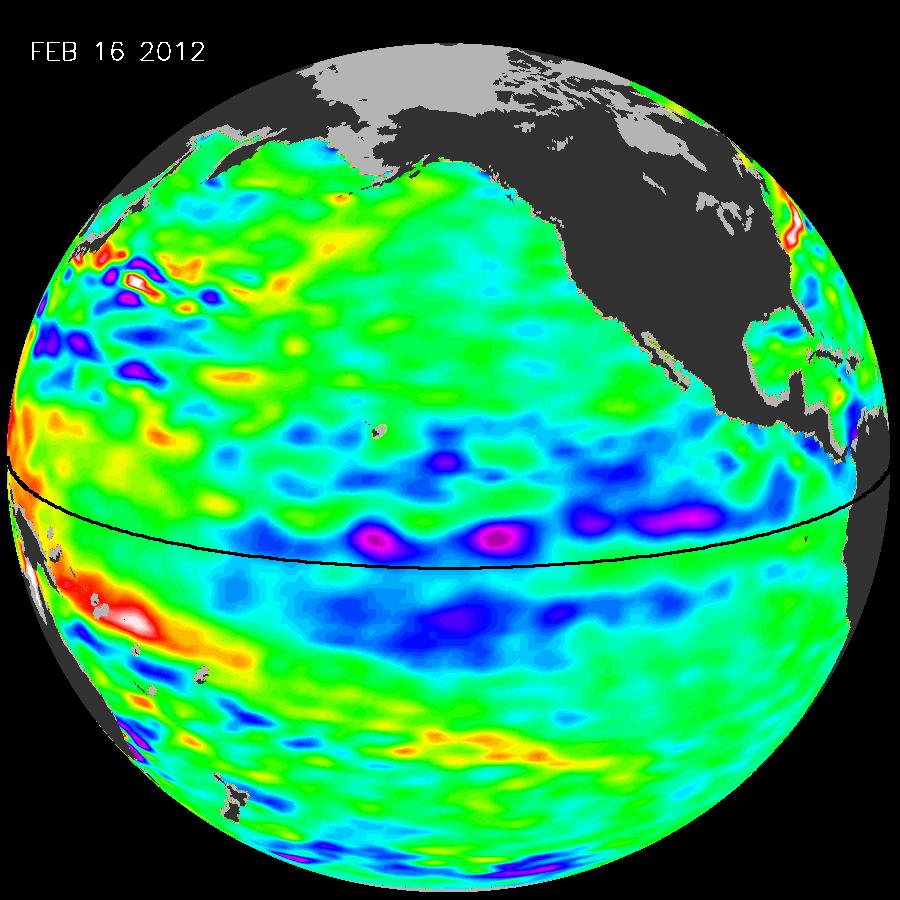
This image shows La Niña conditions from last month, collected by NASA's Jason-2 satellite.

This has been a historically dry winter, dry enough that it’s likely to land a spot as one of the top ten driest since the Gold Rush. And even though La Niña is waning, that probably won’t make much of a difference, because there’s a delay between when ocean surface temperatures change, and when that change actually has an effect on our weather.

“March 20 is just around the corner, and that’s the first day of spring. Our winter — our snowpack and our rain — is essentially over,” NASA Jet Propulsion Laboratory climatologist Bill Patzert told me. Though Patzert’s observation comes as three Pacific storms are poised to potentially bring a week of rain to Northern California, he said, “a weakening La Niña won’t necessarily give us a March miracle in terms of snowpack and rainfall.”

La Niña is caused by colder-than-average ocean surface temperatures in the equatorial Pacific. It typically makes for warm, dry winters in California. But not always. Last year was also affected by La Niña, and it was historically wet.

Continue reading La Niña on its Way Out, but so Is Winter

Should NOAA Focus on Climate or Weather Research?

House Republicans question NOAA chief on her agency’s priorities

Satellite imagery shows the storm that spawned tornadoes across the Midwest earlier this month.

Jane Lubchenco, director of the National Oceanic and Atmospheric Administration, answered questions about the agency’s budget today in a hearing held by the House Subcommittee on Energy and the Environment.

Lubchenco began by sending her condolences to people who lost loved ones to the tornadoes that tore across the Midwest in the past week. This year, she said, now ranks in the top five for the number of tornadoes occurring in the first two months of the year. She said making the nation “weather-ready” is a top priority in her budget request for Fiscal Year 2013, which comes to $5.1 billion, an increase of $153 million over last year’s.

Not all programs get more money in the budget request. NOAA is asking for nearly $20 million less than last year for the National Weather Service (NWS), a point with which Andy Harris, Maryland Republican and chair of the subcommittee, took issue.

Continue reading Should NOAA Focus on Climate or Weather Research?

Belief in Climate Change Depends on Which Way the Wind Blows

More people think the climate is changing, and many say the weather convinced them

People cited their experience of warmer temperatures as a major influence in their views of climate change.

Most Americans now say that the climate is changing, according to the National Survey of American Public Opinion on Climate Change (PDF). Nearly two out of three people (62%) answered “yes” to the question, “Is there solid evidence that the average temperature on Earth has been getting warmer over the past four decades?” The primary reasons they gave for that answer? About one in four said it’s because they’ve observed warmer temperatures, and an identical 24% because they’ve observed weather changes — and the survey was taken last fall, before this year’s generally mild winter in the U.S. had entered the national chatter (we recall a recent tweet from NOAA saying that Midland, TX had logged more snowfall this winter than New York, Boston and Philadelphia combined). Continue reading Belief in Climate Change Depends on Which Way the Wind Blows

New Boss at the Pacific Institute, New Salvo from Heartland

The Pacific Institute and the Heartland Institute: Both sides are digging in

Peter Gleick is taking a temporary leave of absence from the Pacific Institute.

The Pacific Institute has posted a new statement to its website, saying the board is hiring an independent firm to investigate the actions and allegations surrounding its founder, Peter Gleick, who admitted last week to using deception in order to obtain documents from the Heartland Institute.

Gleick requested a temporary leave of absence over the weekend and the board has nominated Elena Schmid, an independent consultant, to head the organization on an interim basis. According to a bio from the Pacific Institute, Schmid has worked at California Independent System Operator, “focusing on policy, communications, and human resources for this corporation that manages the high voltage transmission lines for California,” and at the California Public Utilities Commission, “developing policies, programs, projects, and budgets that resulted in active representation of long-term consumer interests in telecommunications, gas, water, and electric industries.” Continue reading New Boss at the Pacific Institute, New Salvo from Heartland

Clouds Gather for Scientist who Purloined Documents

Support from Pacific Institute’s board, funders may be wavering

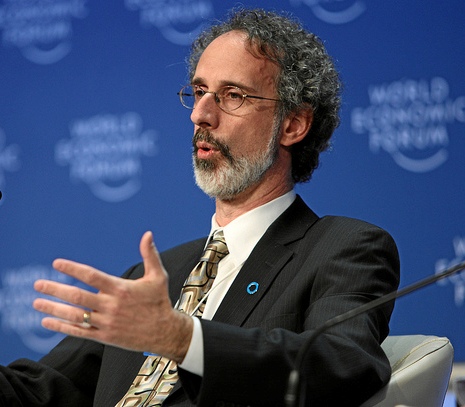
Peter Gleick is a prominent water scientist and a Macarthur Fellow.” credit=”World Economic Forum/Flickr

The furor surrounding Peter Gleick’s admission that he lied in order to get internal documents from the Heartland Institute appears to be gaining momentum, with the board and at least one major funder of Gleick’s Oakland-based Pacific Institute appearing to back-peddle on initial statements of support.

Gleick, who co-founded the Institute, wrote in a blog post earlier this week that he impersonated a Heartland insider to obtain the information, which includes strategy and fundraising details from the organization, a conservative think tank that’s against taking action on climate change.

Gleick has already stepped down from positions with the American Geophysical Union and the National Center for Science Education. Initially the Pacific Institute stood by him, saying in a brief statement posted to its website, Gleick “has been and continues to be an integral part of our team.” That statement is no longer there, replaced yesterday by one that takes a different tone:

The Board of Directors of the Pacific Institute is deeply concerned and is actively reviewing information about the recent events involving its president, Dr. Peter Gleick, and documents pertaining to the Heartland Institute. Neither the board nor the staff of the Pacific Institute knew of, played any role in, or condones these events. As facts emerge and are confirmed, the Board will inform all stakeholders of our findings and of any actions based on these findings.

Continue reading Clouds Gather for Scientist who Purloined Documents

Resignation and Remorse: Gleick Faces Fallout from Heartland Documents Leak

The Pacific Institute is standing by its founder, but other consequences are piling up

Peter Gleick is a co-founder of the Pacific Institute, a research group based in Oakland.” credit=”Craig Miller/KQED

Climate scientist Peter Gleick, who last night admitted that he was the source of leaked documents from the Heartland Institute, has resigned from the American Geophysical Union’s Task Force on Scientific Ethics. Gleick was chair of the task force, which met for the first time last November. According to a press release from the AGU, Gleick resigned last Thursday — after the explosive documents appeared on various blogs but before his online admission as perpetrator.

He’s also stepped down from a position which he hadn’t yet officially begun with the National Center for Science Education, an organization that advocates for evolution and climate change education in schools. Gleick was scheduled to begin serving on its board this week, but tendered his resignation yesterday.

Continue reading Resignation and Remorse: Gleick Faces Fallout from Heartland Documents Leak

Bay Area Scientist Owns up to Lying to Get Heartland Documents

The Pacific Institute’s Peter Gleick says he was blinded by frustration when he used subterfuge to obtain and leak the internal documents

Earlier this month, documents were allegedly leaked from the Heartland Institute — a think tank that questions human-caused climate change — which describe elements of the organization’s strategy to discredit climate science, and include background on funders. Now climate scientist Peter Gleick, the founder of the Pacific Institute, has admitted to using deception to obtain the information.

Continue reading Bay Area Scientist Owns up to Lying to Get Heartland Documents