All posts by Molly Samuel

Molly Samuel joined KQED as an intern in 2007, and since then has worked here as a reporter, producer, director and blogger. Before becoming KQED Science’s Multimedia Producer, she was a producer for Climate Watch. Molly has also reported for NPR, KALW and High Country News, and has produced audio stories for The Encyclopedia of Life and the Oakland Museum of California. She was a fellow with the Middlebury Fellowships in Environmental Journalism and a journalist-in-residence at the National Evolutionary Synthesis Center. Molly has a degree in Ancient Greek from Oberlin College and is a co-founder of the record label True Panther Sounds.

Challenges for EPA’s Top Man In San Francisco

The latest in our series of television interviews with climate change thought leaders

Just about two years ago, Jared Blumenfeld took charge of the Environmental Protection Agency’s largest West Coast office, promising “revolutionary” strides forward. But it’s been a tough slog on the climate front, given the political climate in Washington.

Climate Watch Senior Editor Craig Miller sat down with Jared Blumenfeld, Administrator for EPA’s Pacific Southwest Region, to talk climate, green business and smart growth. Their interview airs this weekend on This Week in Northern California, on KQED Public Television 9. The segment is edited from a longer interview; here’s a clip that’s not in the TV version.

Continue reading Challenges for EPA’s Top Man In San Francisco

Six Citizen Science Projects that Help Keep Tabs on Climate Impacts

Count some birds, shoot a wave, set out a rain gauge — the sky’s the limit

An iPhone can be a field guide, a tool for recording observations and a way to share data.

Today is the first day of the annual Great Backyard Bird Count, when people all over North America tally the birds they see and record their results on the GBBC website. It’s a simple citizen science project to try. Even if you don’t know your birds, you can print out a list of what you’re likely to see in your area to help figure out which bird you’re looking at. And as the four-day project progresses, you can watch results come in from all over the continent.

The Bird Count is important to scientists, too. The information you collect helps answer questions about how bird populations are doing and how migrating birds are responding to the weather or climate change

But the Great Backyard Bird Count is far from the only citizen science project worth trying. While some science is done by people in crisp white lab coats, with specialized tools, a lot of it isn’t. Scientists don’t just work in labs, they don’t just use beakers and Bunsen burners, and most of the time they’re not wearing lab coats.

Also: you don’t have to be a scientist to do science.

Continue reading Six Citizen Science Projects that Help Keep Tabs on Climate Impacts

The Case of the Disappearing Sierra Snowfall

A new report says snowfall in the Sierra hasn’t shrunk, but not everyone’s buying it

Snow has been sparse in the Sierra Nevada this winter.

There are good years and there are bad years, but overall, snowfall in the Sierra hasn’t declined in the past century. That’s according to a new study by University of Alabama climatologist John Christy (who, it’s worth noting, has come under fire as a climate change denier).

The San Francisco Chronicle had a story about the report, “Searching for information in 133 years of California snowfall observations,” (link is to the abstract; full article is behind a pay wall) in today’s paper:

Continue reading The Case of the Disappearing Sierra Snowfall

Take Me to the River (Without Leaving My Desk)

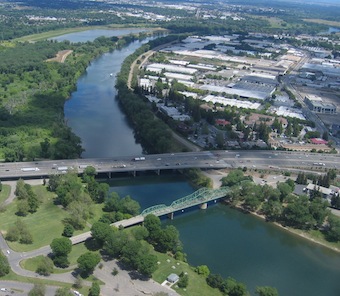
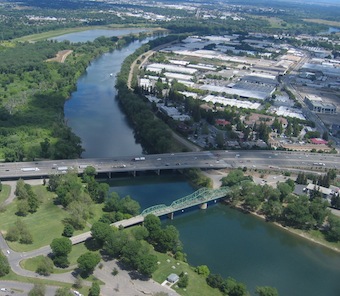
A new project to visually map American waterways will start with California’s Sacramento

The Sacramento River is a lifeline for California.

By the end of the summer, you may be able to float down the Sacramento River from your computer, thanks to the Riverview Project. It’s an initiative to document and map rivers, using similar tools to the ones Google used to create Street View, and with similar results: the ability to drop into a place on a map, click to move down the street (or float down the river), and take a look around.

“There’s reams of data (about rivers),” Jared Criscuolo, one of the founders of the Riverview Project told me. “But the thing we’ve noticed we’re missing is a visual piece.”

Continue reading Take Me to the River (Without Leaving My Desk)

Next-Gen Snow Surveys: “Activate the Laser”

New technology could provide a much clearer picture for water forecasts

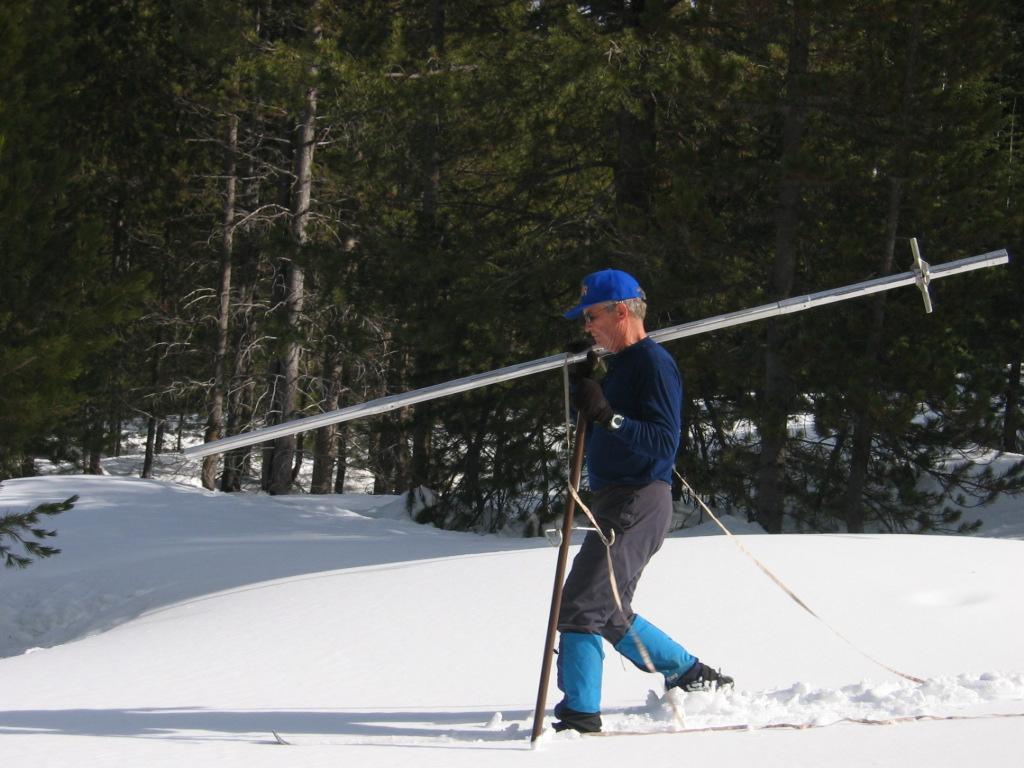
Frank Gehrke conducts a manual snow survey using a "Mt. Rose gauge," essentially a hollow aluminum tube shoved into the snow at predetermined locations.

In California, where most of our water comes from the mountains, being able to accurately measure the snow pack is vital. And it is in outlier years like this — very dry years, though the same goes for very wet ones — when water managers have the hardest time making accurate predictions.

“Knowing the water content of the snow in an entire watershed is the holy grail for snow scientists,” survey guru Frank Gehrke told me.

During the winter, Gehrke trudges into the woods on a monthly basis to do manual snow surveys for the state Department of Water Resources. DWR uses remote snow sensors, too. But even with all that data we don’t get an exact picture of the snow pack. So scientists from National Center for Atmospheric Research (NCAR) and NASA Jet Propulsion Laboratory (JPL) are developing tools to measure snow with lasers. This new technology has the potential to be that holy grail that Gehrke’s looking for.

Continue reading Next-Gen Snow Surveys: “Activate the Laser”

This is Your Atmosphere on Drugs

A new report on extreme weather compares climate change to steroids

The tornado that tore through Joplin, MO in May was one of the worst of last year's extreme weather events. But tornadoes have one of the more tenuous connections to climate change.

As we’ve noted before, last year was packed with extreme weather events, but it’s difficult to out-and-out blame any particular one of them on climate change. Explanations are often along the lines of, “This is the kind of thing that could become the norm in the future.” The science just isn’t quite there to able to pinpoint any single event and say exactly what caused it.

To try to sort out what we know from what we don’t, the University Corporation for Atmospheric Research (UCAR), a consortium of universities doing earth science research, has a new feature on its website, “In Depth: Weather on Steroids,” about that science: the science of attribution, as in, what can we attribute to climate change?

Continue reading This is Your Atmosphere on Drugs

The Unequal Effects of Climate Change

Low-income communities in CA are more vulnerable to climate change-related health risks

The most at-risk families are lower-income and live in more urban areas than the less vulnerable familes.

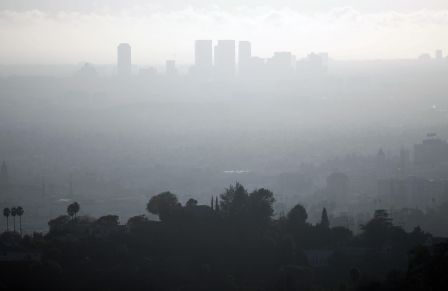
A study by the California Department of Public Health finds that people in poorer areas of Los Angeles and Fresno Counties are more at risk of ill health effects from climate change than those in wealthier neighborhoods. The report found that in LA, neighborhoods on the coast were the most vulnerable, mostly because of sea-level rise, though it also blamed “poor public transit, wildfire risk, and a large proportion of elderly living alone.” In Fresno, there were similar issues (aside from the obvious fact that sea-level rise won’t directly affect the landlocked county).

Continue reading The Unequal Effects of Climate Change

Insurance Industry Awakening to Climate Risks

California will require all major insurers to survey and report climate risks

Insurers in California, Washington, and New York will be required to describe the steps they're taking to address climate change.

Insurance commissioners in three states, including California, are now requiring that insurers report on how they’re preparing for climate change. Insurers will fill out a survey, which was adopted by The National Association of Insurance Commissioners (NAIC) in 2009, but was never implemented by commissioners in all fifty states. Instead, it’s been a piecemeal approach. California administered the survey in 2009 and ’10, requiring all insurers that met a minimum size requirement and that were headquartered in the state to fill it out. Now California is expanding the initiative: all insurers that write premiums worth more than $300 million and do business in the state–not just those based here–will be required to fill out the survey. New York and Washington are doing the same.

The Climate Risk Survey covers general questions: does the company have a climate change policy with respect to risk management and investment management, has the company considered the impact of climate change on its investment portfolio, does the insurer have a plan to assess or mitigate its own emissions?  Continue reading Insurance Industry Awakening to Climate Risks

Snow Survey May Portend a Dry 2013

Skimpy Sierra snowpack may take a while to show up in water supplies

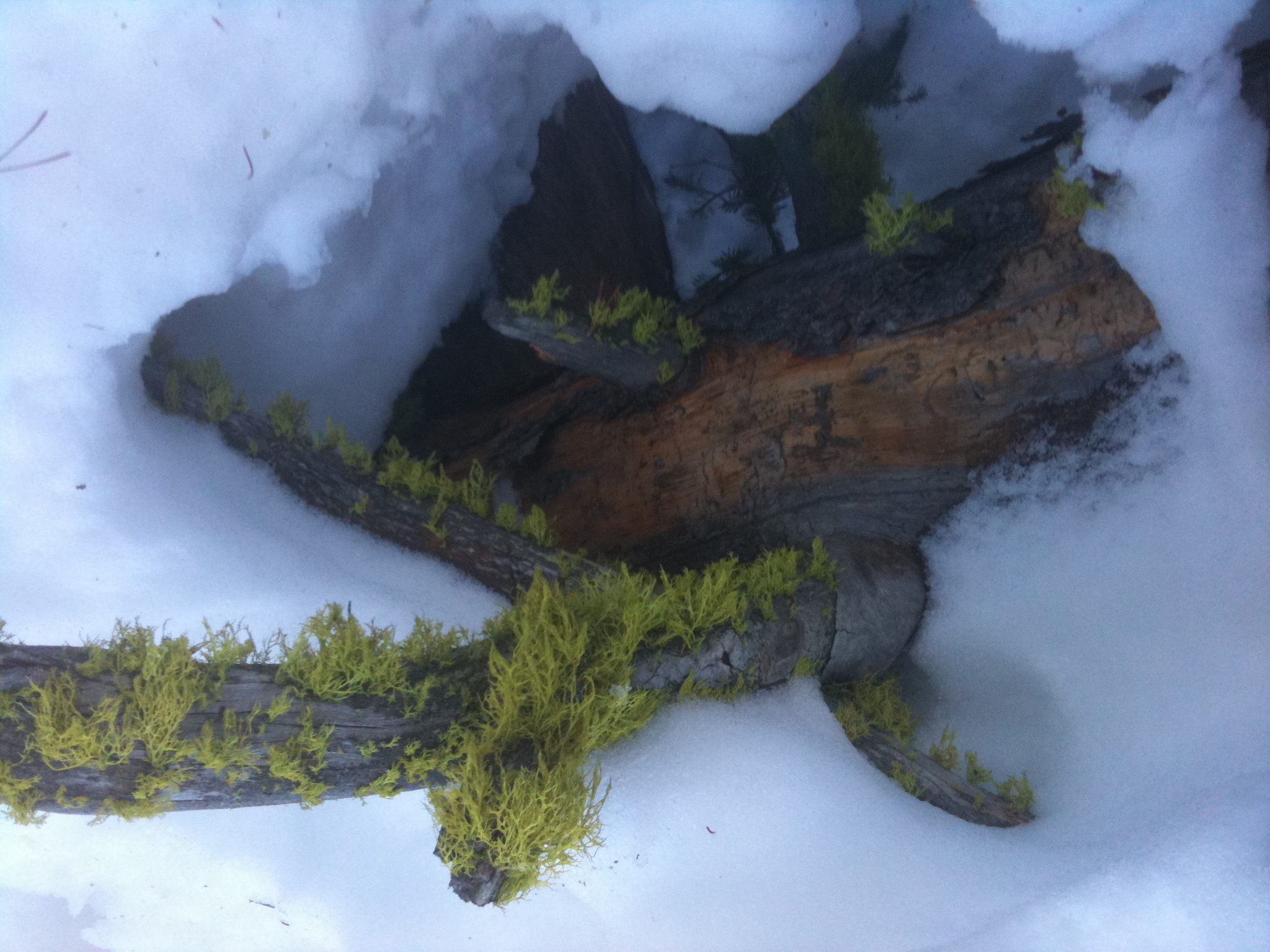
snow Tahoe Sierra California water
After a record dry December, there's finally snow on the ground near Soda Springs, at Lake Tahoe.

This morning’s snow survey (PDF) didn’t turn up any big surprises. As remote sensors foreshadowed, water content in the Sierra snowpack is 37% of normal for this time of year, and less than a quarter of the average for April, which is when the snowpack is usually at its peak before it begins melting and filling up California’s reservoirs.

What’s worrisome about that, according to Jeanine Jones, Interstate Resources Manager at the Department of Water Resources, is that about half of California’s annual precipitation typically falls between December and February, months that are mostly already behind us. “So where we are this year is: November was dry, December was close to record dry, January was maybe half of average,” Jones told me. “And currently the forecast for the first  ten days or so of February is essentially dry.” Continue reading Snow Survey May Portend a Dry 2013

Gov. Brown Signs Agreement to Fast-Track Renewable Projects

Brown and Secretary of the Interior Ken Salazar are expanding a state and federal partnership to expedite large-scale renewable projects.

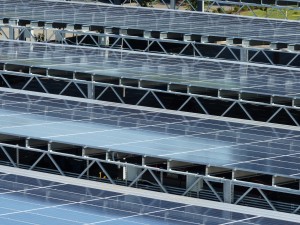
The partnership between the Department of the Interior and the state of California expedites the approval process for large-scale solar, wind, and geothermal projects.” credit=”Craig Miller/Climate Watch

The partnership originates from an agreement then-Governor Arnold Schwarzenegger signed in 2009. Now Brown and Salazar are extending it, and broadening the scope of the agreement, to include not only energy, but also transmission projects. They signed a memorandum of understanding (pdf) at a solar project being built in Elk Grove this morning.

According to a press release from the state, the projects now being fast-tracked, which are the Bureau of Land Management’s seven priority projects, plus other projects on private land, will generate enough renewable energy to meet the state’s 33% by 2020 goal.

The MOU signed today doesn’t guarantee they’ll all be built, rather, it’s a move towards expediting the lengthy permitting process these large-scale projects require.