All posts by Craig Miller

Craig is a former KQED Science editor, specializing in weather, climate, water & energy issues, with a little seismology thrown in just to shake things up. Prior to that, he launched and led the station's award-winning multimedia project, Climate Watch. Craig is also an accomplished writer/producer of television documentaries, with a focus on natural resource issues.

Heat Relief for Coral Reefs?

This post is condensed from a Stanford News Service release. Cassandra Brooks is a science-writing intern at the Woods Institute for the Environment at Stanford.

Reed Galin
Photo: Reed Galin

Stanford scientists find heat-tolerant coral reefs that may resist climate change

By Cassandra Brooks

Some experts say that more than half of the world’s coral reefs could disappear in the next 50 years, in large part because of higher ocean temperatures caused by climate change. But now Stanford University scientists have found evidence that some coral reefs are adapting and may actually survive global warming.

“Corals are certainly threatened by environmental change, but this research has really sparked the notion that corals may be tougher than we thought,” said Stephen Palumbi, a professor of biology and a senior fellow at Stanford’s Woods Institute for the Environment.

Palumbi and his team began studying the resiliency of coral reefs in the Pacific Ocean in 2006. “The most exciting thing was discovering live, healthy corals on reefs already as hot as the ocean is likely to get 100 years from now,” said Palumbi, director of Stanford’s Hopkins Marine Station. “How do they do that?”

Coral reefs form the basis for thriving, healthy ecosystems throughout the tropics. They provide homes and nourishment for thousands of species, including schools of fish that feed millions of people across the globe.

Corals rely on partnerships with tiny, single-celled algae called zooxanthellae. The corals provide the algae a home, and, in turn, the algae provide nourishment, forming a symbiotic relationship. But when rising temperatures stress the algae, they stop producing food, and the corals spit them out. Without their algae symbionts, the reefs die and turn stark white, an event referred to as “coral bleaching.”

During particularly warm years, bleaching has accounted for the deaths of large numbers of corals. In the Caribbean in 2005, a heat surge caused more than 50 percent of corals to bleach, and many still have not recovered, according to the Global Coral Reef Monitoring Network, an international collaboration of government officials, policymakers and marine scientists, including Palumbi.

Havens of healthy reefs

In recent years, scientists discovered that some corals resist bleaching by hosting types of algae that can handle the heat, while others swap out the heat-stressed algae for tougher, heat-resistant strains. Palumbi’s team set out to investigate how widely dispersed these heat-tolerant coral reefs are across the globe and to learn more about the biological processes that allow them to adapt to higher temperatures.

In 2006, Palumbi and graduate student Tom Oliver, now a postdoctoral researcher at Stanford, traveled to Ofu Island in American Samoa. Ofu, a tropical coral reef marine reserve, has remained healthy despite gradually warming waters.

The island offered the perfect laboratory setting, Oliver said, with numerous corals hosting the most common heat-sensitive and heat-resistant algae symbionts. Ofu also has pools of varying temperatures that allowed the research team to test under what conditions the symbionts formed associations with corals.

In cooler lagoons, Oliver found only a handful of corals that host heat-resistant algae exclusively. But in hotter pools, he observed a direct increase in the proportion of heat-resistant symbionts, suggesting that some corals had swapped out the heat-sensitive algae for more robust types. These results, combined with regional data from other sites in the tropical Pacific, were published in the journal Marine Ecology Progress Series in March 2009.

Global pattern

To see if this pattern exists on a global scale, the researchers turned to Kevin Arrigo, an associate professor of environmental Earth system science at Stanford and an expert on remote satellite sensing of marine microalgae. Arrigo gathered worldwide oceanographic data on a variety of environmental variables, including ocean acidity, the frequency of weather events and sea-surface temperature.

Oliver then compiled dozens of coral reef studies from across the tropics and compared them to Arrigo’s environmental data. The results revealed the same pattern: In regions where annual maximum ocean temperatures were above 84 to 88 degrees Fahrenheit (29 to 31 degrees Celsius), corals were avoiding bleaching by hosting higher proportions of the heat-resistant symbionts.

Most corals bleach when temperatures rise 1.8 F (1 C) above the long-term normal highs. But heat-tolerant symbionts might allow a reef to handle temperatures up to 2.6 F (1.5 C) beyond the bleaching threshold. That might be enough to help get them through the end of the century, Oliver said, depending on the severity of global warming.

A 2007 report by the United Nations International Panel on Climate Change concluded that the average surface temperature of the Earth is likely to increase 3.6 to 8.1 F (2 to 4.5 C) by 2100. In this scenario, the symbiont switch alone may not be enough to help corals survive through the end of the century. But with the help of other adaptive mechanisms, including natural selection for heat-tolerant corals, there is still hope, Oliver said.

Heat-resistant corals also turn out to be more tolerant of increases in ocean acidity, which occurs when the ocean absorbs excess carbon dioxide from the atmosphere–another potential threat to coral reefs. This finding suggests that corals worldwide are adapting to increases in acidity as well as heat, Oliver said, and that across the tropics, corals with the ability to switch symbionts will do so to survive.

“Although we are doing things to the planet we have never done before, it’s hard to imagine that these corals, which have existed for a quarter of a billion years, only have 50 years left,” Palumbi said. “And part of our job might be to figure out where the tougher ones live and protect those places.”

For more on this story:
MICRODOCS: BRINGING THE LAB TO THE REEF

MICRODOCS: EXPERIMENTING WITH GLOBAL WARMING

Paddling to the Sea

Jessie Raeder is Bay Area Organizer for the Tuolumne River Trust. More than 200 paddlers are expected to take to the river between now and June 7, for this river awareness relay. Raeder offers this dispatch from the starting line, near the headwaters in Yosemite National Park.

By Jessie Raeder

Paddle to the Sea got off to a roaring start over the weekend.  Melting snow caused by an early heat wave in the Sierras had the river pumping at much higher flows than rafters typically face. The Tuolumne is usually rated Class 4–but goes to Class 5 when flows get over 4000 cubic feet per second.   This weekend saw the river flowing at 7000 cfs! For a while it looked like we might have to cancel all the whitewater trips due to safety concerns, but in the end one trip did go on and needless to say it was an epic journey for our Paddle-to-the-Sea team.

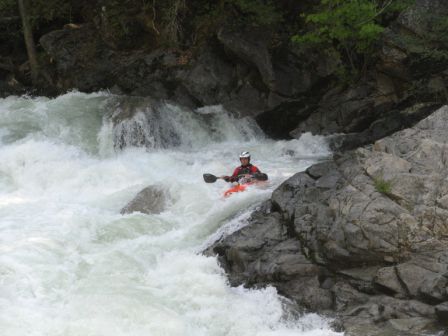
A paddler takes on the Clavey. Photo:
A paddler takes on the Clavey. Photo: Patrick Koepele, Tuolumne River Trust

Meanwhile, an international team of 12 hotshot kayakers ran the Clavey River, a tributary of the Tuolumne and one of only three remaining free-flowing rivers in the Sierra.  The Clavey is a class 5+ river that’s rarely run and only by experts.

Paddle to the Sea is a three-week festival to foster stewardship of the Tuolumne River. Hundreds are joining in this epic journey from the Sierra to the Sea. Kayakers and rafters will begin on the upper stretches of the Clavey and Tuolumne Rivers, travel through the Central Valley where canoers take the lead, pass through the confluence of the Tuolumne and San Joaquin Rivers, and sea kayakers will finish the trip in San Francisco Bay.

A changing and increasingly unpredictable water supply will be the first way that most people in California experience climate change affecting their own lives.  Here in the Bay Area, tap water for 2.5 million people comes from the Tuolumne River, whose headwaters start with melting snow from the Lyell Glacier (picture attached).  That glacier is on the retreat, and more frequent droughts are expected throughout the Sierra.

Paddle to the Sea is meant to demonstrate that issues that affect one section of the river ripple up and down the watershed.   Bay Area water users share this resource with farmers in Modesto, anglers in Yosemite, the commercial salmon industry on the Pacific, and a host of native fish, plant, and wildlife species, many of which are endangered.

As population and demand for water continues to grow, California will be faced with many questions about how we use water, and where it will come from.  The Tuolumne River Trust is working to ensure that we turn to water efficiency and water recycling as much as possible–alternatives which are far more sustainable and renewable than continuing to take additional water from the Tuolumne River, which has been the solution most turned to in the past.


“The Australian Reality”

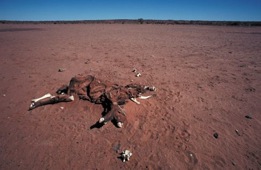
Australia's Simpson Desert. Photo: Mike Gillam

Referring to Australia’s seven-year drought, that’s how the state’s top water manager describes the new paradigm for water planning at the Dept. of Water Resources.

Speaking to a packed house at the annual forum of the Sacramento River Watershed Program yesterday, DWR Director Lester Snow said his staff is assuming that 2010 will be another dry year. Snow warned about “loss of resilience” in the state’s water system, calling it “completely unsustainable” in it’s present form, given predictions for population growth, coupled with anticipated effects of climate change.

All speakers at the forum seemed to agree that a paradigm shift is in order. Thomas Philps, a strategist at SoCal’s Metropolitan Water District, pointed out that in Victoria’s capital city of Melbourne (Australia), per capita water consumption runs about 40 gallons per day, while in California’s capital, it’s 280 gallons. As Sasha Khoka will report Monday morning on The California Report, Sacramento is just one of several cities in the Central Valley that still doesn’t meter its water use. Philps added that the Sacramento region is “on a trajectory” to use the same volume of water as Los Angeles, though he did not say by when.

UC Davis geologist Jeff Mount cautioned against relying on additional surface storage to secure California’s water future. Not only does storing water become “very expensive” year over year, but dams and reservoirs “don’t create any new water,” he said. (If some think Mount is taking a “jaundiced view” of the situation, it might be because he braved a bout of hepatitis to deliver his morning talk)

In a panel discussion on resource planning, moderator Greg Zlotnick of the Santa Clara Valley Water District asked panelists to respond with “true” or “false” to a quote from the Pacific Institute’s Peter Gleick in a story aired on NPR last week. The quote, as given by Zlotnick, was: “Government has built infrastructure and made promises that can’t be kept.” Here are the panelists’ responses:

Tina Swanson, The Bay Institute: “True.”

Philps: “True, but…” (Generally true but MWD doesn’t really expect to get its full contractual allocation of water anymore, anyway)

Don Glaser, US Bureau of Reclamation: “False, but…” (Water allotments from his agency’s Central Valley Project are intended to be “supplemental contracts,” to augment use of groundwater and other sources, but Glaser sees the statement becoming “more and more true in the future.”)

Snow: “Hell, no.”

Dancing With the Devil

Sometimes that’s what it feels like, confronting another fire season in California. But last week, network news videographer Tim Walton found himself literally in that position, while covering the Jesusita Fire near Santa Barbara.

Walton spends much of his time chasing the state’s most threatening wildfires, shooting video for outlets like NBC Nightly News.

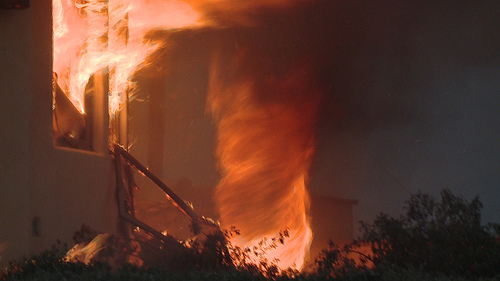
Santa Barbara "Fire Devil." Photo: Tim Walton

On Wednesday (5/6) he was shooting a “fully involved” home, when he was visited by a dangerous and awe-inspiring presence. In an email, he writes:

“I was filming the house when it felt like someone was standing next to me. I panned the camera over and this “fire devil” was spinning around outside the burning house. It came out a window for a few seconds and went right back where it came from in the house (of course “it” is just gases that were sucked out of the burning house by the wind and ignited by the heat).  The vortex stays as long as the wind.

BTW this fire started on the same date as the Summit Fire did last year, I observed the same type of fire behavior we saw early last season. I think we are in for a very interesting year. “

Fire devils are also referred to as “fire tornadoes” or “fire whirls.” Walton’s remarkable collection of photos from California wildfires is posted at his Flickr site. The photo of this “devil” is actually a still frame from some of his HD video:

NPR Spotlights California Water Issues

farm_0799_blog1

NPR’s Morning Edition launched an “occasional series” on California’s water woes this morning. Veteran correspondent John McChesney begins with the impact on agriculture in the Central Valley’s Westlands Water District, the nation’s “biggest irrigated region.”

KQED’s Central Valley Bureau Chief and Climate Watch contributor Sasha Khokha will have three stories in the series, two of which will debut on The California Report in the weeks ahead:

WATER METERS: Many California cities are preparing for or implementing mandatory water rationing this summer. But there are still cities and towns, particularly in California’s Central Valley, where water can’t be rationed because residents don’t even have water meters.  Residents are charged a flat rate for any amount of water they use. Khokha looks at the city of Fresno, where water meters will be phased in, but not until 2013.

MENDOTA PROFILE: The town of Mendota in California’s Central Valley is at the heart of the economic crisis spawned by drought and the loss of farm jobs.  Sam Rubio grew up here, the son of a Mexican farmworker.  He went off to college, and was planning to become a doctor, but instead has returned to this town to teach biology, mentor local kids, and run a café that’s become a haven for the farmworker youth.

AG ADAPTING TO DROUGHT: California farmers are facing an increasingly uncertain water supply, brought about by drought, environmental restrictions on pumping, and climate change. How will farmers adapt? Some of them are yanking out water-intensive crops and replacing them with more drought-tolerant ones. But others are trying to keep growing the same crops with improved technology. We’ll follow a new tech start-up that’s helping farmers use water more efficiently by tracking how much moisture reaches each plant in their fields–and sending a satellite message to their cell phones. We’ll also talk with a researcher who says there are ways California can grow some key crops, like oranges and nuts, using less water.


Decoding California’s Drought History

Abbie Tingstad is a paleoclimatologist at UCLA. She specializes in reconstructing drought records in the western United States, and takes us along on some of her field research in this guest post:

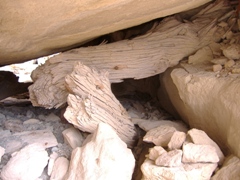
Part of a Piñon pine beam under the collapsed rock shelter. This beam was one of several sampled for tree ring analysis. Photo by Abbie Tingstad.
Part of a Piñon pine beam under a collapsed rock shelter. This beam was one of several sampled for tree ring analysis. Photo by Abbie Tingstad.

By Abbie Tingstad

The site was so remote we needed a team of archaeologists and a couple of heavy-duty 4x4s to get us there.

Deep within the rocky piñon-juniper cliffs of northwestern Colorado was a secret so well hidden I didn’t see it until I was physically inside, face-to-face with a series of hand prints made over a thousand years ago. This rock shelter was occupied during Medieval times by Fremont Indians, contemporaries of the Anasazi whose cultural center was further south in the Four Corners Region. The site had already been excavated, but our interest as dendroclimatologists was not in artifacts. We had come to take samples from the ancient piñon and juniper beams that once supported this structure for the valuable paleoclimate information contained within their annual growth rings.

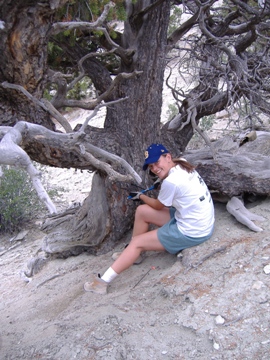
Tingstad sampling a live Piñon pine tree in northeastern Utah. This tree is about 550 years old. Photo by Glen MacDonald.

Gathering Medieval climate information from tree rings, lake sediments, and other natural climate archives in the Western US is critically important for understanding the implications of increasing temperatures in this region, particularly when it comes to future water supply and demand.

Research has confirmed that temperatures rose in the Western U.S. from about A.D. 800-1300, which translated into a series of droughts. The most devastating of these occurred in the mid-11th and 12th Centuries, when dry conditions persisted for several decades and may have contributed to the collapse of the Anasazi and Fremont cultures.

Paleoclimate data from tree rings and other sources also suggest that the mechanism driving drought during the “Medieval Warm Period” was eastern Pacific Ocean cooling. Like a widespread, extended La Niña event, cool sea surface temperatures may have strengthened the persistent moisture-blocking system of high-pressure off the West coast, nudging storm tracks north.

While the Medieval period is an instructive analogue for the warming we are beginning to experience, it is an imperfect one. Two major factors separate the episode the Fremont and Anasazi experienced a thousand years ago from what we are just beginning to undergo today. First, Medieval warming appears to have been fostered by a combination of increased solar irradiance and decreased volcanic activity, rather than anthropogenic greenhouse gas emissions. Secondly, Medieval times were characterized mainly by summer warming, while winter and spring temperatures are expected to increase most dramatically in the future. These differences manifest themselves in many ways, but notable for the water-starved West are the implications for decreased winter snowpack and earlier spring river discharge.

The Medieval Warm Period may not offer a precise preview of our future, but it serves as a valuable warning about the tenuous balance of water supply and demand in California and the Western US, something the occupants of the Fremont rock shelter we visited were likely aware of.

Since the turn of the new Millennium, drought has been the norm rather than the exception in this region and the end is not in sight: As of May 1, 2009 surveys suggest that the Sierra Nevada snowpack is two-thirds of normal. What we can learn from Medieval times is not to expect “normally” moist conditions to return any time soon, and to plan accordingly.

Pika One Step Closer to ESA Listing


American pika. Photo by Chris Ray.

UPDATE: Federal fish & wildlife authorities have decided to proceed with a full review of the American pika, for potential listing under the Endangered Species Act. The US Fish & Wildlife Service will formally publish its decision this week, including this summary:

“We, the U.S. Fish and Wildlife Service, announce a 90-day finding on a petition to list the American pika (Ochotona princeps) as threatened or endangered under the Endangered Species Act of 1973, as amended. We find that the petition presents substantial scientific or commercial information indicating that listing of the American pika may be warranted. Therefore, with the publication of this notice, we are initiating a status review of the species, and we will issue a 12-month finding to determine if the petitioned action is warranted. To ensure that the status review is comprehensive, we are soliciting scientific and commercial data regarding this species. We will make a determination on critical habitat for this species if, and when, we initiate a listing action.”

The Center for Biological Diversity (CBD) first petitioned for listing in 2007, and then followed with a lawsuit a year later, when federal authorities shelved the request.

The significance of this week’s decision, according to a CBD news release, is that “the pika will become the first mammal considered for protection under the Act due to global warming in the continental United States outside of Alaska.”

Last month a San Francisco court ruled that state wildlife officials wrongly denied the CBD’s petition for listing under California’s ESA. So it looks like the little critter will get a fresh review at both the state and federal levels.

Short-Term Data Clouds the Climate Picture

Two established climate scientists have issued a warning about using short-term data in arguments over climate change. This is such a common point of confusion that I’ve published the news release from Lawrence Berkeley National Lab, in its entirety:

BERKELEY, CA – In the hotly debated arena of global climate change, using short-term trends that show little temperature change or even slight cooling to refute global warming is misleading, write two climate experts in a paper recently published by the American Geophysical Union–especially as the long-term pattern clearly shows human activities are causing the earth’s climate to heat up.

In their paper “Is the climate warming or cooling?” David R. Easterling of the National Oceanographic and Atmospheric Administration’s National Climatic Data Center and Michael Wehner of the Computational Research Division at the Department of Energy’s (DOE) Lawrence Berkeley National Laboratory note that a number of publications, websites and blogs often cite decade-long climate trends, such as that from 1998-2008, in which the earth’s average temperature actually dropped slightly, as evidence that the global climate is actually cooling.

However, Easterling and Wehner write, the reality of the climate system is that, due to natural climate variability, it is entirely possible, even likely, to have a period as long as a decade or two of “cooling” superimposed on the longer-term warming trend. The problem with citing such short-term cooling trends is that it can mislead decision-makers into thinking that climate change does not warrant immediate action. The
article was published April 25 in Geophysical Research Letters.

“We wrote this paper, which was carefully reviewed by other researchers and is scientifically defensible, to clearly show that even though our climate is getting warmer, we can’t expect it to do so in a monotonic way–or that each year will be warmer than the preceding year,” said Wehner. “Even with the climate changes caused by human activity, we will continue to see natural variability including periods of cooler temperatures despite the fact that globally averaged temperatures show
long-term global warming.”

“It is easy to ‘cherry pick’ a period to reinforce a point of view, but this notion begs the question, what would happen to the current concerns about climate change if we do have a sustained period where the climate appears to be cooling even when, in the end, the longer term trend is warming?” write Easterling and Wehner.

The research was funded by the DOE Office of Science’s Office of Biological and Environmental Research through its Climate Change Prediction Program.

Citing an accepted climate modeling scenario in which no efforts are made to reduce the amount of greenhouse gases released into the atmosphere, the earth’s climate is expected to warm by 4 degrees Celsius (7.2 degrees Fahrenheit) by the end of the 21st century. The authors point out that this is consistent with other simulations contained in the Fourth Assessment Report (AR4) of the Intergovernmental Panel on Climate Change (IPCC 2007), which was recognized with the 2007 Nobel Peace Prize.

“Climate scientists pay little attention to these short-term fluctuations as the short term ‘cooling trends’…are statistically insignificant and fitting trends to such short periods is not very meaningful in the context of long-term climate change,” the authors write. “On the other hand, segments of the general public do pay attention to these fluctuations and some critics cite the most recent period as evidence against anthropogenic-forced (human-induced) climate change.”

The authors used both observed climate data from 1901-2008 and a series of climate model simulations performed on supercomputers to study the occurrence of decade-long trends in globally averaged surface air temperature. They found that it is possible, and indeed likely, to see periods as long as a decade in the recent past which do not show a warming trend. The authors even found that running computer simulations for the 21st century with significant increases in greenhouse gas emissions showed some decades with lower or static average temperatures. One such example can be found by looking at data from 1998 to 2008, which shows no real trend, even though global temperatures remain well above the long-term average.

According to the authors, the unusually strong 1997-98 El Niño contributed to unusual warmth in the global temperature for 1998, so that without similar dramatic changes, the following decade does not appear to be warming. A similar interpretation can be made by looking at the short-term data from 1977-85 or 1981-89, “even though these periods are embedded in the 1975-2008 period showing a substantial overall
warming,” Easterling and Wehner write. In the first example, dropping data from 1998 and looking at 1999-2008, the researchers found a strong warming trend.

Berkeley Lab is a U.S. Department of Energy national laboratory located in Berkeley, California. It conducts unclassified scientific research and is managed by the University of California.

Editors’ Note: Of course, this cuts both ways. Though it may be tempting to do so, it’s no more legitimate to point to the latest heat wave or a single fire season as proof of global warming. This is a conundrum that makes it difficult to find consensus on pubic policy. There are additional links posted with the full news release at the LBNL site.

Pivotal Week for Pika Protection

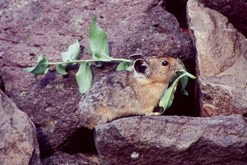
American pika. Photo by Chris Ray.

Note that an update to this story was posted on May 6.

The hamster-sized, high-elevation haymaker known as the American Pika has had its “day” in court–and then some. Now it may be making inroads toward listing as a threatened species, while questions persist over whether that would be premature.

Friday was the deadline for officials at the U.S. Fish & Wildlife Service to decide whether to further consider the pika for listing under the federal Endangered Species Act.

The San Francisco-based Center for Biological Diversity (CBD) has been pursuing listing for the pika under both the state and federal Endangered Species Acts. On April 16, a Superior Court judge in San Francisco ruled that the California Fish and Game Commission applied too stringent a standard, when it voted last year to reject the CBD’s petition to list the pika under the California law. The CBD says it expects the court to formally order the state to go back and take a second look at whether the critter deserves protection.

Meanwhile federal wildlife officials had until May 1 to decide whether to formally review the pika’s plight and consider listing it under federal law. A response is expected to be published in the Federal Register this week.

Complicating the case is an apparent difference between the fate of pika populations in the Great Basin, where field research clearly shows pika colonies in trouble, and colonies in the Sierra Nevada range, which may be faring better.

Pika thrive only at high elevations, in the rocky conditions known as talus. Their band of tolerance for temperature is very narrow, so some biologists see them as an indicator species for global warming. Temperatures that humans may consider merely balmy, can be fatal for pika.


Chris Ray, an ecologist at the University of Colorado, has studied pika in the mountain ranges of the Great Basin. She’s identified and ranked several stress factors that pose threats to the animals, including habitat shrinkage and exposure to both heat and cold.

Ray, who presented her latest research at the USGS-sponsored Pacific Climate Workshop last month, is cautious about endorsing an ESA listing just yet, saying: “I do not think there are data indicating that the species as a whole is in danger of extinction, however the loss of isolated populations from the Great Basin has me concerned.”

“I think it’s very reasonable to consider potentially listing some sub-populations of pika.” Ray says that in order to do that, a case would have to be made that there are genetically distinct sub-species of pika. In its petition, CBD claims that five sub-species have been identified in California. But scientists at UC Berkeley and the U.S. Forest Service who have done field research in the Sierra, have said it’s less clear that those colonies are in trouble.

CBD staff biologist Shaye Wolf says a 1995 study found “evidence for four genetic units across the pika range, roughly grouped as Sierra Nevada, Cascades, Southern Rockies, and Northern Rockies. However, better genetic analyses using more sensitive genetic markers (like microsatellites) are necessary to understand pika population structure.”

Wolf says that for its ESA petition, the CBD drew on a 1981 study that used population distribution to break out 36 “subspecies” of pika.

Sierra Snow Season Ends with a Whimper

Surveyor Frank Gehrke takes on last poke at the season's shrinking snow pack. Photo by Craig Miller.
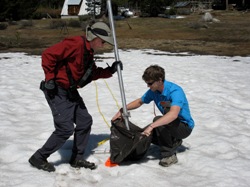
Surveyor Frank Gehrke takes one last poke at the season's shrinking snow pack. Photo by Craig Miller.

When veteran snow surveyor Frank Gehrke stuck his aluminum tube into the thinning snow course at Phillips Station this morning, the “Mount Rose” snow gauge stopped dead a few inches in. He then withdrew a sad little cylinder of corn snow, about the size of a flashlight battery. There was barely a foot of snow left at this measuring station, 6,900 feet above sea level. Water content: 35% of normal. Yikes. Of course, that’s just one station among many surveyed on a monthly basis to help handicap the coming summer’s water supply.

The numbers are in for the season’s last snow survey: On average throughout the Sierra Nevada, water content clocks in at 66% of normal for this date. Last year at this time it was 72% of normal. The southern third of the Sierra came in at 61%.

So even with that hope-lifting late-season burst of precipitation that started in mid-February, we ended up even worse than last year–at least in terms of the snowpack. Some local reservoirs filled up nicely with the soggy spring. The trouble, says Gehrke, is that “The big ones didn’t.”

Some municipal water districts have vacillated on rationing plans for the summer. But the big state and federal systems that supply irrigation water to farms have largely stuck with their drastic cuts in allocations this year.

The bottom line, according to state water director Lester Snow:  “When combined with extremely dry years in 2007 and 2008, low storage in the state’s major reservoirs, restrictions on Delta pumping, a growing population and prediction of increasingly unpredictable weather patterns due to climate change, it is clear the problems facing California will persist beyond this year and this drought.”

Official drought proclamations have been a source of some controversy since the rain finally began falling in February. The Department of Water Resources has produced a statewide water plan and put it up for comment until June.