All posts by Craig Miller

Craig is a former KQED Science editor, specializing in weather, climate, water & energy issues, with a little seismology thrown in just to shake things up. Prior to that, he launched and led the station's award-winning multimedia project, Climate Watch. Craig is also an accomplished writer/producer of television documentaries, with a focus on natural resource issues.

No Shockers in White House Climate Report

The Obama Administration released a much-vaunted update on climate change today. In its nearly 200 pages, the report contains no new data and few new conclusions on the pace and impact of climate change across the U.S. Rather it affirms the core findings of recent research and sounds the alarm for rapid, definitive action to reduce carbon emissions and prepare for changes already on the way.

In a statement from Lawrence Berkeley National Lab, Evan Mills, one of the report’s 28 co-authors, calls it “the most thorough and up-to-date review ever assembled of climate-change impacts observed to date as well as those anticipated in the future across the United States.” Mills is one of two northern California scientists listed in the report’s credits, along with Ben Santer of Lawrence Livermore National Lab.

One clear signal from the report is that it’s time to move adaptation strategies to the front burner; preparing for climate effects already in the pipeline.

Louis Blumberg directs the California climate change team for The Nature Conservancy, and told me in a telephone interview this morning, “I would say it’s a very clear signal that even if we dramatically reduce emissions immediately, which we need to do as soon as possible, we’ve already put enough CO2 into the atmosphere where we’re going to have have significant changes to our way of life. And we need to begin now and plan to adapt to these unavoidable impacts and I think this report underscores that urgency.”

But neither Blumberg nor Mills have given up on the mitigation side. Mills says “the good news is that the harshest impacts of future climate change can be avoided if the nation takes deliberate action soon.”

Here is a summary of  “key findings,” taken directly from the report:

1. Global warming is unequivocal and primarily human-induced.

Global temperature has increased over the past 50 years. This observed increase is due primarily to human-induced emissions of heat-trapping gases.

2. Climate changes are underway in the United States and are projected to grow.

Climate-related changes are already observed in the United States and its coastal waters. These include increases in heavy downpours, rising temperature and sea level, rapidly retreating glaciers, thawing permafrost, lengthening growing seasons, lengthening ice-free seasons in the ocean and on lakes and rivers, earlier snowmelt, and alterations in river flows. These changes are projected to grow.

3. Widespread climate-related impacts are occurring now and are expected to increase.

Climate changes are already affecting water, energy, transportation, agriculture, ecosystems, and health. These impacts are different from region to region and will grow under projected climate change.

4. Climate change will stress water resources.

Water is an issue in every region, but the nature of the potential impacts varies. Drought, related to reduced precipitation, increased evaporation, and increased water loss from plants, is an important issue in many regions, especially in the West. Floods and water quality problems are likely to be amplified by climate change in most regions. Declines in mountain snowpack are important in the West and Alaska where snowpack provides vital natural water storage.

5. Crop and livestock production will be increasingly challenged.

Agriculture is considered one of the sectors most adaptable to changes in climate. However, increased heat, pests, water stress, diseases, and weather extremes will pose adaptation challenges for crop and livestock production.

6. Coastal areas are at increasing risk from sea-level rise and storm surge.

Sea-level rise and storm surge place many U.S. coastal areas at increasing risk of erosion and flooding, especially along the Atlantic and Gulf Coasts, Pacific Islands, and parts of Alaska. Energy and transportation infrastructure and other property in coastal areas are very likely to be adversely affected.

7. Threats to human health will increase.

Health impacts of climate change are related to heat stress, waterborne diseases, poor air quality, extreme weather events, and diseases transmitted by insects and rodents. Robust public health infrastructure can reduce the potential for negative impacts.

8. Climate change will interact with many social and environmental stresses.

Climate change will combine with pollution, population growth, overuse of resources, urbanization, and other social, economic, and environmental stresses to create larger impacts than from any of these factors alone.

9. Thresholds will be crossed, leading to large changes in climate and ecosystems.

There are a variety of thresholds in the climate system and ecosystems. These thresholds determine, for example, the presence of sea ice and permafrost, and the survival of species, from fish to insect pests, with implications for society. With further climate change, the crossing of additional thresholds is expected.

10. Future climate change and its impacts depend on choices made today.

The amount and rate of future climate change depend primarily on current and future human-caused emissions of heat-trapping gases and airborne particles. Responses involve reducing emissions to limit future warming, and adapting to the changes that are unavoidable.

On KQED Public Radio’s Forum for Wednesday, 6/17

9am Forum with Michael Krasny
White House Climate Report
We discuss the report, as well as federal climate change legislation from Congressmen Henry Waxman and Ed Markey. Guests include Dan Kammen, professor of energy at UC Berkeley and co-director of the Berkeley Institute of the Environment; and Katharine Hayhoe, professor of geophysics at Texas Tech University and a lead author of the climate study.
Speed Bumps on the “Hydrogen Highway”

Seems like the Governor is spending a lot of time looking at cars lately. If the rest of us spent as much time cruising Auto Row, the recession might already be fading in the rear-view mirror.

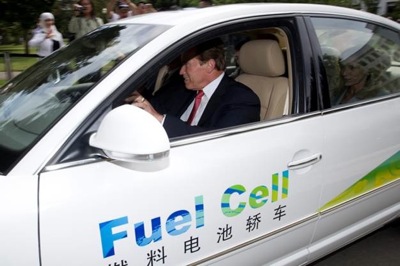
Governor Schwarzenegger tries out the Volkswagen Passat Lingyu. Photo: Governor's Office
Governor Schwarzenegger at the wheel of a Volkswagen Passat Lingyu. Photo: Governor's Office

But California’s chief executive isn’t interested in run-of-the-mill rolling stock (he will, of course, happily take credit for inventing the Hummer). He’s into exotics: the alternative-fuel cars of the future–and in some cases, present.

At least five times in the last three weeks, the Governor’s Office has created photo ops with alt-fuel autos, prototypes or refueling stations; from a fuel-cell Volkswagen (June 3) to the Mutt-&-Jeff of electrics, Hummer and Peapod (May 28 & June 10, respectively), he’s kicked the tires on a whole generation of not-widely-available wheels–not to mention the home ethanol refinery (June 4) or the hydrogen refueling station in Santa Monica (May 27).

All of which got us to wondering: “Dude, where’s our Hydrogen Highway?” You may recall the Governor’s promise five years ago, that California would by now be coming down the home stretch on a whole new infrastructure for the coming swarm of cars powered by hydrogen fuel cells.

Monday morning on KQED’s weekly Quest radio feature, David Gorn reports that we’ve apparently hit a few speed bumps:

“The technology clearly has promise, but it’s behind schedule. Schwarzenegger’s original plan called for 100 to 150 hydrogen fuel stations by next year, and so far there are only about two dozen. He also wanted 2,000 hydrogen-powered cars on the road, yet fewer than 200 are being road-tested today. The lack of progress has prompted California’s non-partisan state legislative analyst to recommend scrapping state funding for the hydrogen program. And on the federal level, Energy Secretary Steven Chu has asked Congress to cut about half of the national hydrogen-research budget. Chu said hydrogen technology is too far from fruition.”

None of these details stopped Governor  Schwarzenegger from hyping the 2009 Hydrogen Road Tour, a recently concluded San Diego-to-Vancouver rally, designed to highlight fuel-cell technology:

“We will keep pushing, and thanks to our public-private partnerships and the commitment of these automakers and energy companies, the era of pollution-free transportation is dawning.”

The Governor’s statement went on to say that “Auto manufacturers expect the number of hydrogen vehicles to increase to 4,300 by 2014 and more than 40,000 vehicles by 2017.” Of course, that was before Energy Secretary Steve Chu announced that R&D funding for hydrogen fuel cells on the road didn’t quite make the cut for the next DOE budget. Plug-in hydrid, anyone?

Transportation’s Tricky Carbon Footprint

Kristine Wong is our Climate Watch intern for the current term. She’s a student at UC Berkeley’s Graduate School of Journalism.

interchange_0145_blogStudy comparing environmental impact of transportation modes yields surprising results
By Kristine Wong

You may not believe that during peak commute hours, Boston’s light rail system generates more greenhouse gases (GHGs) per person than a gas-powered, fully occupied SUV–or a commercial airliner filled to capacity, traveling the same distance.

Yet this is what UC Berkeley researchers found in a study released this week. Mikhail Chester and Arpad Horvath compared the environmental impacts of cars, buses, planes, and rail after adding up all the energy costs and emissions (both GHGs and local air pollutants) over their entire life cycle–not just by what came out of the tailpipe. The authors say no such comprehensive study had been done before.

The researchers developed a method that evaluated each transportation mode based on the energy inputs needed for production and maintenance of the vehicle itself. They also looked at the infrastructure for each mode, such as construction of supporting components like rail station platforms and airport runways, bus and rail station lighting and parking, and the source of  power for each mode (e.g. gasoline, jet fuel, diesel or electric–and the costs of distributing and producing these inputs).

In total, Chester and Horvath compared 79 components across all transportation modes. Within each they also selected a few variations to represent differences, depending on factors such as vehicle make and mileage, passenger occupancy, and size.

The results were both logical and surprising. Most of the energy consumed and GHG emissions from auto, bus and air travel originated from the operational period, not from the materials needed to produce and maintain the vehicles. Rail produced the greatest amount of GHGs compared to all other modes over their life cycle. But Chester and Horvath point out that there is a big difference in GHG emissions from light rail systems in the Bay Area versus, say, Boston due to the portion of fossil fuel-based electricity used. Boston’s fuel mix is 82% fossil, while the Bay Area’s BART system clocks in at just 49% fossil fuel–a major factor in efficiency and GHG emission rates.

Finally, passenger occupancy was a key factor influencing efficiency. Not surprisingly, each mode was most efficient when used to capacity. But the researchers caution that boosting passenger occupancy is not a magic bullet. They say minimizing fossil fuel inputs and adding pollution filters and controls would have a greater effect on efficiency.

Chester and Horvath say that they hope their results will provide a framework for more comprehensive analysis of the environmental impacts of transportation, and to assess the impact of hybrid or electric vehicles and alternative energy sources such as biofuels, solar power, and wind power, none of which were included in the study.

There are more details of the study posted at the websites for Green Car Congress and Sustainable Transportation.

River Diaries, Part 4: Homecoming

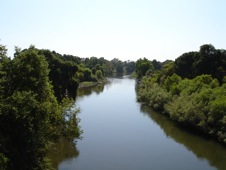
Tuolumne River, near Modesto. Photo: National Weather Service

The Tuolumne River Trust’s Paddle to the Sea project concludes today on the San Francisco waterfront. This is another journal entry from Emilio Martinez, one of two paddlers who traveled the entire route, from Yosemite to the Golden Gate.

Emilio Martinez: Return to the Valley

The surprise for the day was that my old stomps look completely different from the vantage point of a kayak on the River’s surface. Some visuals betokened our peculiar Central Valley “look:” the sudden appearance of palm trees behind the oaks and willows; the five bright yellow shopping carts submerged or waiting on the banks for their shiftless owners; and the three homeless sleeping bag spots.

All told, for the first time in my life, the exposed flanks of the Tuolumne were a genuine joy to behold.

A few more things of note, some nice, some just off-putting: the clarity of the water disappeared as we progressed from Fox Grove (Hughson) toward Modesto, going from a fairly deep green of decent transparency to the opaque silt-colored, pale oil-green that we Modestans are quite used to. Not only that, the counter breezes and slowing current acted like a turgid brake on our once swift progression on the water; and of course the air became redolent with–something–either fermenting processed vegetable matter (from where?) or the fertilizer smells wafting over the River from the nearby farm fields. I don’t know.

Besides, the obvious enjoyment of seeing your familiar haunts appear new, fresh, and full of the variety and appeal that Nature’s fecund imagination can contrive, was just sublime. And the River yielded some surreal grace notes, too, specifically in the form of an exquisitely colored horse, sporting every imaginable shade of black and white, lounging serenely underneath the Mitchell Bridge, a place I usually associate with graffiti, industrial consumer detritus, and shiftless “recreational” types: this image shall always remain in my conscious as almost mystical, an ancient ancestral avatar.

Modesto

If the Tuolumne may be considered an emerald queen in its Sierra manifestations, imprisoned and ghostly nobility during its Don Pedro phase, and a country beauty during its descent from La Grange to Waterford, then perhaps the best description of Her Majesty in Her Legion Park – to – Big Bend garb is that of Cinderella. What I mean is that after the Tuolumne’s creep through the homeless camps, fishing holes, arson-burned river banks, defunct Dennet Dam, past sunken fishing boats (five at least), felled floodplain almond trees, topped with a good dousing of cow muffin-perfumed swamp gases, even a queen emerges covered in the cinders and muck of real life as we know it in these troubled regions.

Nonetheless, the “Paddling to the Sea” company was fine and filled with story, song, and revelation; their faces fair and wise; their hearts still courageous enough to brave possible death by choosing life; and their eyes and ears eager to identify the symphony of wildlife that still calls the Tuolumne its home (today’s additions: dogs, crows, palm trees).

Our crew of Tuolumne River Trust personnel and their Grateful Rowers have been at it at least five-days-straight on the River (not counting at least three months of advance preparation on the part of TRT) and we are battered and bruised but still strong and excited by the new face that the River presents every day with each new bend.

So, perhaps fittingly, we began today’s ten-mile row on the nascent topology of the future “Gateway Park” beneath the 7th St. “Lions’ Bridge,” a place where ornate four-foot-high crucifixes memorialized the tragic death of 14-year-old Jeremy Wilson, a drowning victim of the ancient, defunct, and evil Dennett Dam, and ended it at the current “Big Bend” renovation site, where thousands of newly planted trees no higher than year-old-babies dotted the landscape in their blue and red ribbons–all a product of the indefatigable efforts of the TRT’s committed humanity.

I leave you with one image that marks the end of today’s trip in memory: the pale blue gauze of the Coastal Ranges slowly emerging from the horizon to steadfastly gaze back at us from beyond Westley, the small migrant town of my childhood days, the place where the River first entered my consciousness as something to be feared and revered: to many a theologian these are the two faces of the sacred.

Amen.

I want to end on the positive note here. I want to give credit where credit (and kudos) must be given: every one of the human representatives involved in this venture have displayed nothing but stellar professionalism, humanity, and good cheer: from the Hispanic Leadership Youth Council teens to the TRT (Tuolumne River Trust) people–especially the latter, who’ve had the huge task of dealing with boats, people, hunger, and rallies. I cannot imagine an undertaking of this scope being carried out in a better manner by better people, under more challenging conditions, or for a greater cause.

The Return of El Nino?

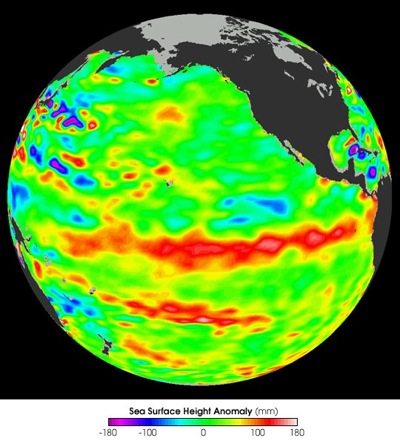
The federal Climate Prediction Center, operated by NOAA, reported this week that current conditions in the Pacific would seem to foreshadow a return to El Nino conditions, possibly within the next few weeks.

2006 El Nino conditions, as observed by the Jason satellite. Photo: NASA

The ocean conditions formally known as ENSO, or the El Nino/Southern Oscillation, arise when normal upwelling of deep, cold water abates, causing warmer surface temperatures (SST).

El Nino and its opposite, La Nina, have far-reaching implications on weather patterns. Here on the West Coast, it usually means wetter winters in southern California and drier ones in the Pacific Northwest.  Because northern and central California lie in between, things there can go either way.

El Nino can also have a significant impact on fisheries, as much of the food chain is interrupted when upwelling slows.

Here’s a good overview of El Nino “mechanics” from UC Berkeley.

River Diaries, Part 3: Encounters with Civilization

Here are some more journal entries from participants in the Paddle to the Sea project, to raise awareness of river and water supply issues. Two paddlers have pledged to go all the way, from the Sierra to San Francisco Bay. At this point, they’ve descended from the high country and are preparing to traverse California’s Great Valley.

On the tamed lower Tuolumne. Photo: Jesse Raeder

Emilio Martinez: Don Pedro Reservoir & Turlock Lake

After the whitewater thrills of the upper Tuolumne, Don Pedro Reservoir was exciting in the same way that a putting green is exciting: smooth and well-groomed, and so accommodating to the well-mannered sportsman. With the whine of the fishing engine accompanying a distinct lack of visual variety in the blond hills, we boated for two hours towards the Dam, then hiked Bonds Flat Road, then J59 for 2 more hours in the near hundred degree heat, examining road kill for diversion.  Besides the houseboats and odd floating trash, there was not a whole lot to feed the river-bound soul.

So it was with a complete sense that all the excitement that the River Tuolumne had to offer had been expended during the upper portion that I stepped awkwardly into my canoe on the 27th of May. I had already complacently decided that the River was something of a “has been” and would be nothing now but a gentle, rolling presence.

What a complete and arrogant assumption of what the River is, without any knowledge of the true meaning of that word as Nature herself uses it.

The River, in short, thrashed both my thesis–and companion Tim and I like the inconsequential beings that we are before the River’s sublime power and majesty: it slapped us upside the head with willow branches drenched in chilling waters, banged our thighs and knees with the fiberglass canoe we haughtily thought we’d master it with: instead, it made us respect it and fear it: precisely because we are mere visitors to its emerald green kingdom, our canoes so much jetsam and flotsam in its consciousness: in short,  the Tuolumne did everything it needed to do to show us how we must not underestimate Nature, but rather, protect one’s reverence and humility before it so that one can live and be nurtured by it.

Long live the River!

Looking for fish. Photo: Jesse Raeder

Owen Segerstrom: Don Pedro Reservoir

Today’s crossing of Don Pedro was an instructive microcosm of the damage that dams cause. While the former Tuolumne River Canyon rests under hundreds of feet of water, the remaining habitat is a virtual biological desert. Turkey vultures, mallards, and hatchery-raised fish are a far cry from the wildlife of an intact river system. What was once a salmon-bearing, thriving ecosystem sequestering untold millions of metric tons of carbon is now a layer of anaerobic matter at the bottom of the reservoir, the decomposition of which releases methane (a greenhouse gas that is orders of magnitude more potent that carbon dioxide) into the atmosphere.  [Editor’s note: The figure most quoted by scientists is that methane is about 20 times more potent than CO2 as a greenhouse gas. In California, however, livestock and leakage from oil & gas operations are much bigger emitters of methane than natural decomposition from lakebeds].

Upon arrival at the dam, Emilio, Mason (a friend of mine from Kentucky who accompanied us) and I were presented with an interesting conundrum.  Despite indications to the contrary from National Geographic’s mapping database, there is no trail from the dam to the Old La Grange bridge.  After consulting a local ranger, we determined that the only way to walk this leg of our journey was on the side of Bonds Flat road and eventually J59 (approximately 7 miles).  The partially decomposed remains of a fox, whose life was ostensibly claimed by a motorist on the highway, were yet another sobering reminder of the human-caused chasm between a Mt. Lyell-to-the-Pacific river system and the Tuolumne’s current state.  We maintained morale by nicknaming this stretch of our sojourn the “great asphalt eddy of the T,” but the experience was nonetheless jarring.

After the experience at Don Pedro, the first section of the Lower Tuolumne was quite literally a breath of fresh air.  Heritage oaks, the call of an osprey from its nest along the river bank, and the water’s peaceful meander were a feast for the senses.  The integration of community advocacy groups throughout the valley is a hopeful sign for the future of freshwater consciousness, and the results of their efforts are evident.

Though anadromous fish passage beyond the Old La Grange Dam is still impossible, the efforts to address disastrous impacts on salmon populations (an unparalleled gauge of the health of a river ecosystem) between this impasse and the ocean are inspiring.  Salmon have been described as the conscience of a watershed, as they represent the lone upstream vector for ocean nutrients that have historically fertilized inland ecosystems.  The conscientious cooperation of central valley communities along the Tuolumne represents the utterly necessary prevention of local extinction of Chinook salmon.

[Editor’s Note: Here’s the latest biological opinion on California’s Chinook salmon and how it stands to affect water supplies.]

Turlock Lake to Waterford Park

Today’s paddle began with a conversation about the history of California river advocacy. As our group went through individual introductions, many of the participants recalled the (ultimately unsuccessful) efforts to prevent the damming of the Stanislaus River in the late 1970’s, including Mark DuBois chaining himself to a riverside boulder in protest.  While the beauty and avian abundance of yesterday’s journey punctuated the beginning of our day, reminders of the need to rekindle Mark’s passion quickly confronted us.  The soundscape for our lunch break was provided by an industrial gravel pit, the footprint of which has massively diverted the river channel.  As one volunteer pointed out, the beautiful hyacinth blooming in the pond adjacent to the pit were nonetheless a dubious indicator of the river’s ecological health.  The day culminated in a rousing gathering of Waterford’s riverfront restoration community at the local park,  A group of children enjoying a game based on answering questions about salmon presented hope that somewhere there is a young person who will carry Mark’s torch in defense of the Tuolumne’s continuity.

Our posts are running a bit behind the paddlers’ progress. In real time, they are set to cross San Francisco Bay today and conclude their journey tomorrow, with a celebration at Aquatic Park in San Francisco.

BK Franchise Serves Up Some “Baloney”

I know: This didn’t happen in California, so why mention it? Well, sometimes stories come in that just seem to crystallize the persistent (some polling would suggest growing) public division over climate change and this is a good example.

When signs on Burger King outlets started opining that “Global warming is baloney,” a Memphis reporter decided to check it out. His exchanges with the local burgermeister and the parent company make for pretty amusing reading.

Interesting that while polls taken within the last year have indicated flagging faith in the prevailing view of climate scientists that the world is warming, a spring poll by the Pew Research Center showed 59% of Americans supporting some kind of cap on carbon emissions. Though still sharply divided along party lines, that could indicate that some kind of reluctant consensus is forming around the issue.

More Adventures “Paddling to the Sea”

Here are some more journal entries from participants in the Paddle to the Sea project, to raise awareness of river and water supply issues. For most, it’s a relay event and they’re taking a leg or two of the voyage from the upper Tuolumne to the San Francisco Bay. But two paddlers have pledged to go all the way. Here are some of their observations.

Facing the froth--and mortality--on the Tuolumne.
Facing the froth--and mortality--on the Tuolumne. Photo by Jayne Johnson.

Emilio Martinez: whitewater section, Tuolumne River

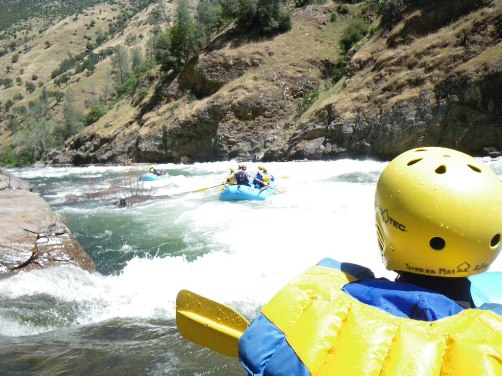
Once the green terror subsided and I knew I might not drown, rafting the “T” (river rat lingo) was an absolute blast! Our blue rafts, manned by a crew of four apiece, plus an experienced guide at the helm, put in about ten miles upstream from where the Clavey River and the Tuolumne River meet in a thunderous embrace. And I am not ashamed to tell you that seeing the river run at 7000+ cubic feet per second was exhilarating to the point of terror. Whether due to climate change or pure luck, the Tuolumne was in fine form that weekend: racing down its bed like some aquatic serpentine creature from another dimension, wildly snaking its way through ancient bedrock as it bucked and thrashed, arching into the wind, pummeling its way through narrow confines of rock and tree as only a force of nature unleashed can.

For two days, thirty of us clung to the River, loving it and fearing it, crawling out of our rafts each day, tired and hungry, but somehow spiritually cleansed by the only worldly thing I’ve ever known that I can call sacred.

Unlike my rafting cohorts–who likely must travel some distance to the “T” to pay it homage–as denizens of Modesto’s “Airport District,” we are blessed with the Tuolumne as a constant benevolent feature of our neighborhood (emphasis on hood), which squats on the River’s banks, roughly one square mile of humanity and squalor broiling in the San Joaquin Valley, and whose inhabitants are more known for our deficits than our merits, for our God-fearing ways rather than earth-loving hearts.

My first encounters with the “Tuolumne” were a mix of horror (fear of drowning), awe (Pentecostal baptisms), joy (childhood treasure hunts at the Modesto landfill – now filled up and landscaped into something called the Tuolumne River Regional Park), and food (Mexican fiestas, where beer, barbeque, and corridos mixed nicely).

And, as befits my low-income neighborhood: I am still largely ignorant of the ecology of this gorgeous river.

So, speaking for myself, my trip down the Tuolumne River is something like an awakening to nature in the Garden of Eden, for there is precious little vocabulary in the noisy, backward streets of the Airport District for the marvels of nature that abound on the banks, canyons, and hillside forests that flank the River: though we children of the Airport grow up touching the River almost daily, we are taught almost nothing about its nature or how to address it.

Shame.

Still, I figure (hope) that my vocabulary for its flora and fauna and geology will grow as I flow downstream towards the San Francisco Bay; that I’ll be able to distinguish an oak from alder some day, egret from swallow, poison ivy from blackberry vine, and that my eyes will see “salmon” and not just vague swimming things.

I exaggerate, but not by too much.


Emilio Martinez grew up in the Central Valley and currently lives in Modesto. The rivers are uncharted territory for him and have inspired his poetic side.

Segerstrom and Martinez on the river.
Segerstrom and Martinez on the river. Photo by Jayne Johnson.

Owen Segerstrom: whitewater section, Tuolumne River:

It is a privilege to be on the “T” (Tuolumne River) during a peak snow melt flow like the one we experienced over the weekend.  My cousin Tom, son of Sierra Mac founder and TRT (Tuolumne River Trust) board member Marty McDonnell, said it was the second highest flow he had ever seen (out of an estimated thirty-five trips).

Our guide, an east coaster working his first season for Sierra Mac, opined that the T would be the national gold standard in whitewater if such flows were a regular occurrence. We took a nasty swim on a 4+ rapid called “Frame Crusher,” a humbling reminder of the river’s power.  The excitement of the water conditions was rivaled only by the magnificence of the river canyon itself.  As if to remind us not to stay away for too long, a bald eagle swooped above us on an up-canyon trajectory less than a mile before the take-out.

Owen Segerstrom grew up in Sonora, near the upper reaches of the Tuolumne River, and spent his childhood and teenage years exploring the Tuolumne and Clavey swimming holes.  He’s also done quite a bit of rafting on the Tuolumne.


No Crystal Ball for Fusion Power

Lawrence Livermore Nat'l Lab
Photo: Lawrence Livermore Nat'l Lab

Now here’s a guy with some historical perspective: For something north of a half-century, David Perlman has been covering science for the San Francisco Chronicle. On KQED’s Forum program this morning, he noted that “40 years ago, they said ‘in 20 years, we’ll have unlimited energy from fusion’.”

The record will show that we didn’t quite get there–but that hasn’t stopped them from trying. The long quest for bottled fusion will pass another milestone this week, when the US Dept. of Energy formally cuts the ribbon on the National Ignition Facility (NIF) at Lawrence Livermore National Lab.

Comparing the hardware with other titanic undertakings, like the CERN particle accelerator in Switzerland, Perlman called the 192-laser assembly “one of the most amazing machines–if it succeeds–and one probably won’t know for the next two, three years.”

That’s the hopeful time frame for creating fusion in a fuel pellet the size of a BB (artistically rendered in the image, above) Will they? Perlman says: “I would not dream of putting a bet on it.”

Nor would sparking some mini-fusion at NIF quickly translate to a national solution for clean, safe energy. Scaling that ignition up to practical size for reactors would likely require decades more.

A NIF technician appears to be gazing into a "crystal ball," which is actually used to amplify laser beams--but not much good for predicting the future. Photo: Lawrence Livermore National Lab
A NIF technician appears to be gazing into a "crystal ball." Precision-ground crystals are used to amplify laser beams--but not much good for seeing into the future. Photo: Lawrence Livermore National Lab

Earlier this week, in an interview with NASA scientist James Hansen, I asked him about the potential for nuclear power to make a comeback with new technology. Rather than waiting for fusion, Hansen favors the technology known as “fourth-generation nuclear,” which he says could “burn nearly all of the fuel, where at present, the nuclear technology that we’re using burns only one percent of the energy in the uranium.” From one percent to “nearly all” would represent a drastic reduction in the current radioactive waste problem.

There may be some wishful thinking in that. An early report published in the magazine 21st Century Science & Technology describes these “Generation IV” reactors as “about 50% more efficient than conventional nuclear reactors.”

Other nations have moved ahead with Gen-IV reactors. The French expect to have one under construction by 2020.

Meanwhile, as the US pursues a parallel Gen-IV research program, it will press on toward the Holy Grail of fusion with its Livermore megalaser, described by Perlman as “already a mini-Manhattan Project.” Costs so far have run to nearly triple the original budget of more than a billion dollars. DOE expects to spend $140 million per year to run the NIF. So, it would be–you know–nice if something comes of it.

Carbon Offsets in the Air

Friday on The California Report’s weekly magazine, Rori Gallagher reports on ways to assuage your carbon guilt with a quick stop at an airport kiosk.

By Rori Gallagher

Reed Galin
Photo: Reed Galin

I first got the idea to do a story on carbon offsets back in December, when San Francisco International Airport announced it was partnering with a private company called 3Degrees to install carbon offset kiosks.

Originally, the kiosks were supposed to be installed sometime “in the spring.” But there seems to be a delay with the contract negotiations. I kept checking in with 3Degrees about a launch date. At first they were saying Earth Day–then it was pushed to May, and now “by the end of June.”

But there are already other options out there. I found that Virgin America, the only major airline based in California, was the first to offer carbon offsets in the sky. Other airlines do offer customers the chance to purchase offsets but Virgin allows you to do it during the flight through the in-flight entertainment system.

Carbon offsets are supposed to stop carbon emissions that would have otherwise taken place. That’s really difficult to substantiate. Projects like wind farms for example, certainly seem good for the environment but likely most of them would be built anyway and produce power without this type of third-party incentive.

Virgin’s program managers say they stringently vetted carbon offset programs, and that theirs are among the most credible out there. But as I point out in my radio story, there is very little regulation of the voluntary carbon offset industry and it’s difficult to know if they’ll do what they say they will.

There are some independent efforts to separate the sheep from the goats, for example the Natural Resources Defense Council has produced a buyer’s guide for carbon offsets.

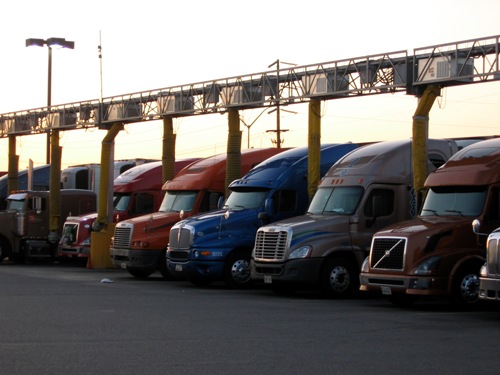
Trucks line up at an IdleAire terminal, which provides "carbon offsets" for airlines. Photo: Rori Gallagher