Craig is a former KQED Science editor, specializing in weather, climate, water & energy issues, with a little seismology thrown in just to shake things up. Prior to that, he launched and led the station's award-winning multimedia project, Climate Watch. Craig is also an accomplished writer/producer of television documentaries, with a focus on natural resource issues.
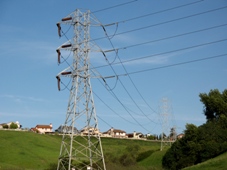
The mainstream media’s beginning to catch up to the “smart grid” story; the grand plan to remake the nation’s electrical distribution system.
On Friday, NPR began a ten-part series; “Power Hungry: Reinventing the U.S. Electric Grid.” The reports will air on both of the network’s flagship programs, Morning Edition and All Things Considered.
And if you’re still “power hungry” after all that, Scott Pelley’s piece on the coal power industry is well worth a twelve-minute investment at the 60 Minutes website.
Photo: Peter Johnsen, U.S. Fish & Wildlife Service
In hearings by the House Energy & Commerce Subcommitee today, Rep. George Radanovich (R-Fresno) called the Delta smelt “a worthless little worm that needs to go the way of the dinosaur.” He made the remark as part of a five-minute attack on “environmental alarmism,” in response to testimony from former vice-president Al Gore, founder of the Alliance for Climate Protection.
The tiny fish, recently listed by the state Fish & Game Commission as “endangered,” came up in remarks by Radanovich about the current drought conditions in the Central Valley. He blamed the lack of water on lawsuits that have restricted water supplies to farms, “for a Delta smelt–a worthless little worm that needs to go the way of the dinosaur. They’ve shut pumps down and restricted water deliveries to California over that thing, when what’s eating it is a striped bass, a non-native species in the Delta.”
Radanovich rejected the possibility that climate change might be a player in the current drought. Instead he took aim at what he described as “collaboration between environmentalists and sport fishermen,” blaming that for slashed water allocations to farms, as many as 60,000 job losses and “a $6 billion-dollar hit to our economy.”
“That is not global warming,” he said. ” “It’s the result of bad policy caused by environmental alarmism.”
Joining Gore among the 21 witnesses before the subcommittee on Day 4 of the climate bill hearings was UC Davis professor Dan Sperling (.pdf link), who had just come from a marathon hearing before the California Air Resources Board. Last evening the Air Board approved the first-ever Low-Carbon Fuel Standard, as part of it’s plan to reduce greenhouse gases.
After years of study and a day of marathon testimony in Sacramento, state regulators have adopted the world’s first low-carbon standard (LCFS) for transportation fuels. Only one member of the California Air Resources Board, John Telles, voted against adoption.
During nearly six hours of testimony by almost 100 speakers, businesses lined up both for and against the new rules. As Marjorie Sun reported for us this week, some claimed that calculations for the carbon footprints of different fuels–especially ethanol–were not even-handed. Speaker after speaker assailed the LCFS as being the product of “incomplete analysis” or just bad math (public testimony begins about an hour into the webcast).
But Daniel Sperling, a UC Davis professor and member of the Air Board, calls it “government at its best.”
“There’s been a huge amount of effort,” he said, ” in working with the oil companies, working with the electricity companies, working with the environmental community, working with the biofuels companies, to try to get this really done right.”
Though numerous speakers challenged the view that it was done right, both Sperling and Air Board head Mary Nichols seemed to leave the door open to additional tweakage of the regulations. “In the end, it’s a science-based policy,” said Sterling. “There are a lot of pieces of this that we’re not certain exactly the best way to do it but we’ve got the framework of a really outstanding policy and an important policy. And we’ve made the commitment to work with all the different stakeholders in refining it, to make sure that it really works best.”
Small-business and environmental justice groups locked arms to decry the cost of the new rules. Some cited a report from Sacramento-based Sierra Research estimating $3.8 billion in increased fuel costs by 2020, if the LCFS takes effect.
An “expert working group” is due to report back on January 1, with possible suggestions for fine-tuning the plan.
Board member Ron Roberts summed up the proposed regulation by paraphrasing Winston Churchill: “It may not be the end or even the beginning of the end, but it’s the end of the start,” said Roberts (falling somewhat short of Churchillian eloquence but point taken).
The new rules are designed to cut greenhouse gas emissions from transportation 10 percent by 20-20. Sperling is now headed to Capitol Hill, to testify before Congress on national legislation. California’s process is being closely watched in Washington, where pending federal carbon legislation is widely seen to be modeled after California’s plan.
This week, the California Air Resources Board is expected to pass a controversial new standard that measures the carbon footprint of transportation fuels. Reporter Marjorie Sun filed a story for Climate Watch on the measure and why the ethanol industry is fighting it. She provides some additional insights here:
The proposed low carbon fuel standard is part of a broad effort by the California regulators to roll greenhouse gas emissions back to 1990 levels by 2020.
Slashing carbon emissions from cars and trucks is a big part of the state’s game plan. That’s because transportation accounts for 40 percent of the state’s greenhouse gas emissions. A whopping 96 percent of the fuel sources that power our cars and trucks is petroleum-based. Right now, the bulk of ethanol sold in California–and the rest of the United States for that matter—is corn-based. (Brazil makes its ethanol fuel from sugar cane, which has a smaller carbon footprint.) U.S. producers argue that the proposed Low-Carbon Fuel Standard (LCFS) would make corn-based ethanol less competitive in the marketplace because of the way it calculates emissions. Pacific Ethanol was the biggest ethanol producer and marketer in California– until recently. With the drop in gasoline prices over the past year, demand for ethanol has plummeted. Over the past several months the company suspended operations at its two production plants in California and stopped construction of a third facility. In March, it filed for loan extensions with its creditors. So the new fuel standard could deliver yet another blow to the company. Hence, ethanol interests have been putting up a fight. But the Air Resources Board is counting on the proposed standard to spur innovation in the alternative fuels market, to reduce carbon emissions. The state says it’s hoping to “expand the size of the current renewable fuels market in California (already the largest in the nation) by three-to-five times. Instead of today’s corn, over half of the ethanol is likely to be made from extremely low-carbon, cellulosic feedstocks such as agricultural waste and switchgrass. There are numerous startups in California working on cellulosic ethanol. They’re experimenting with a wide range of plants, from switchgrass to algae, as potential sources of ethanol. Getting a new fuel to market, however, requires enormous capital costs. The state is projecting that by 2020, Californians will have bought more than 7 million alternative-fuel and hybrid vehicles. That’s about 20 times greater than today. But in these tight economic times, folks are hanging onto their old cars. So it’s not clear how fast Priuses and plug-ins will replace the carbon-spewing cars on the road today.
This post has been modified based on clarifications by the study’s lead author, which are outlined in her comment, below.
A recent study seems to confirm what many have already surmised: The spring melt from the Sierra snowpack is happening sooner.
To get a handle on the timing of mountain runoff, a team led by Iris Stewart of Santa Clara University pulled together data from 52 stream gauges up and down California. For her study, Stewart says she chose only water courses unaffected by dams and diversions, with at least 20 years of continuous data.
Stewart’s data shows that over the 60 years spanning 1948-2008; 80% of the gauges show the “stream pulse” that accompanies peak runoff, coming consistently sooner in the season–an average of about 10 days sooner, though at least one location had shifted up by more than a month. In fact, combining all of the metrics in the study, Stewart says only one gauge showed a later trend.
The trend seems remarkably consistent. Stewart says that despite a warming trend over the past ten years, she has not seen any acceleration of the trend within that period.
Stewart cautions that there’s more work to do on this and was reluctant to draw broad inferences from the study. Runoff in a particular stream is affected by many factors, including the elevation, slope, aspect (which direction it’s facing), vegetation cover and soil composition. Stewart says further study of these variables will better help identify the most vulnerable streams. But the latest results seem consistent with an earlier study in which Stewart found “earlier runoff on a continental scale.”
Scientists are concerned that as average temperatures rise, California’s mountains will see more rain, less snow–and what snow there is will melt off sooner. Reservoirs can only retain so much runoff at once, so if more of the “frozen reservoir” dissipates earlier in the season, farms and cities stand to be caught short of water before the rains return.
Stewart, an assistant professor at SCU’s Environmental Studies Institute, presented her findings this morning to researchers at the Pacific Climate Workshop (known as PACLIM, the conference does not have a website), a semi-annual gathering of climate scientists doing front-line research around North America. The conference in Pacific Grove is organized by the USGS office in Menlo Park.
Over the course of four days, about 60 researchers will hear findings on the climatic implications for fire, fog, glaciers, the ocean and wildlife, among other topics.
Reactions are coming in to The EPA’s long-awaited finding today that carbon dioxide and five other greenhouse gases pose a threat to “the public health and welfare.” One California environmental group actually used the word “Duh” in its official response.
After two years of study, prodded by a Supreme Court decision, the federal agency finds that CO2, methane, oxides of nitrogen and two other industrial gases should be regulated as pollutants under the Clean Air Act. A sampling of reactions:
“‘Duh’ may not be a scientific term, but it applies here. Today, common sense prevailed over pressure from Big Oil and other big polluters to deny the obvious in order to maintain the status quo on energy. EPA has embraced the basic facts on global warming that scientists around the world have acknowledged for years.”
Governor Schwarzenegger:
“While the federal government was asleep at the wheel for years, we in California have known greenhouse gases are a threat to our health and to our environment – that’s why we have taken such aggressive action to reduce harmful emissions and move toward a greener economy. Two years after the Supreme Court declared greenhouse gas emissions a pollutant, it’s promising to see the new administration in Washington showing signs that it will take an aggressive leadership role in fighting climate change that will lead to reduced emissions, thousands of new green jobs and a healthier future for our children and our planet.”
“Today’s action by the EPA is the beginning of a regulatory barrage that will destroy jobs, raise energy prices for consumers, and undermine America’s global competitiveness,” Senator Inhofe said. “It now appears EPA’s regulatory reach will find its way into schools, hospitals, assisted living facilities, and just about any activity that meets minimum thresholds in the Clean Air Act. Rep. John Dingell was right: the endangerment finding will produce a ‘glorious mess.’
“This finding was expected, but long overdue because the previous administration respected neither the science nor the law. The consequence of this finding is that EPA will now begin the task of reducing these emissions through the permitting process provided by the Clean Air Act. One way or the other, the clear and present danger of endlessly dumping pollutants into the atmosphere must be confronted. We will either find a way to build a future for our children based on clean energy and sustainable jobs, or we will face a very unsentimental foe unarmed – a climate that makes life unsustainable. The choice is clear, and the new Administration is following the wisest path forward.”
California moved to regulate carbon emissions three years ago, when state lawmakers passed the Global Warming Solutions Act of 2006, also known as AB 32. But many specific regulations required by that law have yet to take effect.
If you think climate change just means hotter summers in California, think again. The writer of this week’s guest post argues that we’ll all “feel the heat” in myriad ways, both obvious and subtle.
Climate and Nature
by Anthony Barnosky
Some impacts of climate change in California are pretty obvious, things like rising sea level submerging large parts of the San Francisco Bay region, or drought cutting into our water supplies. Less obvious, but every bit as important, are impacts on something you probably don’t even know you have: your relationship with nature.
One part of that relationship is the concept of “ecosystem services;” the direct benefits you get from nature. California’s Climate Action Team highlighted some of the state’s ecosystem services in their recent report. Examples include the ski trip you may have taken this winter, the salmon fillet you may have bought at the grocery store, or surprisingly, even your hamburger.
Snow will be less, soggier, at higher elevations, and on the ground for fewer days of the winter, melting some of the $500 million-per-year revenues of the ski industry–not to mention melting your favorite ski run. Altered river dynamics and temperatures will almost certainly cut into the state’s $33-million-per-year salmon industry. Climate-caused loss of forage means that in 2070 California’s cattle ranchers will be losing up to $92 million in comparison to today’s markets, which means higher beef prices at the grocery store. Combined, the losses in these ecosystem services likely will cost the state’s already suffering economy well over a hundred million dollars per year as we move into the next few decades. And those are just three of many ecosystem services that will be affected.
A second part of your relationship to nature is the species around you, that is to say, biodiversity. Simply put, biodiversity is which species live in a place, and the extent to which those species are rare or common. In general, biodiversity means more productive and healthier ecosystems, which translates as more benefits to humans that inhabit those areas. As it turns out, California is a globally recognized biodiversity hotspot, unique in the world. But biodiversity losses from global warming promise to be severe: one study predicts that two-thirds of the 2387 plant species found only in the state will lose 80% of their range within the century.
The third part of your relationship to nature is how it makes you feel. There’s no question: you can’t get the same feeling you get looking at a giant redwood anywhere but in a redwood forest. Among species that may have little or no suitable climate left in California, however, are its coastal redwoods and sequoias.
Such impacts of climate change on nature are not confined to California. Many other reports indicate that global warming is redefining our relationship to nature worldwide. As with other impacts, this one can be partially mitigated by reducing greenhouse gas emissions immediately, but also will require some new management strategies for preserving nature in the age of global warming. California, in particular, has a lot to lose.
Barnosky is scheduled to appear Saturday as part of Berkeley’s “Cal Day” activities. His talk is scheduled for noon at the Valley Life Sciences Bldg, Room 2060, followed by a book-signing at the T-Rex (which is hard to miss).
But beyond just another villification of uninvited come-ons for “male enhancement” or Nigerian money schemes, it sort of drives home the point that everything seems to have some kind of carbon footprint–even activities that take place entirely in the “digishpere.”
Tonight, San Francisco’s KQED Public Television (HD 9) will air the first collaboration between Climate Watch and Quest, its weekly series on science & environmental topics. “California at the Tipping Point” is a half-hour special that explores the likely affects of climate change on the state. One of those anticipated effects is greater risk of wildfire. This post expands on the program with some of the recent science in that arena.
The conventional wisdom is that a warming planet means more wildfires–and in many cases the conventional wisdom is right. But globally it’s a more complex question.
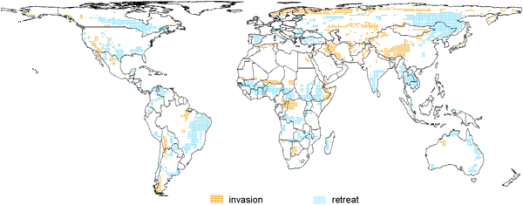
What they found were suggestions of rapid changes in fire regimes, and not all in the same direction. Some places (like most of California) will likely see a spike in the fire hazard, while other regions (like the Pacific Northwest) could see a retreat of wildfire frequency and intensity:
“In contrast to any expectation that global warming should necessarily result in more fire, we find that regional increases in fire probabilities may be counter-balanced by decreases at other locations, due to the interplay of temperature and precipitation variables. Despite this net balance, our models predict substantial invasion and retreat of fire across large portions of the globe.”
Moritz has been stumping for new approaches to fire-climate analysis. He says rather than treat fire strictly as the product of other climate change variables, we should think of it also as a climate driver.
Map shows areas of potential fire advance (orange) and retreat (blue) by 2010-2039 (medium-high emissions scenario)
You can use the player below to hear an excerpt from my interview with Moritz, in which he explains the new perspective that he thinks his team’s study brings to the fire-climate connection.
Many believe that climate change presents us with opportunities to tackle multiple problems with a single well-designed response. The authors of this guest post suggest that public health presents one of those opportunities.
Public Health and Climate Change: A Shared Agenda
by Marice Ashe and Richard Jackson
Climate change may be the greatest threat to human health in this century. More intense heat waves will make bad air even worse. More severe droughts and floods will further imperil the water supply California is already struggling to protect. The world is going to see a rise in the number of water-, food-, insect- and animal-borne diseases we have to fight.
Who will suffer most? The elderly, children and the poor—populations that are least able to and can least afford to adapt to such extreme conditions. Although public health leaders have a responsibility to protect and enhance the well-being of the entire population—and especially those most at risk—we have lagged behind in considering climate change as one of the threats that we must confront.
In March, we released An Action Plan for Public Health: Initial Recommendations for Involving Public Health in Climate Change Policy, assembled after talking to more than 150 experts in public health, climate science and environmental law. We hope it helps the public health community think in new terms about their mission.
We must work faster, because making communities healthier can prevent climate change. For example, we work with communities all around California to create safe walking paths and bike routes throughout cities. We encourage these changes to prevent obesity and increase community safety. But when people get out of their cars, they also put less carbon emissions in the air. We call this a “co-benefit:” by taking one action to improve physical health, we gain other benefits to improve planetary health.
Other co-benefits happen when we encourage the development of new housing and retail centers close to public transit. This increases exercise while keeping people out of their cars. But why stop there? Transit-oriented development also preserves agricultural lands for food production and protects our food security. With anticipated changes in rainfall, agricultural pest and disease patterns will shift, too. Safeguarding a regionally based and resilient food system should be a primary public health goal in addressing climate change.
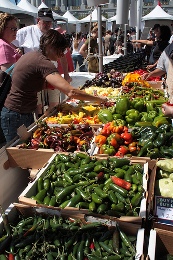
We are working with communities to make it easier to hold farmer’s markets, get more healthy foods in corner markets, and increase fresh fruits and vegetables in schools. This is particularly critical in poor and under-served areas where it’s harder to find healthy and affordable food. The public health goal is to lower rates of diabetes, heart disease, and obesity, which are epidemic in those communities. As a co-benefit, it expands opportunities for local and regional growers who bring the food a much shorter distance on the way to market, thus dropping transportation-related greenhouse gas emissions.
Improving public health will mitigate climate change, and fighting global warming will make people healthier. By approaching this impending public health disaster from many directions, we stand a better chance of making a real difference.
Marice Ashe, JD, MPH directs Public Health Law & Policy, which partners with advocates, health departments, and policy-makers to create healthier communities. PHLP provides in-depth research and analysis on legal and policy questions, and translates complex information into practical tools and model policies for community action.
Richard Jackson, MD, MPH is the Chair of the Environmental Health Sciences division of the UCLA School of Public Health. He is the former director of CDC’s National Center for Environmental Health and California State Public Health officer. Dr. Jackson is a member of the PHLP Board of Directors.
 The mainstream media’s beginning to catch up to the “smart grid” story; the grand plan to remake the nation’s electrical distribution system.
 Slashing carbon emissions from cars and trucks is a big part of the state’s game plan. That’s because transportation accounts for 40 percent of the state’s greenhouse gas emissions. A whopping 96 percent of the fuel sources that power our cars and trucks is petroleum-based. Right now, the bulk of ethanol sold in California–and the rest of the United States for that matter—is corn-based. (Brazil makes its ethanol fuel from sugar cane, which has a smaller carbon footprint.) U.S. producers argue that the proposed Low-Carbon Fuel Standard (LCFS) would make corn-based ethanol less competitive in the marketplace because of the way it calculates emissions.
  Snow will be less, soggier, at higher elevations, and on the ground for fewer days of the winter, melting some of the $500 million-per-year revenues of the ski industry–not to mention melting your favorite ski run. Altered river dynamics and temperatures will almost certainly cut into the state’s $33-million-per-year salmon industry. Climate-caused loss of forage means that in 2070 California’s cattle ranchers will be losing up to $92 million in comparison to today’s markets, which means higher beef prices at the grocery store. Combined, the losses in these ecosystem services likely will cost the state’s already suffering economy well over a hundred million dollars per year as we move into the next few decades. And those are just three of many ecosystem services that will be affected.
 The third part of your relationship to nature is how it makes you feel. There’s no question: you can’t get the same feeling you get looking at a giant redwood anywhere but in a redwood forest. Among species that may have little or no suitable climate left in California, however, are its coastal redwoods and sequoias.