All posts by Craig Miller

Craig is a former KQED Science editor, specializing in weather, climate, water & energy issues, with a little seismology thrown in just to shake things up. Prior to that, he launched and led the station's award-winning multimedia project, Climate Watch. Craig is also an accomplished writer/producer of television documentaries, with a focus on natural resource issues.

Climate Debate Runs Hot and Cold

We see occasional references in our discussions here to a “cooling phase” over the past decade or so. It’s often evoked in arguments against the case for global warming. Of course, in the centuries-long span of the Earth’s climate patterns, a decade or so is a mere blip on the screen.

Now a climatologist at Lawrence Berkeley National Lab has co-authored a paper that warns against using “periods of a decade or two” to argue the case one way or the other (we also often hear people use temperature data from recent hotter years as evidence for global warming).

Andrew Revkin summarizes the findings in his blog for the New York Times.

Wehner works in the Computational Research Division at LBNL and co-authored the paper with NOAA scientist David Easterling of the National Climatic Data Center, in Ashville, NC. Easterling wrote the Center’s FAQ page on global warming, in which he includes this answer to the question of whether the global climate is warming:

Global surface temperatures have increased about 0.74°C (plus or minus 0.18°C) since the late-19th century, and the linear trend for the past 50 years of 0.13°C (plus or minus 0.03°C) per decade is nearly twice that for the past 100 years. The warming has not been globally uniform. Some areas (including parts of the southeastern U.S. and parts of the North Atlantic) have, in fact, cooled slightly over the last century. The recent warmth has been greatest over North America and Eurasia between 40 and 70°N. Lastly, seven of the eight warmest years on record have occurred since 2001 and the 10 warmest years have all occurred since 1995.”

As for the geographic fluctuations, Robert Bornstein of San Jose State has produced data showing a general cooling trend along the California coast over the past 30 or 40 years. But he’s quick to point out that the anomaly is most likely a result of, not an argument against the broader global warming trend.
Survey Says: Drought Still On

It’s still “cause for concern.” That’s how California’s water chief summed up the water outlook for this summer, based on the latest survey. The Sierra snowpack stands at 81% of normal for this date, according to today’s measurements by the state Department of Water Resources.

Chopping up the Sierra Nevada into segments, Northern California fared a little better at 87%. The situation deteriorates as you move southward, with Southern Sierra stations clocking in at 77% of normal.

In most years, the April survey marks the peak of the season’s snow water content.

Ultimately what matters is runoff, or the total amount of water that actually comes off the mountains with the spring melt. And snowpack isn’t necessarily a good predictor of that, as we heard in David Gorn’s story on The California Report and in his blog notes from today.

Just yesterday the Governor’s Climate Action Team released its 2009 assessment of likely climate change effects in California. One  predicted outcome is that ripple effects from water shortages could run up a tab of $3 billion per year. And that’s the rosy scenario, based on being able to quickly move 5 million acre-feet of water to where it’s needed. Eileen Tutt of Cal-EPA cautions that the actual capacity of the current system to quickly redistribute water is closer to 1 million acre-feet. An acre-foot is about the amount of water that a typical household uses in one year.

Fire and (Less) Ice: California’s Climate Future

firesign_blogThere was little “news” in this week’s report from California’s inter-agency Climate Action Team. The distillation of 37 academic studies mostly affirmed what we’ve been hearing from multiple sources lately; that “severe and costly impacts” likely lie ahead as the state’s climate changes.

The report’s findings are aligned with two of the scenarios modeled by the U.N.’s climate panel; the “B1” outlook for moderate emissions of CO2, and the higher-emissions “A2” scenario. While California has ambitious plans to curb carbon emissions, many recent reports agree that the world is presently on a path toward emissions even higher than the worst IPCC scenario.

Under that more severe tableau, says report co-author Dan Cayan of the Scripps Institution of Oceanography in San Diego, the number of wildfires in the state could double by 2085. Cayan said that “by every model,” the state is warming and in some areas, drying. One regional model sees precipitation in Southern California tailing off by 10% in years to come.

There’s more coverage of the report in Jane Kay’s article for the San Francisco Chronicle and Bettina Boxall’s story in the L.A. Times.

The Times article points to some relatively “good” news in the report; a UCLA study that the strength of fire-fanning Santa Ana winds may be subsiding. But there is also research out of Lawrence Berkeley National Laboratory that points to a longer Santa Ana season, so it’s unclear what the net effect might be in the long run.

In a media conference call attended by report authors and state officials, I asked about murmurings that the Western Climate Initiative may be unraveling. Eileen Tutt of Cal-EPA denied that the planned regional cap & trade program for cutting carbon emissions is in trouble. She said that in working with people from California’s six potential partner states, it’s her view that they “aren’t backing off at all.” She admitted that “rumors abound,” however.

Climate Watch has dispatched freelance correspondent Tom Banse to look further into those rumors. He’ll be reporting in from Washington and Oregon in the weeks to come.

Handicapping the Snowpack Derby

shasta_0759

On the eve of the season’s fourth Sierra snow survey, David Gorn files a report that poses the question: “Is it time for Californians to redefine the term “drought?” His report airs on The California Report Thursday morning and some additional thoughts appear here:

Anybody who’s lived in California for a while has been trained to watch the snow. When the monthly snow surveys come around, we handicap them like they’re the Triple Crown. We all know what’s at stake: when it doesn’t snow, our reservoirs don’t get enough runoff, and we dive deeper into drought.

The snowpack gives us a sneak preview of the coming summer, when our other water sources dry up. The last big snow measurement of the season happens on Thursday. State officials are hoping for the best but preparing for something less than a miracle.

We get about a third of our water from snowpack runoff. But the biggest number in water circles is not the number of inches of snow. It’s the amount of runoff that snowmelt produces. And that can be deceiving, which may explain the caution that always seems to pervade official post-survey pronouncements.

Case in point: Last year at this time, the snowpack measurement was 100% of normal and state officials were breathing easier. And yet the amount of runoff that snow produced last year was only 58 percent of normal, and that’s frighteningly low.

What accounts for the difference? Department of Water Resources meteorologist Elissa Lynn says that the wind can disperse snow, which happened last year (maybe Nevada had a “windfall”). Also, a hot spring can melt snow before its time, resulting in too much runoff being released too early, leaving too little for the summer months.

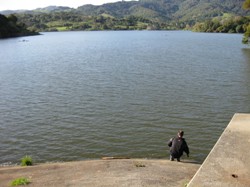
A deceptively full Stafford Lake reservoir in northern Marin County. Photo by David Gorn.

A little rainy weather can be deceiving, too. Even though some local reservoirs around the state topped off–or nearly so–with the late-season storms of February and March, some of the people served by those same reservoirs may still face rationing this summer. That’s because many communities draw their water from multiple sources, which may include mountain runoff.

Projections this year are for snowpack runoff to clock in at about 70% of normal. That beats than the 52% and 58% of the previous two years but is still cause for concern.

A Billion People in the Dark?

Where will you be when the hour arrives? Wherever it is, you might want to take a flashlight–LED, of course. In it’s third year, the organizers of Earth Hour are shooting for one billion people to turn out the lights in this global demonstration in support of decarbonization.

It’s being promoted as a kind of switchplate referendum. Begun in Sydney, Australia, in 2007, it’s a simple concept, which may be part of its appeal: Wherever you are, at 8:30 local time tomorrow (Saturday) evening, turn off the lights for one hour.

Last year organizers estimated that 50 million people complied. California icons like the Golden Gate Bridge went dark. This year, about two dozen California cities and counties have signed up to participate, as well as the State of California.

They’re not telling you to turn off your computer or iPhone, however. Electrons we save at the light switch might be made up for on the Internet, which will likely be abuzz with a worldwide conversation documenting the event on blogs and social networks like Twitter (tag your updates with #earthour and #location). Photo sites will be bombarded with picture uploads.

Personally, I’ll be in the high desert of New Mexico, beyond the sight of any town or even neighbors, so the event won’t make for much of a snaphot.

It might also be a bit anticlimactic for the folks who run California’s power grid. I asked Gregg Fishman at the California ISO (Independent System Operator) if they’d be able to see a dip in the load at 8:30 p.m. tomorrow. He’s not counting on it: “It will probably have some impact but it’s really hard to measure,” he told me.

This time of year, the state is usually pulling about 27-28,000 megawatts at that hour on a Saturday evening. In fact, if you look at the ISO’s grid status graph, you can see a little spike around 8 p.m., as people normally start turning lights on. But Fishman says that even though “most of the load is lighting” at that hour, it may be hard, even for grid technicians, to measure the actual effect of Earth Hour.

But of course, that’s kind of beside the point. The event isn’t designed to achieve palpable energy savings for one hour. It’s supposed to be a visual show of support for policies designed to reduce energy consumption and the global carbon footprint. Recent surveys have shown that economic woes have pushed concerns about global warming and the environment to their predictable recessionary lows, at least in this country. Tomorrow night we’ll find out how the rest of the world feels about it.

Letter from Paris: Confessions of a Generalist

eb_blog21Eleanor Beardsley, whose  South Carolina drawl is often heard emanating from Paris on NPR, agreed to take on her first climate policy symposium for us. She’s covered presidential elections, civil riots and the Tour de France. But climate policy wonks–whoa. Now that’s scary. From her notebook:
When I walked into the rather run-down conference room at Paris’ Universite Dauphine at the edge of the city, about 20 people were sitting around a huge circular table discussing climate issues. I have to say that I almost gave up the idea of doing a report at first, because I couldn’t get my head around what they were talking about. They were discussing the minute points of such things as paying for carbon emission reduction schemes, and the fairness of the CMD, or clean development mechanism! It seemed like a lot of blah, blah techno-speak. I jotted down several beyond-me phrases in my notebook, like “sectoral baselines without additionality.”

But I decided to stick it out. I had schlepped out there early in the morning, making two changes on the Paris metro. I might as well stay a while. That’s often the hardest part about being a reporter. You’re not really an expert at anything, and sometimes you have to find a way to quickly understand a complex story. But you just have to keep focused on what you think your general audience would want to hear about. They always tell you, “pretend as if you’re explaining it to your grandmother.”

In the end, all of the officials — both French and Californian — were more than happy to explain the main issues to me and what the stakes were.

I got the feeling these climate experts from the US and Europe have been working together and learning from each other for years, despite America’s seeming non-interest in the topic under the second Bush administration. Everyone seemed to know each other and be familiar with each other’s work. Someone described the advances that had been made over the years as “leap-frog progress.”

Now here was a concept I could grasp. You can see an example with the cap-and-trade policy on emissions the Obama administration wants to put in place. Apparently they are studying the already-existent European scheme to limit carbon emissions. But that European system, in turn, is based on the US’s successful reduction of sulfur dioxide, or acid rain, in the 1990s.

So even though everyone said global warming was already well under way, I came away from the conference with a comforting sense that at least there are some very smart people working passionately on the issue. I think they will find a way for the world to work together on this, rich and poor nations alike. There was also a lot of talk about fairness; making sure the richer, industrialized nations helped the developing countries get their act together.

They might even achieve those sectoral baselines without additionality…whatever that is.

Water Allocations Tweaked Slightly Upward

A few drops of good news for farmers and cities this week: a heftier late-spring snowpack means there will be slightly more water headed their way this summer.

Earlier this week, the State Department of Water Resources said it will increase water from state reservoirs from 15% of what cities and farms had hoped for, to 20%.  Today the federal Bureau of Reclamation (Central Valley Project) followed suit and nudged some of its projected allocations up, too.

The five-percentage-point bump is mildly good news for some northern California farmers.  But farmers in the southern San Joaquin Valley are still slated to get zero gallons from federal reservoirs. For that to change would require an April of historically soggy proportions.

The previous nadir for State Water Project deliveries was set in 1991, when urban and industrial customers got 30% of their requested water and farms got zero.

Oh, No–Another “Superhighway”

Just when we could exhale, assured that the term “Information Superhighway” had faded mercifully into the rear-view mirror–at the signpost up ahead: Your next stop: the “Electron Superhighway.”

That’s the term that Interior Secretary Ken Salazar is using to describe the transmission web that will facilitate the nation’s transformation to clean energy. Some random notes from his (and others’) appearance today before the Senate Energy & Natural Resources Committee:

Salazar:

– 6,000 miles initially identified on BLM lands for new transmission lines on the “Electron Superhighway,” 1,000 on US Forest Service lands.

Access to land for transmission will be the “Achilles heel” of the plans for a new  clean-power grid.

– Oil & gas need to be part of a “comprehensive energy plan,” along with renewables. The US now imports 70% of its oil.

– Seven major onshore leases already approved, auctioning off another 34 million acres along the Gulf Coast this week.

Ron Wyden (D-OR):

– Let’s use the “backlog of deadly fuels” on the floor of federal forests to generate bio-fuels and reduce fire danger at the same time (Energy Act of 2000 apparently excluded forest slash from its definition of “biomass.”)

Hydrokinetic (wave & tidal) power should be higher on the priority list for energy development.

John McCain (R-AZ):

– The Obama administration “has effectively killed nuclear power in the foreseeable future, for this country” (by its actions regarding Yucca Mountain and reprocessing of fuel).

Phil Moeller, FERC (Federal Energy Regulatory Commission):

– Wave & tidal power could potentially fill 10% of the nation’s energy portfolio.

Joanna Prukop, NM Secretary of Energy, Minerals & Natural Resources:

– Wind energy is now price-competitive with natural gas (about 5 cents/KW-Hour currently) and could thrive without federal subsidy. Solar, not so much.

Dan Arvizu, Director, Nat’l Renewable Energy Lab:

– Used the term “smart grid” one hour and 38 minutes into the hearing, the first and only time it was mentioned.

You can view the entire webcast at the DOI archive.

By the way,  Salazar will hold a public hearing on energy policy in San Francisco on April 16th. It’ll start at 9 a.m. at UCSF’s Mission Bay Conference Center.

Robust Discussion of Rising Seas

KQED’s Forum program devoted a full hour this morning to recent projections for sea level rise and the threat it poses to California. Listen to the archived program here.

I joined host Michael Krasny and guests Peter Gleick and Will Travis, to discuss some of the recent findings. Travis heads the Bay Conservation & Development Commission and Gleick’s Pacific Institute issued a new report on the impacts last week.

Travis is just back from a trip to The Netherlands where he was studying some of the engineering techniques that the Dutch have deployed, to keep the North Sea at bay. Gleick has been tracking the issue here in California since 1990.

Gleick’s impact projections were underscored last week when scientists at a climate conference in Copenhagen projected a potential one-meter rise in the mean sea level by the end of this century, depending on how soon and how much we’re able to cut greenhouse gas emissions. That’s a pretty significant adjustment from the 2007 UN report, which had the rise pegged at a foot or two over the same time span. And two months ago, a USGS-led report postulated that a four-foot rise isn’t out of the question.

Some interesting questions and comments that came in from listeners:

– Sewage treatment plants in the Bay Area recently overwhelmed by storms are one glimpse into a future with higher sea levels.

– If pumps that convey water through the giant state and federal water projects in the Central Valley were solar-powered, it would reduce the carbon footprint of moving water around in California (often cited as 20% of our electricity use).

– A barrier at the Golden Gate could help “stem the tide” and potentially be part of a plant generating tidal power (Travis was skeptical).

– The Earth’s rotational bevavior also affects sea level and should be factored in.

In response to a listener who asked about a recent newspaper column that was dismissive of the prevailing climate science, I got the following note from Dave Johnson, a former Silicon Valley lawyer who teaches at Stanford:

“As to the climate-change contrarians, my short-form answer is this: I favor giving the scientifically-credible contrarian point of view some credit, and quite likely more than Al Gore or others would like. Why? Not because they necessarily have the science part right (or closer to right) than the IPCC.  Rather, it’s because the problem itself is a very complex system. Science is just now scoping the boundaries and behaviors of complex systems; to predict their behavior (especially of non-physical systems) will, to paraphrase Edward Witten, require ’22nd century’ knowledge.  As such, we all have to recognize the possibility, if not likelihood, that the global climate system might do things that we cannot fathom, much less predict. One possibility is self-correction to an equilibrium that can hold for another century or two. The other, sadly, is the converse – a spin-out into disequilibrium. Objectively, each has its percentage of possibility; so, objectively, each has to be seriously considered.  In short, whether I agree or disagree with the contrarians is, objectively, of no moment whatsoever.  In science, the strongest advocate of a particular conclusion must embrace the most aggressive testing of that conclusion. “

Hard to disagree with that. It’s always perilous to dismiss contrarian views out of hand. Galileo was a contrarian.

The Other “Earth Day”

Photo by Reed Galin
Photo by Reed Galin

There is another “Earth Day” that’s been around for, oh, about a hundred years longer than the one we mark on April 22. It’s Arbor Day, though few people can tell you when it is. In fact, nowadays few seem to even know what it is.

Julius Sterling Morton would be crestfallen that the tradition he started shortly after the Civil War is so little remembered. The soon-to-be Secretary of Agriculture under President Grover Cleveland was a big believer in the trans formative power of trees. He reckoned that what his Nebraska farm needed were trees, to gird against both the relentless winter wind and intense summer sun. The idea caught on. When the state marked its first official Arbor Day in 1872, Cornhuskers are said to have planted a million trees (I’ve driven through Nebraska and I’m not sure where they all went).

During the Nixon administration, Arbor Day was designated as the last Friday in April, another reason why it languishes in the shadow of Earth Day. Adding to the confusion is that different states celebrate it at different times, depending on the local climate. In Florida, it’s the third Friday in January. Here in California, it’s not even a “day.” It’s a week. The calendar maintained by the Arbor Day Foundation gives the date of California’s Arbor Day as “March 7-14,” which happens to be right now.

The Arbor Day spirit endures at places like the Sacramento Tree Foundation, which has been using funds from the local utility, SMUD, to fill out the urban canopy and reduce the effect of urban heat islands. Over the past 25 years, the Foundation has orchestrated the planting of 1.25 million trees. The goal is five million. That’s a lot of trees but then it takes a lot of trees to cool down a metro area the size of Sacramento. The shade freaks at SMUD have done the math and say that to make any measurable difference in temperature, you have to add about 10% to the urban canopy.

It’s doubtful that Julius Sterling Morton had urban heat islands or carbon sequestration in mind, back in 19th century Nebraska. He was probably just trying to get out of the damn wind. But given the crucial role of trees in storing carbon and recent reports documenting trees dying off at an alarming rate throughout the West, now seems like a terrific time to exhume Arbor Day from the Tomb of the Unknown Occasion.