All posts by Craig Miller

Craig is a former KQED Science editor, specializing in weather, climate, water & energy issues, with a little seismology thrown in just to shake things up. Prior to that, he launched and led the station's award-winning multimedia project, Climate Watch. Craig is also an accomplished writer/producer of television documentaries, with a focus on natural resource issues.

A Rising Tide Raises All Costs

Pacific Institute. Complete maps at link, below.
Photo: Pacific Institute. Complete maps at link, below.

This has been a week of dire predictions about the rising sea level and its eventual consequences.

On Tuesday, scientists preparing for the Copenhagen climate talks this year said that the current IPCC working model for sea level is out of date and overly cheerful.  German climate researcher Stefan Rahmstorf told the International Scientific Congress on Climate Change that even the most optimistic outlook for carbon emissions now portends at least a one-meter rise, or 3.28 feet by the end of this century. The U.N.’s 2007 report had anticipated a rise of up to two feet over the same time period.

Then today, analysts at Oakland’s Pacific Institute chimed in with a projection of California impacts from rising seas, based on a rise of 1.4 meters by 2100.

The report, which includes maps of projected inundation, projects nearly a half-million people at risk of a “100-year” flood event and loss of 41 square miles of coastal land, due to erosion.

“Critical infrastructure” in harm’s way includes highways, hospitals, schools, power and sewage treatment plants, as well as residential neighborhoods. It also includes several of the state’s busiest airports.

The report estimates that the tab for protecting that infrastructure could easily run to $14 billion. According to co-author Matt Heberger, “Communities really have to decide what it is that they value about the coast, whether that’s habitat, recreation, aesthetics, boating, shipping, all sort of things. We won’t necessarily be able to preserve all of those things at the same time. ”

The Governor has already issued an executive order requiring sea level rise to be factored into urban planning in all vulnerable regions of California. There remains an enormous planning task ahead.

Heberger sums it up thusly: “The evidence is in and we know what the impacts to the state are going to be. Now, what are we going to do about it?”

We’ll get some answers to that question on Monday’s Forum program on KQED and Sirius satellite. Listen to the archived program here.

Oceans Rising
Guests joining our discussion include Will Travis, executive director of the San Francisco Bay Conservation and Development Commission; Peter Gleick, president of the Pacific Institute, a non-partisan research institute on the environment and social equity; and Craig Miller, senior editor of KQED’s Climate Watch.
EPA Waiver Still Not “In the Can”

Now the waiting begins–or resumes. After nearly seven hours watching opposing sides duke it out in a Beltway hearing room this week, the EPA will settle down to deciding (again) if California should be allowed to set its own standards for auto emissions.

During the hearing, one group was using Twitter to pass around an online petition supporting the required EPA waiver. They weren’t too late. EPA will continue accepting public comment until April 6. EPA spokesman Cathy Milbourn says “We will review all of the comments, with a decision to follow.” No further timeline for that decision has been made public, however.

Meanwhile, the Detroit News is reporting today that California’s top air regulator may be ready to compromise on a new national standard that would obviate the need for a special waiver.

In case you need a quick review, the issue is whether the tailpipe emissions standards passed into law by California several years ago–the so-called Pavley regulations–can actually be enforced. The Pavley standards are more stringent than the current federal standard and the state is leaning heavily on them to attain its greenhouse gas targets under the Global Warming Solutions Act of 2006 (AB 32). But the waiver was denied under the Bush administration.

Thirteen other states are lined up to enact the California standard if they get a green light from EPA. The auto industry has long argued that this will create a “patchwork” of regulations across the nation, and the ensuing complications of compliance would place an onerous burden on the industry and push up prices for car buyers.

Supporters of the California standard, like Jim Kliesch of the Union of Concerned Scientists, say that automakers already have the technology and can easily comply. Kliesch conceded that consolidating the most efficient technology into one car would add–he figures–about $700 to the cost. But he says the same technology would recoup $1,800 in fuel savings over the life of the car.

Mark Cooper of the Consumer Federation of America pointed to an apparent disconnect in the car maket. He referred to a survey in which half the respondents said they wanted their next car to get at least 30 MPG–but Cooper said only 2% of models currently on the market deliver that.

And so, the argument goes, that if car makers would just follow the market toward cleaner, more fuel-efficient cars, it would actually help them recover from a financial abyss that threatens to topple them.

At the end of the day, the EPA has to make its decision based on three criteria, says David Doniger of the NRDC. To be valid, the California standard must be:

1. Equally strict or more stringent than the federal standard,

2. Needed to meet “compelling and extraordinary conditions,” and

3. Technologically and economically feasible.

Hmm. It seems like you could make a solid case for checking off numbers 1 and 2 but what’s “economically feasible” is a potential tripwire, especially with General Motors teetering on the brink of bankruptcy. Much of it will come down to whether the Obama administration buys into the “patchwork” argument. It’ll be at least another month before we know.

Delta Smelt Listed as Endangered

The California Fish and Game Commission today officially qualified two species of freshwater fish for special protection under the California Endangered Species Act.

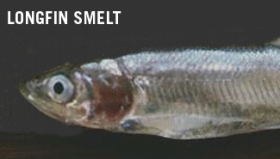
Longfin smelt. Photo: NOAA
Photo: NOAA

The Commission listed the delta smelt as “endangered” and the longfin smelt as “threatened,” a lesser classification. Both are denizens of the Sacramento-San Joaquin Delta and have long been at the center of controversy over water diversions from the Delta. According to the San Francisco-based Center for Biological Diversity:

“The San Francisco Bay-Delta Estuary is home to the largest and southernmost self-sustaining population of longfin smelt. Longfin smelt populations that inhabit the estuaries and lower reaches of Humboldt Bay and the Klamath River have also declined and may now be extinct. Since 2000, the Bay-Delta longfin smelt population has fallen to unprecedented low numbers. Since 2002, the delta smelt has plummeted to its lowest population levels ever recorded.”

CBD was among the environmental groups that petitioned the state for listing of the longfin in 2007. Delta smelt have been protected as a “threatened” species since last year but today that designation was escalated to “endangered.” The Center has also petitioned for–but has yet to attain–federal listing for both species by the U.S. Fish & Wildlife Service.

The listing could have major implications for water supplies this year. Court decisions in favor of the fishes have already forced reductions in water pumped out of the Delta for diversion to the San Joaquin Valley and Southern California. The rulings have prompted some to characterize subsequent reduced water deliveries as a “regulatory drought.”

Snowpack Buildup “Too little, too late”

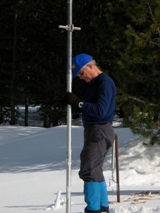
Frank Gehrke at Tamarck Flat last winter.
Frank Gehrke at Tamarack Flat last winter.

That’s how Frank Gehrke described the somewhat improved numbers in the latest Sierra snowpack survey. Gehrke has been trekking up to the snow courses for decades to do the seasonal surveys. Today, the statewide average for water content in the snowpack came in at 80% of normal for this date.

Northern Sierra locations clocked in a bit better at 84%, southern locations at 77%. These are an improvement over last month’s tally, when the state averaged only 61% of normal–but reservoirs are not filling fast enough to make up for the long, dry winter that preceded this recent string of storms.

Not that the recent rains haven’t helped. Oakland, Long Beach, Riverside and San Diego are among several spots that have now had at least 90% of their normal precipitation–and some local reservoirs have been catching up. But up in the Sierra, where it really counts for the Big Picture, they’re not catching up fast enough. The main holding “tanks” for the state’s two major water supply systems, Shasta Lake and Lake Oroville, are still at 60% and 55% of normal, respectively.

The recent storms have been relatively warm, too, with precipitation falling as rain all the way up to 7,500 or 8,000 feet. This is precisely the condition that climatologists have been warning about. Snow sticks to the mountain and makes its own reservoir, slowly releasing water well into the spring, as it melts off. But rain at those high elevations is double trouble. It runs off immediately into the rivers and also accelerates the snow melt. That means less water for later in the season, when we really need it.

That may be why the Governor didn’t wait around for today’s numbers. He went ahead and declared a statewide drought emergency on Friday, urging urban water users to cut consumption by 20%.

Can There Be This Much Climate News?

"Reports to the Contrary" by Chester Arnold

Some weeks it seems like KQED could fill up its entire “news hole” with climate-related stories (thank goodness we don’t). Last week was a prime example.

Monday: A keynote speaker at U.C. Berkeley’s annual Energy Symposium said that we need a “Fed” for energy policy. John Hofmeister, a former executive at Shell Oil and founder of Citizens for Affordable Energy, told the lunch crowd that the only way to overcome the current two-year “policy cycle” (the length of a congressional term) is with an autonomous policy group like the Federal Reserve Board, which can take a longer view.

Tuesday: PG&E announced a massive new solar power initiative (it was brought to my attention this week that no news story is complete these days without the word “massive”–at least when there’s no opportunity to use “deadly”). If approved by state regulators, the project will provide 500 megawatts of photovoltaic energy by 2015. Perhaps the most interesting aspect of the plan is that instead of, say, taking over huge tracts of the Mojave, the project will rely heavily on “solar infill;” making use of property already owned by the company, where they can conveniently access the grid.

Wednesday: Senator Barbara Boxer chaired a hearing of the Energy and Public Works Committee to update members on the latest climate science. They heard testimony from four experts, including Christopher Field of Stanford, who essentially said things are worse than you think. Ranking minority member James Inhofe of Oklahoma seized the moment to decry a $6.7 trillion “climate bailout,” a reference to upcoming federal climate legislation and costs associated with an aggressive plan to fight global warming. You can watch the entire two-and-a-half hour webcast for the gory details.

And of course also on Wednesday, the Coen Brothers rolled out their TV ad for The Reality Coalition, assailing the concept of “clean coal.”

Thursday: The California Air Resources Control Board rolled out new regulations to control some of the lesser known (but highly potent) greenhouse gases, including sulfur hexaflouride, used in the manufacture of computer chips. CARB says a pound of it has the same atmospheric warming potential as ten metric tons of CO2. The board also unveiled a new drought page on its website.

Friday: The Governor issued the latest in a series of drought declarations, this one proclaiming a state of emergency and called on cities to reduce their water use by 20%.

And this week wasn’t all that unusual.

Monday, another week begins with the winter’s third survey of the Sierra snowpack. While recent storms will no doubt have raised the water content from last month’s 61% of normal, it should be something of an anticlimax, especially given that the Governor didn’t wait for the numbers to make his drought declaration last week.

No Country for “Clean Coal?”

An activist group led by the Alliance for Climate Protection has crafted another national TV ad aimed at debunking “the clean coal myth,” this one directed by Hollywood legends Joel & Ethan Coen (directors of No Country for Old Men, in case you’re still puzzling over my obscure headline).

Produced by The Reality Coalition, the ad depicts a pitchman touting a fictional product called “Clean Coal” air freshener. He’s inter-cut with shots of a family spraying what looks like coal dust out of an aerosol can and coughing. The spot ends with the coalition’s stock text message: “In reality, there is no such thing as ‘clean coal.'” The best line in the mock ad, though, is when the pitchman explains that the product “harnesses the awesome power of the word ‘clean,'” the implication being that saying something is clean doesn’t make it so.

Former Vice President Al Gore has been on the stump for some time, carrying the same message; that clean-coal technology “doesn’t exist.” Reality Coalition spokesman Brian Hardwick goes farther than that. He claims that not only does it not exist but the industry isn’t doing much to make it reality. A separate analysis by the Center for American Progress pegged the research commitment by U.S. coal companies to carbon capture technology at about $3.5 billion “over several years,” compared to combined profits of $57 billion in just one year (2007).

The clean-coal debate is relevant to Californians. Mostly through imported power, coal provides more than 16% of the electricity we use. And as I mentioned in my radio segment for The California Report, China is counting on the U-S to develop technology to allow them to burn coal “cleanly.”

While clever, the ad does kind of miss the climate connection. It seems to be aimed at particulate pollution rather than the unseen emissions of carbon dioxide and other greenhouse gases blamed for global warming. Hardwick responded to that critique by saying that “Truly clean coal would have to mitigate all the (environmental) issues” involved in burning the fuel. Still, it’s a source of potential confusion for viewers unclear about the distinctions among greenhouse gases, ozone-depleting gases and local air quality issues.

Governor Gets His White House Climate Confab

Our Governor is a hard man to ignore. Less than a month ago, he and eleven other U.S. governors wrote a letter to the new President, reminding him of commitments he made to work in earnest with states on climate issues. Governor Schwarzenegger specifically recalled a line from President (then-elect) Obama’s remarks to the Governors’ Climate Summit last November: “Any governor willing to promote clean energy will have a partner in the White House.”

The January letter (this link is a .pdf download) requested a meeting with top-level members of the White House environmental team “as soon as possible…to discuss a state-federal partnership on clean energy and climate change issues.” This weekend the governors got their meeting.

The President didn’t show up but at least four high-level players did, including energy secretary Steven Chu, interior secretary Ken Salazar, EPA chief Lisa Jackson and the President’s energy and climate deputy, Carol Browner.

While no substantive announcements came out of it, Governor Schwarzenegger said afterward:

“Today’s meeting was the first step in creating a close and lasting partnership with President Obama and his administration on climate change. I look forward to working hand-in-hand with our federal partners to realize the ambitious clean energy and climate change goals I know we share, and that I know will provide a boost to our nation’s economy.”

Some remain skeptical that the path back to prosperity is paved with Green. California’s governor has been a vocal cheerleader for just such a strategy, to tackle both environmental and economic challenges.

The governors’ group’s stated goals include aggressive programs to reduce greenhouse gas emissions and harnessing “market mechanisms” (read that: “cap-and-trade”) to fund development of clean energy technology. They also want to “preserve and enhance state and local authority” in the regulation arena, and stave off “federal preemption” of what the states have already started.

Amateur Bird Counts Really Do Count

Photo by 10,000 Birds contributor Mike
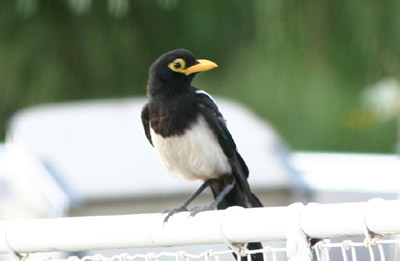
The yellow-billed magpie could lose 75% of its range. Photo by Mike Bergin

The hardiest of volunteers are winding up the Audubon Society’s Great Backyard Bird Count today. Consistent rain has made it a challenge throughout much of California (don’t get me wrong–you won’t see me complaining about rain at this point).

These bird counts are more than just feel-good exercises in pubic education. The data is useful in serious research,  like the Society’s recent stunning report on the likely effects of climate change on bird populations. The study, released last week, combined climate models with 40 years of data from Aububon’s Christmas Bird Count, to paint a grim picture for California’s birds.

The part of the study that focused on California warned that a third of the state’s native bird populations could see their ranges shrink substantially as the planet warms. According to the report:

“These reductions will be part of massive range shifts to all of the state’s bird species caused wholly or in part by the effects of climate change.”

Gary Langham, who co-authored the California study, says it should provide a wake-up call, and not just for those crafting policy to cut greenhouse gas emissions: “It’s also a tool for land managers and conservation groups and others to look at the landscape and understand where their conservation investments would be most wisely spent.”

Langham and his co-author, William B. Monahan note that this is more than a projection:

“Climate change is already pushing species globally poleward and higher in  elevation. In California, directional changes in climate during the 20th century were substantial.”

That squares with the observations of local birdwatchers. Tom Rusert, who founded the non-profit Sonoma Birding, says he’s seen a huge influx of American robins (something that might be a welcome sight in my hometown of Syracuse, NY, right about now). Rusert says his Sonoma Valley Christmas Bird Count drew 150 volunteers last year.

Thanks to nature sound recordists Martyn Stewart of Naturesound and Bernie Krause of Wild Sanctuary for providing bird calls for last week’s radio story. The magpie photo comes to us by way of 10,000 Birds.

IPCC Scientist: A “Vicious Cycle” of Carbon Spikes

For a while now, we’ve been hearing that greenhouse gas emissions are still off the charts, which is to say increasing beyond the U.N.’s worst-case scenario for global warming. Now a Stanford researcher has laid out some specific scenarios–and they’re not pretty.

Chris Field, who is working on the next IPCC report, said “There is a real risk that human-caused climate change will accelerate the release of carbon dioxide from forest and tundra ecosystems, which have been storing a lot of carbon for thousands of years.”

Field, a professor of biology and of environmental Earth system science at Stanford, and a senior fellow at the Woods Institute for the Environment, issued a warning for members of the American Association for the Advancement of Science (AAAS) in Chicago today: “We don’t want to cross a critical threshold where this massive release of carbon starts to run on autopilot.”

And yet, that would appear to be path that we’re on. As Field told the AAAS symposium, “We now have data showing that from 2000 to 2007, greenhouse gas emissions increased far more rapidly than we expected, primarily because developing countries, like China and India, saw a huge upsurge in electric power generation, almost all of it based on coal.”

So what would some of the consequences be? “Tropical forests are essentially inflammable,” Field said. “You couldn’t get a fire to burn there if you tried. But if they dry out just a little bit, the result can be very large and destructive wildfires. It is increasingly clear that as you produce a warmer world, lots of forested areas that had been acting as carbon sinks could be converted to carbon sources. Essentially we could see a forest-carbon feedback that acts like a foot on the accelerator pedal for atmospheric CO2.”

The loss of functioning forests worldwide is already estimated to account for about 20% of carbon emissions. But field also warns of another carbon burst from decomposed plants that have been locked in permafrost for tens of thousands of years. As if all that weren’t plenty, Field says the accelerated forest destruction and melting permafrost could combine to create a “vicious cycle” of accelerated carbon emissions.

Field sums up by saying: “We now know that, without effective action, climate change is going to be larger and more difficult to deal with than we thought.”

The Chicago symposium is being held to address new developments since the last IPCC interim report, in 2007. A formal update is due out next year. Field is co-chair of the IPCC’s Working Group 2, which is assessing the impacts of climate change on social, economic and natural systems.

Boulder Bunnies May Break Ground with ESA

Copyright 2006, Doug Von Gausig
Photo: Copyright 2006, Doug Von Gausig

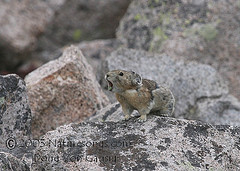
The American pika has begun a long-delayed journey toward possible listing under the Endangered Species Act.  It could become the first mammal in the Lower 48, let alone California, to be listed as specifically threatened by global warming.

The U.S. Fish & Wildlife Service agreed today to review the petition, as part of a court settlement with San Francisco’s Center for Biological Diversity.

Under the settlement, negotiated by lawyers with Earthjustice, the agency commits to a May deadline for determining whether the cartoon-cute alpine critter merits consideration for federal protection.

Pika live in rock colonies only at high elevation (usually above 9,000 feet, though some have been documented lower). They’re well insulated against the harsh mountain environment but can suffer heat stroke at temperatures approaching 80 F.

As alpine temperatures increase with global warming, conservationists worry that the pika will be driven further upslope and eventually out of existence.

Back in the fall of 2007, CBD petitioned for listing under both the federal and California ESA’s. The feds more or less ignored the request. California turned it down flat, saying there was insufficient data to warrant a review. There was also some sentiment on the commission that using global warming as a basis for listing any species would be setting an uncomfortable precedent. CBD sued both agencies and the California case is still in court.

Not all scientists are convinced that the pika’s in trouble. Find out why in our Climate Watch radio feature, Monday morning on The California Report. Listen to the story here.

By the way, “boulder bunny” is a fairly accurate description. They may look like rodents but pika are actually relatives of rabbits and hares.

Use the audio player below to hear Doug Von Gausig’s recording of pika vocalizing.
[audio:http://www.kqed.org/.stream/anon/climatewatch/pika1.mp3]

Audio recording provided by Doug Von Gausig and NatureSongs.com