
 April 10, 2013
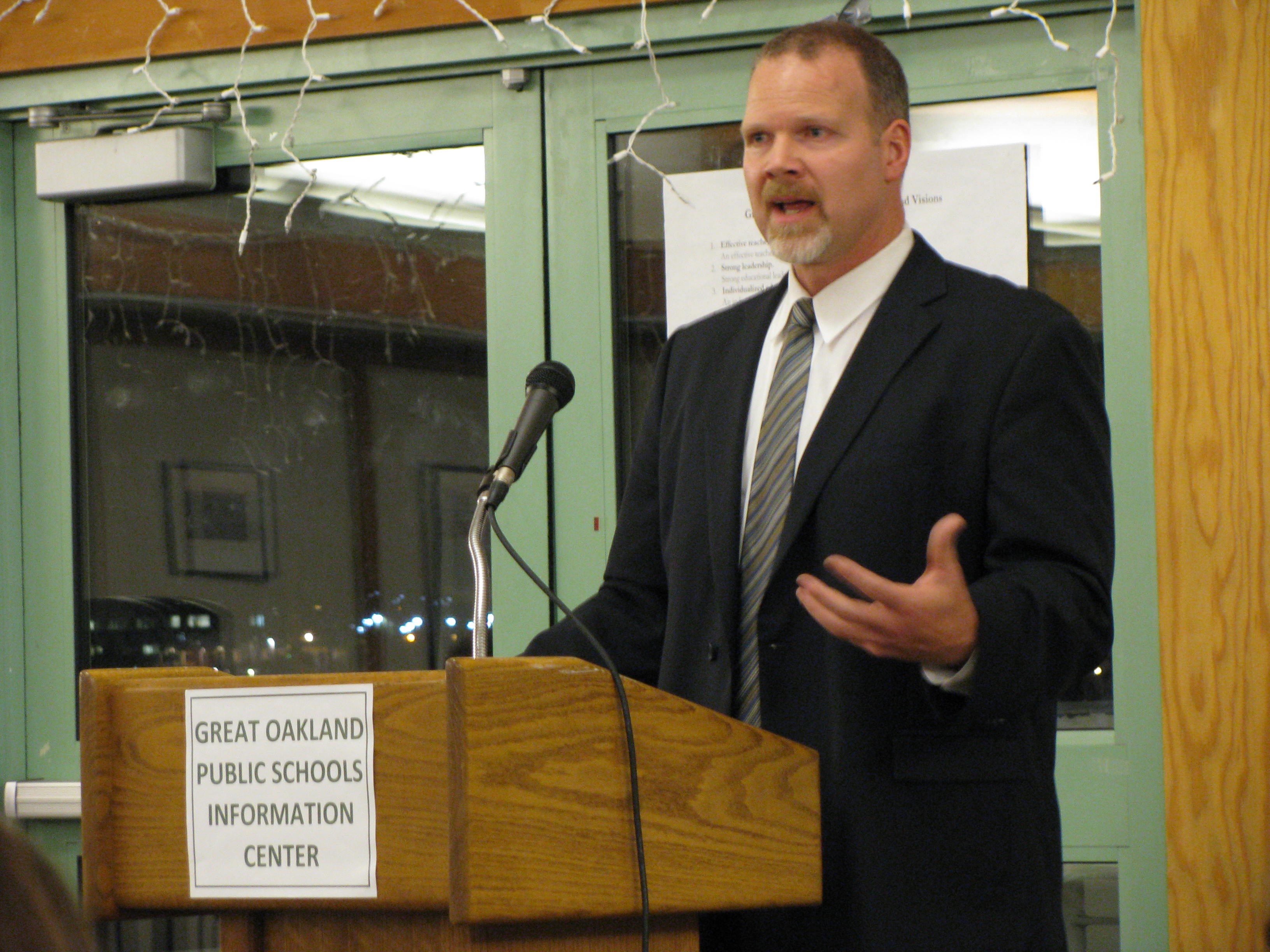
School board officials in Oakland have begun the process of replacing outgoing superintendent Tony Smith. Smith surprised colleagues last week when he announced he was resigning so that his family can be closer to his ailing father-in-law, who lives in Chicago.
Reporter Stephanie Martin spoke with Jill Tucker, who covers Oakland Unified for the San Francisco Chronicle, about Tony Smith and his record as superintendent — and what a new superintendent could mean for Oakland schools.
Stephanie Martin: Ms. Tucker, when Smith came on board four years ago, the district was trying to turn around very severe financial problems. How did he fare?
Jill Tucker: I think there’s nearly universal agreement that he’s leaving the district better than he found it. Last year, for the first time in a decade or more, the school budget in Oakland had no deficit. Even though they balanced their budget every year, they had been operating with a deficit for a very long time. So he was able to get rid of that structural deficit.
And yet at the same time, he avoided layoffs, even in the midst of a recession and all the budget cuts. When they had a bond on the ballot in November, it passed with 84 percent voter support. And a poll showed the highest support of the district in about 18 years. So in general, I think there are a lot of very sad people in Oakland that he’s leaving.
Stephanie Martin: But he did have to make some controversial calls, like closing schools. How did he weather that criticism?
Jill Tucker: You know, I remember speaking to him at the time. Because he is sort of evangelical in his efforts to address racism and to address race issues in Oakland. And some of the other community issues that are really tough to discuss — violence, inequality in our schools.
And I think it was very difficult for him when they started closing schools. He felt there were too many schools for the population; they’d been losing enrollment. And yet some of the schools that he was closing were predominantly minority schools, and they’d accused him of being a racist. But he was very steadfast, and said, look, when you’re in this position you just have to keep going forward. You can’t stop and think about what people are saying, when you believe you’re doing the right thing, you do the right thing.
So they did shut down a few schools, it was not popular. He also took on the teachers’ union, trying to tackle seniority in hiring issues so that he could get higher-quality teachers in some of the lowest-performing schools. That was not popular with the union.
But in general, he’s a very steadfast person. He has a very strong belief system, and he just has stuck with it. And at times that hasn’t been popular, but in general, the union and everybody else said they were disappointed to hear he was going.
Stephanie Martin: Oakland has really struggled to raise the graduation rates and the test scores. Those have improved overall, but from what I understand there still is an achievement gap. What remains to be done in that area?
Jill Tucker: As Tony Smith said, there’s still a lot to do in Oakland, and I don’t think anybody would disagree with that. Test scores are still below the state average, though they’re moving in the right direction. Graduation rates, dropout rates; we still have issues with at-risk students not achieving, schools where the teachers don’t have the same experience level, the resources that other schools have.
So there’s still a lot of work to do, even though they have gotten clear of direct state control, from the state takeover days of 2003. I think everyone agrees Oakland has a long way to go. But at least most people believe they’re on the right track.
Stephanie Martin: Oakland teachers have complained that they are paid less than those in comparable districts. Could that change under a new superintendent?
Jill Tucker: I think it could, if and only if more money starts coming in to Oakland. And we could see that under the governor’s proposed budget, where schools and districts that serve low-income or English-learner students would see more money. If that passes and Oakland does see an increased share of the state budget for education, you would probably see teachers being paid a little bit more. But it’s very difficult to pay them more when you have a static budget coming in.
On the plus side, Oakland teachers haven’t had gone through as many layoffs as many other districts. They’ve safeguarded them from that. But on the other hand, they are paid lower than many other districts.
Stephanie Martin: What else is the teachers’ union looking for?
Jill Tucker: I think from a new superintendent, or in general, what I’ve heard from the union this week is they want stability. They want to be able to count on their school system, their leaders. I think that was the hardest part of seeing Tony Smith leave, was that he has been here for four years and increased the stability in the district.
And I think that everyone would just love to see Oakland catch a break. It’s going to be a challenge for whoever the school board brings in, to stay the course. The school board has said they don’t want someone to come in and shake things up; they like the road they’re on.
That’s going to be the difficult part, when they look at who they’re going to hire. Because anyone who comes to a large city like Oakland to be superintendent, they’re going to want to put their own mark on it. The job comes with a bit of ego. It’s going to be difficult to find somebody to stay the course, to take the reforms that Tony Smith has implemented and keep on that path.
Stephanie Martin: Is there any sense of whether that new person would come from outside the district or within?
Jill Tucker: They haven’t started the process yet. They’ll start discussing it at the meeting tonight, as you mentioned. The first step is accepting Tony Smith’s resignation. Then they’ll decide whether they want to hire a consulting firm, do a national search, or try to stay a little more local.
There haven’t been any names from inside the district that folks have said, here’s a valid candidate that they might consider. No names have come forward in these few days since the announcement of the resignation. So it’s unclear if there’s anybody inside the district that’s ready to step into that role. We’ll have to see. As Jody London, one of the school board members said when I asked her about a replacement, “I didn’t know Tony Smith existed until I met Tony Smith.”
 April 5, 2013