Tag Archives: KQED American Graduate

Student Voices in San Jose: Designing the 21st Century School

December 22, 2012
By Daniel Zapien, Fernando Perez of Silicon Valley De-Bug

On November 15th at 2:30pm, De-Bug started making its way to the Schools of Arts and Culture at the Mexican Heritage Plaza for an event called “Designing the 21st Century School.” This event was created for the students from all over the Santa Clara County to come out and talk about how school could be better suited for them and their futures. The event also represented a coming together of various organizations who united in the interest of improving our school system – groups such as San Jose 2020, Santa Clara County Office of Education, Californians for Justice, American Leadership Forum, San Jose Youth Commission, School of Arts and Culture, De-Bug, and more.

As we got to the event, Malcolm Halcrombre was setting up the DJ booth, which was designed to entertain, and keep background music for the youth during the dialogues of the event. We began setting up the “21st Century School Graduation Photo Booth” where kids stood in front of a graphic Adrian Avila made of the school of the future. Students, who got to wear a cap and gown, chose which “diploma” they wanted to be pictured with, which were themes based on what schools could be. So the diplomas to choose from read that the youth graduated from a school of the future where students:Have Full Use of Technology, Have Teachers That Students Connect With, Never Have to Worry About Being Hungry in Class, Get Support for Issues They Face Off of Campus, Won’t Feel Judged Based on How You Look.

As the school buses started coming in, the youth started to come out and sign in, some would sit down and listen to the music, while others would walk over to the photo booth and take pictures with their friends. After the music was getting really funky, and the kids took as many pics as they could, before the event started. There were over 200 students, who sat in small groups, ready to create new possibilities for education.

As the room got silent, Dr Xavier De La Torre (Santa Clara County Schools Superintendent of Schools), and Christian Sanchez (San Jose High student and Youth Commissioner) grabbed the microphones and started making announcements for the evening full of events. They then introduced the first act — De-Bug who showed the  ‘Schoolin the Schools’ media contest entrees. Fern and myself (Ookie), went up to let the youth see what other youth were doing for the contest. Claps and cheers were heard as the students watched and listened to the videos and slideshows.

After getting the crowd live we gave the mic back to Christian and Dr. De La Torre who introduced the next part of the evening. This was the research portion that was done through surveys all across East San Jose schools by Californians for Justice. It was amazing to see to see the amount of concern students have regarding the level and quality of their education. Then we came to the part of the evening where the youth sat in circles and began giving their opinions on certain questions that was asked by community leaders and educators in a fashion that let everyone speak. The discussion was lead by youth facilitators. Students were asked to reflect on the media and research they all just saw, then proceeded to answer the question, “ If you invented school, what would it look like?” The students had plenty to say – giving direction and ideas that could transform our schools into education hubs that really prepare and inspire youth.

And they connected their dreams to the current realities facing their schools. In my small group, as students were speaking about how important one on one time with a teacher is, one student said, “The teacher at my school would only tutor three kids out of every class. She has six classes. It’s sad because now there is no one to help the rest of us students, because the school won’t get more teachers to help.”

Even the youngest of attendees got a lot out of the discussion, and what it represented. Samaj Kenney, age 12, was there to perform through his dance crew Monster Motion, but also participated in the small group discussion. He said, “It was amazing how they got all the kids out there to attend the event and actually listen and participate.”

After all the small groups were done, it was the last portion of the evening where the performances started. Danae James Johnican performed his submission to Schoolin the Schools, a song called “Hard Lessons.” After he performed, two members of Monster Motion got a chance to dance and make the crowd go wild.

View entire article.


Josue Diaz Jr.: Director and Teacher of The Green Academy at Oakland Technical High School

December, 28 2012
By Lisa Hewitt

Growing up in the San Fernando Valley, Josue Diaz Jr. never thought he’d be teacher. It wasn’t until his mother helped get him a TA position in a local kindergarten class that he began to consider the possibilities of a career in education. School wasn’t always his central focus; Diaz graduated from Cal State Northridge and after dropping out once he reapplied and returned to school. Diaz worked days and took classes in the evenings where he was surrounded by much older adults making him feel alienated by the entire process. As the first in his family to go to college, it was unclear to him what was involved in the college system,

“I didn’t know what financial aid was until my senior year of college. I didn’t even know you could get financial aid. I had no idea how the college system worked. I just knew my mom put an application in front of me, I filled it out and I got into Cal State Northridge. I had no idea about all the opportunities because I was the first in my family to go to college. I didn’t have anyone to help me out or guide me through high school. So I sort of fell through the cracks.”

Struggling with his own college experience, he knows the importance of preparing students for life after high school. He feels an obligation to guide the students he comes in contact with, from helping students with their transcripts to providing his classroom for after school clubs.

After graduating with a degree in education and his teaching credential, he moved to San Diego and began teaching elementary classes at a charter school and eventually went on to middle school and high school where he taught Earth Science. Working for over 13 years in education, Diaz has taught in a variety of schools, some with world class laboratories and state of the art learning tools.

“They tore down this one [high school], it was in South East San Diego, the part that’s not on the postcards, they tore down the school and rebuilt the school from scratch. And put laptop carts
and smart boards in every room. Our lab was just as good as [The University of California’s]. The thinking was the more resources you have the [more the] scores will go up. But I just found it more challenging to keep the students engaged especially in the labs. And they took a lot more things for granted. It was so much easier for them, ‘Oh here’s a graduated cylinder, oh it broke
we got boxes of them in the back,’ whereas at the charter school with those 6th grades we got really creative with some of the stuff. I think that’s what’s lacking, the imaginative…side of science.”

In the schools with limited resources Diaz and his students had to be more creative. At his first job in San Diego teaching elementary science labs, all the supplies they used could be found at home or bought cheaply, so the lessons could be recreated with their families in order to solidify the lesson they learned in class. After spending several years in the San Diego school system, Diaz and his wife moved to Oakland when her former high school assistant principal at Oakland Tech informed her of an opening in the science department. Diaz took over as director of the Green Academy in his first year of teaching.

As part of the Oakland Unified School District’s Linked Learning initiative, the Green Academy offers students academic and practical training in the sciences in order to prepare them for work in the growing environmental sector. Community partners in the sustainable energy sector help provide students with academic training, internships, and job shadowing. They also come to Oakland Tech and give guest lectures and teach labs. They often have equipment unavailable to the average high school, for instance, the East Bay Young Scientists from the Lawrence Hall of Science, are currently helping to test the water quality of Oakland Tech.

The aim of the Green Academy is to make science less abstract and more relevant to the lives of Oakland Tech’s students. Beginning four years ago, the Green Academy focused on broader scientific concepts, since Diaz has taken over, he’s sought to change the focus and explore more of the students’ interests and emphasize action research, which are projects designed to effect social change. At the beginning of the year, students think of a problem they see in their community that relates to the environment. Throughout the year, Diaz and the students do experiments outside of the school to guide their research, which results in a lengthy term paper.

Beyond the academic side, it also functions as a community service activity; it has to affect the community in a positive way. Some projects that have come out of the Green Academy were a fundraising project for community planter beds and promoting South Pacific culture while researching the effects of global warming and rising sea levels. Due to lack of staffing and Diaz’s own demands as a teacher, the Green Academy is going on indefinite hiatus, but he’d like to bring it back when the support and preparation are solidified. For the time being, Diaz hopes to continue to work with Bay Area partners to bring alternative education and job experience to his students.

If you’re interested in contacting Josue Diaz as a community partner please visit http://oaklandtech.com/staff/jdiaz/.

KQED: Oakland Schools' New Effort to Fight Soaring Suspension Rates


December 26, 2012
By Ana Tintocalis

Oakland’s public schools are heading into the New Year with an ambitious plan to curb a skyrocketing student suspension rate.

The vast majority of Oakland’s suspended kids are African-American, even though they make up just a third of the school population.

Federal civil rights officials investigated the suspension rate. And that led the school district to adopt a plan requiring all teachers to use so-called “Restorative Justice” practices in the classroom.

That approach keeps kids in school, encouraging them to examine their attitudes and the impact of their behavior.

But faculty members like Benjie Achtenburg, who teaches eighth grade at Melrose Leadership Academy, says the district is not providing enough resources and training.

“Being a public school teacher in Oakland,” Achtenburg says, “you are already overwhelmed by everything you have to do, no matter how many years you’ve taught in this district.”

Superintendent Tony Smith says teacher buy-in is one of the district’s big hurdles.

OUSD has five years to reverse the troubling discipline trend or face sanctions.

View article.

KQED's Forum: Living With Gun Violence

December 21, 2012

The entire nation has been shaken by the brutal killings of 20 children and six adults from Sandy Hook Elementary School in Newtown, Connecticut. Less discussed has been the pervasive gun violence in some urban communities. Last year in Oakland, nearly 150 kids under the age of 18 were victims of shootings. Six were killed. We discuss the effects of gun violence on a community. How does it impact children and their families, and what can be done to help?

Hear audio.

Mieko Scott, Founder of Imagine That Kids

December 21, 2012
By Lisa Hewitt

Imagine That Kids, an Oakland non-profit, began in 2008 when Mieko Scott, a former kindergarten teacher, found herself laid off and frustrated with the educational system in California. “During my lay off I was thinking about what I could still do and I was very depressed
I started to see the affect I had on those kids and their families. It just didn’t sit well with me.” She knew she wanted to continue to work in education and with children but actively sought to work outside the system to effect change. By providing educational enrichment and resources to kindergarten through 5th grade students in Oakland and surrounding cities, Imagine That Kids strives to support students, their families, teachers and the local school system. Their focus is primarily on children of incarcerated parents, underprivileged, foster and homeless youth. Operating with just six staff people, this non-profit relies heavily on the contributions of volunteers, including many young people.

One of Imagine That Kids’ programs, which is sustained almost entirely by volunteers, is in partnership with the Oakland Unified School Police. A literacy program, it serves exclusively African American male students in first and second grade at Cole Elementary every summer.  Students from McClymonds High School volunteer their time and help tutor the students, while strengthening their own literacy abilities.

Beyond the literacy program, Imagine That Kids does six big give-aways every year beginning in January with a coat drive. As a One Warm Coat agency, Imagine That Kids solicits donations from retailers around the region and distributes the coats to families in need. It’s deliberately scheduled for after the holidays when donations dramatically decrease.

Additionally, in February they organize a mother-son dance called Boys Need Love, designed for boys typically 5 to 11 years old. Scott explains, “We created that because we found that a lot of boys are afraid of love. They think love is something nasty, it’s gay. Why should I hug? Why should I love? When I saw that I wanted to create something for them
The sons can come and respect their mothers and learn etiquette on how to behave.” The event highlights an essential aspect of Imagine That Kids’s mission: to involve parents. They hold an event called Oakland’s Parent CafĂ©s, which are enrichment programs that allow parents to come together and share different parenting techniques they found to be effective.

Imagine That Kids works with a variety of community partners including KQED, which co-organize the Back to School Rally in Oakland’s City Hall every August. Imagine That Kids gives K-5 students backpacks with school supplies, lunch boxes filled with one days worth of lunch  with healthy snacks like sealable pineapple strips and apples, Quaker oat bars and bottles of water. Scott reflects that in her own life, she was able to succeed in school because she had every amenity she needed. She adds, “Having books and the resources and the pens and pencils and everything that we needed helped me not want. So I tried to think about what stuff I could do to help these kids succeed
The [Back to School Rally] supplies the kits
those are things that when you’re a low income family, it’s not a necessity.” The events and give-aways Imagine That Kids organizes serve an assortment of purposes. For instance, their mission is to give young people the resources they need to succeed in school and beyond, but at the same time they strive to instill vital life and social lessons in the young people about respecting their family, their peers, their teachers and themselves.

Imagine That Kids plans to deliver presents to families on Christmas Day. If you’d like to help out with this event or any other Imagine That Kids events please visit imaginethatkids.org.

Good: How We Can Curb America's Staggering Dropout Rate

jasoncityyear

December 21, 2012
By Jason Bateman

Most people would agree that starting a family is a major game changer. The second a child comes in to your life you are no longer the priority. Every bit of focus is about what’s best for your family, and you will do anything to provide them with the best possible opportunities in life.

I am no exception to this rule. I want my two young daughters to have everything they need to be successful—and I believe that education is the key to their success.

About three years ago I joined the board of City Year Los Angeles, an education-focused nonprofit organization that partners with public schools to help keep students in school and on track to succeed. In that time, I’ve seen cities across the country make great strides to improving education, but we still have a long way to go.

More than a million students give up on high school every year—that’s one every 26 seconds. This is a pretty jarring statistic made even more staggering when we recognize the consequences these dropout rates are having on our economy. Low graduation rates mean a significant loss to our workforce. Unless we’re able to graduate students at higher rates, nearly 12 million students will likely drop out over the next 10 years, resulting in a loss to the nation of $1.5 trillion. Cutting the dropout rate of a single high school class in half would likely support as many as 54,000 new jobs.

Thankfully, City Year has a solution. We know what the problem is, where it is, and how to identify and intervene with the students who are falling off the path to graduation.

City Year takes teams of young AmeriCorps members between the ages of 17-24 and places them in our city’s highest-need schools to help students stay on track to graduation. Corps members work side-by-side with students and teachers, acting as tutors, mentors and role models, from 7 a.m. to 6 p.m. every day. This year, 2,500 City Year corps members in schools and communities across the country will complete over 4 million hours of service.

As if their commitment to changing the trajectory of students in-need wasn’t enough, what really makes City Year stand out is their impact. Last year, 85 percent of all students in grades 3-5 tutored by City Year improved their literacy scores, and 88 percent of teachers believe corps members have helped foster a positive environment for learning.

City Year provides results, and it’s for the future of my daughters—and the future of all of our children—that I’m asking you to support City Year this holiday season. I’ve joined the Mozilla Firefox Challenge on Crowdrise with a goal of raising $50,000 for this amazing organization that will help make a brighter future for our families. Donate at least $27 to the fundraiser before Jan 11 and you will not only be helping our kids, but you will also be entered for a chance to win two tickets to the premiere of my new movie Identity Thief. This could mean you will be able to avoid having to actually pay to see me in a movie, while at the same time, wear that special outfit for a red carpet stroll!

Please join me and give the gift of a donation to City Year for the holiday and help us win the Mozilla Firefox Challenge!

View Story.

SF Gate: As reported shootings rise, analyzing gun violence, and its effect on young people, in Oakland

December 17, 2012

Scid Howard III grew up on the streets of East Oakland, so he knows what it’s like to be a teenager in a city where some young people are lost forever to gun violence and others live on, scarred physically and mentally. Howard himself was shot at age 19 and witnessed the shooting death of his best friend at age 17. He now counsels young people for several support organizations in Oakland to save them from a similar fate.

“My job is to figure out the math of it and try to solve it,” Howard said. “And I love these kids.”

In a city where 1,077 shootings were reported in 2011, no one is affected more than the city’s young people—city and community leaders say shootings of minors are not only particularly tragic but deeply affect them for years to come. Of the 1,594 reported shooting victims in Oakland last year, 143 were 17 years old or younger, according to data from the Oakland Police Department. Of these, six shootings were fatal. Some—including Howard—say the danger of gun violence among the city’s young people is increasing. “Today you got men teaching their children, “He gonna be the next me, he gonna be the next killer,’” Howard said. “It’s getting worse.”

Data compiled by the Urban Strategies Council—which works with, and collects data for, agencies like the OPD—shows the overall number of reported shootings rising in recent years, from 869 in 2009 to more than 1,200 in 2011, the highest since 2003, the earliest year for which they have data. Homicides—which are by and large committed by people with guns—have followed a similar trend. As of early December, 2012, the city had already seen 117 homicides, soaring past 103 for last year and perhaps reaching the highest total since 2008 police say, when 124 people died.

While the final statistics for the number of shootings in 2012 will not be available until early 2013, Oakland North reporters worked with the Oakland Police Department to obtain citywide shooting statistics for 2011, the most recent complete year on file. The data gives a unique snapshot of gun violence in Oakland. In particular, Oakland North analyzed shootings in which minors were victims to provide a better picture of gun violence in the city.

To learn more.

Mercury News: Oakland library chief ready for life's next chapter

December 13, 2012
By Maggie Sharpe

By The director of the Oakland Public Library is beginning a new chapter in her life.

Carmen Martinez, 62, who has led the library through ups and downs for the past dozen years, is set to retire Saturday.

“It was a benchmark that I wanted to retire when I was 62,” Martinez said. “You still have the energy and curiosity to keep active and intellectually stimulated. There’s a lot to look forward to without the structure of work.”

Martinez’ contributions to what she calls a “noble cause” were recognized in a formal proclamation from Mayor Jean Quan and Oakland City Council at the Dec. 4 council meeting.

“(The City) commends Carmen Martinez for 12 years of outstanding service and congratulates her on the occasion of her retirement,” reads the resolution.

Martinez, a native of Los Angeles who grew up in Glendale, received her bachelor’s in arts degree from then-CSU Hayward in Spanish language and literature; a certificate in proficiency in language from the University of Barcelona; and a master’s degree in library science from CSU Fullerton.

Martinez was recruited to Oakland in 2000 from the Los Angeles Central Library, where she worked for eight years. The same year, Gerry Garzon, who is taking over from Martinez as interim library director, joined the Oakland Public Library as associate director. He had previously held that position with the Arapahoe Library District in Colorado.

“We both came from library systemswith a lot of money,” Martinez said. “So it was a big adjustment for both of us when we came to Oakland.”

She said that before she began her job, there hadn’t been a director for three years.

To read more.

Huffington Post: Oakland Schools To Allow Federal Monitoring Of Black Student Discipline

December 10, 2012

The Oakland Unified School District and the U.S. Department of Education agreed last week to allow for at least five years of federal monitoring as the district attempts to reduce the disproportionately high black student suspension rate, the Los Angeles Times reports.

The resolution, of which the Oakland school board voted 6-0 in favor, concludes an investigation by the Department of Education’s Office for Civil Rights into whether discipline of black students was harsher and more frequent and harshly than for their white peers.

Data released by the Department of Education in March showed that black students are three-and-a-half times as likely to be suspended or expelled as their white classmates.

Under last week’s agreement, federal officials will keep watch on 38 Oakland schools and oversee the district’s five-year plan to address students’ needs by offering mentoring services to at-risk students, providing training for teachers and staff and combatting disciplinary issues without resorting to suspensions.

According to the San Francisco Chronicle, almost 20 percent of Oakland’s black males were suspended at least once last year — six times the rate of white students. In middle school, one out of every three black students was suspended at least once. Furthermore, research conducted during the 2010-11 school year found that more than half of African American male students in the Oakland Unified School District are at risk of dropping out.

Russlynn Ali, the Education Department’s assistant secretary for civil rights, told theLA Times that last school year, African American students comprised about 39 percent of the district’s total enrollment but accounted for 63 percent of students with at least one suspension and 61 percent of those who were expelled.

“Historically, they have been the whipping boys in our district,” Chris Chatmon, executive director of the district’s African-American Male Achievement Office, told the Oakland school board. “We are here today to ante up and reclaim our children.”

Federal education officials say they are hopeful Oakland can serve as a model for other districts that are seeking to address disproportionately high rates of suspensions of minority students, the AP reports.

“Disparities in disciplinary procedures are inherently wrong and all too common,” U.S. Education Secretary Arne Duncan said in a statement. “I commend Oakland for being the first district to directly confront this challenge.”


The Education Report: Oakland Unified to score 
 everyone

matrix 2

December 10, 2012
By Katy Murphy

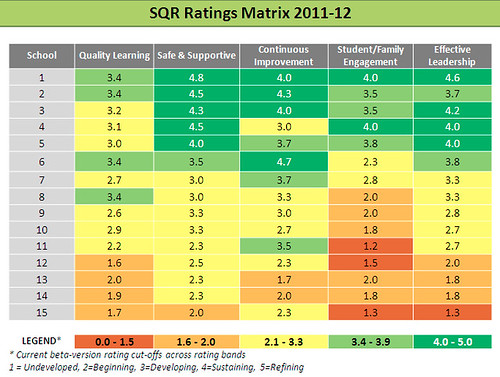
The above matrix of nine elementary and six middle schools — which underwent a pilot School Quality Review process last school year — is just a sample of the kinds of targets and scoring systems being put in place in Oakland Unified.

At 6 p.m. Wednesday, the OUSD board holds a special meeting to discuss this and other parts of its “Balanced Scorecard,” which sets goals for student achievement, attendance, discipline rates (racial disparities, in particular), effective teaching, teacher satisfaction, teacher retention — and, yes, for a balanced budget that maximizes teaching and learning with an equitable (read: not equal) base funding model for its schools.

It calls for increasing the graduation rate for each student subgroup (black, white, Asian, Latino, male, female, English learners, special education students) by 1 percent this year, as well as the overall rate.

Other goals include upping the number of students who graduate UC/CSU eligible, with A-G requirements (this is key, as OUSD’s current 9th and 10th-graders must complete A-G requirements to receive a high school diploma, as a result of a policy change promoted by student leaders and Ed Trust West in 2009); boosting the number of students who graduate from an academy or career pathway, and making it mandatory for 11th-graders to take the CSU’s Early Assessment Program test in English and math.