Tag Archives: KQED American Graduate

Radio Forum: Investing in Youth of Color

Kevork Djansezian/Getty Images Students fill out applications for youth programs in Los Angeles.

Originally aired August 10, 2012

California must reduce the barriers to success for youth of color, according to a new report assessing the bleak prospects facing Latino and African-American boys and young men in the state. These groups make up a disproportionate share of prisoners, school dropouts and the unemployed. We’ll discuss the report, which offers policy ideas for improving the lives of young people of color.

Host: Joshua Johnson

Guests:

  • Jorge Ruiz de Velasco, director of education law and policy at the Chief Justice Earl Warren Institute on Law and Social Policy at the UC Berkeley School of Law and co-author of the report
  • Marc Philpart, senior associate at PolicyLink, a national research and action institute advancing economic and social equity
  • Michael Muscadine, contributed testimony to California Assembly’s Select Committee on the Status of Boys and Men of Color
  • Rigo “Bubba” Fuentes, contributed testimony to California Assembly’s Select Committee on the Status of Boys and Men of Color
  • Sandre Swanson, California state assemblymember and head of the Select Subcommittee on the Status of Boys and Men of Color, which released the draft


Listen in>>

OUSD’s Black Male Students: School-by-School Data

The Education Blog
Tuesday, May 22nd, 2012
Written by Katy Murphy

This morning, Urban Strategies Council released a series of reports about the experience of black boys in the Oakland school district: one on out-of-school suspensions, one on chronic absenteeism, and lastly, an analysis of numerous factors to estimate how many children are on track to graduate high school — beginning in elementary.

There is so much data here that the short story in today’s Tribune (which is long by today’s standards) and blog post can’t do it justice. Each school will receive a data profile to further the district’s African American Male Achievement initiative. These reports were produced in partnership with OUSD as part of the initiative.

Some of the stats that I pulled for the paper on African-American boys in OUSD. The suspension rates are the percentage of individual students that received an out-of-school suspension at least once during a single school year.

Read more about the statistics about African-American boys in OUSD.

KQED Radio Forum: The Cheating Culture

Originally aired on Forum with Michael Krasny, April 24, 2012
More than 30 students have been suspended from Berkeley High School for breaking into the school’s attendance system and changing records. We begin with a look at the Berkeley High scandal, and then we’ll discuss cheating more generally with David Callahan, author of “The Cheating Culture: Why More Americans Are Doing Wrong to Get Ahead.”
Listen to more.

Guest Youth Blogger: Sydnee Logan

East Oakland Step to College Graduates

Written By Yo Ann Martinez

KQED is excited to partner with the Step to College Program at Fremont High School in Oakland, California as they prepare to present Build Your Own School (BYOS) project at the American Educational Research Association Conference (AERA) in Vancouver, Canada.

Sydnee will be blogging about their presentation, his classmates and thoughts on traveling to Canada. He will also share a video highlight reel of the trip. We look forward to it!

Here is Sydnee in his own words:

“Hello everybody, my name is Sydnee Logan. I’m a 17-year-old native of Oakland, California. I am currently a junior at the John C. Fremont High School in Oakland, attending a smaller school named Mandela Law and Public Service Academy. In my free time I play sports, hang out with my friends, and have participated with the Step to College Program since my 9th Grade year.”

Stay tuned for his first submission.


KQED News: California Report Special Coverage Baby Steps California's Early Learning Challenge

KQED California Report Special Coverage
Written by Ana Tintocalis
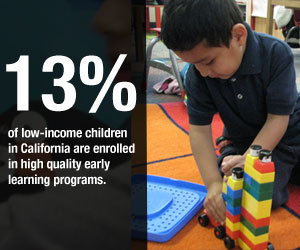
Research shows that a quality early childhood education can improve a child’s readiness for school and help prepare them to succeed as adults. How will this prepare them for the rest of their school years? Follow this California Report Special Coverage of Early Learning Challenges in California


KQED News: Budget Cuts Threaten Transitional Kindergarten

A project by transitional kindergarten students at Kingsley Elementary School in Los Angeles. (Image credit: Ana Tintocalis/KQED)

KQED News
Posted on April 11, 2012
Written By: Ana Tintocalis

About a dozen kids buzz around a colorful classroom at Walteria Elementary in Torrance, just north of Long Beach. Some kids are stacking Legos and playing with dolls. Others are at tables with jumbo crayons.
At the center of the action is teacher Lisa Rodeski.
“In my classroom, when they first come in in the morning, this is what I call table time, so everything out on the tables is focused on small motor development or it’s math skills,” Rodeski says.
But this is not your typical kindergarten class. It’s called “Preppy K,” a transitional kindergarten program for kids just shy of their fifth birthdays. Rodeski says these kids are not quite ready for the structure of regular kindergarten.
“They stand out in a number of ways,” she says. “It might be academic, it might be physical, it might be social, it might be emotional or it might be a combination of all of those things. So this program has been developed to meet all of their needs.”
The program here has been around for about 20 years. The district makes a commitment to fund it because they see the benefits. Learn more about this important topic.

Video: How Does Tutorpedia Fight The Drop Out Crisis?


Written By Emma Bundy
Tutorpedia fights the dropout crisis by providing critical academic support to students. Through personalized, one-on-one tutoring, students receive the individualized attention that is often difficult for over-extended teachers to provide in the classroom.

By collaborating with teachers and academic advisors at students’ schools, Tutorpedia tutors reinforce school curriculum and support lessons in dynamic ways outside of the classroom.  As Ms. Moyenda, a veteran SFUSD teacher explains, “It’s not just me saying to the tutor, ‘here give the kid this.’ It’s me getting the information back from the tutor that says, ‘here’s where your focus needs to be.’ I think every kid needs their own one-on-one tutor because now we can no longer give that one-on-one instruction.” Tutorpedia tutors develop relationships with their students to focus on specific academic needs while also addressing issues that impact learning within the classroom environment.

Tutorpedia tutors are experts in education who are passionate about student learning. Experienced tutors develop creative ways to help students understand in order to make education realrelevant, and rigorous. By connecting academic success to real-life, tutoring helps students engage with school and graduate. Since 2007, Tutorpedia has provided more than 6,000 hours of tutoring to low-income families through the Supplemental Educational Services program and through the generosity of private donors and grant-making institutions. Learn more about Tutorpedia and the Tutorpedia Foundation.

Pinterest: Why I Go to School

Pinterest is an online pin board. Why I Go To School is the topic of this pin board. Students share why they go to school as part of the American Graduate project focusing on the high school dropout crisis. If you would like to submit your motivation for why you stay in school, email us at newshourextra@gmail.com. Please include your first name, age, grade in school and brief blurb in addition to your Pin. For teachers, here is a lesson plan to get your classroom involved. Check out our recent reporting.