Category Archives: Research

California Community College Approve Overhaul

San Francisco Chronicle
January 10, 2012
Written By Nanette Asimov
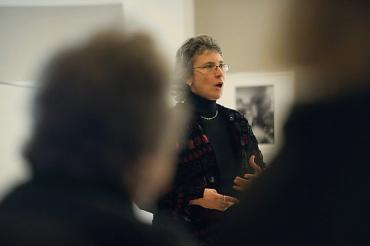
Shelley Glazer, chairperson and instructor of the older adults department at San Francisco City College, talks with students at the Jewish Community Center in San Francisco. California community college leaders voted on a systemwide overhaul that could end many free classes for older adults.

Over the objections of angry college students and worried faculty members, California community college leaders voted Monday to support a systemwide overhaul that could end many free classes for older adults and squeeze out students who fail to move quickly through the system.

The 22 recommendations approved by the college system’s Board of Governors are intended to address a devilish problem: Essential classes are in critically short supply and thousands of students are turned away from classes they need because of the state’s economic crisis.

Board member Peter MacDougall, chairman of the Student Success Task Force that drew up the recommendations over the last year, said colleges can no longer afford to put out the welcome mat they have offered for generations.

“As wonderful as having open admission is, if it’s a false promise, it fails,” he said.

Under the new plan, all students will be expected to set up an education plan to move quickly toward an associate’s degree or vocational certificate. If they linger too long or take too many classes unrelated to their goal, they lose registration priority. Others poor enough to quality for a fee waiver would lose that benefit after 110 credits, well beyond the 60 credits needed to transfer.

These changes, including a shift in key decision-making from the 112 campuses to the state chancellor’s office, won’t be automatic. Legislation is required for several of the proposals.

But Monday’s vote, unanimous with two abstentions, was a significant step toward implementing them.

“This is the most significant issue that’s come before the board,” said Board of Governors President Scott Himmelstein.

Supporters include the Community College League of California and other groups that say the recommendations will focus more attention on students who fall through the cracks.

Scott Lay, president of the league, said it was “unconscionable” that higher education has been cut $2 billion this fiscal year. “But it’s more unconscionable that we have a 20-point achievement gap between white and black students. We cannot ignore this any longer,” he said.

Dozens of opponents addressed the board, fearful that students who don’t fall within the scope of the recommendations will be shut out.

Many said that 110 credits isn’t enough time for some students, especially those who have had troubled childhoods, are single parents or former offenders.

“These recommendations are discriminatory,” said Paul Munoz, who works with needy students at Ventura Community College.

Ed Murray, an instructor at City College of San Francisco, where many opponents were from, urged the board to oppose the recommendations.

“Don’t cut out the poorest of our society. Where are they going to go if they can’t go to community college? To prison?” Murray asked.

Several of the speakers oversee programs for older adults, which offer free classes from memoir writing to music appreciation.

The recommendations direct colleges to spend their dollars first on students with academic or vocational goals. Only then should scarce resources be spent on free enrichment classes.

Chancellor Jack Scott told the audience that he has nothing against older adults. “I happen to be one of them,” said the white-haired former state senator.

Scott also addressed those who criticized the rationing of education, an expression he has used himself.

“We’re already rationing education,” he said. “We’re just doing it haphazardly.”

Abstaining from the vote were board member Natalie Berg, also a City College of San Francisco trustee, and Danny Hawkins.

As the board members voted, students stood, interrupting with “Mike check!” the Occupy movement’s signature statement. They paused only long enough to allow the board to finish voting, then shouted:

“We’ll be back! We shut down the Port of Oakland – twice – and we’re coming for you!”

Steering Girls To Science and Tech Careers

MindShift Blog
January 6, 2012
Written By Tina Barseghian

Thirteen-year-old Ebony Green has hopes for a career in science.

For Ebony Green, a career as a scientist might have seemed unlikely just last year.
The stereotypical outcome for girls like Ebony, an eighth-grader at Frick Middle School in a rough part of East Oakland, isn’t necessarily a high-paying job in science, math, engineering or technology. In fact, 40 percent of Oakland Unified School District students drop out.
Still, despite her surroundings and the legacy of her race, gender, family background, and income bracket, Ebony sees a different future for herself. She wants to be a pediatrician, or maybe a vet, and she’s starting to take steps to get there. To read the rest of this compelling article go to: MindShift

As part of the PBS American Graduate Program, I produced a segment for the PBS NewsHour on Ebony Green and Techbridge with correspondent Spencer Michels. Here’s the segment.

From Homeless Barracks to U.C. Berkeley

Huff Post
December 30, 2011
Written by Linnie Frank Bailey
The road to U.C. Berkeley was not an easy one for Moreno Valley’s Jamal Samuel. It included 4:15 am treks along the barren landscape of the former March Air Force base to catch the first of two buses that would get him to Riverside’s North High School.

Unbeknownst to most of his fellow students and teachers, Jamal spent his junior and senior year of high school living at King Hall — a homeless shelter on the base run by Path of Life Ministries. Once military housing, the barracks have been converted into small one-room apartments for the homeless.
Read this inspirational story at The Jamal Samuel Story

Video: Girls and Technology

PBS News Hour
December 29, 2011
Written by Spencer Michels
Steele, author of “Whistling Vivaldi and Other Clues to How Stereotypes Affect Us,” sat down with me to talk about prospects for programs like Techbridge, which enrolls 600 girls in Oakland and nearby cities in two hours of after-school science classes a week. Many of the girls are not high achievers, many are black or Latina, girls some people wouldn’t expect to see giving up their 3 to 5 p.m. slot so they could design catapults or connect electrical circuits. But they’re doing it and the results have been good. They are more aware of job opportunities for women in technology; they see themselves as having a role, and their interest has been piqued.

In the video below, Steele also shares his concerns about the real-world implications for gender stereotypes — including its role in the dropout rate — and some of the other proactive solutions schools and companies can take to counterbalance them.

Book Review: Why Our High Schools Need the Arts

Huff Post
December 30, 2011
Written By Kristen Pagalia
According to Department of Education data, about 1 in 5 students in California dropped out of high school in 1986 when the blockbuster was released, and that statistic has not improved. In recent years, the drop out rate in the Los Angeles Unified School District has climbed as high as 1 in 3. Further, a University of California, Santa Barbara study found it costs California over $46 billion for each year’s cohort of dropouts over their lifetimes. Still, year after year, district leadership and educational policy makers cite reducing attrition as a top priority while continuing to cut resources to the curricular activities proven to keep kids in school and doing well — namely the arts. In her new book, Why Our High Schools Need the Arts — Fighting Attrition with Interest and Relevance, Dr. Jessica Hoffmann Davis weaves a masterful case for arts education as an antidote to academic disengagement, as well as a uniquely affective method of teaching the character and intellectual traits associated with scholastic, social, and professional success.

For more about this article go to: Schools Need the Arts

Video: In San Francisco Bay Area, New Ideas on Innovating Out of Dropout Crisis

PBS News Hour
December 29, 2011
Written by Spencer Michels
One of the toughest jobs in modern America has got to be running an urban school district. Superintendents of schools in big cities like Washington, D.C, Los Angeles and Oakland, Calif., don’t have very good job security because if they are taking any risks, and messing with the status quo, it provokes controversy and opposition.

Celebrity Calls Urge Students To Get Up, 'Get Schooled'

PBS News Hour
December 14, 2011
Written By Veronica Devore
A teenager punches the snooze button again and is contemplating skipping class to stay in bed when her cell phone rings. Tyra Banks is on the line telling her to get up, go to school and do what she has to do to graduate.
Pre-recorded robocalls from the likes of Banks, rappers Nicki Minaj and Wiz Khalifa plus many other celebrities are behind an initiative from the Get Schooled Foundation — in partnership with The Bill & Melinda Gates Foundation*, Viacom and other major sponsors — to increase attendance in American high schools. Students and parents can sign up for the twice-weekly wake up calls that, in combination with school-wide attendance challenges and activities rolled out in 90 schools across the nation, encourage teens to get up and get to school.
Listen to celebrity wake up calls.

Behind the Numbers: Why Dropouts Have it Worse Than Ever Before

A new dropout crisis study reveals staggering statistics on economic gaps between those in Chicago and around state of Illinois with and without high school diplomas.
Earlier this week, our friends over at WTTW Chicago Tonight interviewed economist Andrew Sum about the study, released by the Center for Labor Market Studies at Northeastern University. As Sum highlights, these numbers add up to a long-term effect not only for American society, but also for dropouts for most of their lives.
Watch below for Chicago Tonight’s interview with Sum, director of the Center for Labor Market Studies:

Watch December 8, 2011 – High School Dropout Rates on PBS. See more from Chicago Tonight.

Group aims to recall five OUSD board members

The Education Blog
Wednesday, December 14th, 2011
Written by Katy Murphy

In Oakland, recall is in the air.
As some citizens collect signatures to recall Mayor Jean Quan, another group named Concerned Parents and Community Coalition is trying to oust five of the seven Oakland school board directors. It’s targeting those who voted `yes’ on the proposal this fall to close elementary schools: Jody London, David Kakishiba, Jumoke Hinton Hodge, Gary Yee, and Chris Dobbins.
To read more about the board meeting go to OUSD five.