Category Archives: Local

GSA Network Presents: Youth Empowerment Summit

LGBT summit on school push out & bullying to draw hundreds of CA youth

Gay-Straight Alliance Network hosts 8th annual Youth Empowerment Summit
on Saturday, December 15, 2012 
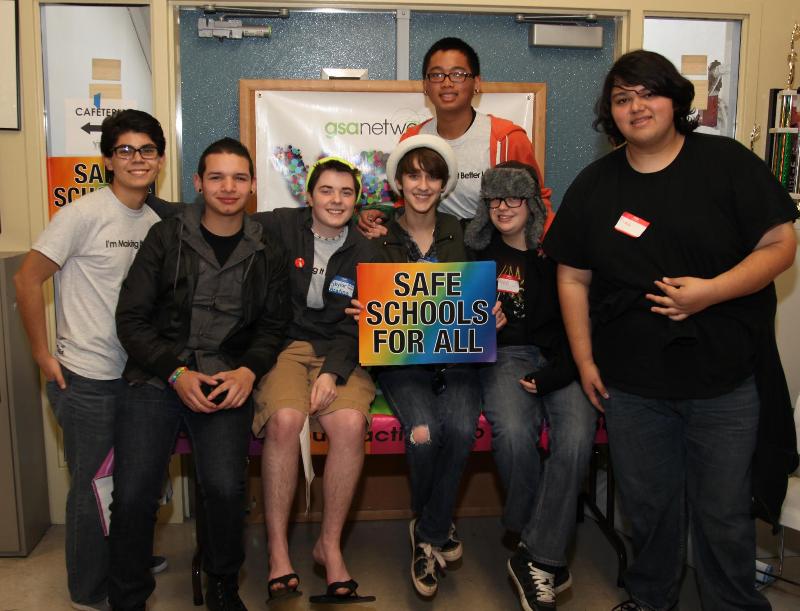
Photo: Youth leaders at the 2011 Youth Empowerment Summit

San Francisco, Dec 6, 2012 — The 8th annual Youth Empowerment Summit (YES), hosted by Gay-Straight Alliance Network and planned and led by youth, will bring hundreds of California high school and middle school students to San Francisco on December 15, 2012. Aimed at making schools safer for lesbian, gay, bisexual and transgender (LGBT) youth, the summit will include skills-building workshops, a resource fair, and a keynote youth panel to discuss the impact of the school-to-prison pipeline on LGBT young people. LGBT youth are 1.4 times as likely to be expelled from school as their straight peers.

What: 2012 Youth Empowerment Summit
When: Saturday, December 15th, 2011, 9am-5pm (followed by a youth dance party)

  • 10am: Keynote youth panel on LGBT youth and the school-to-prison pipeline
  • 10:45am: Photo-op, media opportunities
  • Where: Mission High School, 3750 18th Street, San Francisco, CA

    “Like many LGBT youth, I’ve faced slurs and bullying from my peers and then punishment from my administrators for acting out against that harassment. I got involved with my Gay-Straight Alliance club because I had to make my school a safer space if I was going to succeed,” said Rexy Amaral, a sophomore at Mission High School in San Francisco, CA. “I helped plan today’s conference to empower other young people to find their voices, transform their communities, and strengthen the GSA movement.”

    The 2012 Youth Empowerment Summit will offer 45 workshops, including: “LGBTQ Students: Know Your Rights;” “Opening the Locker Room Closet;” and “Coming Out Against Push Out.” The keynote panel will feature youth voices discussing the school-to-prison pipeline, a set of policies and practices used by school districts that indirectly push out or exclude youth of color, LGBT youth, low-income youth, and youth with disabilities. Last year’s Youth Empowerment Summit drew more than 500 participants.

    “Youth from across the state have seen the devastating effects of a school systemthat educates some students while punishing others for how they dress, act, or look,”said Carolyn Laub, Founder and Executive Director of Gay-Straight Alliance Network. “That’s why hundreds of LGBT and straight ally youth are coming to the 2012 Youth Empowerment Summit, where they can find the tools they need to organize their Gay-Straight Alliance clubs to advocate for safer schools for all youth struggling against oppression and discrimination.”

    The 2012 Youth Empowerment Summit is supported by community co-sponsors Genentech, PG&E, the Rainbow Community Center, and PFLAG San Francisco. Volunteers from PricewaterhouseCoopers, Google, the Gap, and the University of San Francisco LGBT Caucus also help make the summit possible.

  • Gay-Straight Alliance Network (GSA Network) is a national youth leadership organization that empowers youth activists to fight homophobia and transphobia in schools by training student leaders and supporting student-led Gay-Straight Alliance clubs throughout the country. In California alone, GSA Network has brought GSA clubs to 56% of public high schools, impacting more than 1.1 million students at 890 schools. GSA Network’s youth advocates have played a key role in changing laws and policies that impact youth at the local and state level. GSA Network operates the National Association of GSA Networks, which unites 37 statewide networks of GSA clubs throughout the country. GSA Network is also the founder of the Make It Better Project, which aims to stop bullying and prevent suicide. www.gsanetwork.org


    Empowering youth activists to fight homophobia and transphobia in schools


Mercury News: Oakland library chief ready for life's next chapter

December 13, 2012
By Maggie Sharpe

By The director of the Oakland Public Library is beginning a new chapter in her life.

Carmen Martinez, 62, who has led the library through ups and downs for the past dozen years, is set to retire Saturday.

“It was a benchmark that I wanted to retire when I was 62,” Martinez said. “You still have the energy and curiosity to keep active and intellectually stimulated. There’s a lot to look forward to without the structure of work.”

Martinez’ contributions to what she calls a “noble cause” were recognized in a formal proclamation from Mayor Jean Quan and Oakland City Council at the Dec. 4 council meeting.

“(The City) commends Carmen Martinez for 12 years of outstanding service and congratulates her on the occasion of her retirement,” reads the resolution.

Martinez, a native of Los Angeles who grew up in Glendale, received her bachelor’s in arts degree from then-CSU Hayward in Spanish language and literature; a certificate in proficiency in language from the University of Barcelona; and a master’s degree in library science from CSU Fullerton.

Martinez was recruited to Oakland in 2000 from the Los Angeles Central Library, where she worked for eight years. The same year, Gerry Garzon, who is taking over from Martinez as interim library director, joined the Oakland Public Library as associate director. He had previously held that position with the Arapahoe Library District in Colorado.

“We both came from library systemswith a lot of money,” Martinez said. “So it was a big adjustment for both of us when we came to Oakland.”

She said that before she began her job, there hadn’t been a director for three years.

To read more.

Huffington Post: Oakland Schools To Allow Federal Monitoring Of Black Student Discipline

December 10, 2012

The Oakland Unified School District and the U.S. Department of Education agreed last week to allow for at least five years of federal monitoring as the district attempts to reduce the disproportionately high black student suspension rate, the Los Angeles Times reports.

The resolution, of which the Oakland school board voted 6-0 in favor, concludes an investigation by the Department of Education’s Office for Civil Rights into whether discipline of black students was harsher and more frequent and harshly than for their white peers.

Data released by the Department of Education in March showed that black students are three-and-a-half times as likely to be suspended or expelled as their white classmates.

Under last week’s agreement, federal officials will keep watch on 38 Oakland schools and oversee the district’s five-year plan to address students’ needs by offering mentoring services to at-risk students, providing training for teachers and staff and combatting disciplinary issues without resorting to suspensions.

According to the San Francisco Chronicle, almost 20 percent of Oakland’s black males were suspended at least once last year — six times the rate of white students. In middle school, one out of every three black students was suspended at least once. Furthermore, research conducted during the 2010-11 school year found that more than half of African American male students in the Oakland Unified School District are at risk of dropping out.

Russlynn Ali, the Education Department’s assistant secretary for civil rights, told theLA Times that last school year, African American students comprised about 39 percent of the district’s total enrollment but accounted for 63 percent of students with at least one suspension and 61 percent of those who were expelled.

“Historically, they have been the whipping boys in our district,” Chris Chatmon, executive director of the district’s African-American Male Achievement Office, told the Oakland school board. “We are here today to ante up and reclaim our children.”

Federal education officials say they are hopeful Oakland can serve as a model for other districts that are seeking to address disproportionately high rates of suspensions of minority students, the AP reports.

“Disparities in disciplinary procedures are inherently wrong and all too common,” U.S. Education Secretary Arne Duncan said in a statement. “I commend Oakland for being the first district to directly confront this challenge.”


The Education Report: Oakland Unified to score … everyone

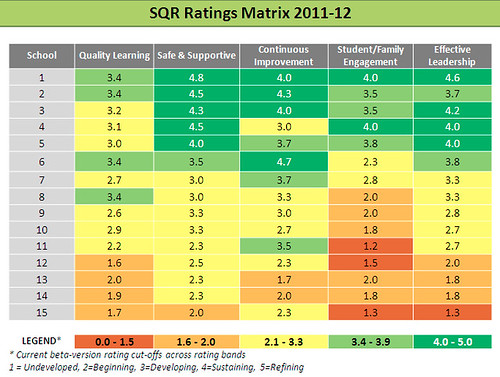
matrix 2

December 10, 2012
By Katy Murphy

The above matrix of nine elementary and six middle schools — which underwent a pilot School Quality Review process last school year — is just a sample of the kinds of targets and scoring systems being put in place in Oakland Unified.

At 6 p.m. Wednesday, the OUSD board holds a special meeting to discuss this and other parts of its “Balanced Scorecard,” which sets goals for student achievement, attendance, discipline rates (racial disparities, in particular), effective teaching, teacher satisfaction, teacher retention — and, yes, for a balanced budget that maximizes teaching and learning with an equitable (read: not equal) base funding model for its schools.

It calls for increasing the graduation rate for each student subgroup (black, white, Asian, Latino, male, female, English learners, special education students) by 1 percent this year, as well as the overall rate.

Other goals include upping the number of students who graduate UC/CSU eligible, with A-G requirements (this is key, as OUSD’s current 9th and 10th-graders must complete A-G requirements to receive a high school diploma, as a result of a policy change promoted by student leaders and Ed Trust West in 2009); boosting the number of students who graduate from an academy or career pathway, and making it mandatory for 11th-graders to take the CSU’s Early Assessment Program test in English and math.

Troy Flint, Director of Public Relations of OUSD on the Dropout Crisis

December 7, 2012
By Lisa Hewitt

Troy Flint, the Director of Public Relations of the Oakland Unified School District (OUSD), is the face of an organization which serves a complex city. Now living in West Oakland, Flint made the move out to California to work with a tech startup. For the better part of a decade, Flint has worked in various communication fields including journalism and public relations. Originally from Pittsburg, Pennsylvania, Flint began in the district in 2007.

Arguably the largest looming issue the district faces is its persistently low graduation rate. With dropouts in Oakland reported from the San Francisco Chronicle at 27.7%, well over California’s 14.4%, Flint concedes OUSD has a lot of work to do. The drop out crisis in Oakland is not a unique situation. He explains, “It’s abysmal, our graduation rate. [But] it’s in line with districts with similar demographics, those with high poverty and high minority populations-particularly Black and Latino.” To begin to explain why these areas are struggling to keep their students in school, Flint points to a lack of investment at the national and state level and points out that the achievement gap serves to highlight the staggering underinvestment in urban areas. The dropout crisis is not confined to one school district or California alone, the issue is a systemic problem.

The problem extends beyond those who dropout entirely; even enrolled students may miss significant portions of the school year and are much less likely to graduate on time or at all. The district is working to ensure that chronic absences decrease. From following up when students miss, to offering incentive programs, the district is making a concerted effort to stress the importance of attending school. Beyond attendance, Flint points to three key strategies to ensure students stay in school: early education programs, interventions when students begin to fall behind and strong career and college readiness preparation.

The problem is more likely to be solved if students are engaged at an early age. It’s vital to have a strong early education program, beginning before kindergarten, to ensure the students are able to stay on track throughout their academic careers. Flint explains, “We set up a department which we’re calling Zero to Eight… to make a continuum of learning to get kids on track.” Without the solid foundation from a young age the problem is only exacerbated.

At the high school level, Flint expressed the need for college and career preparedness. “The idea is to introduce every student to a plausible career path, whether it’s university or it’s a vocational school or some professional activity”. In order to connect students to a career path or ensure they’re college bound, Flint points to a national initiative called Linked Learning. Linked Learning is a holistic approach to education, comprised of four areas targeted at high school students. The first element is academic rigor, requiring all students to take the necessary course load to make them eligible to attend a CSU or UC. Additionally, the program includes a technical component or vocational training, worked based learning component (internship, externship, apprenticeship) and social/emotional supports (counseling, tutoring, intervention to struggling students).

Beyond the nuts and bolts of academic life, Flint stresses there are much more serious needs in the community, such as the continued lack of resources and support for the entire family. One solution is the community school model. In order to combat issues which impact students in Oakland such as poverty, problems in the home, and violence in the community, the district envisions schools where these issues can be addressed.  Community schools, Flint explains, should serves as the “center of community and act as an anchor for the neighborhood, drawing people in where they can be part of the solution. Not just academic resources, but [offer] parent engagement classes, health care, dental care, eye care, nutrition services, parks and recreation and extra curricular opportunities. We want the school to be the center of where all these services are orbiting.” At the moment, the resources aren’t fully available, but working in partnership with non-profit and community organizations, the business community, and government partners, OUSD can create a network of services which address not only the academic needs but all community needs. Investment and support from the students and parents is essential to see these community schools succeed.  Young people must be active learners, while teachers, administrators and parents must view each other as partners in their children’s’ academic careers. There are many hurdles for a district with a historically underserved population to overcome such as persistent violence, poverty, and underpaid and overworked teachers, but the hope is, “In the not too distant future, every [school] will be a quality [school].”

MissionLocal: A Teen Becomes a Casualty at 19

Cesar Bermudez in 2010 at the age of 16 posing during a Conscious Youth Media Crew video shoot.

December 3, 2012
By Jessica Naudziunas

“My name is Cesar Bermudez, I was born and raised in San Francisco, Mission District.”

Two years ago, a teenager introduced himself after several tries in front of a video camera. He was an intern for the Conscious Youth Media Crew, a San Francisco digital production studio, which was recording interviews for production practice.

If you could go back in time and look into the viewfinder of this camera, you would have seen a tall 16-year-old, with his wide body nervously shifting in a chair and filling the frame; his close-cut, squared hairline framing eyes that darted around the room.

The person behind the camera asked him serious questions. Bermudez pondered carefully, breaking the tension with a nervous laugh. Asked what inspired him, he seemed unsure. Then a more clear voice emerged.

“The things that inspire me, are everybody that never give up on me,” Bermudez said, “especially my mom, my school counselors, my uncles, all my family…my cousins — everybody…who hasn’t given up on me.”

Bermudez recorded just eight minutes of tape on February 23, 2010. When he left the Conscious Youth Media Crew office that day, the files were loaded onto a computer for a routine project that was never completed. On that hard drive, one piece of advice lay dormant.

“Put business before pleasure,” Bermudez said, his back against a wall tagged with colorful art. “If you are on the street messing up, get high school done first. You are going to want a job someday, and you are going to want more than minimum wage.”

On October 24 of this year, Bermudez died on the sidewalk from a shower of bullets just as the sun set in the Mission District. His death at age 19 was the 58th homicide reported in San Francisco this year. But he was more than a number. In front of his body was the apartment building that would become the site for an altar prepared by his friends and family – all the people who never gave up on him. These people visited his altar regularly when it was up on the 2800 block of Harrison. Now, all that is left is a portion of sidewalk stained white and red from candle wax; what remains from a week of grieving and remembrance, and a bloody murder.

His Family

“In the last two weeks, I saw him act differently,” said Esperanza Bermudez, Cesar’s mother, who spoke for the family. “He acted sad, but his face wasn’t sad.”

The last time she saw her son was on the morning he died. Before she left the house, she peeked into his bedroom. He was sleeping late.

“He didn’t call me that day,” she said, “and I didn’t call him either.”

She spoke while seated on a small chair in the middle of the front room of her apartment just a few days after he died. A box containing photos of her son throughout his life sat at her feet. The newness of her son’s death was fresh in her voice. She has a strength born of rearing three children in a big city, a strength she summoned when asked to speak about the life of her dead son to a stranger whom he never met.

Esperanza Bermudez was one of the first people to know something was wrong the day Cesar died, but she didn’t know exactly what happened until she arrived on Harrison Street. About fifteen minutes after the shooting, Cesar’s aunt rang their doorbell.

“She told me, ‘Get ready. We need to leave soon. It’s Cesar,’ ” Esperanza said. “And that’s the only thing she would tell me, and my daughter already knew that he had been killed, but she didn’t say that to me. I thought maybe he had been beaten up.”

She grabbed a sweater, and her diabetes medicine, just in case she needed it, and left with her family. She kept asking, “Where is Cesar? Where is he?” They didn’t answer her.

They neared Folsom Street, and Garfield Square came into view.

“I saw the park, and I remembered I didn’t like that he used to hang around there,” Esperanza said. “And I noticed we weren’t going to the hospital, and I said, ‘Where is Cesar?’ And they said, ’You’re going to see soon.’”

They arrived at the 2800 block of Harrison, and Esperanza asked if her son was dead. There, they finally answered her. She wept, distraught and inconsolable.

Desperate to see her son, Esperanza broke open the body bag just to know that it was really Cesar inside. Until nearly 9 p.m., police maintained the crime scene with the bag that held the body of her youngest child.

Cesar Bermudez was born in the summer of 1993. A picture of him in childhood shows him at a party wearing a bright white miniature tuxedo and a big smile. He was the last-born child in the Bermudez family, shy but loving, said those who were closest to him.  He was smart, introspective and deep, they added, but he never excelled in school.

He loved the Giants, sports, his friends, music and tamales. On his 19th birthday – his last — he told his mother he didn’t want any gifts, just a big dinner filled with tamales.

Esperanza’s box of photos documents Cesar’s short life. The pictures showed a life filled with family togetherness. Each milestone was celebrated with a big party, his family gathered around him.

His mother and father are married. They work hard to support their children in the service industry. He left behind some nieces and nephews who look just like him when he was little.

They played and ran around their grandmother, unaware she was talking about their uncle. The timeline in that box of photos ended around the time Cesar recorded the video. He didn’t want to be in photos, and had asked his mother not to take any more.

At his memorial at a funeral home on Valencia, he lay in an open casket the same color as the tiny tuxedo he once wore at special events. A big projection screen to the right displayed the photos from Esperanza’s box for everyone to see.

People wore white ribbons with his name in molded white and gold plastic lettering. Esperanza leaned over the casket, weeping and holding onto her son, asking why in Spanish.

“¿Por que, Cesar, por que?” she asked.  His father stood by in silent grief.

Mixed into her personal collection of photos is a MUNI ticket from the day of his birth given to her by a family member for good luck. What sticks out in this pile of mementos is a recently clipped newspaper article about his death from the San Francisco Chronicle.

To read more.

Oakland North: American Indian Model Schools file response to allegations of financial, organizational misconduct

AIMS board chairperson Jean Martinez looks on as attorney Paul Minney addresses the OUSD board at the Sept. 27 board meeting. Photo by Lauren Kawana.

November 29, 2012
By Nausheen Husain

Administrators at the American Indian Model Schools—a set of three Oakland charter schools, two middle schools and one high school—responded late Monday night to a 1,080-page notice of violations given to them by the Oakland Unified School District, OUSD spokesperson Troy Flint said Wednesday.

School officials had been given until November 28 to respond to the district’s allegations regarding improper business contracts, inappropriate credit card usage and lack of school board meeting documentation, but filed their response two days early. If the response does not appropriately answer the questions posed by OUSD school board members about the schools’ finances and organization, the district could decide to revoke the schools’ charters.

The response will be summarized and released to the public after the Oakland school board members read it and remove confidential information, such as student or employee names, Flint said. “It was a long response. It filled up many binders,” Flint said. “The board will have some guidance from our legal team, but they will ultimately decide the fate of AIMS, whether the schools will remain open and in what capacity.”

AIMS operates three charter schools in Oakland: American Indian Public Charter School, American Indian Public High School and American Indian Public Charter School II. The schools reported a total enrollment of almost 500 students during the 2010-2011 school year; in that year, reports to the California Department of Education indicated that almost 70 percent of the students were Asian, 18 percent were Hispanic and 1 percent were American Indian. For the past few years, the schools have had consistently high Academic Performance Index scores, which measure a school’s yearly progress and determine federal funding. During the 2009-2010 school year, American Indian Public Charter School had an API of 988, the highest of all the schools in the state.

The district’s review of the school’s operations began in 2011, when it was given information from a confidential source regarding “improper financial dealings” at the AIMS schools, Flint said. Early this year, the Alameda County Office of Education requested that the Fiscal Crisis and Management Assistance Team (FCMAT) audit the AIMS schools. The audit was released this June. According to the audit, the study team found evidence of problems, including conflicts of interest in awarding school contracts, inappropriate credit card charges made by school officials, and a lack of documentation for decisions made by the schools’ board members in their meetings. 

This September, the district issued a “notice of violations” to the schools based on that audit, as well as public records and previous correspondence between OUSD and AIMS board members. The AIMS administration was given 60 days to provide documentation that the FCMAT auditors said had been missing when they compiled their June report. AIMS administration members were also required to provide a written response to the OUSD, including an explanation or defense against the notice’s accusations, and a plan for remedial measures.  This is the written response the district has just received.

At a heavily-attended September 27 school board meeting, when OUSD formally gave AIMS the notice of violations, board members emphasized that the notice did not mean they would close the schools, something that concerned AIMS schools parents in attendance.    But if this new AIMS response proves unsatisfactory, officials made clear, OUSD could begin the process of revoking the schools’ charters.

Some of the central allegations in the district’s notice focus on financial transactions involving Ben Chavis, the founder of two of the AIMS schools and the former director of all three.  The notice asserts that Chavis and his wife, Marsha Amador, collected almost $4 million from contracts made between the AIMS schools and Chavis’ businesses, including lease agreements, storage agreements and construction contracts—upgrading restroom facilities in 2006 and 2007—for the schools.

According to the notice, though the AIMS school board approved the contracts, there is no indication that they were aware of the money Chavis and his spouse would make from their businesses, including Lumbee Holdings and American Delivery Systems. Since state laws prohibit public officials, officers and employees from engaging in a contract in which they have a financial interest, Chavis’ membership on the AIMS board and the AIMS contracts that financially benefited him appear to be conflicts of interest, according to the FCMAT audit report.

To read more.

The Education Report: Oakland’s new youth theater company opens its season Dec. 6

Gritty City Rep rehearsal

November 28, 2012
By Katy Murphy

Gritty City Rep opened in January, and its executive artistic director, Lindsay Krumbein, says it’s the first stand-alone youth theater company in Oakland.

The group rehearses six hours a week in downtown Oakland. Its first show of the season opens at the Berkeley City Club Theatre on Dec. 6 and runs for two weeks. The actors will be performing “Anon(ymous)” by Naomi Iizuka, which Krumbein describes as “very physical, minimalist, dealing with issues of war and immigration, exploitation of refugees – relevant stuff. Not your typical `high school theatre’ by any stretch of the imagination.”

To read more.

Meet Downtown College Prep's Slam Poets

November 28, 2012
By Lisa Hewitt

“Slam poetry, for me is a just another means of expression. We all have different ways of expressing ourselves and this is how we choose to.”- Carlos Nolasco

Beginning just over a year ago, the slam poetry group at Downtown College Preparatory (DCP) in San Jose, California, has a unique weekly gathering. In a classroom surrounded by posters breaking down Spanish verbs and maps of Spain, they write and perform poetry for each other. I met with a few regulars in Michael Bower’s classroom: Gabriel Orozco, Naila Cazares, Jose Luna, Angel Barragan, Amanda Pea, and Carlos Nolasco. They all agreed the group is a positive influence in their lives and provides a platform to speak their minds. Naila, a sophomore, explains, “Poetry’s not just about rhyming; it’s about expressing yourself and what you see around you.” Amanda, a sophomore, adds, “I come to poetry and I can…just say it. And [the group members] tell me how they feel about it. And they’ll tell me the truth and that’s basically what spoken word is, the truth. It’s different truths…coming together and unifying us.”

Hailing from Brooklyn, New York, Mr. Bower grew up surrounded by Hip Hop, but it wasn’t until college and with the encouragement of his roommate he started performing poetry. Coming to San Jose in Fall 2011 with Teach for America, Mr. Bower decided to perform a piece of poetry for the DCP administration, teachers, staff and the students. “In the beginning I got up in front of assembly, and I said ‘I’m going to start a poetry group. I’m from Brooklyn, I love Hip Hop; just come if you want to express yourself.’ And I got some kids who were really talented and really passionate about it and then it just grew.” Angel, a senior, explains, “He’s our Spanish teacher and I’ve never thought about Bower as a slam poet/rapper of anything. And one day he presents us one of his pieces and it was really awesome, I liked it. So then…I decided to join slam poetry.”

The poetry group is a unique setting amongst the normal high school experience; they don’t have to edit what they say or how they communicate. For Gabriel it’s about giving voice to the underrepresented, “What I mainly write about is how I’ve gone through this really hard struggle in my life. I might not look it on the outside because I’m skinny and tall but on the inside I’m Hercules when it comes to problems. I want to be a voice for everyone who has struggles in their life, who’s grown up in the ghetto, the projects whatever you want to call it, because those people are what really drive me to become great.”

The first time the DCP group performed together was at San Jose State University on October 24, 2012, an event sponsored by the Cesar Chaves Community Action Center and KQED. Though some students have performed their poetry in the past, for others this was the first time they’ve shared it in a public venue. After the performance, Mr. Bower explains, “[The group members] got in the van and they started talking about how we’re all a family. That was cool and a very touching moment for sure. Many of them don’t have a place for expression and many don’t have a place where people listen to them. So when they have both at the same time and they can talk about their deepest feelings, I think they really value that.”

If you’re interested in learning more, please visit Downtown College Prep’s website: www.dcp.org.

View Selected Poems

Oakland North: Oakland Raiders, students sort food at Alameda County food banks

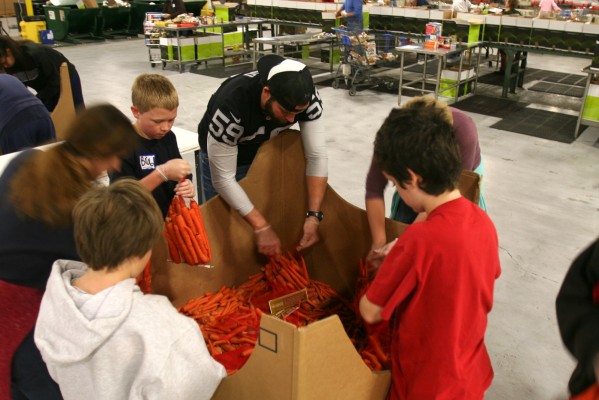
Long snapper Jon Condo sorts carrots.

November 21, 2012
By Sam Rolens

When Brad Lubeck, 11, and his mother Stacey showed up at the Alameda County Community Food Bank for an afternoon of volunteering with his Boy Scout troop, he didn’t expect much in the way of thrills. Food bank staff showed Brad and the others what to do with the broccoli and carrots they’d be unloading, and said it would be the Scouts’ job to teach the process to another group of volunteers arriving shortly.

Then the surprise was sprung. Six giants in black and silver strolled up to the boys and asked for instructions. The Oakland Raiders had arrived.

Brad, who is something of a football fan, would be beaming for the rest of the day as he packed up carrots. “We have a cat named Raider,” said his mother. “He got to name it.”

On the Tuesday before Thanksgiving, Oakland Raiders quarterback Terrelle Pryor, long snapper Jon Condo, wide receiver Derek Hagan, linebacker Aaron Curry, defensive end Matt Shaugnessy and running back Taiwan Jones sorted donated food alongside local high school students, Girl Scouts, and Boy Scouts at the Food Bank’s warehouse across the highway from the Coliseum.

“I wear the black and silver on TV every Sunday,” said Condo. “Kids look up to us. Adults look up to us. This shows people watching that we’re in this together for the cause of our community.” Condo said that every Tuesday, which is the only day off from workouts for the Raiders, members of the team are volunteering somewhere in the city. Condo, originally from Pennsylvania, said the community spirit he’s seen in Oakland has impressed him. “They’re very dedicated people,” he said. “It’s a close-knit community committed to helping each other.”

The Oakland Raiders are also hosting a virtual food drive over the holiday season in partnership with the Food Bank that collects money for food and supplies.

The cavernous warehouse is kept cold inside. Volunteering kids wore warm beanies and coats on Tuesday, while the Raiders wore their jerseys without pads or helmets. Conversation was lively, as kids clustered around one or two towering players at each of the cardboard boxes holding donated vegetables.

Big hands and small hands worked quickly through the veggies, while conversation covered primarily school and football. “They’re tough,” said Condo, who was paired with Brad’s Scout troop. “They’re hard little workers—packing carrots just as fast as I was.”

Food Bank communications manager Mike Altfest said the facility needs all the help it can get from volunteers in the weeks leading up to the holiday season. “The operation is ticking this time of year the way we’d want it to be ticking all year,” said Altfest. The Food Bank provides food for 49,000 people (enough food for roughly 300,000 meals) each week through its 275 partner food pantries, soup kitchens and other facilities.

But the amount of donations peaks at this time of year, said Altfest, and so does the Food Bank’s need for volunteers. People tend to sign up for shifts during the holiday season, he said, but interest starts flagging by January. He encourages anyone who wants to volunteer to sign up for shifts after the holidays by using the Food Bank’s volunteer webpage.

“The Raiders have been helping us out a lot this year,” said Altfest. “It’s a great morale booster, and it helps bring awareness to hunger in Oakland.”

Not far from the Food Bank’s warehouse, at the Columbian Gardens Food Pantry, pro-bowl defensive tackle Richard Seymour was handing out frozen chickens, canned corn and collard greens, and boxed stuffing mix with the help of his family. Altfest said Seymour had specifically asked to pass out food, and that the appearance was “just something Richard wanted to do.” Seymour was helped by his wife Tanya, his kids Richard, Kayla, Kennedy and London, and other friends and family.

To read more.