Category Archives: Theater

Marc Bamuthi Joseph

Marc Bamuthi Joseph is one of an emerging class of hip hop theater artists who combines a variety of art forms in his work. Bamuthi uses theater, West African and tap dance, spoken word, poetry, and live music to stretch the bounds of traditional hip hop and create a new forum for expressive performance art. His works challenge audiences of all ages to reevaluate the relationship between spoken language, body language and the body politic.

Bamuthi has been a performer since childhood, working on commercials at the age of 5, Broadway stage by age 9 and a television series when he was 12 and 13. At 21, Bamuthi found himself in San Francisco, entering the arena of spoken word and performance poetry, first in poetry slams, then as a playwright. Bamuthi has already received four spoken word poetry awards and was featured on Russell Simmons’s Def Poetry Jam in 2003.

In the Spark episode “Telling Stories,” meet Bamuthi as he prepares for his first solo theatrical work based on his experience of becoming a father. “Word Becomes Flesh” is a highly personal piece that is a performed series of letters from a single unwed father to his unborn son. Bamuthi translates the words from the page to the stage, narrating his very personal experience through creative expression that combines spoken word with movement, visual art and music.

Bamuthi is also the current artistic director for the Living Word Project and program director for Youth Speaks. Through the spoken word medium, he leads students through a process of examining their world and the issues that are important to them and turning their perspectives into meaningful expression. His mission to be an agent for social change fuels much of his work, taking him far beyond the need for recognition into the realm of spiritual and personal expression.

Array

  • Array
  • Array
  • Array

Larry Reed

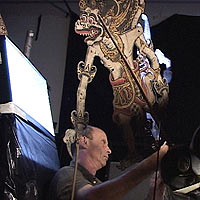
Spark follows puppet master Larry Reed as he and the Gamelan Sekar Jaya orchestra prepare for a performance of “Wayang Bali: Dangerous Flowers” at the Julia Morgan Theatre. For more than 30 years, Reed has studied, performed and developed the ancient art form of Balinese shadow play, producing unique performances that have stretched the bounds of the tradition.

Wayang kulit, or Balinese shadow puppet theater, is a tradition that has been passed down through generations for more than 1,000 years. Mythic tales and archetypal characters are played out, blending high drama, improvisation and slapstick comedy. In one performance, more than 20 intricately carved leather puppets are manipulated by one puppeteer, the “dalang” or “shadowmaster,” who assumes the role of the conductor, director, actor and all the voices. The shadow puppets are animated atop a banana log in between a large screen and a coconut oil flame so that their images cast shadows onto the screen.

The traditionally wayang kulit shadow plays are accompanied by an ensemble of two to four gamelan musicians, who respond to every move of the dalang. Gamelan, meaning “orchestra,” refers to the instruments themselves, which exist as an inseparable set. Each bronze key and gong of the gamelan instrument is forged at the same time. They are then tuned and blessed as a whole and cannot be individually sold.

Introduced to shadow plays in the ’70s while in Bali, Reed found himself drawn to the complex spiritual and ancient tradition and the powerful ephemeral nature of shadows. Reed spent the next 10 years learning the art form in the traditional manner, apprenticing himself with shadowmasters. Today, Reed performs in the traditional style, but he has also created his own company, ShadowLight Productions, a changing ensemble of actors and puppeteers who create modern shadow puppet works on a cinematic scale with scene changes, lighting cues and a larger music ensemble.

Array

  • Array
  • Array
  • Array
  • Array

David Edgar

English playwright David Edgar was commissioned to write “Continental Divide” in 2000 by Berkeley Repertory Theatre‘s artistic director Tony Taccone, as a co-production with the Oregon Shakespeare Festival. Three years later, after months of research, the play opened as part of Berkeley Rep’s 2003-04 season. From first meeting to opening night, Spark is there for the backstage drama as the script is finalized against the backdrop of California’s real-life gubernatorial drama.

Edgar describes this production as a “European epic play that has an American subject.” Taking the form of two three-hour interconnected plays that explore the complex political landscape of contemporary America, the setting is a gubernatorial election — “Mothers Against” looks at the Republican campaign and “Daughters of the Revolution” concentrates on the Democratic Party. With the same characters appearing in both plays, the plays can be seen in either order, and each one can also stand alone.

“Continental Divide” explores what has happened to the ideals of the 1960s, exploring the dissipation of the beliefs of the American Right and Left. Although “Continental Divide” takes place in a state that seems to resemble the West Coast of the United States, Edgar maintains that any resemblance to real events in Californian politics is purely coincidental. Additionally, the ending is deliberately ambiguous so that the focus of the play is the political process and the possibilities of the future as seen on either side.

More about David Edgar
Edgar lives in Birmingham, England, and has been a lifelong supporter of the Labour Party. Politics have always been his central concern as a dramatist, but he does not use drama to answer questions, rather to raise them. His works include the Tony Award-winning adaptation of Dickens’s “Nicholas Nickleby” along with the original plays “Death Story,” “That Summer” and “Entertaining Strangers.” Edgar is a professor at the University of Birmingham, where he founded and directed Britain’s first postgraduate course in playwriting.

More about Berkeley Repertory Theatre
Michael W. Leibert founded Berkeley Rep in 1968 as a storefront community theater. Winner of the 1997 Tony Award for Outstanding Regional Theater, its national reputation draws theater artists from around the country to work on a variety of productions from September through July. The season consists of seven productions of the finest classic, contemporary and new plays. The Berkeley Rep School of Theatre offers classes and activities for both youth and adults and tours a fully staged professional production to schools throughout the 11-county greater Bay Area.

Berkeley Repertory Theatre
berkeleyrep.org
Where: 2025 Addison St., Berkeley
Phone: (510) 647-2949

Array

  • Array
  • Array
  • Array

Woodminster Summer Musicals

Woodminster Summer Musicals

Jim and Harriet Schlader have been staging Woodminster Summer Musicals since 1967. In the Spark episode “Community Institutions for the Arts,” take a behind-the-scenes look at as the Schladers direct cast and crew for their production of “Singin’ in the Rain” with only 40 hours of rehearsal over three weeks.

After completing successful Broadway careers — Harriet was a dancer at Radio City Music Hall, while Jim acted in original productions of “The Music Man” and “Brigadoon” — the Schladers moved to Oakland and founded Producers Associates, Inc., a non-profit organization dedicated to bringing American musical theater to new generations. Since its inception in 1967, Producers Associates Inc. has staged more than one hundred productions, making summertime Broadway musicals along-standing tradition for many Bay Area families at the Woodminster Amphitheater in Oakland’s Joaquin Miller Park.

Besides providing an opportunity for family members to come together and enjoy American musical theater, the long-time married couple has transformed Woodminster into a family legacy with the passing of the directorial torch to their son, Joel. However, far from retiring, Jim and Harriet continue to be involved at Woodminster, with Jim planning to stay on as producer, and Harriet continuing to manage the box-office and oversee costumes and choreography.

To date, Jim and Harriet have directed more than 2000 actors on stage, including their own four children. Many of these performers have continued to return to Woodminster over the years, such as choreographer Cynthia Ferrer and actor Carl Danielsen. Ferrer, who started at Woodminster when she was thirteen, says “I always feel likethe best stuff I learned, everything I learned, I learned here.” Carl Danielsen, whose role in “Singin’ in the Rain” marks his fifty-first show at Woodminster, attributes his career in theater to his “second parents” Jim and Harriet, without whom, he says, “I wouldn’t be in the theater.”

Woodminster Amphitheater
woodminster.com
Where: 3300 Joaquin Miller Rd., Oakland
Phone: (510) 531-9597

  • Array
  • Array
  • Array

FlockSmart

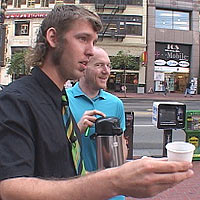
If you’ve come across them, you might think that their behavior might seem inexplicable — but is it? A “smart mob” is defined as “a group of strangers organized by electronic media, who gather in a public space, behave in a pre-determined manner for pre-determined amount of time, and quickly disperse.” They come together for all kinds of reasons, from those inspired by politics or artistic creativity to a simple desire for ridiculousness.

A smart mob could be classified as group performance art or a public prank, but its collaborative nature makes it a unique social gathering that encourages positive interaction, often between perfect strangers. Spark watched as a San Francisco’s FlockSmart came together in 2003 via cell phone and instant messaging to spread a little holiday cheer in Union Square — in July.

  • Array

(Jon Brumit and Marc Horowitz) Sliv & Dulet

For five weeks during the summer of 2003, artists Jon Brumit and Marc Horowitz took over the San Francisco gallery New Langton Arts, and reinvented themselves as the business team of Sliv & Dulet, the fictional enterprise behind 2001’s much-publicized one-minute art show. In the Spark episode “The Bleeding Edge … is this really art?” meet these unusual art entrepreneurs as they collaborate with 25 other artists to “develop new products and services” for The Summer Line 2003, an experiential installation that comments with great humor on the conventions of office life and the art world.

Brumit and Horowitz, who met through the Artist-in-Residence Program at San Francisco Recycling & Disposal, create interactive performance works that predominately focus on social exchanges and the creative potential of ordinary objects. Incorporating elements of absurdity and the mundane, Brumit and Horowitz have collaborated on numerous Bay Area events that push the boundaries of public/performance art including: The One-Minute Show (2001), a 30-person group exhibition that took place in 60 seconds; Bring Your Own Big Wheel Race (2002), an annual public big wheel race down historic Lombard street; and the first annual Duct Tape Festival (2002) in Oakland.

Jon Brumit holds an MFA from Cranbrook Academy of Art. He designs tools, instruments, and scenarios for interaction which often produce unpredictable results — oftenhumorous and highly interpretable — although typically arising frompublic spectacles, dynamic failures and intentionally problematizedconstructions. Solo projects include “Door to Door,” “VendettaRetreat,” and “BYOBW.” Collaborative projects include NeighborhoodPublic Radio and numerous performance installations such as “Crossover” and “Strip Club.”

Marc Horowitz communicates through the highly personal and often ironic language of material objects in his installations and sculptures, which have been described as “encounters.” He often uses photography as a way of presenting visual and conceptual discordance and harmonies. In 2001 he founded Your Local Gallery in Oakland, and has curated and performed in numerous exhibitions including Think Again, Pictures, Photos, Sculptures, Sounds & Installation, and Stuffed Animal Golf over the Great Highway, a collaborative public performance. Horowitz holds a degree in marketing from Indiana University and lives and works in San Francisco.

  • Array
  • Array
  • Array
  • Array
  • Array

Young Audiences of Northern California

Editor’s note: In May 2004, Young Audiences of San Jose and Silicon Valley merged with Young Audiences of the Bay Area to become Young Audiences of Northern California

Young Audiences of the Bay Area (YA Bay Area) is the area’s oldest and largest provider of arts education programs and services. Founded in 1958, YA Bay Area is one of 32 non-profit chapters of Young Audiences, Inc. across the nation. Collectively, Young Audience chapters are the single largest provider of arts education programs in the US. In 2001-02, the 5,016 professional artists working for YA chapters provided 102,980 arts programs for 8.1 million young people and educators.

As one of the YA network’s top 10 chapters, YA Bay Area is dedicated to making the arts (classical, contemporary, and multicultural) an essential part of every young person’s education and life. Founded in 1958, the organization offers performance assembly performance, workshops, artist residencies, and professional development in dance, music, theater, media, storytelling, and circus, literary, and visual arts to K-12 and public audiences.

In 2000-2001, YA Bay Area reached 189,976 students, teachers, and families through its in-school, community, and public programs in ten counties of the Bay Area. YA Bay Area’s diverse roster includes over 150 professional artists and ensembles from the Bay Area and the greater US. All of YA Bay Area’s artists are auditioned on an annual basis by YA Bay Area staff and advisory committee to ensure the highest quality programs.

In the Spark episode “Art Goes Back to School,” tag along with a few of the artists represented by YA Bay Area from in-school assemblies with Kulintang Dance Theatre and Eddie Madril from Native American Dance & Arts, to artist residencies with Poet Gail Newman and Photographer Shashari Murphy. Assembly performances are 45-minute performance demonstrations designed to introduce an artform(s) and usually the culture or tradition of the practicing artists. Artist residencies are longer-term (8-32 weeks) experiences between an artist(s) and a group of students designed to provide hands-on learning beyond the introductory level.

In addition to these valuable educational programs, YA Bay Area also offers the ArtsCard, a free family arts program offering discounts to over 50 arts and culture organizations throughout the Bay Area — including discounts on admission, special events, membership, and classes. Enrollment is open to all families with children between preschool and grade 12.

Array

  • Array
  • Array
  • Array

San Francisco School of the Arts (SOTA)

Editor’s note: SOTA was renamed the Ruth Asawa San Francisco School of the Arts in 2010.

Spark visits the San Francisco School of the Arts (SOTA), humming with end of the year excitement as students prep for final art shows, theater reviews, and end of the year concerts. Meet, among others, student Anna Pasternak and teacher Elvia Marta, who give an insider’s look at SOTA’s dance department as students prepare for final exams — a four-night run of concerts.

SOTA is a public visual and performing arts high school dedicated to providing students with an alternative educational program that fosters artistic development and creativity. Since its founding in 1982, SOTA has admitted students selected by audition from all over the Bay Area in areas of performing, visual, and literary arts, thus creating an ethnically diverse and energetic student body.

In what the school calls its “pre-professional” program, SOTA engages students in a curriculum that combines academics with art instruction. SOTA offers art instruction in nine disciplines, including creative writing, dance, film and video arts, instrumental music, piano, theater arts, theater design and technology, visual arts, and voice. The teaching staff at SOTA, which is comprised of specialized arts teachers as well as artists in residence, create an educational program which allows students to study their selected discipline for at least two hours a day.

SOTA was originally founded by a group of renegade artists and teachers, and has continued to be a work-in-progress, frequently changing campuses and even sharing spaces with other schools. However, as of fall 2002, SOTA moved to its own campus where it has since been awarded the title of California Distinguished School. SOTA is not merely being recognized on a local level but also is well on its way to establishing a national reputation for itself. Pending on the allocation of funds, the school may eventually move to the Civic Center where it would neighbor the Symphony, Opera, Ballet, and Asian Art Museum. By joining the art mecca of downtown San Francisco, SOTA would no doubt increase its visibility and attract even more students to its growing population of young and emerging artists.

  • Array
  • Array
  • Array

TheatreWorks

In 1970, Robert Kelley founded TheatreWorks, a regional theater company that stages performances in Mountain View and Palo Alto. Since then, he has helped the small company grow to its contemporary status as the fourth largest in the Bay area and has directed over 100 of its productions. In this segment, he discusses the art of being a good leader and how he has contributed to TheatreWorks evolution.

Spark also goes behind the scenes at the company’s production of the 2001 Pulitzer Prize and Tony Award-winning play, “Proof.” Written by David Auburn, “Proof” opened the 2003-2004 TheatreWorks season and deals with the relationship between a mathematician and her mathematical genius of a father.

  • Array

African-American Shakespeare Company

Have you ever wondered how theater companies take an idea and make it into a performance? For the African-American Shakespeare Company, it starts with a brainstorming session. Spark visits executive director Sherry Young and their development group as they start work on a production of “Beauty and the Beast” at the Zeum Theater.

The African-American Shakespeare Company is dedicated to presenting classical European works in a contemporary African-American context. The company hopes to encourage cross-cultural communication and reflect the world’s diversity by using stories that encompass the shared human experience.

  • Array
  • Array

Word for Word

Word for Word

Based on Seattle’s Book-It Repertory Theatre, San Francisco’s Word for Word is an innovative professional theater company that transforms short works of fiction into fully staged pieces of theater without changing a word of the original text. Spark follows the entire process as Word for Word develops and stages “The Fall River Axe Murders.”

Founded by JoAnne Winter and Susan Harloe, Word for Word made its official debut in 1993 with Edith Wharton’s “Xingu” at the Fort Mason Center’s Bayfront Theatre. Since then, Word for Word has become a permanent Z Space program, staging more than 60 pieces that include works by Tobias Wolfe, Barbara Kingsolver, Langston Hughes, Julia Alvarez and Upton Sinclair.

For their 10th anniversary, Word for Word has chosen author Angela Carter’s gothic deconstruction of the infamous Lizzie Borden murders, “The Fall River Axe Murders.” This special production includes all 10 charter members of Word for Word and is directed by Amy Freed, who directed the group’s first production and has since gone on to a successful career as both director and playwright (“The Beard of Avon”).

Dedicated to the written word, Word for Word will not edit the author’s original text — even pages of background descriptions and all the “he saids” and “she saids” get acted out on stage. So with each production, problematic sections arise and need to be imaginatively worked out. “The Fall River Axe Murders” is no exception with a nonlinear timeline and constantly shifting points of view, but these challenges are what make this theater company’s work genius.

  • Array
  • Array
  • Array
  • Array

California Shakespeare Theater

California Shakespeare Theater

Jonathan Moscone, California Shakespeare Theater‘s artistic director, is drawn to the political themes in “Julius Caesar” for very personal reasons. In the Spark episode “Page to Stage,” watch as Moscone breathes new life into an oft-performed Shakespeare classic, bringing his unique and personal perspective to bear on this timeless political thriller.

In producing “Julius Caesar,” Moscone faces the directorial challenge of producing a historical play from 44 b.c. Rome that is relevant to 21st-century audiences. Although many viewers may not know the play’s entire story, many know Caesar was betrayed and murdered. The effectiveness of “Julius Caesar” and other classics depends largely upon whether the audience perceives the story as being relevant to their lives. This task largely falls upon the director, who must direct the action in a manner that supports and deepens the audience’s understanding of the text. Oftentimes, developing these understandings can be difficult, given that the language, social customs and historical contexts in such works no longer exist, as is the case with “Julius Caesar.”

But Moscone has an unusually unique and personal relationship with the story, as his father, San Francisco mayor George Moscone, was slain along with supervisor Harvey Milk by former city supervisor Dan White in 1978. In his adapation of “Julius Caesar,” Moscone stages a truthful depiction of just how violent and horrifying it is to take another person’s life — slowing down the action of the murder scene and allowing the blood to seep from Caesar’s body in a long and dramatic silence — an expression of the belief that a political assassination is never justifiable.

More about California Shakespeare Theater

Formerly located in Berkeley’s John Hinkel Park, California Shakespeare Theater (also known as Cal Shakes) is located in Bruns Memorial Amphitheater nestled in the Berkeley Hills. Founded in 1974 as an artist collective, the company is known for its innovative productions of classic theater. Although its mainstay is still Shakespeare, since 2000, Director Moscone has expanded the repertoire of Cal Shakes to include works by Anton Chekov, George Bernard Shaw, Tom Stoppard, and Jack London as part of its continuing commitment to rediscovering seminal theatrical works.

California Shakespeare Theater
calshakes.org
Where: Bruns Memorial Amphitheater, 100 Gateway Blvd. at Hwy. 24, Orinda
Phone: (510) 548-3422

Array

  • Array
  • Array
  • Array

Campo Santo with Denis Johnson

Denis Johnson

Theater productions often have no more involvement with the author than their name on the script. San Francisco’s theater company Campo Santo prefers to collaborate with authors, like Denis Johnson, to create works beyond any one person. In Spark‘s episode “Collaborations,” witness the relationship between writer, actors and director working together on the development of shows from first reading of the new work “Psychos Never Dream” to final rehearsals and the performance of “Soul of a Whore.”

Campo Santo, founded in 1996, is the resident theater company at Intersection for the Arts. Along with executive director Deborah Cullinan, the core members of Campo Santo are Margo Hall, Luis Saguar, Sean San José and Michael Torres, who came together in an effort to create socially relevant theater that is accessible to a diverse inner-city population. Campo Santo has produced over twenty highly successful productions of new works by contemporary writers continuing to experiment and take risks. They have received numerous grants and awards including Bay Area Theater Critics Circle Award for Best New Play for “Hellhound on My Trail” by Johnson.

Offering a unique theater experience, they let the words do much of the talking, presenting the plays simply in an intimate setting. Currently all of the plays are developed collaboratively over a period of months with not only the final product, but the process opened up to the community by early readings through the Open Process Series. Campo Santo works with playwrights as well as authors more accustomed to forms such as fiction, like Johnson, who is one of Campo Santo’s longest-running collaborators.

Having begun in 1999 with short stories from Johnson’s cult classic, “Jesus’ Son,” they have continued with a new production annually ever since. Johnson may be most well known for “Jesus’ Son,” which was made into a movie in 1999, but he has published over a dozen books including novels, collections of poetry and a collection of his international journalism. Johnson, still a relative newcomer to the world of theater, is able to continue experimenting as he finds his way. His production of “Soul of a Whore” is created entirely in verse. Johnson says, “It’s almost like a practice play. I’m just trying it out. It’s all very experimental for me.”

The collaboration benefits both Campo Santo and Johnson. “Soul of a Whore” director Nancy Benjamin says, “If a playwright’s dead or out of town, you can’t ask the questions we’re able to ask.” Through this process they are able to speak directly with Johnson, though they admittedly do not always agree with him, his words can often provide the clarity they are looking for. For Johnson, sharing with Campo Santo has been a way to move away from working alone as he does with fiction.

For Johnson maintaining this level of involvement isn’t just about finessing the dialogue or putting his stamp on the production — it’s an opportunity to connect with the actors in ways that continue to inspire him. He is able to spend time with people who now know his work as well as, if not better than he does. Johnson says, “I really feel as if I’m being intensely read and deeply appreciated. Maybe it’s not by the whole world, but even just a handful. It’s great. It’s just wonderful. It’s a writer’s dream.”

Campo Santo
theintersection.org/theatrecamposanto
Where: Intersection for the Arts, 446 Valencia St., San Francisco
Phone: (415) 626-3311

  • Array
  • Array
  • Array

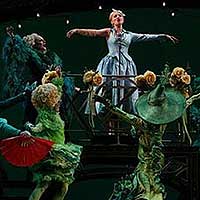
Best of Broadway presents “Wicked”

“Wicked: The Untold Story of the Witches of Oz” premiered on Broadway in October 2003. But before it hit theaters in New York, the multimillion dollar production impressed San Francisco audiences with a test run by the Best of Broadway company. In the Spark episode “The Engineering of Art,” we watch as the production crew tries to mount sets on a scale rarely seen at the Curran Theatre. From coordinating a fire-breathing dragon and flying monkeys to a spinning bed and enormous moving gears, the production team puts on a special effects show worthy of the great Wizard of Oz himself.

Based on the 1995 novel by Gregory Maguire, “Wicked” includes music and lyrics by Stephen Schwartz (“Godspell” and “Pippin”). The musical tells the story of two girls in the Land of Oz, one of whom become the Wicked Witch of the West and the other the Good Witch, Glinda. The stars of the original production were Tony Award winner Kristin Chenoweth, Tony nominee Idina Menzel (the original Maureen in “Rent”) and legendary two-time Tony winner Robert Morse.

The process of bringing “Wicked” to stage was no easy engineering feat. Costing $14 million, the play’s production involved over 150 people and took almost two years to become a reality. Built in Calgary, Ontario the show’s complex set took over a year and a half to design and had to travel over 1,500 miles to the Curran Theatre in San Francsico. Although the labor intensive set includes flying houses, a mechanized fire-breathing dragon, and individually hand-dyed corn fields, the hardest part of design proved to be staying away from the visual images of the original film version of “The Wizard of Oz.”

Under the direction of Carole Shorenstein Hays and Scott E. Nederlander, Best of Broadway is committed to bringing high-quality musicals and award-winning plays to the Bay Area. Over the years, local subscribers to the Best of Broadway have enjoyed a host of works, from the Tony Award-winning play “Fences” to the spectacular United States premiere of Baz Luhrmann’s production of Puccini’s “La Boheme.” Best of Broadway venues in the San Francisco-Bay Area include the Curran Theatre, the Golden Gate Theatre, and the Orpheum Theatre.

  • Array
  • Array
  • Array
  • Array