Category Archives: Theater

Philip Kan Gotanda

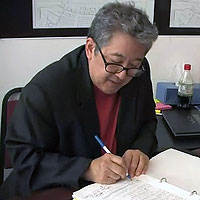
Philip Kan Gotanda, one of America’s leading playwrights, has created an extensive body of work about the Asian American experience. Stories of identity, race, conflict, pain, joy and love resonate through his work. Spark talks with Gotanda at the American Conservatory Theater, where his play “After the War” is being staged.

Commissioned by A.C.T., “After the War” is set post-World War II in a boarding house in San Francisco’s Japantown. The diverse cast of characters, including Japanese Americans, African Americans, poor whites and a Russian Jew, portray, from their very different points of view, the interracial conflicts that arose out of the Japanese American internment.

In his work, Gotanda, whose parents were sent to an internment camp in 1942, tells the particulars of his own life experiences, his struggle with identity and the history of Japanese American society. He says, “You should write because you have something to say.”

In his late teens, Gotanda traveled to Japan, looking for a place where he could find “racial anonymity.” Instead, he was regarded not as Japanese, but as a sansei, a third-generation Japanese American. Gotanda returned to the United States, graduated from the University of California at Santa Barbara and earned a law degree from Hastings College of Law. While working at the North Beach-Chinatown Legal Aid Society in San Francisco, he wrote his first play, a musical entitled “The Avocado Kid, or Zen in the Art of Guacamole,” based on a classic Japanese children’s tale.

Gotanda has also worked with the Asian American Theater Company, Berkeley Repertory Theatre, Campo Santo, the East West Players, the Manhattan Theatre Club, the Mark Taper Forum, the New York Shakespeare Festival and the San Jose Repertory Theatre, among many others. He is also a noted filmmaker whose works include “The Kiss,” “Drinking Tea” and “Life Tastes Good.”

Array

  • Array
  • Array
  • Array

Marc Bamuthi Joseph

Marc Bamuthi Joseph is one of an emerging class of hip hop theater artists who combines a variety of art forms in his work. Bamuthi uses theater, West African and tap dance, spoken word, poetry, and live music to stretch the bounds of traditional hip hop and create a new forum for expressive performance art. His works challenge audiences of all ages to reevaluate the relationship between spoken language, body language and the body politic.

Bamuthi has been a performer since childhood, working on commercials at the age of 5, Broadway stage by age 9 and a television series when he was 12 and 13. At 21, Bamuthi found himself in San Francisco, entering the arena of spoken word and performance poetry, first in poetry slams, then as a playwright. Bamuthi has already received four spoken word poetry awards and was featured on Russell Simmons’s Def Poetry Jam in 2003.

In the Spark episode “Telling Stories,” meet Bamuthi as he prepares for his first solo theatrical work based on his experience of becoming a father. “Word Becomes Flesh” is a highly personal piece that is a performed series of letters from a single unwed father to his unborn son. Bamuthi translates the words from the page to the stage, narrating his very personal experience through creative expression that combines spoken word with movement, visual art and music.

Bamuthi is also the current artistic director for the Living Word Project and program director for Youth Speaks. Through the spoken word medium, he leads students through a process of examining their world and the issues that are important to them and turning their perspectives into meaningful expression. His mission to be an agent for social change fuels much of his work, taking him far beyond the need for recognition into the realm of spiritual and personal expression.

Array

  • Array
  • Array
  • Array

Marga Gomez

Nationally touring comedienne and actress Marga Gomez writes and performs solo shows based primarily on biographical material. Spark goes backstage with Gomez at The Marsh as she discusses her transitions between the worlds of stage comedy and Hollywood and workshops “Los Big Names,” which is about her experience growing up in a show-business family.

  • Array
  • Array

Shailja Patel

During her childhood in Nairobi, Kenya, South Asian Indian poet Shailja Patel had the distinct feeling that her world could disappear at any moment, and for good reason. In 1972, neighboring country Uganda expelled its South Asian residents, many of whom had called Africa home for generations. “I grew up very much with this sense of ‘we don’t have a future here,'” says the Oakland-based artist.

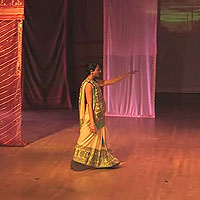
It should come as no surprise, then, that Patel’s one-woman show, “Migritude,” addresses the immigrant experience. The performance piece combines spoken word, dance, photography and 18 traditional Indian saris to unravel the notion of otherness and to explore those parts of immigrant identity that become altered, changed and sometimes lost within another culture’s dominating forces. The name of the play is a term Patel coined herself. Derived from the words “migrant,” “attitude” and “negritude,” it refers to, in Patel’s words, “a generation of migrants who don’t feel the need to be silent to protect themselves.”

The brightly colored saris Patel folds and unfolds, wraps about her body, and waves overhead during her performance are much more than props. For 30 years, Patel’s mother collected the saris for her daughter’s trousseau. Instead of passively protecting and adorning her body as they might have, had she married and remained in her native country, the garments have become active participants in Patel’s quest to reveal and celebrate otherness through rhythmic language, movement, and sharp observations about the mind, body and spirit.

Directed by Kim Cook, “Migritude” is Patel’s first one-woman show. Since arriving in the United States in 1997, Patel has been an active participant in the Bay Area’s slam poetry movement. She has won championships in competitions, including the Santa Cruz Poetry Slam and the Lambda Literary Festival, and has participated in events at colleges and cultural institutions ranging from Yale University to the Artwallah Festival in Los Angeles. She has performed in New York City’s Javits Center and Lincoln Center, San Francisco’s ODC Theatre, and many other venues.

  • Array
  • Array

Rebar

Rebar members Matthew Passmore and John Bela wanted to preserve the cultural integrity of the 32-year-old Southern Exposure gallery; not through photographs or a painting, but by drilling out a chunk of the gallery’s wall and canning it. Yes, canning it. This may sound a bit strange but their intentions are quite clever. The two got the idea by looking into the history of the gallery. Before SoEx’s existence, the building was a can manufactory called the American Can Company.

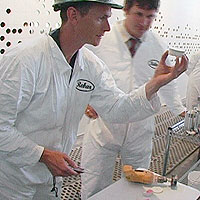
The process of canning the walls was a project created by Rebar, a San Francisco-based arts collective. For Rebar’s “Encanment” project, Passmore, Bela and their team clad in work suits, hard hats and goggles drilled 2 ½ inch holes all over the gallery’s walls so that they could be processed, condensed, labeled and sold. This took place during Southern Exposure’s last exhibit, “Between the Walls,” before their move to a temporary new location so the gallery could undergo a seismic retrofit and renovation. Luckily, Spark made it just in time to visit the “encannery” process.

For just $20 dollars, one can holds three pieces of 2 1/2 inch of wall immersed in mineral oil, sealed shut and labeled with the words “Best Quality Gallery Space”. The money benefits Rebar and Southern Exposure.

  • Array
  • Array

San Francisco Young Playwrights Festival

Giving young Bay Area playwrights the opportunity to develop their work is the goal of the San Francisco Young Playwrights Foundation, created in 2005 by Lauren Yee. The author of more than a dozen plays, which have been produced for festivals and theaters around the world, Yee knew firsthand the benefits of gaining early writing experience. In high school and later as a Yale University student, she won awards and gained recognition from events ranging from the California Young Playwrights Festival to the Florida Teen Playwright Festival. But despite the many programs available for teen performers in her hometown of San Francisco, there was a lack of opportunities for students to hone their skills in writing for the stage.

In 2001, as a student at Lowell High School, Yee founded the entirely student-run Youth for Asian Theater. A few years later, she decided it was time for a citywide festival, and in May 2006, she inaugurated the first San Francisco Young Playwrights Festival at the Diego Rivera Theater, City College of San Francisco.

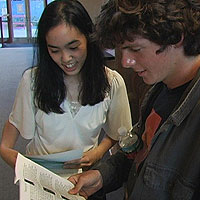
Spark follows four of the high school seniors and juniors whose work was chosen from the dozens of submissions that bring to life stories drawn from the students’ own lives and experiences. The process of selecting and developing the work of the festival’s participants began in September, when the teens submitted their work. After the winners were selected, two months of polishing followed, under the guidance of mentors from the professional theater community. The process culminated in a public performance in May 2006.

Helping to promote young voices and fresh perspectives in the San Francisco theater scene is one of the primary goals of the San Francisco Young Playwrights Foundation. Yee plans to make the Young Playwrights Festival an annual event, and she hopes the festival will encourage more kids to think about writing as a career.

  • Array
  • Array

headRush

The Oakland-based guerrilla performance group headRush is serious when it comes to taking their message to the streets. You can find them performing their brief but high-energy sketches not only in theaters, festivals and cafés, but also on sidewalks and in parking lots. The group brings its brand of urban poetry and satire to audiences wherever it finds them.

The brainchild of a trio of teacher-actors — Rosa González, SimĂłn Hanukai and Xago (LuĂ­s Juarez) — headRush debuted at Oakland’s Jahva House in September 2003. Calling themselves a “psycho-politico spoken-word theater crew,” González, Hanukai and Juarez hoped to exhort and incite their viewers out of passivity using Chicano “teatro,” a satirical agitprop style made popular in the 1960s by LuĂ­s Valdez and the farmworkers’ El Teatro Campesino. Setting up wherever there is space to move, headRush’s off-the-cuff improvisations and audience involvement recall the immediacy of Campesino’s “actos,” or one-act plays, which might have been performed on the back of flatbed truck or on a picket line.

In fact, El Teatro Campesino was where Xago came to be so deeply involved in Chicano theater. Xago was also instrumental in founding community performance group Los Illegals Comedy Clica and the Salinas hip hop crew Baktun 12. González, an author as well as a performer, is a founding member of Las Man@s, and Hanukai serves as program director of the Destiny Arts Center. Education is a high priority for the three performers, who have all studied theater and taught at middle schools and high schools throughout the Bay Area.

With a focus that promotes making social issues and current events relevant and immediate to a new generation, the dynamic headRush has shown up at colleges, open mic nights, political events and comedy shows. In “Performance Ideas,” Spark follows headRush from a performance of their acto “Throwdown” to the workshops they conduct to help kids explore complex issues through theater and movement.

Array

  • Array

Jared Choclatt

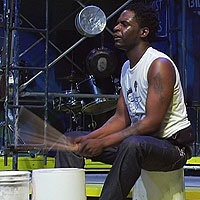
To close their 25th anniversary season, the Lorraine Hansberry Theatre chose a musical extravaganza, Jared “Choclatt” Crawford‘s wildly percussive autobiographical journey “Hit It!” which celebrates the drum-infused music of Big Band sounds, Latin styles, rhythm and blues, soul and today’s hip hop masters. Spark goes behind the scenes as the star, director, cast and crew of “Hit It!” prepare for its world premiere.

The Lorraine Hansberry Theatre was founded in 1985 by artistic director Stanley E. Williams and executive director Quentin Easter. Named for Lorraine Hansberry, the first African American woman to have a play produced on Broadway, the company strove to showcase the work of African American playwrights and give voice to an underrepresented population in Bay Area theater.

Williams and Easter felt that the Bay Area’s rich variety of cultures wasn’t visible on the stages of mainstream theaters. Convinced that these theaters were underestimating theatergoers’ desire to see plays representing diverse cultural experiences, they produced work by playwrights such as Ntozake Shange and August Wilson and commissioned new works by local writers. Their belief has been validated by an audience that consistently fills the 300-seat theater and that considers the Lorraine Hansberry Theatre a beloved and integral part of the Bay Area cultural scene.

At the age of 3, Choclatt Crawford began playing drums. At the age of 12, he found his singing voice. Performing in subway stations and on the sidewalks of New York City, Crawford became one of the New York Bucket Drummers. Crawford caught the attention of Broadway producer George C. Wolfe and tap-dancing prodigy Savion Glover. The two asked him to choreograph the on-stage percussion for “Bring in ‘da Noise, Bring in ‘da Funk” as well as to join the cast as a featured performer.

Opening on Broadway in 1996, “Bring in ‘da Noise, Bring in ‘da Funk” traced centuries of African American history through evocative music and dance. The show had a nearly three-year run, then Crawford moved on to create and star in “Keep Bangin’,” a critically acclaimed musical featuring different drumming styles from around the world.

In “Hit it!” Crawford took his own coming-of-age story and created a musical under the direction of Williams, with choreography by Antonio Naranjo. The show’s book (the text and narrative of the production) is made up of poems by “Bring in ‘da Noise, Bring in ‘da Funk” writer reg E. Gaines that pay homage to jazz history and Manhattan’s African American heritage. The book also includes story segments from Crawford’s life written by AndrĂ© C. AndrĂ©e, who is Crawford’s father and a regular performer at the Lorraine Hansberry Theatre.

As Crawford’s character takes a magical ride through the subways of New York, each subway stop represents a different style of percussion-driven urban music. The audience follows him on an odyssey through the history of drumming, from the Big Band sounds of Chic Webb, Max Roach, Cab Calloway and Buddy Rich to the Latin styles of Tito Puente, Mongo Santamaria and Celia Cruz. Crawford also covers rhythm and blues/soul legends Al Green, Marvin Gaye, Sam Cooke and Aretha Franklin as well as hip hop performers Sheila E., Grand Master Flash, Doug E. Fresh and Run-DMC.

Array

  • Array

Liebe Wetzel

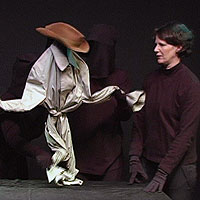
If you were to look up object puppetry in the dictionary, there is a good chance you would find Liebe Wetzel‘s name. In the world of puppetry, Wetzel and her company, Lunatique Fantastique, are pioneers. In Wetzel’s skillful hands, inanimate objects are given breath, movement and focus — the three rules of object puppetry. As she puts it, she is finding the essence of a character in an object. Wetzel’s work is loosely based on Japanese bunraku puppetry, in which the artists dress from head to toe in black so that they disappear and create the illusion that their puppets are moving on their own.

Wetzel was always interested in puppets, but she was not confident in her ability to construct them. This led her to develop a form of object animation that requires nothing more than an interesting object and a manipulator’s skill in bringing it to life. Her first character, for example, was a talented young actress by the name of FomĂ© constructed of a single strip of beige-colored foam.

Spark reveals the secrets behind Wetzel’s puppetry magic and the profound subject matter of her plays, which could be more difficult for traditional theater with live actors. Without dialogue of any kind and with puppets that are nothing more than mere outlines of living characters, Wetzel has the uncanny ability to tell tragic stories with grace and humor. Wetzel is interested in populations that don’t have a voice, such as Japanese Americans who were interned during World War II, people who have polio and women who are victims of sexual abuse.

In her 2006 project titled “Beauty and the Breast,” Wetzel, in collaboration with longtime Bay Area theater director Jayne Wenger, broaches the subject of breast cancer. Produced by Exit Theatre, “Beauty and the Breast” tells the story of Bresty, a bright purple bra who battles breast cancer and makes the difficult decision to have a mastectomy. For this production, Wetzel and Jayne Wenger decided to get rid of the black outfits of the puppet manipulators and expose them, a first for a Wetzel production. Other objects, such as a flowerpot, trowels and handkerchiefs, fill out a cast of characters that may never have realized their full potential if Wetzel hadn’t come along.

Liebe Wetzel, a Texas native, earned a B.A. in biology and biochemistry from Rice University. After surviving a nearly fatal car crash, she decided to follow her dream and began studying acting all across the continent, including at the Cornish College of the Arts in Seattle, the Dell’Arte School of Physical Theatre in Northern California and the Loose Moose Theatre in Calgary, Canada. Since its founding in 2000, Lunatique Fantastique has gained popularity in theater sectors locally and overseas from such plays as “Reframing the Hourglass,” “The Wrapping Paper Caper,” “Objects in Predicaments” and “Snake in the Basement: The Persecution of Rev. Bill Pruitt.” Wetzel’s innovative work has won many awards, including the “San Francisco Bay Guardian” Goldie Award for Best New Theater Talent, as well as Best of Fringe and Top Box Office Hit in the 2001 and 2004 San Francisco Fringe Festival.

  • Array

Basil Twist

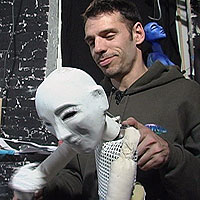
A San Francisco native, Basil Twist first became interested in puppetry through his mother, who was president of the San Francisco Puppeteers Guild. After stints working with designer and Broadway director Julie Taymor and the Swedish Cottage Marionette Theater in New York’s Central Park, Twist became the first American to study at France’s École SupĂ©rieure Nationale des Arts de la Marionnette.

He lives in New York’s Greenwich Village, where he dreams up his shows and constructs puppets in a basement workshop. Spark caught up with Twist in San Francisco, where he was collaborating with dancer Joe Goode and playwright Paula Vogel to stage “The Long Christmas Ride Home” at the Magic Theatre.

Twist first made a splash in 1995 with “The Araneidae Show.” Since then, he has won a Bessie Award for the show and been nominated for a Drama Desk Award for “Tell Tale.” Though well versed in traditional forms, Twist often creates his own blended styles, pushing boundaries to adapt them to new theatrical expectations.

Skilled in a wide variety of animating the inanimate, Twist’s work often brings long-forgotten puppetry forms back to the stage. His 1999 “Dogugaeshi” used more than 700 mobile painted screens — of the style of the same name, one which has nearly disappeared from its native Japanese island of Awaji. And for the 2005 Spoleto Festival, he constructed life-sized marionettes for a return to the lost 18th-century art of puppet opera with the revival of Ottorino Respighi’s “La bella dormente nel bosco.”

In Twist’s version of the beloved Stravinsky ballet “Petrushka,” he created the acrobatic steps of a gamut of fantastical characters using Czech black technique, in which puppeteers clad in black velvet move invisibly in the darkness behind their puppets. And later, he turned to a modified style of Japanese bunraku — making the puppeteers a more integral part of the show as both operators and actors — in “The Long Christmas Ride Home.”

Twist has also developed underwater marionettes for his internationally acclaimed “Symphonie Fantastique,” which was performed in a 1,000-gallon, seven-foot-long aquarium. And he worked with film director Alfonso Cuaron on “Harry Potter and the Prisoner of Azkaban,” using his underwater skills to help animators achieve the underwater flow of the merpeople.

Basil Twist notes that although many people think of puppetry as a children’s art form, it is a deeply resonant and metaphorical practice. For him, puppetry is about giving life and soul to objects and telling the stories of the inanimate, while constantly reinventing the art as he goes along.

  • Array
  • Array
  • Array
  • Array

Sandow Birk

https://youtu.be/aimLeC7mdDw
View a KQED Education video filmed in February 2012 at Catharine Clark Gallery.


View Spark segment on Sandow Birk. Original air date: June 2006. (Running Time: 8:28)

Catch up Sandow Birk as he describes several of his recent projects, including a hand-transcribed and illustrated project called American Qur’an, and a large-scale drawing about the American Constitution. This KQED Education production was filmed in Februrary, 2012 at the Catharine Clark Gallery in San Francisco, CA.

Over the last few years, Los Angeles-based painter Sandow Birk has been expanding his artistic scope — and his audience — by turning his sumptuous contemporary history paintings into motion pictures. Spark visits Birk and his crew as they finish production on Dante’s 14th-century epic “The Divine Comedy” — set in 21st-century San Francisco.

Birk is a keen student of art history and often recasts classic subjects and compositions with modern-day figures and narratives. Birk’s work is deeply influenced by history painting, a European tradition of depicting historical events in detailed and often dramatic images. Birk first encountered 19th-century history paintings on a trip through Europe — he was struck by the grand scale of the images and their theatrical tone. Upon returning to the United States, Birk moved into a storefront apartment in South Central Los Angeles and began creating his own versions of history painting, documenting the events that happened in his neighborhood — gang warfare, drug deals, looting and rioting — in that same dramatic style.

Birk’s first film project was “In Smog and Thunder,” a mockumentary inspired by Ken Burns’s marathon 11-hour film about the American Civil War. In Birk’s version, Los Angeles and San Francisco engage in all-out war for control of the entire state of California. Birk got the idea for the project during a month-long trip to San Francisco for his solo show at the Catharine Clark Gallery.

After multiple affronts to his hometown from a variety of Bay Area dwellers, Birk decided to exact his revenge by making a series of canvases in which San Francisco is finally invaded and conquered by Angelinos. After the success of the series, Birk decided he could reach more people by making a film, and he collaborated with filmmakers Sean Meredith and Paul Zaloom to produce the project.

Like “In Smog and Thunder,” Dante’s “Inferno” began as a series of paintings that Birk then decided to make into a film. Using live actors for the project would have been prohibitively expensive — upwards of a million dollars — so Birk decided to make the film using paper cut-out puppets. Set in contemporary San Francisco, the film follows the experiences of a blue jeans-wearing Dante and his guide, the Roman poet Virgil, as they tour the depths of Hell, finally meeting the Devil himself.

Sandow Birk was raised in Southern California. He lives and works in Los Angeles. Birk earned a B.F.A. from the Otis Parsons Art Institute in Los Angeles and studied painting and art history at both the American College in Paris and the Bath Academy of Art in England. Birk was the recipient of a Guggenheim Fellowship in 1995, a Fulbright scholarship in 1997 and a Getty Award for the Visual Arts in 1999. His work has been shown in galleries and museums throughout North America and Europe.

Array

  • Array
  • Array
  • Array

Kathy Foley

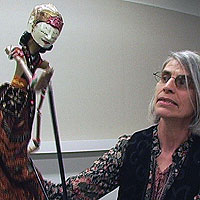
Kathy Foley’s scholarly pursuit of Southeast Asian puppetry has taken her through most of that region. She is a professor of theater arts at UC Santa Cruz, the editor of “Asian Theater Journal” and has performed as a dalang (puppetmaster) of wayang golek rod puppets and wayang orang dance drama for more than 20 years. She is currently writing a book on mask and puppet performance in Southeast Asia.

Spark visits with Foley at the Asian Art Museum to get an expert look at their collection of Wayang Golek puppets from the Sundanese highlands. She explains the traditional use of the rod puppets and their significance in Southeast Asian culture and demonstrates her skills as a puppeteer.

  • Array
  • Array

Peter Riegert

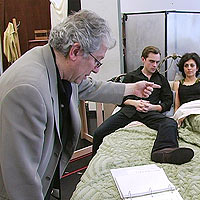
When the David Mamet play “Sexual Perversity in Chicago” premiered at New York’s Off Broadway Cherry Lane Theater in 1976, it not only put Mamet on the theatrical map, but it also boosted the career of the then 28 year old actor Peter Riegert. Spark checks in on Riegert as he returns to the play 30 years later, this time as director of San Francisco’s A.C.T. production.

Mamet’s play, which won an Obie for its 1976 premiere production, follows the experiences of four single people in 1970s Chicago. The piece was controversial in its time for its liberal use of off-color language as well as its frank portrayal of contemporary sexual mores. But perhaps the play’s greater innovations lie in its formal structure, which condenses a staggering 34 scenes into just over an hour.

For the actors in the 2006 A.C.T. production of “Sexual Perversity,” its rapid-fire pace is both demanding and energizing. Mamet’s script leaves no margin for error as the play’s staccato rhythm transforms the dialogue into something like a musical score, wherein every pause and note is meticulously timed and carefully executed. The play is difficult to master for actors and directors alike, often making it difficult to realize Mamet’s dramatic vision.

A devoted student of Mamet since taking on the role of Danny in the 1976 production, Riegert brings a consciousness to the production that can only come from an intimate knowledge of the material. For Riegert, who continues to have a long and successful career in acting, directing is a welcome new frontier, rife with fresh challenges and opportunities for experimentation.

Riegert is a veteran actor who has appeared in more than 60 movies and television series, including “Animal House” (1978), “Local Hero” (1983) and “Crossing Delancey” (1989). David Mamet is one of the most acclaimed American playwrights of the last century. He is known for overturning narrative conventions and crafting contentious situations characterized by emotional confrontations. In addition to “Sexual Perversity,” Mamet’s best known plays include “The Duck Variations” and “American Buffalo.” In 1984, Mamet was awarded the Pulitzer Prize for “Glengarry Glen Ross.”

  • Array
  • Array
  • Array

ASCEND School

ASCEND School is a unique K-8 school located in the Fruitvale neighborhood of Oakland. It is one of a growing number of small autonomous schools in the Oakland Unified School District in Alameda County. The school is an arts-integrated, Expeditionary Learning school that prioritizes family and community partnerships. Arts integration means that students participate in instruction with objectives in an art form and another content area — for example, math, English or history.

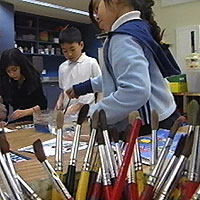
In “New Beginnings,” Spark visited ASCEND as it transitioned from temporary classrooms to a new building and dropped into a class in which students were learning the art of storytelling. They began by reading several Native American myths. What resulted was the students’ own theatrical production, “Raffa and the Gold Volcano,” a morality-hinged musical created by combining attributes taken from the various Native American mythic and legendary sources they had studied. As the students prepared to stage their musical, they learned that storytelling incorporates much more than the spoken word, that stories could be told through music, movement, costumes and setting and through an understanding of how character traits inform actions.

Founded in 2001 with fewer than 100 students, today the school has more than 250 students. The first priority at ASCEND is student literacy — teaching students to be fluent and comfortable with the written and spoken word, technology, contemporary culture, history, media, mathematics, science, arts and the environment. The inquiry-based model employed in the school curricula pushes students and teachers alike to grow and change, maximizing student performance and providing valuable professional development and personal growth for teachers.

ASCEND is one of more than 30 arts learning anchor schools, which is part of a larger initiative spearheaded by the Alameda County Office of Education. The first phase of implementation of a new countywide strategic plan will provide equitable classrooms through arts learning for every child, in every school, every day. ASCEND aspires to grow into a K-8 learning community and family center serving 380 students with 40 to 44 students, at each grade level.

Although it is a local model, ASCEND is also exemplary of a national movement in which schools all over the United States, in rural, suburban and urban communities, are addressing seemingly ever-increasing problems with solutions that put a more holistic approach to student learning at the center, despite the conflicting mandates from the state and federal education systems requiring increased standardized testing, with fewer resources. In their mission and philosophical approach, these schools are actively responding to a growing body of research that continues to reveal the critical importance of arts study and learning to the growth and development of all students throughout their education and throughout life.

Array

  • Array
  • Array