
Higher Ed Trends: MOOCs, Tablets, Gamification, and Wearable Tech

CAL

Justin Sullivan/Getty Images

As tech tools continue to proliferate with new launches and new products, it’s difficult to predict what will stick and what won’t. A recently released report by the New Media Consortium and EDUCAUSE Learning Initiative (ELI) tries to sift through the fads and find the few that will have a real impact on education in the next few years.

What’s worth noting? Sometimes what seemed impossible only a few years ago has already become a new trend. The 2013 NMC Horizon’s Report on Higher Education, which brings together international experts in education and technology, attempts to take the pulse of emerging technologies in higher education and predict where the field will move in the near, middle and far term.

The report points to MOOCs, Massive Open Online Courses, as the big change agent in the higher ed landscape, but it also reaches a little further, bringing 3D printing and wearable technology into the mix.

KEY FACTORS

The panel considered some key factors influencing whether technologies take hold, identifying a move towards “open” content and the ability to share, manipulate, and mold. Even more critical for institutions of higher education is the rise of MOOCs. As more elite institutions align themselves Continue reading Higher Ed Trends: MOOCs, Tablets, Gamification, and Wearable Tech

Money, Time, and Tactics: Can Games Be Effective in Schools?

6660073135_a315ee4b17

If it’s true that 97 percent of teens in the U.S. are playing digital games, then the focus on how games can fit into the shifting education system becomes that much more important. Schools, districts, and individual educators are trying to figure out how games and learning can fit into the current complicated landscape.

The newly released report Games for a Digital Age: K-12 Market Map and Investment Analysis, released by the Joan Ganz Cooney Center and the Games and Learning Publishing Council, describes the many different criteria in play in detail, including obstacles from the policy standpoint, lack of teacher development, as well as how the Bring Your Own Device movement is influencing the push towards games and learning.

“Games are more popular than ever with youth today with many students spending hours a day playing them,” said Michael H. Levine, executive director of the Joan Ganz Cooney Center. “What we don’t know yet is whether and how they can be a key ally in driving pathways to academic success.”

Though it’s well worth reading the report in its entirety, below are excerpts pulled from the report, conducted and written by Dr. John Richards, Leslie Stebbins and Dr. Kurt Moellering.

ON FINDING WAYS TO USE GAMES WITHIN CLASS TIMES

The school day is divided into class periods, and this division limits lesson length. Furthermore, the combination of standards and the scope and sequence tied to core curriculum create “coverage” requirements that place practical limits on the number of lessons that can be devoted to a single topic.

Nearly all games fall clearly along a continuum ranging from short-form to long-form with a critical distinction and a bi-modal distribution pattern based on fitting in a class period. As noted by Rob Lippincott, Sr. Vice President of Education, PBS, “Games don’t fit the time box of a class period; a game succeeds when it is sticky and gobbles up more time. You want games in school to finish quickly and speed up learning.” (CS4Ed interview, April 2012).

We placed games into these two time-based categories, short-form and long-form. Within these broad areas fall dozens of different kinds of games, ranging from three-minute apps to open, immersive Multi-User Virtual Environments (MUVEs) that involve lengthy game playing. In addition to the length of play, the mechanics of a gaming experience varies broadly, with simple “add-on” gamification-type reward systems falling typically at the short end of the time continuum, and more complex, multiple-path, role playing games falling at the long end. In longer-form games, the game mechanics are typically intrinsic to the learning experience rather than placed at the end of or external to the game play itself.

1. Short-Form Learning Games

In most K-12 schools the day is organized in blocks of time that average 40 minutes or less. Transition time and time for instruction or discussion connected to curricular material frequently leaves only 20 to 30 minutes for actually using a learning game. Short-form games are interactive Continue reading Money, Time, and Tactics: Can Games Be Effective in Schools?

Dan Pink: How Teachers Can Sell Love of Learning to Students

love learning
By Jennie Rose

In his new book To Sell is Human, author Daniel Pink reports that education is one of the fastest growing job categories in the country. And with this growth comes the opportunity to change the way educators envision their roles and their classrooms. Guided by findings in educational research and neuroscience, the emphasis on cognitive skills like computation and memorization is evolving to include less tangible, non-cognitive skills, like collaboration and improvisation.

Jobs in education, Pink said in a recent interview, are all about moving other people, changing their behavior, like getting kids to pay attention in class; getting teens to understand they need to look at their future and to therefore study harder. At the center of all this persuasion is selling: educators are sellers of ideas.

Whether a teacher is presenting to her board or pitching a crowd of 12-year-olds on why Shakespeare was a genius, it’s all the art of persuasion. Though his new book has only been out a couple of weeks, Pink said he’s already received many messages from teachers who agree that, “Yes, I sell. I sell students on poetry, on calculus, on biology.”

In fact, the business world has a lot to learn from educators: what motivates people, how to inspire people to perform well. But educators can also take a lesson from the commercial world: namely, teaching the complicated skill of finding problems. In a recent study, Pink said school superintendents rated problemsolving as the top capability they wanted to instill. Corporate executives, however, rated problem-solving as seventh on their list of attributes in employees, but rated problem identification as the single most important skill. That is, the ability to suss out issues and challenges that aren’t necessarily obvious. And this is where students could benefit from educators — learning the process of identifying a problem.

“The premium has moved from problem solving to problem finding as a skill,” Pink said. “Right now, especially in the commercial world, if I know exactly what my problem is, I can find the solution to my own problem. I don’t need someone to help me. Where I need help is when I don’t Continue reading Dan Pink: How Teachers Can Sell Love of Learning to Students

Making Math Meaningful with Online Games and Videos

Re-Roofing Your Uncle's House
By Almetria Vaba

Math can be made meaningful when connected to students’ experiences. With video clips and interactive games from public media students practice math concepts while exploring real world concepts. Learn how to decorate an intricate cake, play the role of the pharmacist, roof a house and more using PBS LearningMedia resources to measure with math.

Using Recipes for Fractions Lesson Plan and Video
While doubling a cupcake recipe, students practice three ways of doubling fractions using representations, addition, and multiplication. Students also convert between improper fractions and mixed numbers. Grades 4-8.

Re-Roofing Your Uncle’s House Interactive Game
In this interactive activity adapted from the Wisconsin Online Resource Center, students use mathematics and measuring skills to solve a construction problem by playing a game using tools (including a tape measure, notepad, and calculator) to determine how many shingles are needed to reroof a house. Students also learn the importance of proper planning and how miscalculating the amount of materials necessary can add to the cost and time spent on a project. Grades 3-9.

Cake Designer Video
Math made delicious! In this video, a cake designer describes how she uses math with her recipes and designs. Students can relate the importance of mathematics to the field of cake designing. Grades 3–9.

Area of Circles with Dive Dog Interactive Game
In this animated activity students learn the formula for the area of a circle and then apply it to multiple scenarios involving Spot the Dog. Activities include solving problems involving the area of a circle and for the areas of parallelograms, triangles, and circles. Students also calculate the area Continue reading Making Math Meaningful with Online Games and Videos

Girls and Games: What’s the Attraction?

Games are increasingly recognized by educators as a way to get kids excited about learning. While the stereotype of a “gamer” may evoke the image of a high school boy holed up in a dark room playing on a console, in reality 62 percent of gamers play with other people either in person or online, and 47 percent of all gamers are girls.

Game developers and academics who have been studying the elements that go into making games more attractive to girls found that those very same qualities are also important components of learning. For instance, girls are more drawn to games that require problem solving in context, that are collaborative (played through social media) and that produce what’s perceived to be a social good. They also like games that simulate the real word and are particularly drawn to “transmedia” content that draws on characters from books, movies, or toys.

“Something we’ve seen as a tremendous motivator for girls to learn about math and science is that they need to see the connection from the classroom out into the real world,” said Victoria Van Voorhis, the founder of Second Avenue Learning in a recent webinar. Her company has received funding from the National Science Foundation to study how to reach girls through gaming with the help of the Rochester Institute of Technology. They tested a physical science game called “Martha Madison’s Marvelous Machines” with middle school girls in urban, suburban, and rural Continue reading Girls and Games: What’s the Attraction?

It’s Time: Create Smart Policies to Support Student Tech Use

Technology has become a seamless part of students’ lives in and out of the classroom, and schools must find ways to integrate it. This is one of the conclusions in a report by the National Association of State Boards of Education (NASBE), which states that policymakers at the highest level need to understand the trend and form a cohesive course of action for schools to follow.

In Born in Another Time: Ensuring Educational Technology Meets the Needs of Students Today — And Tomorrow the NASBE focuses on the importance of understanding students’ needs, ensuring that teachers are prepared to meet those needs, and shoring up the technical infrastructure that will allow schools to participate.

Up until now, much of the enthusiasm for education technology, blended learning, online courses and other digital aids in the classroom have come from teachers themselves. In fact, many ed-tech companies are pursuing a teacher-first strategy, opting to hook the educator and avoid the complicated bureaucracy of selling to school districts. That has left a patchwork of tools and uncertainty among some teachers who would like to take advantage of new tech tools, but aren’t sure how to get started.

“State boards of education along with their state education agencies are key to providing the leadership on education technology issues our school systems need to ensure students are ready for life and work in a digital era,” wrote the NASBE study group tasked with investigating emerging tech trends. At the same time the report acknowledges that the current landscape is a “wild, wild west” of various products and approaches. “Because of their formal responsibilities, state education systems are the only entities able to offer a sustainable platform for aligning these promising—but still fragmented and rapidly changing — forces,” the report said. Continue reading It’s Time: Create Smart Policies to Support Student Tech Use

The U.S. State Department Gets in the Education Game

Trace Effects

The U.S. State Department is jumping into the ed-tech world with an online game meant to help teach “American English” to kids between the ages of 12-16 in more than 30 countries. Meant to provide players with a view of American life and culture different from the typical portrayal in movies, Trace Effects officially launches today. It’s part of a bigger effort from the Bureau of Education and Cultural Affairs (ECA) to revamp its website and materials to today’s technology, as well as offer an interactive tool to engage English learners abroad.

Trace Effects tells the story of Trace, an androgynous male character who returns from the future to visit the United States charged with changing the world for the better. If he’s unsuccessful, he won’t be able to return to his own time. Throughout the course of the game, Trace travels the U.S. to sites like New Orleans and the Grand Canyon, learning about the unique cultures, interacting with local people and completing missions. The missions are related to key themes woven throughout the game that include entrepreneurship, community activism, empowering women, science and innovation, environmental conservation, and conflict resolution. Students can choose Continue reading The U.S. State Department Gets in the Education Game

Video Games That Bring Civics Class to Life

By Andrew Miller

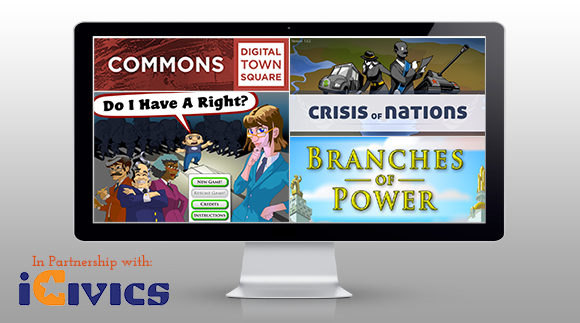
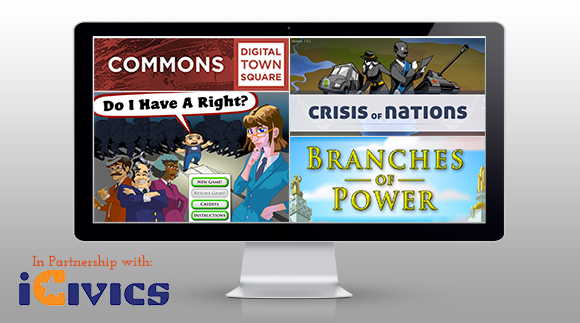
The online educational video game site iCivics, created in 2009 by former Supreme Court Justice Sandra Day O’Connor that features civics curriculum, has partnered with EverFi, an ed-tech company focused on K-12 and higher ed. And through the partnership comes a new initiative Commons – Digital Town Square, offered free to all K-12 schools.

The focus of Commons – Digital Town Square is to provide schools with standards-based educational gaming, aligned to the Common Core, with social components. Students who play iCivics games will be able to move along at their own pace, according to Kara Hedges-Sasse, Executive Vice President of Product Development at EverFi.  “We intend to utilize adaptive-pathing techniques as well as evidence-based practices to help guide each student differently as they learn and ultimately change behaviors,” she said.

So how is Commons – Digital Town Square different from iCivics? In addition to having the adaptive feature, it will have a variety of media including simulations and animations as well as pre- and post-assessments and behavioral surveys that “measure changes in students’ attitudes and behaviors regarding a variety of civic matters.”

Of course, an implicit requirement of using this game is student access to computers. Students Continue reading Video Games That Bring Civics Class to Life

What Can 135 Million Video Gamers Add to Our Collective IQ?

Flickr:Blakespot

By Jennie Rose

An estimated 135 million people play video games, spending three billion hours a week glued to a screen. But that’s not necessarily bad news. In fact, playing video games may be part of an evolutionary leap forward, according to Howard Rheingold, educator and author of the book Net Smart: How to Thrive Online.

Rather than characterizing them as hapless drones wasting time, Rheingold’s book contends that this massive population of gamers is part of a growing group of “supercollaborators,” as described by Jane McGonigal, director of game research and development at the Institute for the Future, who’s interviewed in the book.

Rheingold connects the dots on collaboration literacy and what he calls “Social-Digital-Know-How.” Multi-player games in particular, and virtual communities in general, are technologies that require cooperation. And when you consider the cumulative amount of technical knowledge, these gamers could be the first wave of people who possess what scientists have started calling “collective IQ.” Already, gamers who play the online game Foldit have cracked the code of the structure of a protein-cutting enzyme from an AIDS-like virus, which has eluded scientists for years, and could lead to a new drug.

This idea of collective intelligence and digital culture came from French media scholar Pierre Lévy, who argues that a networked culture gives rise to new structures of power, stemming from the ability of diverse groups of people to pool knowledge, collaborate through research, debate interpretations. Together, these groups refine their understanding of the world.

Wikipedia is one of the best-known byproducts of this process of refinement and social production. Though the website is still dismissed as a research tool in some education circles because it does not represent a traditionally vetted information source, danah boyd, a senior Continue reading What Can 135 Million Video Gamers Add to Our Collective IQ?

What’s the Difference Between Games and Gamification?

Perhaps the best way to think about games in education is not to automatically call everything that looks like fun a “learning game.” Lumping all digital game approaches together makes no more sense than a toddler’s inclination to call every four-legged animal a “doggie.”

Game interest is definitely on the upswing in K-12 and higher education. It seems almost cyclical: every several years, almost in sync with the acceptance of new technologies (such as multimedia CD-ROM, then online, then mobile), there’s a surge of activity with games in education.

But everything game-like is not a game. And while game purists may wince at this simplification, it helps to consider games in education in terms of gamification, simulation and (simply) games. The three approaches aren’t always exclusive – they’re more of a continuum, or a Venn diagram’s overlapping circles – but they are notably different.

GAMIFICATION

Gamification is the current bright-shiny of the three terms – and, as a result, is the most used and frequently misused. But the cleanest definition is straightforward: gamification is adding game elements and mechanics to things that aren’t designed to be games.

Outside of education, some call these “reward, recognition and motivation programs.” And Alex Chisholm, executive director of the Learning Games Network, a spin-off from the MIT Education Arcade and University of Wisconsin, shared an equivalent perspective recently when he noted that saying you’re going to “gamify” something in education means you’re applying game design principles to motivate and inspire learners.

In apps and software, this is commonly interpreted as adding point systems (sometimes with competitive student leaderboards), badges for accomplishments and levels of progression. One of the highest profile examples of this approach is the Khan Academy, which layers avatars, energy points and badges on top of completing traditional math activities.

But gamification can be done well or poorly.

“The first place people go with gamification is ‘rewards.’ There can be dragons,” says Scott Dodson, a gamification expert and executive with Bobber Interactive. “Rewards done wrong Continue reading What’s the Difference Between Games and Gamification?

How to Turn Your Classroom into an Idea Factory

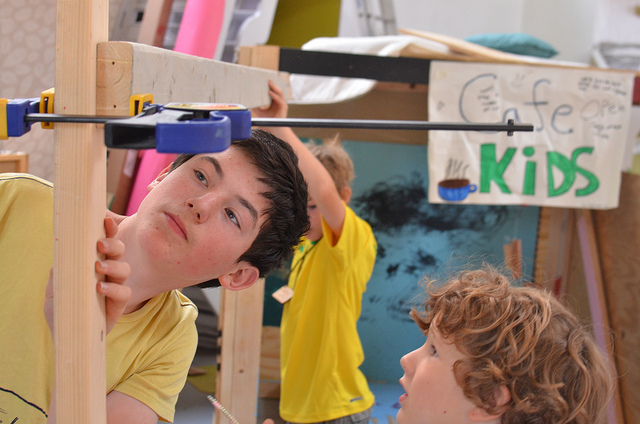
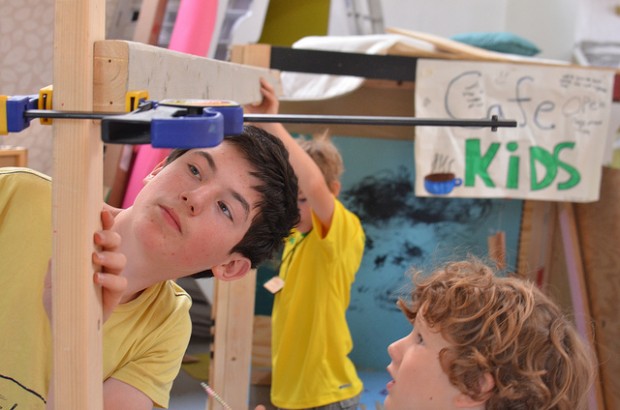
Students building a cafe at Brightworks School in San Francisco.
By Suzie Boss
The following suggestions for turning K-12 classrooms into innovation spaces come from Bringing Innovation to School: Empowering Students to Thrive in a Changing World, published in July by Solution Tree.

How can we prepare today’s students to become tomorrow’s innovators? It’s an urgent challenge, repeated by President Obama, corporate CEOs, and global education experts like Yong Zhao and Tony Wagner. Virtually every discussion of 21st-century learning puts innovation and its close cousin, creativity, atop the list of skills students must have for the future.

If we’re serious about preparing students to become innovators, educators have some hard work ahead. Getting students ready to tackle tomorrow’s challenges means helping them develop a new set of skills and fresh ways of thinking that they won’t acquire through textbook-driven instruction. Students need opportunities to practice these skills on right-sized projects, with supports in place to scaffold learning. They need to persist and learn from setbacks. That’s how they’ll develop the confidence to tackle difficult problems.

How do we fill the gap between saying we must encourage innovation and teaching students how to actually generate and execute original ideas? The answers are emerging from classrooms across the country where pioneering teachers are making innovation a priority. Their strategies vary widely, from tinkering workshops and design studios to digital gaming and global challenges. By emphasizing problem solving and creativity in the core curriculum, these advance scouts are demonstrating that innovation is both powerful and teachable.

Across disparate fields, from engineering and technology to the social and environmental sectors, innovators use a common problem-solving process. They frame problems carefully, looking at issues from all sides to find opportunity gaps. They may generate many possible solutions before focusing their efforts. They refine solutions through iterative cycles, learning from failure along with success. When they hit on worthy ideas, innovators network with others and share results widely.

In the classroom, this same process corresponds neatly with the stages of project-based learning. In PBL, students investigate intriguing questions that lead them to learn important academic content. They apply their learning to create something new, demonstrate their understanding, or teach others about the issue they have explored. By emphasizing key thinking skills throughout the PBL process, teachers can guide students to operate the same way that innovators do in all kinds of settings.

Here are eight tips to borrow from classrooms where teachers are reinventing yesterday’s schools as tomorrow’s idea factories.

1.   WELCOME AUTHENTIC QUESTIONS.

Good projects start with good questions. Listen closely to students to find out what makes them curious. Instead of presenting them with ready-made assignments, invite student feedback when Continue reading How to Turn Your Classroom into an Idea Factory

What Makes Educational Games Work?

As the gaming in education continues to grow, one of the foremost experts in the field, Constance Steinkuehler, makes the case for why it’s important to pay attention to what works in gaming and how it could be applied to learning.

At the recent Aspen Ideas Festival, Steinkuehler, who’s now a Senior Policy Analyst at the Office of Science and Technology Policy in the Executive Office of the President, spoke with author and researcher John Seely Brown about some of the more prominent issues in gaming and education.

WHY GAMES?

In this video, she makes a case for the importance of investing in learning more about games and education. “It will engage [players] in a level of problem solving that’s stunning — and call it fun,” she says.

Continue reading What Makes Educational Games Work?

Is it Time to Reconsider AP Classes?

Flickr: Amitburst

By Katrina Schwartz

Advanced Placement courses have long been the standard for high achievement in high school. The classes are modeled on college courses and are meant to represent the difficulty and breadth of material that students are expected to handle when they get to college. For that reason, some colleges give in-coming freshman credits or allow them to pass out of introductory courses if they score a three or above on the AP test (it’s scored from one to five).

In many schools, AP classes are more popular than ever, as students seek a leg up in the competitive college admissions process. But now, some of the most elite schools in the country are opting out of the AP frenzy, saying they can design better and more rigorous courses on their own that won’t force them to adhere to someone else’s curriculum and timeline and force teachers to teach to the test. And, instead of replicating a college level course in high school, they say they can go one better – partnering with local colleges so their students get the real deal.

“Our major complaint with the AP courses was that it was a race for breadth against depth,” explained Robert Vitalo, Head of School at Berkeley Carroll, a Brooklyn prep school that decided to completely do away with AP courses in the 2011-2012 school year. “We think the way of the world, the way to be teaching, the way that kids should be learning is to look at how subjects and questions and ideas are connected and related, and to take the time to make those connections and ask those questions and not to have it be a race to cover a lot of content.”

To replace AP courses Berkeley Carroll has designed interdisciplinary courses like “The Physical Applications of Calculus,” a course that joins principles of both physics and calculus to uncover how they work together in the real world. Vitalo says they also still offer courses that can Continue reading Is it Time to Reconsider AP Classes?